Studying in Memphis: universities, housing and student life
A practical, honest guide to the Bluff City for students — the universities, where to live and find a room safely, costs, work rules, study spaces and getting around.
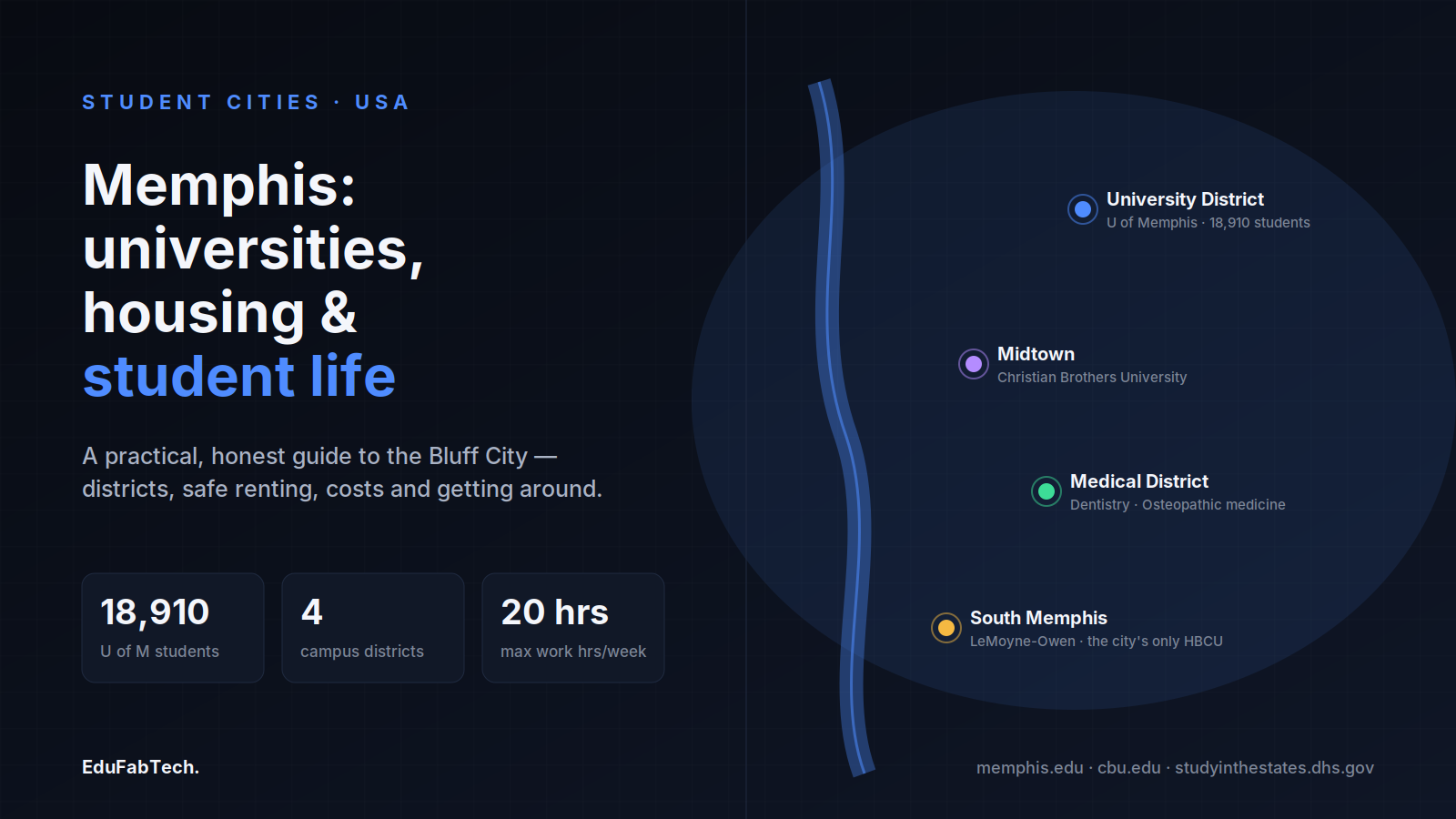
Memphis sits on the bluffs above the Mississippi River, in the far southwest corner of Tennessee where the state meets Arkansas and Mississippi. It is a sprawling, low-rise city built around the river trade, the distribution economy that grew up around it, and the music — blues on Beale Street, soul at the old Stax studio in South Memphis — that the city exported to the world. For a student, the first thing to understand is the shape of the place: Memphis spreads outward rather than upward, and its universities are scattered across distinct districts rather than clustered in one college quarter.
The University of Memphis anchors the east-central University District; Christian Brothers University sits in leafy Midtown; the health-science schools concentrate in the Medical District near downtown; and the city's historically Black college is in South Memphis. Where you study largely decides which neighbourhood you live in, how far you commute, and whether you need a car. That last question matters more in Memphis than in most student cities, and it runs through everything below.
Summers are long, hot and humid; the shoulder seasons are pleasant; winters are mild with occasional ice. Rent is low by the standards of American cities, the barbecue is a genuine local institution, and the trade-off — spelled out honestly later — is a car-centred layout and uneven public transport. This guide works through the universities, housing, furnishing a room, work, study spaces, transport and costs, with every figure tied to the source that produced it.
The universities, campus by campus
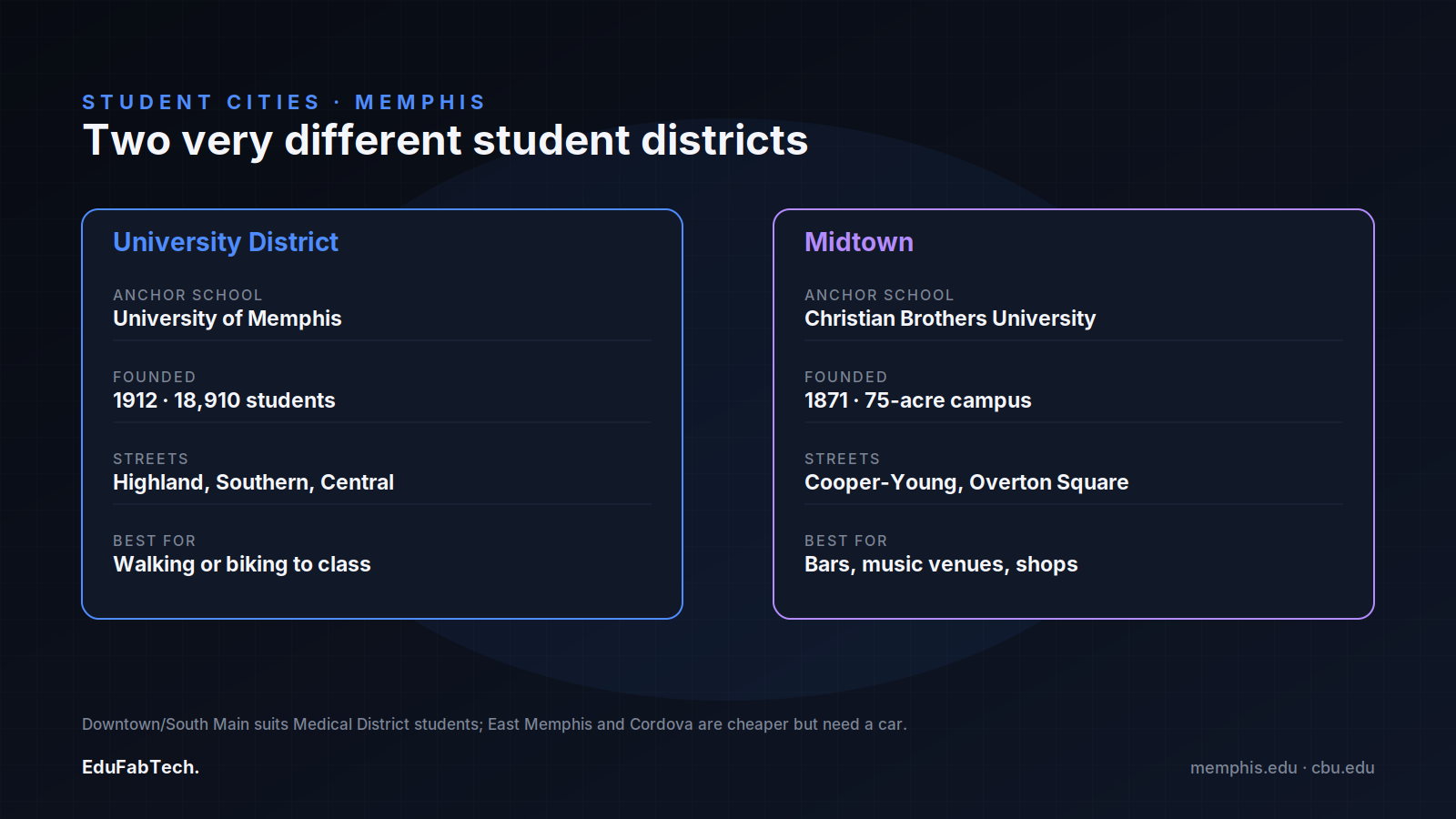
The University of Memphis is the largest institution in the city and the one most international and out-of-state students arrive for. According to the university's own Facts at a Glance page, it was founded in 1912 as West Tennessee State Normal School and enrolled 18,910 students in autumn 2025, across a main campus at 3720 Alumni Avenue (memphis.edu/about/facts.php). The same page lists five state-designated Centers of Excellence — including the Center for Earthquake Research and Information and the Institute of Egyptian Art and Archaeology — and the Cecil C. Humphreys School of Law. The main campus lies in the University District (the Normal Station neighbourhood), east of Midtown, and most undergraduate life revolves around it.
Christian Brothers University is a much smaller private institution in Midtown, at 650 East Parkway South. Its About page states that it was founded in 1871 by the De La Salle Christian Brothers in the Lasallian Catholic tradition, sits on a 75-acre wooded campus, and is known for its STEM programmes (cbu.edu/about). It is the choice for students who want a small, teaching-focused campus close to the restaurants and parks of central Memphis.
Two schools serve graduate and professional students in the Medical District near Union Avenue. The University of Tennessee College of Dentistry, part of the University of Tennessee Health Science Center, describes itself on its About page as the oldest dental college in the South and the third-oldest public college of dentistry in the United States, founded in 1878 and housed since 1978 in the Dunn Building at 875 Union Avenue (uthsc.edu/dentistry/about). Nearby, the Baptist Health Sciences University College of Osteopathic Medicine is a new medical school affiliated with Baptist Memorial Health Care; the American Association of Colleges of Osteopathic Medicine records that it enrolled its inaugural class in autumn 2024 (aacom.org).
LeMoyne-Owen College, in South Memphis at 807 Walker Avenue, is the city's only historically Black college; its own site traces its roots to 1862 and describes it as "the city's sole HBCU" (loc.edu). It is a small liberal-arts college with deep ties to the surrounding Soulsville neighbourhood, a short walk from the Stax Museum of American Soul Music.
You can see current listings across all of these on EduFabTech's Memphis city page, and locality-specific ones near the two biggest campuses at University of Memphis and Christian Brothers University.
District by district: where students live and how to rent safely
University of Memphis undergraduates cluster in the University District around Highland Street, Southern Avenue and Central Avenue — a walkable grid of older rental houses, duplexes and purpose-built student blocks within a short walk or bike ride of the campus. Midtown (Cooper-Young, Overton Square, the edges of Overton Park) is the choice for CBU students and for anyone who wants bars, music venues and independent shops over proximity to a lecture hall. Downtown and the South Main arts district suit Medical District students, who can reach Union Avenue quickly. East Memphis and Cordova, further out, are quieter and cheaper but effectively require a car.
Start looking early. For the University of Memphis, on-campus rooms are contracted through Housing and Residence Life; for everything else you are dealing with a private market that moves fastest in late spring for an August move-in. Browse what is currently on offer through EduFabTech's Memphis rooms listings before you commit to anything, so you have a sense of the going rate for the neighbourhood.
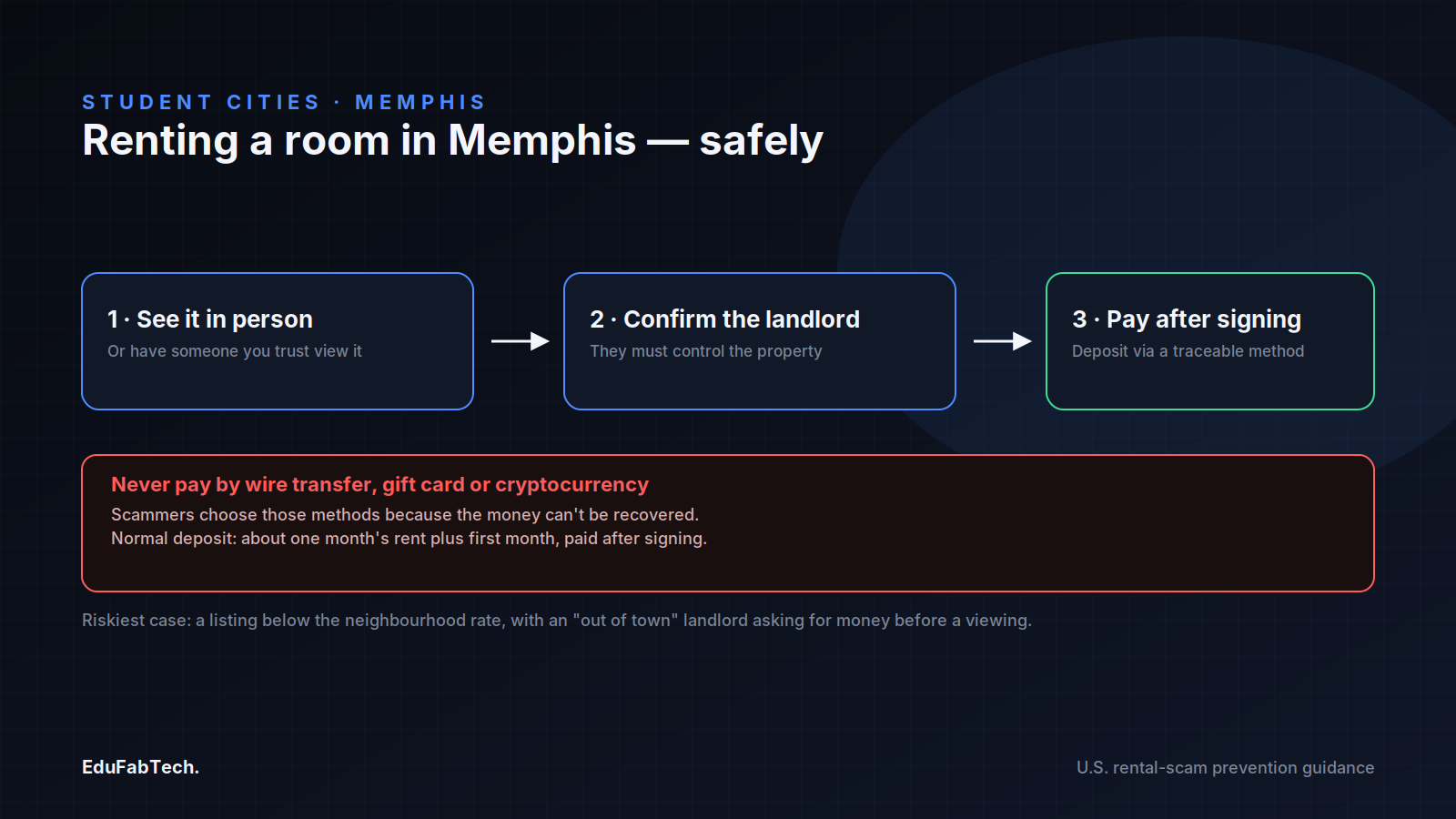
Rental scams in Memphis follow a predictable pattern: an attractive house in the University District or Midtown, listed well below the neighbourhood rate, with a "landlord" who is conveniently out of town and asks you to send a deposit to "hold" it before you can see inside. Do not. See the actual room in person — or have someone you trust see it — before any money changes hands, and confirm the person showing it controls the property. A normal Memphis arrangement is a security deposit of roughly one month's rent plus the first month, paid by a traceable method once you have signed a lease and collected keys. Never send a deposit by bank wire transfer, gift card or cryptocurrency; those are the methods scammers choose precisely because the money cannot be recovered. International students arriving before term, who cannot view a place in person, are the most exposed — it is worth paying for a short stay first and renting only once you are on the ground.
Furnishing a room cheaply
Memphis has a strong second-hand culture, and furnishing a room need not be expensive. Midtown's Cooper-Young district — named for the intersection of Cooper Street and Young Avenue — is the city's centre of vintage and used goods; Memphis Tourism's own guide points to long-standing shops there including the century-old Burke's Book Store for used books, Goner Records for hard-to-find vinyl, and Flashback for retro clothing and eclectic home décor (memphistravel.com). For produce and household basics, the seasonal Memphis Farmers Market runs downtown beside the historic Central Station through the warmer months.
For the bulkier things — a desk, a mattress, a set of chairs — the cheapest route is other students moving out, especially at the end of the spring term. EduFabTech keeps Memphis-specific pages for second-hand goods, used furniture and things given away free; checking these around move-out weekends is usually more productive than buying new.
Working while you study
If you are an international student on an F-1 visa, the rules on work are set by U.S. federal immigration authorities, not by the university or the state. The Department of Homeland Security's Study in the States guidance states that F-1 students whose record is active in SEVIS may take on-campus employment but "may not work more than 20 hours per week when school is in session," and that the first step is always to talk with your Designated School Official before doing any work (studyinthestates.dhs.gov). On-campus jobs — a library, a dining hall, a departmental post — are the straightforward option; off-campus work and practical training carry extra conditions and authorisations. Treat that official page and your DSO as the authority, and do not rely on second-hand advice: working without permission can end your student status. This is general information, not legal advice. Local part-time openings are collected on EduFabTech's Memphis jobs page.
Libraries and places to study
On the University of Memphis campus, the Ned R. McWherter Library is the main study building: its library guides describe bookable group-study and collaboration rooms, individual carrels you can check out for periods from four hours to a week, and a designated silent zone on the fourth floor (libguides.memphis.edu). CBU students have the Plough Memorial Library on their Midtown campus.
Off campus, the public system is a genuine resource. Memphis Public Libraries lists 18 branches across the city, anchored by the Benjamin L. Hooks Central Library at 3030 Poplar Avenue, and offers free public computers, wi-fi, meeting rooms and digital lending through apps such as Libby (memphislibrary.org). For anyone living off campus or studying in the evenings, a branch library is often the quietest free option nearby. EduFabTech also lists bookable desks and quiet rooms on its Memphis study-spaces page.
Getting around
Public transport is run by the Memphis Area Transit Authority (MATA), which operates the city buses and the downtown trolley line. MATA's fares page lists a standard adult and student base bus fare of $1.00 and reduced fares of $0.50 for seniors and riders with disabilities, with a $2.00 daily Fast Pass; at the time of writing it also notes a Zero Fare 90-day pilot under which rides on buses, trolleys and on-demand services are temporarily free, with tickets otherwise bought through the Go901 transit app (matatransit.com/fares). Because that pilot is temporary and routes have been reduced in recent years, confirm the current fare and schedule before you rely on the bus for a daily commute.
The honest picture is that Memphis is a car-centred city. Bus coverage is thinnest in exactly the outer neighbourhoods where rent is cheapest, so many students who live beyond walking distance of campus end up driving or cycling. If you choose a place near the University District or in Midtown, you can manage without a car; further out, factor the cost of one into your budget. Memphis International Airport is a short drive south of the city, and Amtrak's City of New Orleans line stops at Central Station downtown.
What a term actually costs
The clearest dated housing figures come from the University of Memphis itself. Its 2025-2026 Residence Life rates list the community-style Rawls and Smith halls at $2,582 per semester for a double room, the suite-style South Hall at $2,957, and the pod-style Centennial Place at $3,337, each with an additional $15 mail-services charge per semester (memphis.edu/reslife/housing101/housingrates.php). Those are per-semester figures for shared rooms, so a two-semester year roughly doubles them.
Off-campus rents are harder to pin to a single authoritative, dated source, and I would rather say so than quote a number I cannot stand behind; the dormitory rates above are the most reliable published figures. As a practical rule, the University District and Midtown are cheaper than comparable American college neighbourhoods, which is one of the real advantages of studying here — but a shared student block near campus will still cost more per person than a room in a house further out, where a car becomes necessary.
The honest pros and cons
In its favour, Memphis is affordable, culturally distinctive and friendly, with a music, food and arts scene that few larger student cities can match, and universities that span a big public research campus, a small private college and respected health-science schools. Against it: the city is spread out and built around driving, so a poorly chosen address can mean a long or awkward commute; public transport is limited and in flux; summers are genuinely hot and humid; and parts of the city have real problems with crime and uneven investment, which makes choosing your neighbourhood carefully — and visiting it before you sign — more important here than in a compact college town. None of that should put off a prepared student, but all of it rewards planning.
A checklist for your first weeks
- See any room in person before paying a deposit, and never wire money, buy gift cards or send crypto to "hold" a place.
- Pick your neighbourhood around your campus and your transport: University District or Midtown if you want to live without a car.
- If you are on an F-1 visa, meet your Designated School Official before taking any job, and read the DHS Study in the States work guidance.
- Get a free Memphis Public Libraries card for computers, wi-fi and a quiet place to work off campus.
- Check the current MATA fare and the routes that serve your address before committing to a bus commute.
- Furnish your room from Cooper-Young's second-hand shops and from end-of-term giveaways rather than buying everything new.
- Browse EduFabTech's Memphis events page to find your way into campus and city life early.
A quick question for readers
Do you work part-time while you study?
Many students work to pay the bills. See how common it is — and how many hours people really do.
Pick an answer, create a free account in a minute, and your vote counts. Already a member? Sign in
Comments 0
CommentNo comments yet. Members start the conversation.
Source: University of Memphis
Sources (5)
- University of Memphis. UofM Facts at a Glance. University of Memphis, 2025. memphis.edu ↗ · checked 12 Oct 2026
- University of Memphis. Residence Life Housing Rates (2025-2026). University of Memphis, 2025. memphis.edu ↗ · checked 12 Oct 2026
- Memphis Area Transit Authority. Fares. Memphis Area Transit Authority, 2026. matatransit.com ↗ · checked 12 Oct 2026
- U.S. Department of Homeland Security. Working in the United States. Study in the States, 2026. studyinthestates.dhs.gov ↗ · checked 12 Oct 2026
- Christian Brothers University. About CBU. Christian Brothers University, 2026. cbu.edu ↗ · checked 12 Oct 2026