Studying in Morgantown: universities, housing and student life
A practical, sourced guide to West Virginia University's home town — its campuses, where students live, the PRT, study spaces, part-time work rules and honest costs.
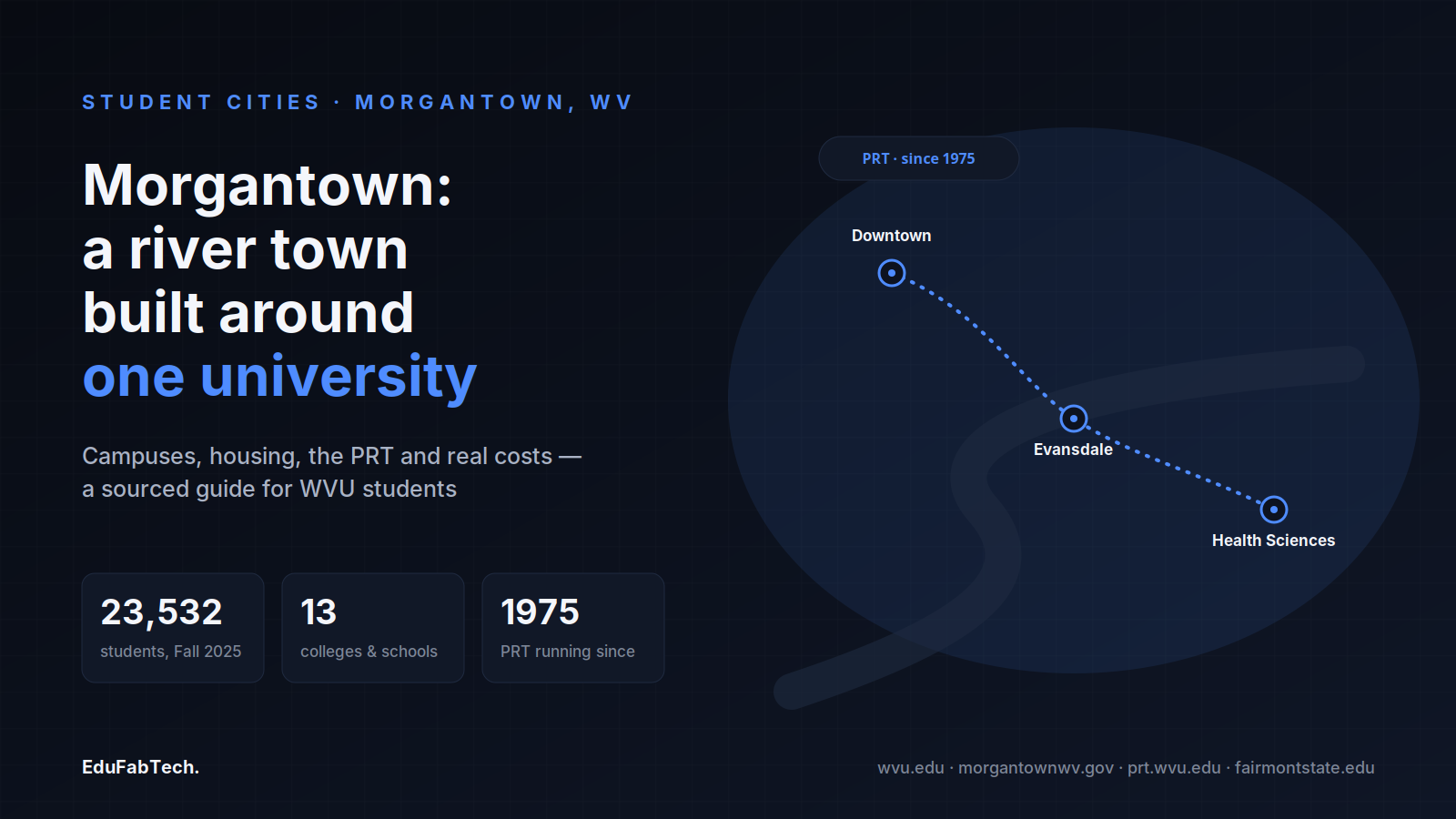
Morgantown is a river town wrapped around a university. It sits in north-central West Virginia, in the hills above the Monongahela River and about fifteen minutes' drive from the Pennsylvania state line, and almost everything that gives the town its rhythm — the morning buses, the Friday-night crowds on High Street, the housing market, the part-time jobs — traces back to West Virginia University. According to the municipal government's own profile, WVU was founded in 1867 as the state's flagship land-grant research university (morgantownwv.gov); the university's own facts page records that the Morgantown campus holds the Carnegie R1 "very high research activity" classification — the only such institution in West Virginia (wvu.edu).
That scale matters for anyone deciding whether to move here. West Virginia University's own facts page reports a Fall 2025 Morgantown headcount of 23,532 students, drawn from 95 nations, 49 U.S. states and all 55 West Virginia counties, with 46% of students being state residents, per wvu.edu. In a city whose total population is well under a hundred thousand, students are not a niche — they set the price of a room and the length of the queue at the coffee bar.
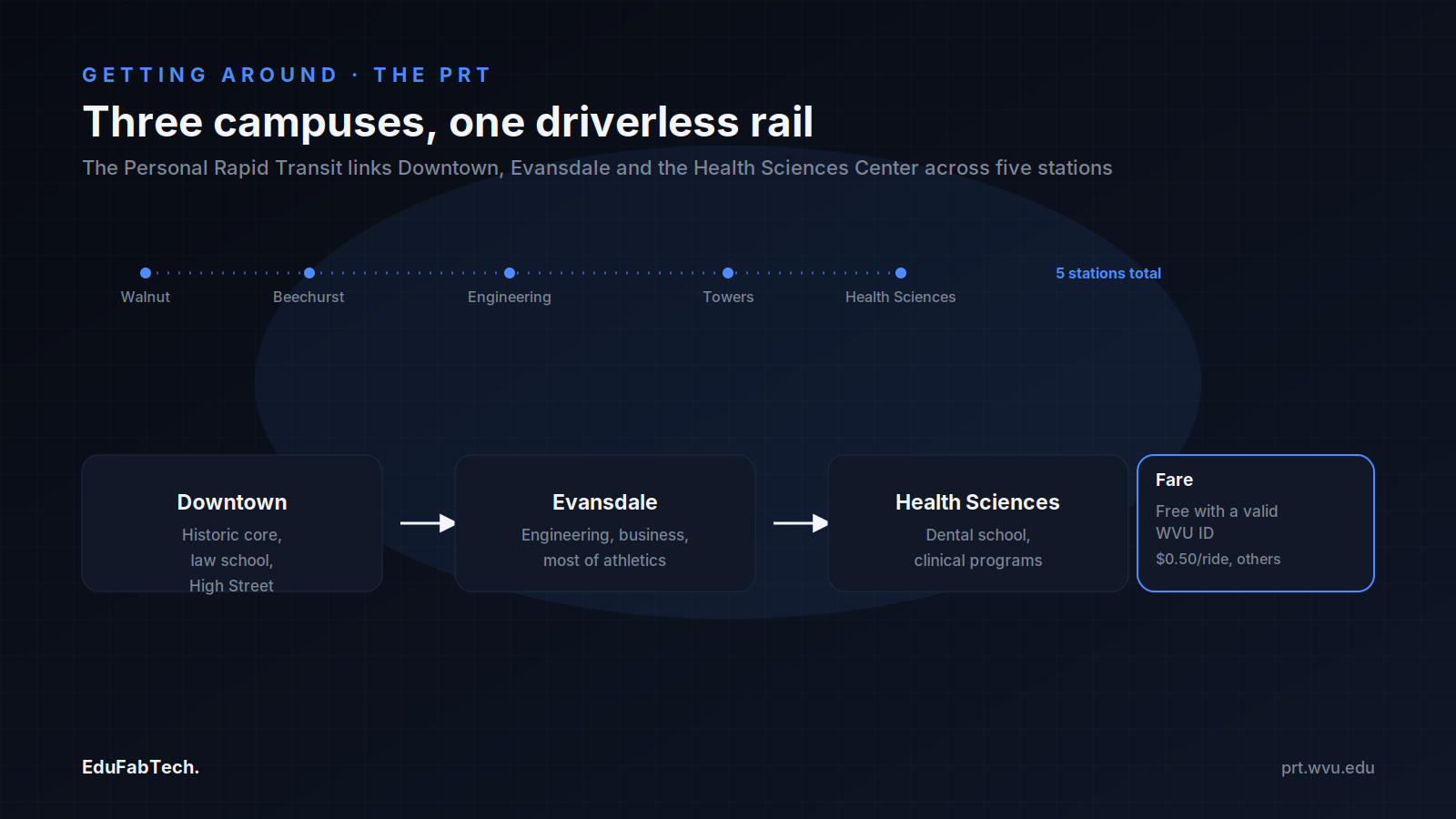
The campus is not one place but three, stitched together by a driverless rail system. The historic Downtown campus sits above the river near the old commercial centre; the Evansdale campus, a couple of miles north, holds engineering, the Health Sciences Center and much of the athletics estate. Knowing which campus your department lives on is the single most useful thing to settle before you sign a lease.
WVU, its professional schools and Fairmont State
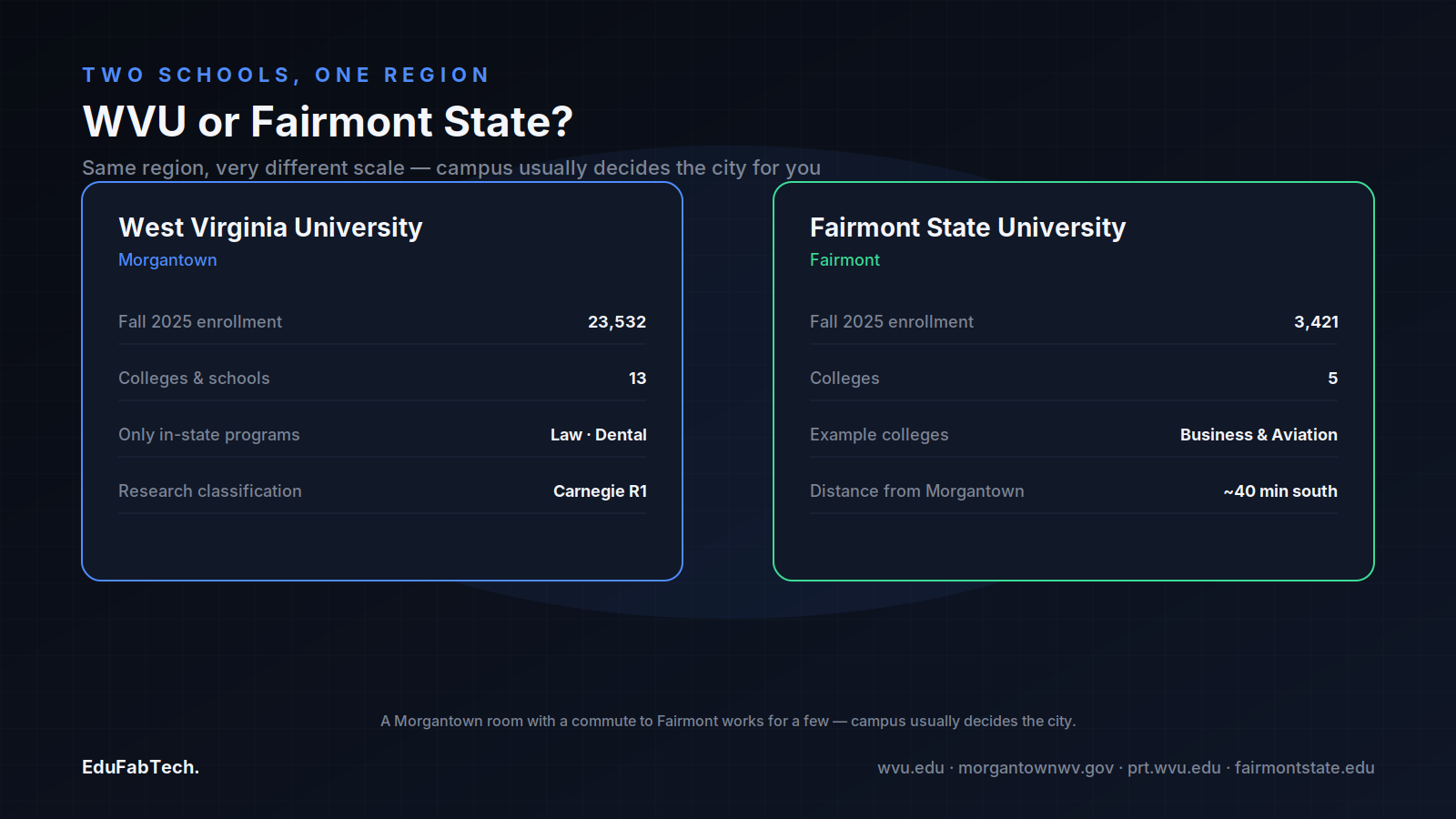
West Virginia University is the centre of gravity. Its own facts page describes more than 350 bachelor's, master's, doctoral and professional degree programmes across 13 colleges and schools, including West Virginia's only law and dental schools (wvu.edu). Those two professional schools are worth naming on their own. The West Virginia University College of Law is on the Evansdale side of campus and is the state's sole law school. The West Virginia University School of Dentistry is part of the Health Sciences Center and, likewise, the only dental school in the state — relevant if you are weighing clinical placements or in-state tuition. Business students apply to the College of Business and Economics (formally the John Chambers College of Business and Economics), which is based on the Evansdale campus near Evansdale Crossing.
About forty minutes south, in the town of Fairmont, sits Fairmont State University, a separate public institution. It is much smaller — its own fast-facts page reports a total enrolment of 3,421 in Fall 2025 — and is organised into five colleges, among them Business and Aviation, Nursing, and Science and Technology (fairmontstate.edu). For a few students, a Morgantown room with a commute to Fairmont (or the reverse) is a workable compromise on rent; for most, campus dictates the town.
Where students live, from Sunnyside to Westover
Housing in Morgantown divides along the same geography as the campuses. First, a rule that shapes the whole first-year market: WVU requires undergraduates arriving with fewer than 24 credit hours to live in a university residence hall, with a residential dining plan, unless they qualify for an exemption such as commuting from a parent's or guardian's home in a contiguous county (Monongalia, Marion, Preston, Taylor, Harrison or Wetzel in West Virginia, or Fayette and Greene in Pennsylvania). The full policy is on housing.wvu.edu. If you are a new undergraduate, your first year is largely decided for you.
After that, students spread into the neighbourhoods. Sunnyside, the slope immediately above the Downtown campus, is the classic undergraduate quarter — old houses chopped into shared units, a short walk to class and to the High Street bars, and correspondingly noisy. South Park, across Deckers Creek on the other side of downtown, is quieter and more residential, popular with graduate students and couples. Around Evansdale and up toward Suncrest and Star City you find more purpose-built apartment blocks, useful if your department is on that campus. Westover, across the river, tends to be cheaper but means crossing a bridge in traffic. Browse what is currently listed in the city on EduFabTech's Morgantown rooms page and the wider city listings, or filter by campus using listings near West Virginia University and near the College of Law.
Timing is the trap. Morgantown's private leasing cycle runs early: many houses in Sunnyside and South Park are signed in the autumn or winter for the following August, so students hunting in the spring for a September move often find the best-located places already gone. Start earlier than feels reasonable, and do not let an early deadline pressure you into paying before you have seen the place.
Spotting a rental scam in Morgantown
The scams here follow the student calendar. They cluster where desperate newcomers look — "available now" posts for cheap Sunnyside or downtown rooms, often on general classified sites and social-media housing groups, with photos lifted from real listings. The warning signs in Morgantown are the ordinary ones: a landlord who is conveniently "out of town," a price well below the street around it, and pressure to secure the room before the semester fills up.
A few habits protect you. See the actual unit in person, or send someone you trust, before any money changes hands; a legitimate Morgantown landlord expects you to walk the house. Get a written lease and understand what a normal deposit looks like here — typically a security deposit in the range of one month's rent, paid by a traceable method once you have the terms in writing and keys in prospect. Never wire a deposit by bank transfer, and never pay by gift card or cryptocurrency to "hold" a room — no genuine local landlord asks for that, and such payments cannot be recovered. If you are abroad and cannot visit, lean on university channels and verified listings rather than a stranger's direct message, and treat any request for payment before a viewing as a stop sign.
Furnishing a room for very little
Because the student population turns over every summer, Morgantown is unusually good for second-hand goods. The national thrift chains in town — Goodwill and the Salvation Army — are reliable stops for furniture, kitchenware and winter clothing, and end-of-semester move-out in particular floods the market with used desks, mini-fridges and bikes.
For food and the weekend browse, the Morgantown Farmers Market runs on Saturday mornings (roughly 8:30 a.m. to noon) at the market place on Spruce Street downtown from spring through autumn, with a smaller winter market on selected Saturdays; details are listed by the state tourism office at wvtourism.com. EduFabTech tracks what is going locally on its second-hand, furniture and free-stuff pages — the free page is worth checking in May, when departing students give away more than they can sell.
Getting around: the PRT and the buses
Morgantown's best-known piece of infrastructure is the Personal Rapid Transit (PRT), the automated electric people-mover that has run since 1975 and links the campuses across five stations — Walnut, Beechurst, Engineering, Towers and the Health Sciences Center. For WVU Morgantown students and employees with a valid WVU ID it is free; everyone else pays $0.50 per ride, according to prt.wvu.edu. When it is running, the PRT turns the two-mile gap between Downtown and Evansdale into a short, weather-proof hop — genuinely useful on an icy January morning.
Off the guideway, the city bus network is run by the Mountain Line Transit Authority. WVU students ride Mountain Line's local routes free simply by swiping a valid WVU ID when boarding, as the operator confirms on its WVU Ride Free page; the twice-daily Grey Line to Pittsburgh is the exception and is paid separately. Between the free PRT and free buses, a student here can live without a car more easily than the hilly terrain suggests — though evening and weekend service is thinner, so check the timetable before relying on it for a late shift.
Libraries and places to study
The WVU Libraries system is large for a town this size: its collections include more than 1.8 million books alongside hundreds of thousands of e-books and e-journals, per library.wvu.edu. The two you will use most are the Downtown Campus Library — the Charles C. Wise Library, on University Avenue, which also houses the West Virginia and Regional History Center (library.wvu.edu/libraries/downtown) — and the Evansdale Library, closer to engineering and the sciences, which runs bookable group-study rooms and quiet-study areas (library.wvu.edu/libraries/evansdale). For cafés and desks beyond the library walls, EduFabTech's Morgantown study-spaces page collects what students are using now.
Working while you study
Part-time work is common, but the rules depend entirely on your immigration status, and nothing here is legal advice — confirm your own case with a WVU designated school official. For students on an F-1 visa, the U.S. Student and Exchange Visitor Program states that on-campus employment is limited to up to 20 hours per week while school is in session, with full-time work allowed during official breaks, and that a student should consult their designated school official (DSO) about any employment; the authoritative page is ice.gov/sevis/employment, and the Department of Homeland Security's broader guidance sits at Study in the States. WVU's International Students and Scholars Services office translates this into campus procedure at isss.wvu.edu. The practical point: on-campus roles — dining halls, the libraries, research labs — are the straightforward path for international students, because they do not require the separate work authorisation that off-campus jobs do. Current local openings, for those eligible to take them, appear on EduFabTech's Morgantown jobs page.
What it costs, and the figures WVU publishes
Start with the one figure the university publishes directly. For 2026–2027, WVU's Board of Governors approved residence-hall rates that, in the traditional halls (Boreman, Dadisman, Bennett, Braxton and the Lyon Towers), come to $3,682 per person per semester for a standard double room, rising to $5,136 per person per semester for a double suite in Oakland Hall and $6,248 per person per semester for a two-bedroom studio in Seneca Hall, according to WVU Housing's room and dining rates page. Remember these are per-semester figures and that a residential dining plan is required on top for students living in the halls.
Off-campus rents are harder to pin to a single authoritative number, and anyone quoting you a precise "average Sunnyside rent" is usually guessing; treat per-room prices as something to verify listing by listing rather than from a headline figure. What is stable is the shape of the market: shared houses near the Downtown campus command a premium for the walk, while a longer commute from Westover or the Suncrest apartments trades convenience for a lower monthly rent. Budget for a cold-weather heating bill, too — winters here are genuinely cold and snowy.
The honest trade-offs
What is good about Morgantown for a student is real. Transport inside the student bubble is free and frequent, the library system is larger than the town's size would predict, second-hand goods are cheap and plentiful because of the annual turnover, and the overall cost of living is lower than in the coastal university cities students often compare it to. The place has a strong, settled student culture built around a single institution, which makes it easy to belong quickly.
What is hard is also real. The housing cycle starts early and punishes latecomers, so the best-located rooms go to those who commit months ahead. Football Saturdays and the Sunnyside party scene mean noise and crowding if you live close in. The terrain is steep and the winters are long, which makes the car-free life easier in theory than on an icy hill. And a town this dominated by one university can feel small by late spring — the thing that makes it convenient also makes it insular.
A checklist for your first weeks
- Confirm which campus — Downtown or Evansdale — your department sits on before you choose where to live; it decides your daily commute.
- If you are a first-year undergraduate, check the live-on requirement and whether any exemption applies to you.
- Get your WVU ID early — it is what makes the PRT and Mountain Line buses free.
- View any off-campus room in person (or via someone you trust) before paying, and never send a deposit by wire, gift card or crypto.
- On an F-1 visa, meet your WVU DSO before accepting any job, and keep on-campus work within the 20-hour term-time limit.
- Scout the thrift shops and the Saturday farmers market in your first fortnight, and check EduFabTech's free-stuff and events pages to settle in cheaply.
A quick question for readers
Do you work part-time while you study?
Many students work to pay the bills. See how common it is — and how many hours people really do.
Pick an answer, create a free account in a minute, and your vote counts. Already a member? Sign in
Comments 0
CommentNo comments yet. Members start the conversation.
Source: West Virginia University
Sources (5)
- West Virginia University. WVU Facts. West Virginia University, 2025. wvu.edu ↗ · checked 10 Oct 2026
- WVU Housing. Room and Dining Plan Rates 2026–2027. West Virginia University, 2026. housing.wvu.edu ↗ · checked 10 Oct 2026
- U.S. Immigration and Customs Enforcement. SEVIS: Employment. Student and Exchange Visitor Program, 2026. ice.gov ↗ · checked 10 Oct 2026
- Mountain Line Transit Authority. WVU Ride Free. Mountain Line Transit Authority, 2026. busride.org ↗ · checked 10 Oct 2026
- WVU Libraries. Collections. West Virginia University, 2026. library.wvu.edu ↗ · checked 10 Oct 2026