Studying in Muncie: universities, housing and student life
A practical, sourced guide to Ball State, where students live, what a room costs, and how to get around a small Indiana city on the White River.
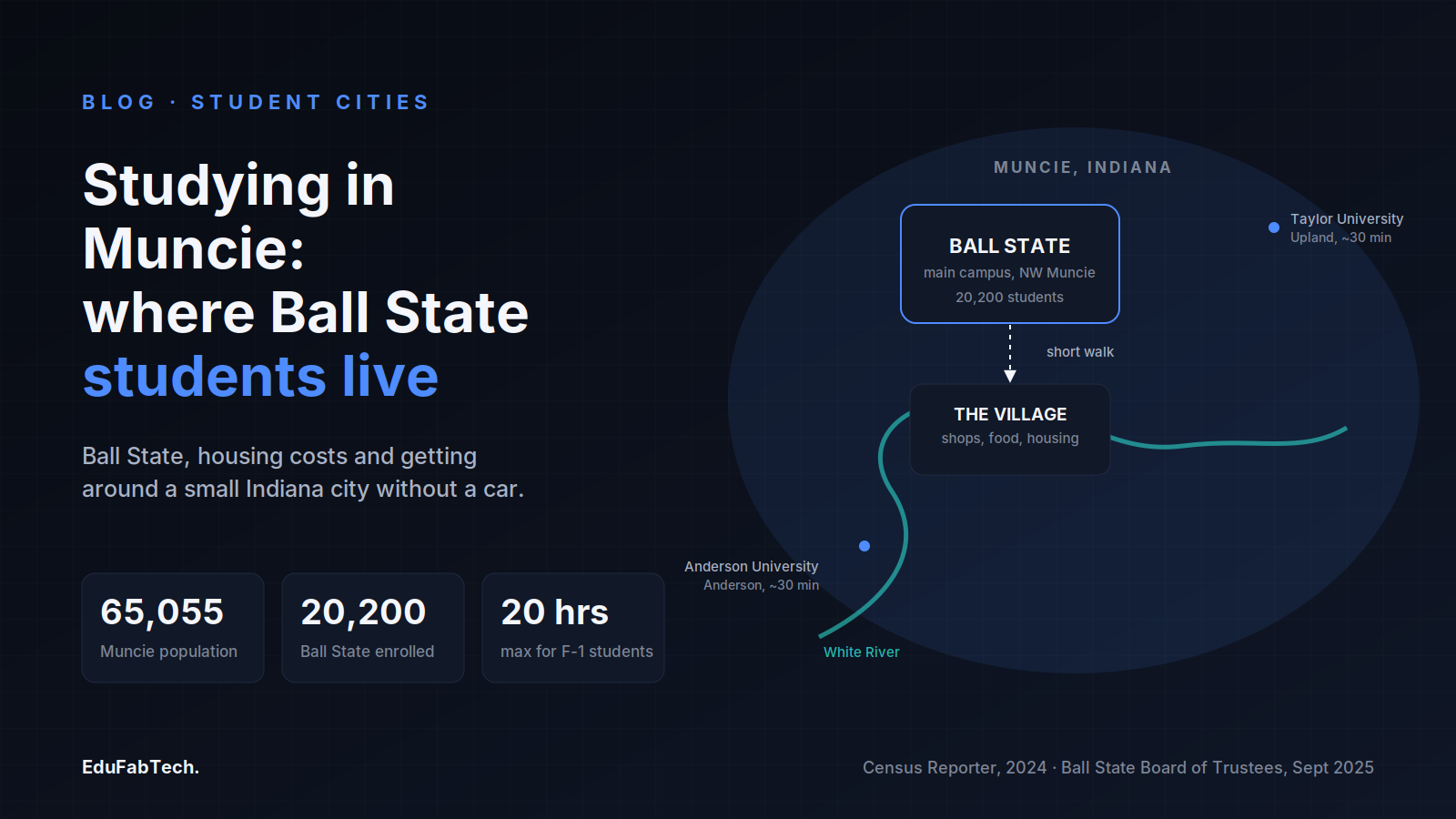
Muncie sits in east-central Indiana, on a bend of the West Fork of the White River, roughly an hour's drive north-east of Indianapolis. It is the seat of Delaware County and, for most of the past century, a factory town: the Ball family built its glass-manufacturing fortune here, gave the state the land that became Ball State University, and left their name on much of the city. According to the U.S. Census Bureau's American Community Survey as summarised by Census Reporter (2024 one-year estimates), Muncie had a population of about 65,055, which makes it small enough that the university is the single largest force shaping daily life.
That matters for anyone deciding whether to study here. Muncie is a college town rather than a city with a university bolted on: term time and the academic calendar set the rhythm, rents soften in summer when students leave, and the walkable core of student life is concentrated on the north-west side of town around campus. It is cheap by the standards of larger American cities, flat and easy to cycle, and quiet — which some students love and others find slow.
Three degree-granting institutions sit in or near Muncie, and a student choosing between them is really choosing between a mid-size public university in the city itself and two smaller faith-based colleges a short drive away. The practical questions — where to live, what it costs, how to get around without a car, how international students are allowed to work — have concrete, local answers, and the rest of this guide works through them. You can browse current student listings for the city on EduFabTech's Muncie page.
The universities in and around Muncie
Ball State University is the anchor. Its main campus occupies a large, tree-lined site on the north-west side of Muncie, and the institution grew out of a teachers' college — the Ball State Teachers College lineage survives today in its Teachers College, long one of its best-known schools alongside the Estopinal College of Architecture and Planning. The university's Board of Trustees reported in September 2025 that overall enrolment had passed 20,200 students, including a new freshman class of 3,733. Ball State is also unusual in how closely it is tied to the city: the university and Muncie Community Schools run a formal partnership, so education students see local classrooms early.
About half an hour's drive from Muncie, two private Christian universities round out the options. Taylor University, in the small town of Upland to the north-east, describes itself on its own site as a Christ-centred liberal arts university offering more than 100 academic programmes; it is known for a tight-knit, strongly residential campus community. Anderson University, in the city of Anderson to the south-west, is a private university affiliated with the Church of God, offering undergraduate and graduate degrees across liberal arts, business, music and theology. Both are considerably smaller than Ball State and have a stronger faith dimension to campus life; neither is realistically commutable to the other on a daily basis without a car. EduFabTech keeps separate listing pages for housing near each campus — Ball State, Taylor and Anderson.
On campus, the Village, and the neighbourhoods students settle in
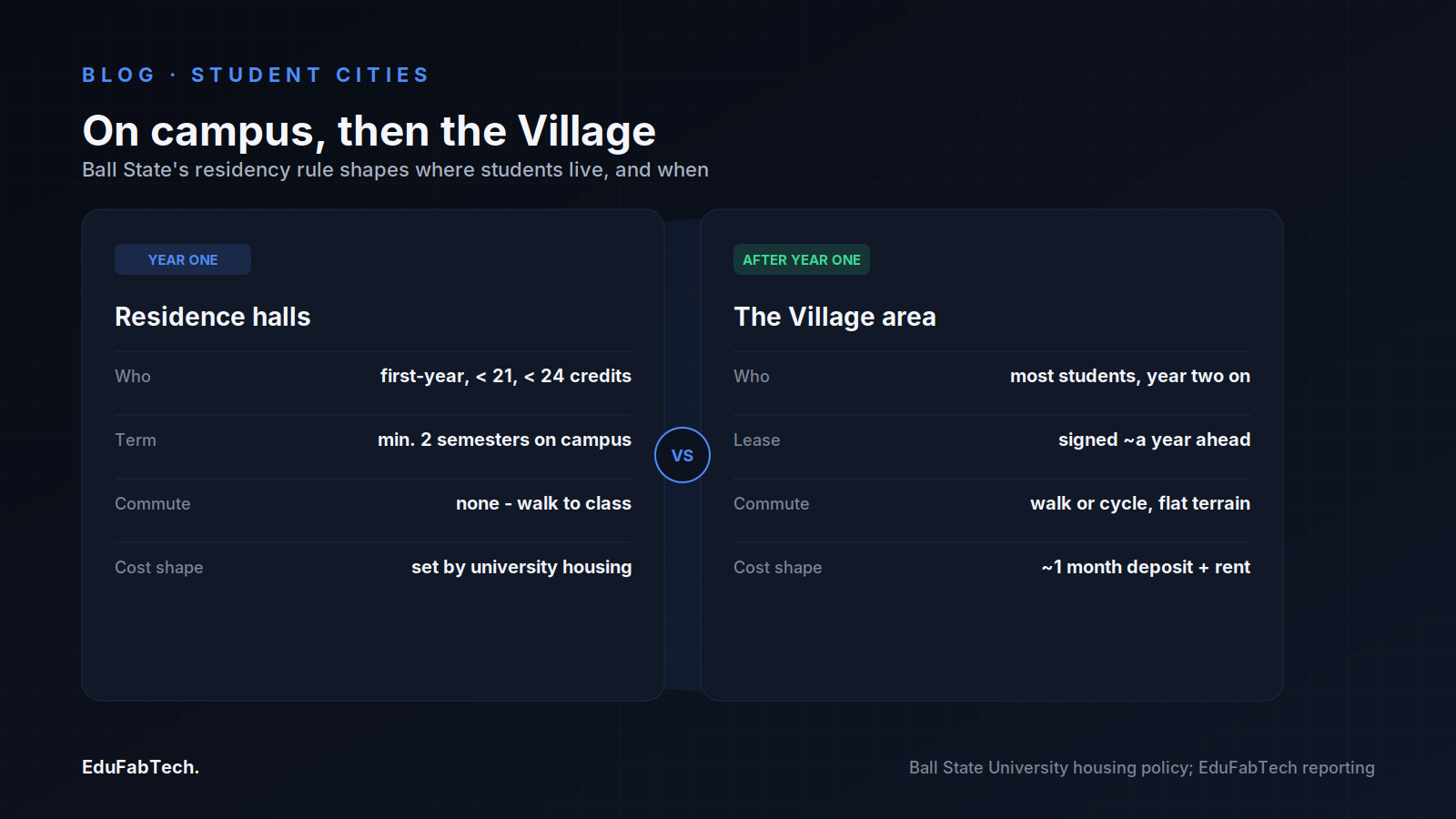
Ball State expects new students to start out in the residence halls. Under the university's residency requirement, incoming students must live on campus for at least two semesters unless they qualify for an exemption — being 21 before the first term, already holding 24 or more college credits, being married, being a custodial parent, or living with parents inside a 60-mile radius. For a first-year international student this effectively settles the first-year housing question, and it is worth budgeting for rather than fighting.
Once that requirement is met, most students move just off campus. The obvious first stop is the Village, the compact commercial strip along University Avenue immediately south of campus, long the traditional hub of student shopping, food and nightlife and now the subject of a multi-year revitalisation. The streets around it — the older Riverside/Normal City grid to the north and east — hold the bulk of walkable student rentals: subdivided houses, small apartment blocks and purpose-built student buildings. Further out, the McGalliard Road corridor to the north is where the big-box shops, chain restaurants and the Muncie Mall are, reachable by bus rather than on foot.
The trade-off is simple. Living in or beside the Village means you can walk or cycle to class and never need a car; living further south or east is cheaper but usually means relying on the bus or a bike. Because Muncie is flat and compact, cycling is genuinely practical for most of the year. You can see what is currently on offer across the city on EduFabTech's rooms page.
Renting off campus without losing a deposit
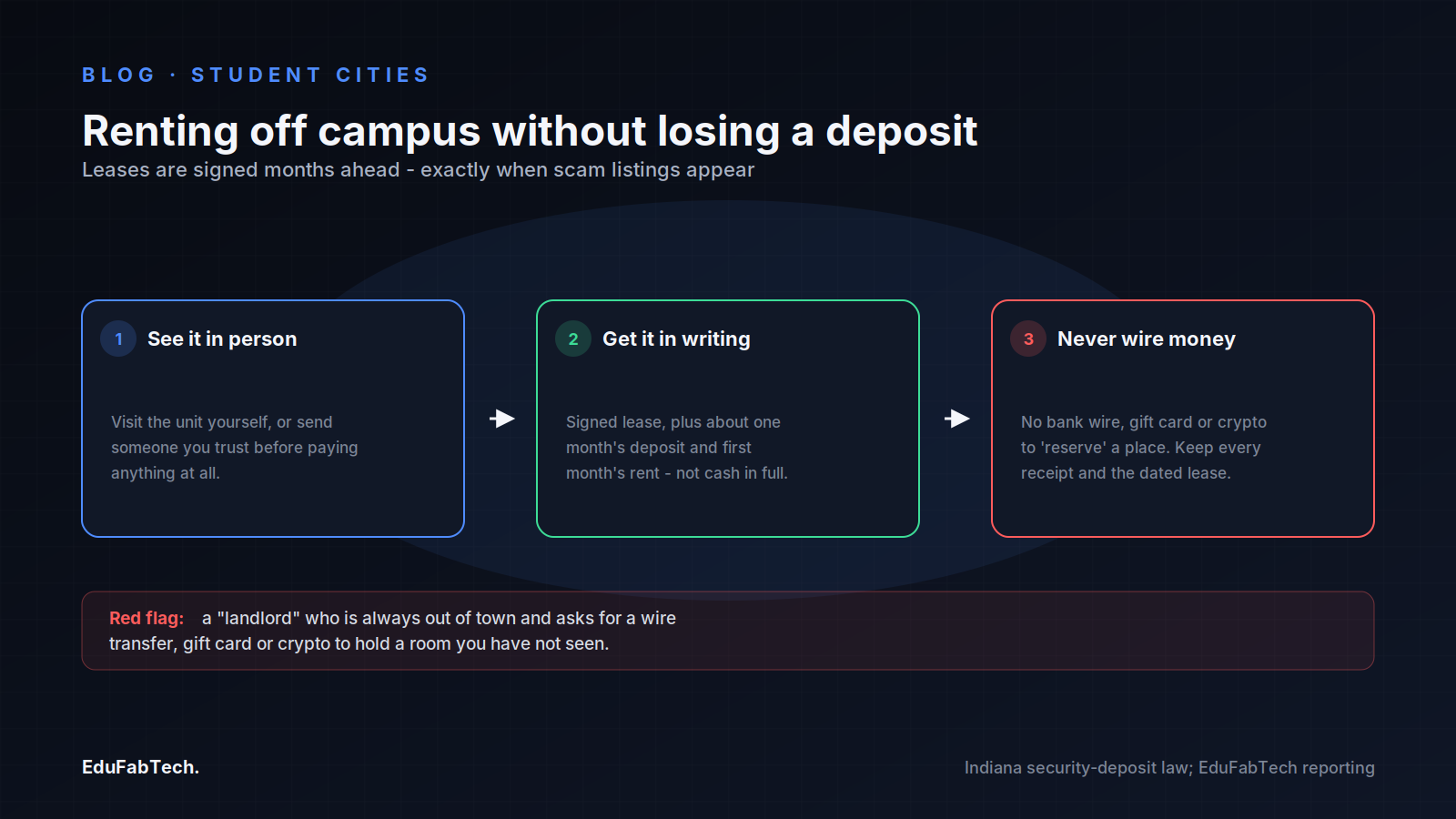
Off-campus leases in Muncie are usually signed many months ahead — it is common for students to lock in next year's house during the autumn semester, well before they need it. That early rush is exactly when scams appear: listings for Village-area houses that look cheap, are advertised only through photos, and come with a landlord who is conveniently "out of town" and wants money to hold the room. Treat any such request as a red flag.
A few habits protect you. See the actual unit in person, or have someone you trust see it, before paying anything; a real local landlord near campus can show you the property. Expect a written lease and, typically, a security deposit of around one month's rent plus first month's rent up front — not several months demanded in cash. Never send a deposit by bank wire transfer, gift card or cryptocurrency to "reserve" a place, and be wary of anyone who refuses to meet or who pushes you to sign without seeing the unit. Indiana has a state security-deposit law governing how and when deposits must be returned, so keep every receipt and a dated copy of the signed lease. If you are arriving from abroad and cannot view a place yourself, it is safer to take a university residence hall for the first semester and search for off-campus housing once you are physically in Muncie.
Furnishing a room, and eating, on a small budget
Because the student population turns over every year, Muncie has a steady supply of cheap second-hand furniture — most of it changing hands in late spring and late summer as leases end. The city has several charity and thrift shops: a Goodwill store on the north side, the St. Vincent de Paul thrift shop, and Attic Window, a resale store whose proceeds go to the Muncie Mission. These are the realistic places to kit out a room with a desk, lamp and kitchenware for very little.
For food and the general feel of the place, the Farmers Market at Minnetrista is worth knowing. Minnetrista is a cultural centre on the former Ball family estate beside the White River, and its market runs outdoors on Saturday mornings in the warmer months — the organisers list the outdoor market at 1200 North Minnetrista Parkway, selling seasonal produce, eggs, baked goods, meat and handmade items, with SNAP benefits accepted at participating vendors; an indoor version runs through the colder months. EduFabTech also carries local classifieds for second-hand things, furniture and items given away free, which is where a lot of end-of-lease furniture ends up.
Working while you study
Pay close attention to the rules here, because they are set by immigration law, not by the university. The U.S. Department of Homeland Security's Study in the States service states plainly that an F-1 student doing on-campus employment may not work more than 20 hours per week when school is in session; more hours are generally allowed during official breaks. Off-campus work — including the Curricular Practical Training and Optional Practical Training schemes tied to your field of study — requires specific authorisation arranged through your Designated School Official before you start, and in some cases a Form I-765 approved by U.S. Citizenship and Immigration Services. Do not begin any off-campus job on the strength of a pending application.
In practice, most international students' first job is on campus — dining halls, the libraries, departmental offices — and Ball State routes new student employees through its Career Center to complete employment paperwork. Treat the DHS guidance and your DSO as the authority on what you may and may not do; this guide is not legal advice, and the penalties for getting work status wrong are serious. Current openings in the city are listed on EduFabTech's jobs page.
Libraries and places to study
The centre of academic study is Bracken Library, Ball State's main library on campus, which offers hundreds of public workstations, bookable group study rooms, individual study pods and a writing centre, with term-time hours that run into the early hours on weeknights. For a change of scene off campus, the Muncie Public Library system runs several branches: the historic Carnegie Library downtown (at Jackson and Jefferson, home to the local history and genealogy collection), the mid-century Kennedy branch on West McGalliard Road, and the Maring-Hunt branch on South High Street. A public library card is free to local residents and gives you quiet desks and internet away from the student crowd. EduFabTech lists additional study spaces and desks around town.
Getting around: the free MITS bus, and life without a car
Muncie's public transport is run by the Muncie Indiana Transit System (MITS), and its most useful feature for students is the cost: MITS states that Ball State students ride free on all routes simply by showing a student ID. Routes connect campus to the McGalliard shopping corridor, Walmart, IU Health Ball Memorial Hospital, downtown and Minnetrista, which covers most of what a student without a car needs. Because the city is flat and the campus-to-Village distance is short, many students combine the bus with a bicycle and never buy a car at all. For trips beyond Muncie — Indianapolis is the nearest big city and airport — you will need either a car, a lift, or an intercity bus.
What it costs, and the honest trade-offs
Housing is the figure that matters most, and the clearest dated number comes from the university itself. For the 2026–2027 academic year, Ball State's housing rates list a standard double room from roughly $5,200 a year in its lower-cost halls up to about $6,268 in its higher tier, before meal plans. Indiana Public Radio reported in 2025 that the trustees froze tuition and mandatory fees — then about $2,134 a year in fees for full-time on-campus undergraduates — while raising room-and-board by 2 percent for 2026–2027, which it put at roughly a $300 increase for a student on the most expensive room-and-dining combination. Off-campus rents are lower per month than that implies once you split a house, though they come without a meal plan.
The wider cost picture is modest. The Census Bureau's American Community Survey, via Census Reporter (2024 one-year estimates), puts Muncie's median household income at about $41,417 and per-capita income near $25,080 — figures that reflect a city where incomes, and therefore prices, sit below the national average. For a student, that generally means affordable rent and groceries.
What is genuinely good about Muncie is this affordability, the short distances, the free bus, and a campus with real strengths in education, architecture and the arts. What is hard is also real: it is a small city with a quiet downtown, limited nightlife beyond the Village, and winters that are grey and cold; some of its neighbourhoods carry the marks of long industrial decline, and without the bus or a bike parts of town feel far apart. Students who want a big-city buzz tend to find Muncie confining; those who want a compact, cheap base to focus on their degree tend to be content.
A short checklist for your first weeks
- If you are arriving from abroad, take a residence hall for at least the first semester rather than renting a place you have never seen.
- Pick up your Ball State ID early — it is also your free pass on every MITS bus route.
- Get a Muncie Public Library card for off-campus study space and internet.
- Learn the bus routes between campus, McGalliard and downtown before you need them; pair the bus with a cheap second-hand bicycle.
- Furnish from Goodwill, St. Vincent de Paul, Attic Window or end-of-lease give-aways rather than buying new.
- Before signing any off-campus lease, see the unit in person, keep a dated copy of the lease, and never wire a deposit to hold a room.
- If you hold an F-1 visa, confirm the 20-hour on-campus limit and any work authorisation with your Designated School Official before taking a job.
- Check EduFabTech's Muncie listings for rooms, jobs and second-hand goods as leases turn over.
A quick question for readers
Do you work part-time while you study?
Many students work to pay the bills. See how common it is — and how many hours people really do.
Pick an answer, create a free account in a minute, and your vote counts. Already a member? Sign in
Comments 0
CommentNo comments yet. Members start the conversation.
Source: Ball State University
Sources (5)
- Indiana Public Radio. Ball State freezes tuition and fees in line with state recommendation, raises room and board fees. Indiana Public Radio, 2025. indianapublicradio.org ↗ · checked 13 Oct 2026
- U.S. Census Bureau (American Community Survey). Muncie, IN — demographic profile. Census Reporter, 2024. censusreporter.org ↗ · checked 13 Oct 2026
- U.S. Department of Homeland Security. Working in the United States. Study in the States, 2025. studyinthestates.dhs.gov ↗ · checked 13 Oct 2026
- Muncie Indiana Transit System. Welcome Ball State Students! MITS Bus is Here to Get You Moving This Fall. MITS, 2025. mitsbus.org ↗ · checked 13 Oct 2026
- Minnetrista. Farmers Market at Minnetrista: Outdoor Market. Minnetrista, 2026. minnetrista.net ↗ · checked 13 Oct 2026