Studying in Omaha: universities, housing and student life
A practical, sourced guide to Creighton, UNO and Bellevue, where students live along Dodge Street, what a room costs, and how to get around a car-shaped city.
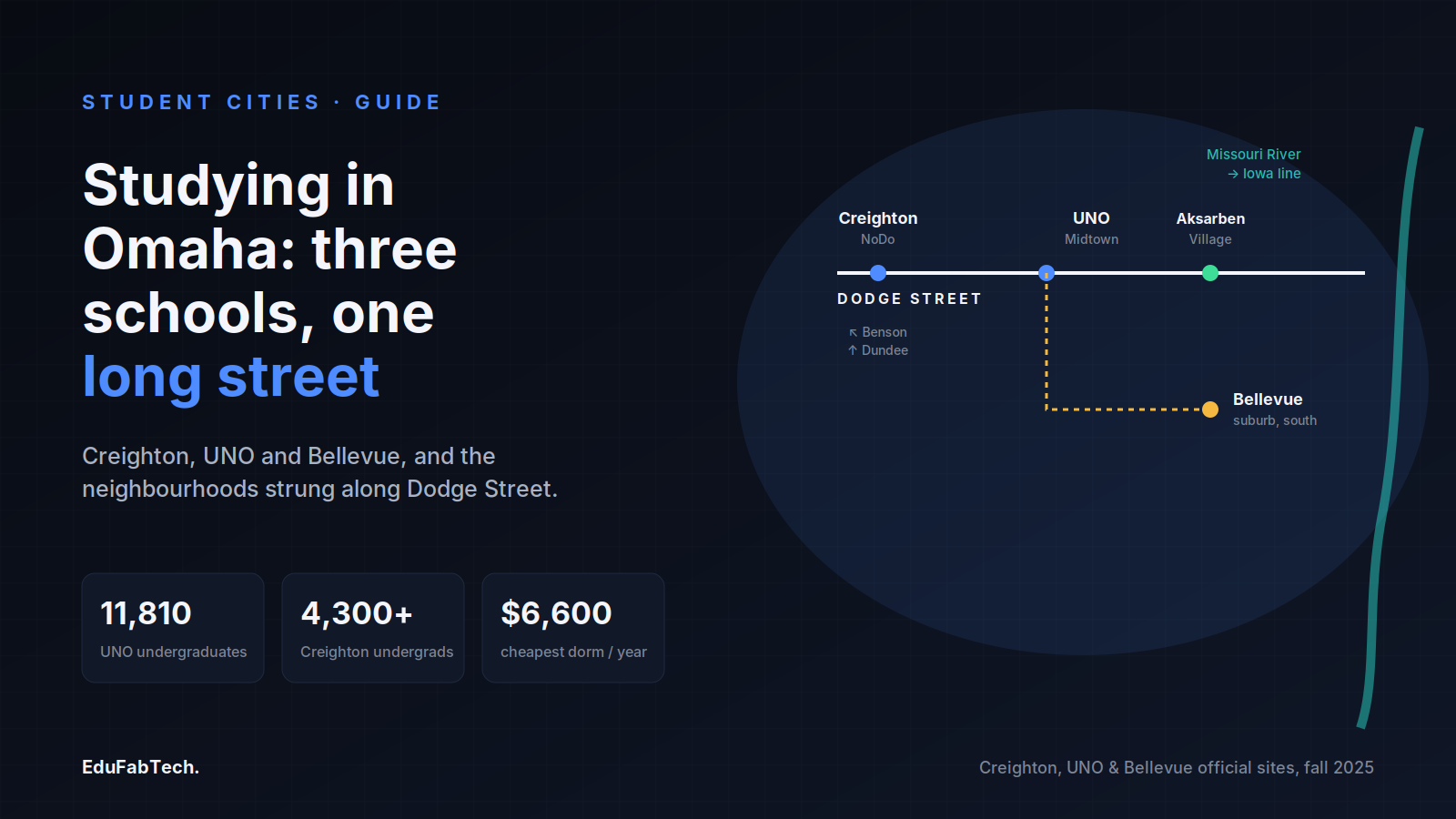
Omaha sits on the west bank of the Missouri River, which is also the Nebraska–Iowa state line: cross one of the downtown bridges and you are in Council Bluffs, Iowa. The city grew westward along Dodge Street, the long east–west spine that still organises most of daily life, and that geography matters for a student because almost everything — campuses, the main bus route, the older walkable neighbourhoods — strings out along or just off that line. Winters are genuinely cold and snowy, summers are hot and humid with a real thunderstorm and tornado season in spring, so the kind of housing and commute you choose is shaped by weather you may not have planned for.
It is a mid-sized, spread-out, car-centred city rather than a compact campus town. That has consequences for rent, for how you get to class, and for how much walking you can realistically do in January. The upside is space and relatively low housing costs by US standards; the downside is that distances are long and public transport is thin outside a few corridors. This guide works through the universities, the neighbourhoods students pick, costs you can check against a source, and the honest trade-offs.
Three institutions in the metro area grant degrees to traditional and returning students, and they are quite different animals. Picking among them is less about prestige than about what you want your days to look like.
The three universities, and how they differ
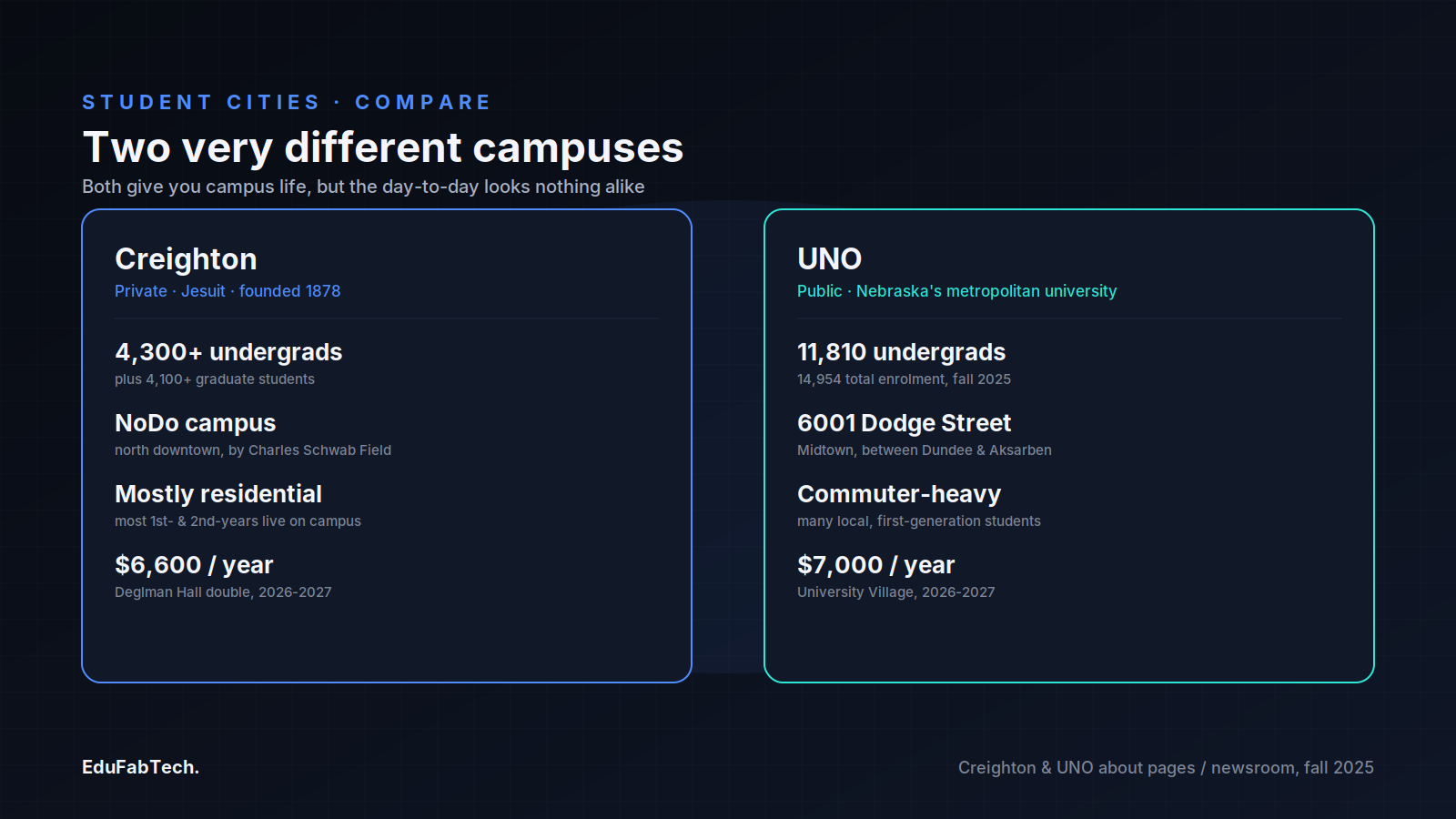
Creighton University is a private Jesuit, Catholic university founded in 1878, on its campus just north of downtown — the area now marketed as NoDo (North Downtown), next to Charles Schwab Field where the College World Series is played each June. Creighton describes itself as offering education "in the Jesuit, Catholic tradition" across nine schools and colleges, including Medicine, Dentistry, Pharmacy, Nursing, Law and Business, and it states on its About page that it enrols more than 4,300 undergraduate and more than 4,100 graduate students. It is strongly health-sciences oriented and residential by Omaha standards; most first- and second-year undergraduates live on campus.
University of Nebraska Omaha (UNO) is the public, metropolitan university, at 6001 Dodge Street in Midtown, between the Dundee and Aksarben neighbourhoods, with a second Scott Campus to the south linked by a free university shuttle. UNO reported on its own newsroom that it enrolled 14,954 students in fall 2025, with undergraduate enrolment up 0.5% to 11,810 — a notably larger and more locally rooted student body than Creighton's, with many commuters and first-generation students. UNO is Nebraska's metropolitan university and home to the Peter Kiewit Institute for computing and engineering.
Bellevue University is a private non-profit in the suburb of Bellevue, south of the city at 1000 Galvin Road South, founded in 1966. Its own site states it serves more than 19,000 students across the country with over 80 academic programs and only about 600 on-campus residential students — reflecting a model built heavily around online and adult learners rather than a residential undergraduate campus. If you want campus life in the conventional sense, Creighton and UNO are the realistic choices; Bellevue suits working and distance students.
Two smaller specialist schools round out the picture for particular fields. Nebraska Methodist College in Omaha grants nursing and allied-health degrees, and the Creative Center, College of Art & Design in Omaha grants art and design degrees — each worth knowing if that is your subject, though neither offers the breadth of the three main universities.
Where students live, neighbourhood by neighbourhood
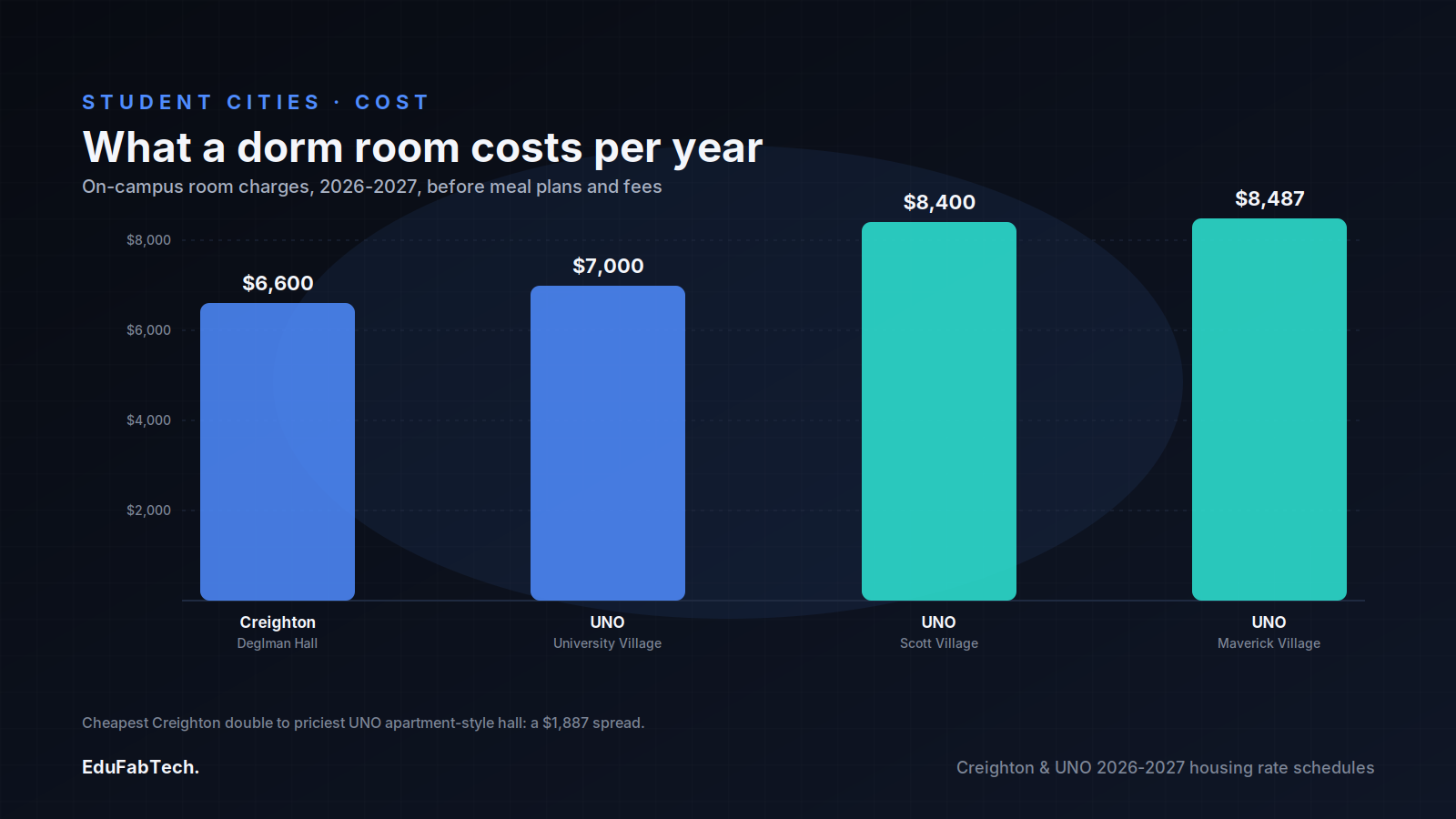
On-campus is the simplest start, and for international students arriving sight-unseen it is the safest. UNO publishes its rates openly: for 2026-2027 a bed in University Village on the Dodge Campus is listed at $7,000 for the academic year ($3,500 per semester), Maverick Village at $8,487, and Scott Village on the Scott Campus at $8,400. Creighton's 2026-2027 living-accommodations schedule lists a double in the freshman Deglman Hall at $6,600 for the year, with suite- and apartment-style halls running higher. These are room charges only, before meal plans and fees.
Off campus, the distinct neighbourhoods are worth learning by name. Dundee and the Blackstone District in Midtown are walkable, older areas near UNO with cafés and small apartments, popular and correspondingly not the cheapest. Benson, a little north-west, is the arts-and-music district with cheaper rentals and vintage shops. Aksarben Village, just south of UNO, is newer and pricier. Downtown and NoDo put you nearest Creighton and the ORBT line but command city-centre prices. South of the river line, students at Bellevue University tend to live in Bellevue itself, which is quieter and more suburban. Because Omaha is spread out, the single biggest lifestyle decision is whether you will have a car; the neighbourhoods above are the ones where you can plausibly live without one.
Start looking early. For the autumn term, on-campus assignments and the best off-campus rooms near UNO and Creighton go through late spring and summer; leaving it to August narrows you to whatever is left and pushes you further from campus. Browse what is currently listed in the city on rooms in Omaha and the broader Omaha student listings, and if you want to be within walking distance of class, filter by what is near Creighton University or near University of Nebraska Omaha.
Leases, deposits and rental scams in Omaha
Rental scams in Omaha follow a predictable shape: a listing for a house or apartment in a desirable, walkable area like Dundee or near the Creighton campus, priced slightly below the going rate, posted by someone who says they are out of state and cannot show it in person. The request that follows — a deposit or first month's rent to "hold" the place before you have seen inside — is the warning sign, whatever the reason given. Insist on viewing the actual unit in person, or having someone you trust view it, before any money changes hands. A legitimate local landlord or leasing office can let you in.
Never send money by bank wire transfer, gift card or cryptocurrency to secure a room; those methods are chosen precisely because they cannot be reversed, and no honest Omaha landlord needs them. A normal arrangement here is a signed written lease, a security deposit (commonly about one month's rent) and the first month's rent, paid by a traceable method once you have the keys and the lease. Get the landlord's name and the property address, and be wary if either is vague. If you are abroad and cannot view in person, prefer university-managed housing for your first term and move off campus once you know the city.
Furnishing a room for very little
Omaha is a good second-hand city, and furnishing a first room cheaply is realistic. The Habitat for Humanity ReStore sells donated furniture and household goods with locations across the metro, and Benson and Dundee are the neighbourhoods to walk for vintage and used furniture shops. Seasonally, the Omaha Farmers Market runs its 2026 season on Saturday mornings in the Old Market (its cobblestoned downtown district) and Sundays in Aksarben Village from early May through mid-October — useful for produce and for the maker stalls, less so for furniture, but it is the city's best-known open-air market and a good first weekend out.
For everything indoors, the student-to-student channels tend to be cheapest of all, especially at term boundaries when people are leaving. See what is going on EduFabTech for second-hand things in Omaha and cheap second-hand furniture, and check what is being given away free; listings turn over fastest in the first week of your own semester, when graduating students clear out, and again in May.
Working while you study
Rules depend entirely on your immigration status, and you should treat the official source as the authority rather than anything here. For F-1 international students, USCIS states on its Students and Employment page that "F-1 students may not work off-campus during the first academic year, but may accept on-campus employment subject to certain conditions and restrictions," and that off-campus options such as Curricular Practical Training (CPT) and Optional Practical Training (OPT) come later and require authorisation from a Designated School Official and, for OPT, from USCIS. The practical step is to talk to your university's international student office — at UNO and Creighton these advisers are your Designated School Officials — before accepting any job. This is not legal advice; confirm your own case with them.
Domestic students face no such limits, and both campuses and the surrounding health-care and service employers hire part-time. On-campus jobs are the easiest to fit around classes and are open to F-1 students within the rules above. Current local openings are collected under jobs in Omaha.
Libraries and places to study
The Omaha Public Library's Downtown Branch (the successor to the long-serving W. Dale Clark library) reopened at 1401 Jones Street, and its location page lists study rooms, meeting rooms, free Wi-Fi, public computers and printing, with the branch open until 8 p.m. Monday to Thursday. It is a genuinely useful neutral study space, free and open to anyone, and close to the Old Market and downtown. On campus, UNO's Criss Library and Creighton's Reinert-Alumni Memorial Library serve their own students with long hours during term; a public-library card, meanwhile, is free to city residents and worth getting in week one. More desks and quiet corners around town are listed under study spaces in Omaha.
Getting around a car-shaped city
Public transport is run by Metro Transit, whose flagship is ORBT, a bus-rapid-transit line running the length of Dodge Street from downtown out to Westroads Mall — the single most useful route for students because it passes close to both the Creighton area and the UNO Dodge Campus. Metro's fares page lists a regular single ride at $1.25 with a 25-cent transfer, a 30-day unlimited pass at $55.00 (half-fare $27.50), and a 10-ride pass at $12.50. The system now uses the contactless Umo card and app for payment, and ORBT riders must pay through Umo. If your campus participates in a transit pass programme, pay as your institution instructs; otherwise the Umo card is the straightforward option.
Be honest with yourself about coverage. Buses are frequent on the Dodge corridor and sparse elsewhere, evening and weekend service is limited, and winter waits are cold. Many Omaha students end up with a car, and parking is generally available and cheap by big-city standards. If you cannot drive, choose housing along the ORBT line or within walking distance of your campus — it is the difference between a workable car-free life and a frustrating one. Campus events and meet-ups worth building a social life around are listed under events in Omaha.
What is good, and what is hard
The good: housing is affordable relative to coastal US cities, the second-hand economy is strong, Omaha has a real food and music culture concentrated in walkable pockets (the Old Market, Benson, Blackstone), and the two main universities sit in genuinely likeable Midtown and downtown settings. Creighton's health-sciences strength and UNO's accessibility and size give two quite different but solid routes into a degree.
The hard: this is a spread-out, car-oriented metro, and without a car or carefully chosen housing the distances wear you down. Transit is thin away from Dodge Street. The climate is demanding at both ends — snow and hard cold in winter, heat, humidity and storms in summer. And the social centre of gravity is diffuse rather than concentrated on one campus quad, so you have to build your own routine rather than have the city hand you one.
A short checklist for the first weeks
- Sort housing before you arrive if you can; for a first term abroad, prefer UNO or Creighton managed housing and view anything off-campus in person before paying.
- Never wire money, buy gift cards or send crypto to hold a room; pay a traceable deposit (around one month's rent) only after you have keys and a signed lease.
- Get a Metro Umo card and check whether the ORBT line on Dodge Street reaches your campus and home.
- If you are on an F-1 visa, meet your university's international office (your Designated School Officials) before taking any job.
- Get a free Omaha Public Library card and scout the Downtown Branch and your campus library for study space.
- Furnish from the ReStore, Benson and Dundee second-hand shops, and student clear-outs at term boundaries; browse local second-hand listings first.
- Decide early whether you will run a car — it shapes which neighbourhood makes sense.
A quick question for readers
Do you work part-time while you study?
Many students work to pay the bills. See how common it is — and how many hours people really do.
Pick an answer, create a free account in a minute, and your vote counts. Already a member? Sign in
Comments 0
CommentNo comments yet. Members start the conversation.
Source: University of Nebraska Omaha
Sources (5)
- University of Nebraska Omaha. UNO Reports Stable Enrollment for Fall 2025. University of Nebraska Omaha, 2025. unomaha.edu ↗ · checked 11 Oct 2026
- University of Nebraska Omaha. Housing Rates 2026-2027. University of Nebraska Omaha, 2026. unomaha.edu ↗ · checked 11 Oct 2026
- Metro Transit (Omaha). Fares & Passes. Metro Transit, 2026. ometro.com ↗ · checked 11 Oct 2026
- Omaha Public Library. Downtown Branch. Omaha Public Library, 2026. omahalibrary.org ↗ · checked 11 Oct 2026
- U.S. Citizenship and Immigration Services. Students and Employment. USCIS, 2026. uscis.gov ↗ · checked 11 Oct 2026