Studying in Oxford, Mississippi: universities, housing and student life
A practical, sourced guide to the University of Mississippi's home town — where students live, what a dorm room costs, how to get around on the fare-free OUT buses, and the honest trade-offs of a small town that doubles in term time.
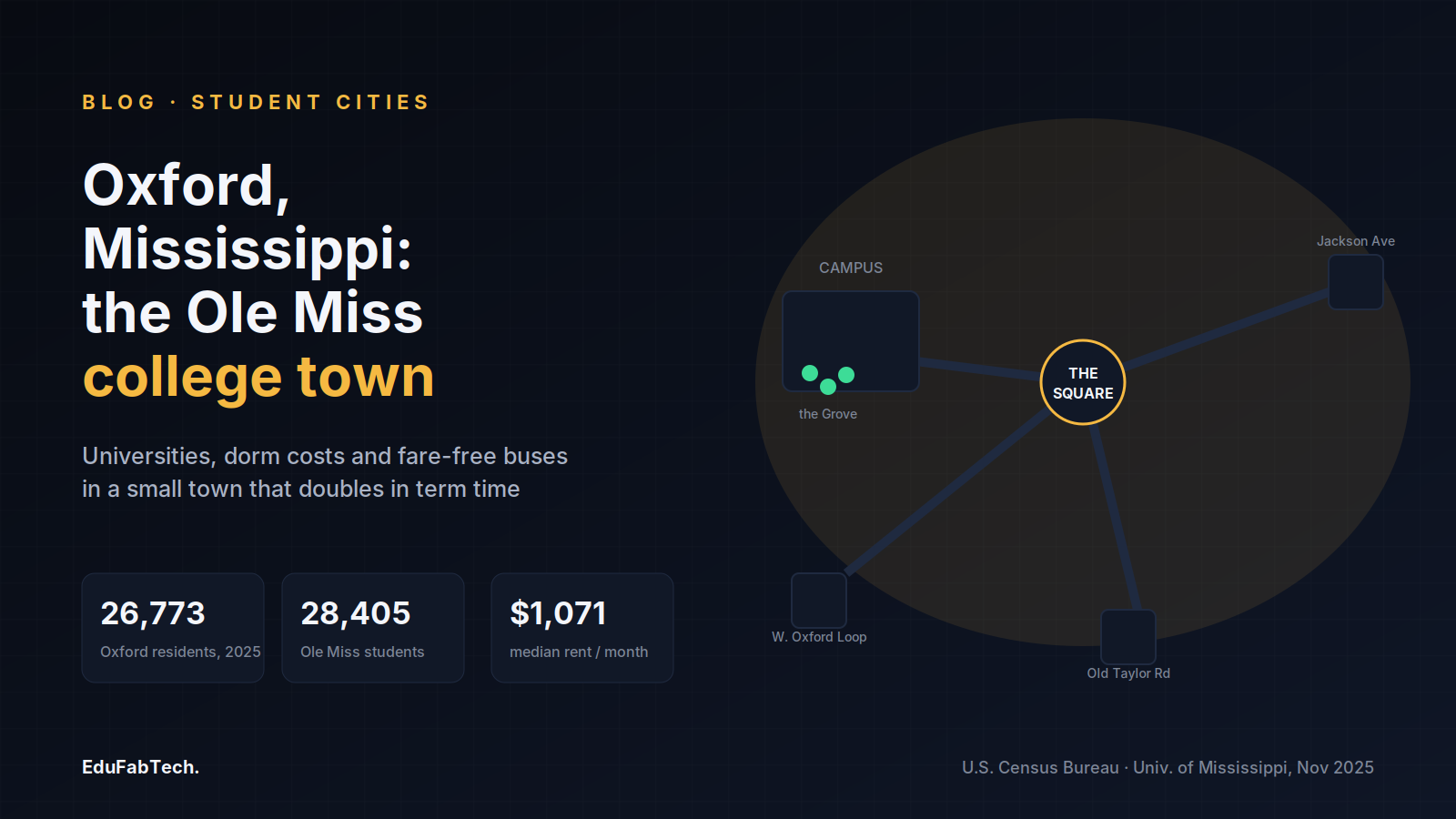
Oxford sits in the hill country of north Mississippi, a courthouse town built around a single square and wrapped around the University of Mississippi. It is the kind of place where the university and the town are hard to separate: the writer William Faulkner lived here at Rowan Oak, the Square fills on football weekends, and the ten-acre stand of oaks on campus known as the Grove is as much a civic landmark as an academic one. If you study here, you are not studying in a city that happens to have a university — you are living in a university town that happens to have a courthouse.
The arithmetic makes that plain. The U.S. Census Bureau's QuickFacts page for Oxford city, Mississippi estimated the town's population at 26,773 as of July 1, 2025 (census.gov). The University of Mississippi reported a total enrolment of 28,405 students across its seven campuses for fall 2025 (olemiss.edu, November 2025). Most of those students are on the Oxford campus, which means that in term time the student body is comparable in size to the resident population — a ratio that shapes everything from rent to how long you wait for a table on the Square.
For a newcomer, the geography is simple to learn and hard to forget: the Square at the centre, campus immediately to the west of it, student apartment complexes fanning out along Jackson Avenue, West Oxford Loop and Old Taylor Road, and the town thinning quickly into county roads and the Holly Springs National Forest beyond. Memphis, Tennessee, and its airport lie within comfortable driving distance to the north, which matters when you are flying in from abroad.
The University of Mississippi and what studying there is like
The University of Mississippi — universally called Ole Miss — is the state's oldest public university. Its academic catalog records that the institution was chartered in 1844 and opened for its first session in November 1848, beginning with a four-member faculty and about 80 students (catalog.olemiss.edu). The main campus is in Oxford; the university also runs a medical centre in Jackson and regional campuses elsewhere in the state, so the headline enrolment figure above is not all in one place.
Part of what it means to study here is to study somewhere with a heavy, contested history. On 1 October 1962, James Meredith became the first African American student to enrol at the university, an admission that triggered a riot in which federal marshals and soldiers were deployed and two bystanders were killed; the university documents this openly through its own history project (60years.olemiss.edu). Students today walk past that history daily — it is part of the institution's self-understanding, not a footnote.
Day to day, Ole Miss is a broad public university with the full range of undergraduate and graduate programmes, a large freshman intake — the fall 2025 class numbered 5,464 and drew students from 49 U.S. states, the District of Columbia and 34 countries, according to the university (olemiss.edu, November 2025) — and a strong athletics and social culture built around the Grove and the Square. International students coordinate most practical matters through the university's international office, which handles the SEVIS record that keeps an F-1 visa valid.
Where students live, and the local housing market
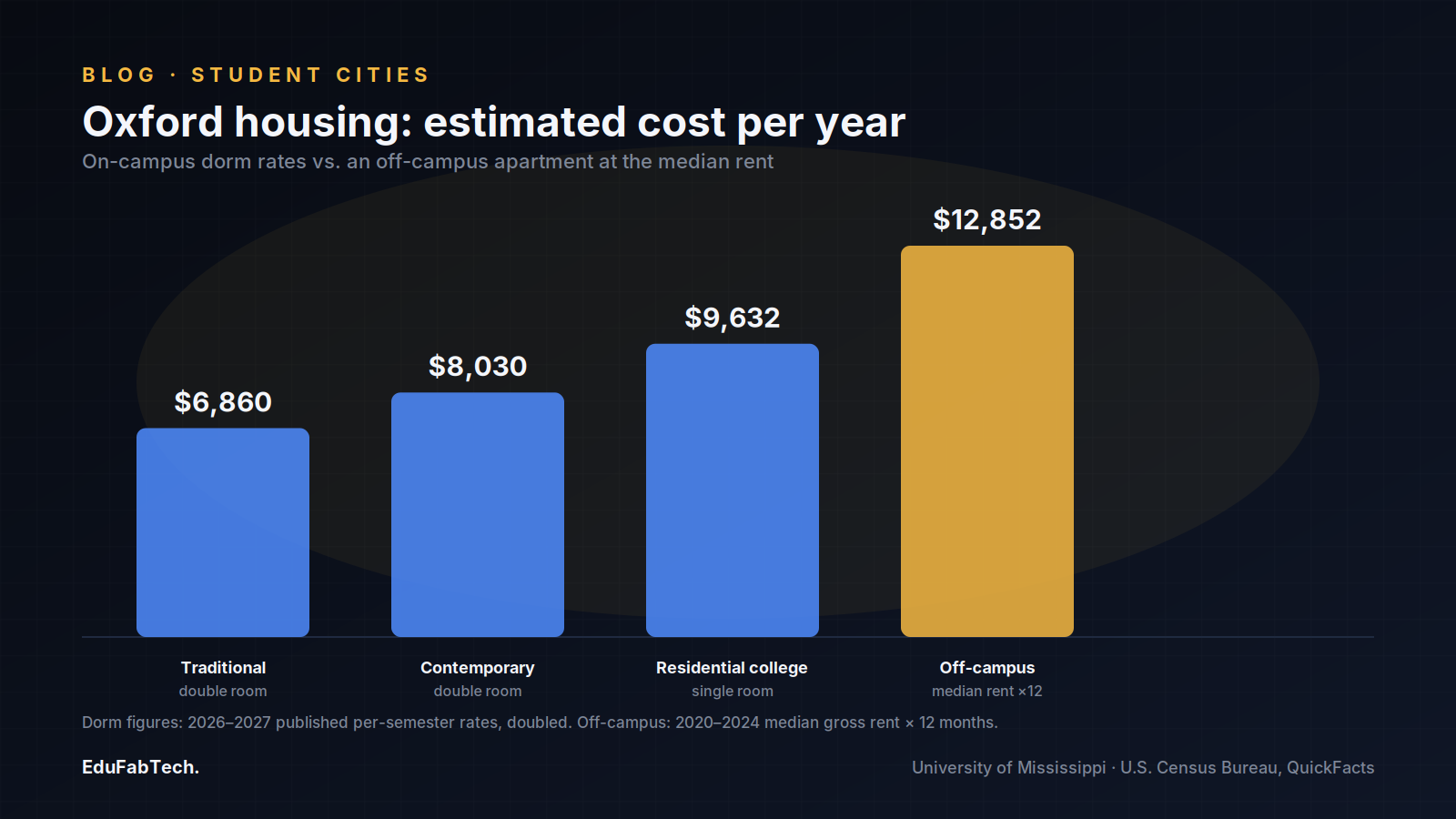
Housing in Oxford falls into two broad worlds. First-year undergraduates typically live in university residence halls on or beside campus; most other students rent in the large purpose-built apartment complexes that ring the town, or in houses shared between several tenants. The university's own residence halls are the clearest priced option, because the figures are published. For the 2026–2027 academic year, the University of Mississippi lists a traditional-hall double room at $3,430 per semester, a contemporary-hall double at $4,015 per semester, and a single room in a residential college at $4,816 per semester, with all rates marked as pending approval by the state's Institutions of Higher Learning board (olemiss.edu, 2026–2027 rates). Those are per-semester figures for the fall and spring terms, not monthly rents, so double them for a rough academic-year total and add a meal plan.
Off campus, the benchmark most students can actually check is the local rent level. The U.S. Census Bureau's QuickFacts page gives a median gross rent of $1,071 a month for Oxford city, Mississippi over the 2020–2024 period, against a median household income of $64,451 in 2024 dollars for the same window (census.gov). A median masks a lot — new complexes marketed to students, often let by the bedroom, can sit well above that figure, while an older house further from the Square can sit below it. Treat the census number as a floor for your expectations, not a quote.
The practical advice for Oxford is specific to its calendar. Demand is tightest in the spring for the following August, because the complexes aimed at students run roughly annual leases that turn over in summer, and the best-located units go early. If you are coming from abroad and cannot visit, aim to have something arranged before you arrive but keep it reversible, and use a first few weeks in temporary accommodation to see places in person rather than committing sight-unseen. You can browse what other students are listing on EduFabTech's rooms page for Oxford, and the city hub collects the rest.
Renting without being cheated in a tight market
In a town where demand spikes every August, the scams that appear are predictable. The common one is a "listing" for a house or an apartment near the Square or campus, priced slightly below the going rate, from someone who says they are out of town — a graduate who has moved, a landlord working offshore — and who asks for a deposit or first month's rent to "hold" the place before you can see it. The money is requested by a method that cannot be reversed.
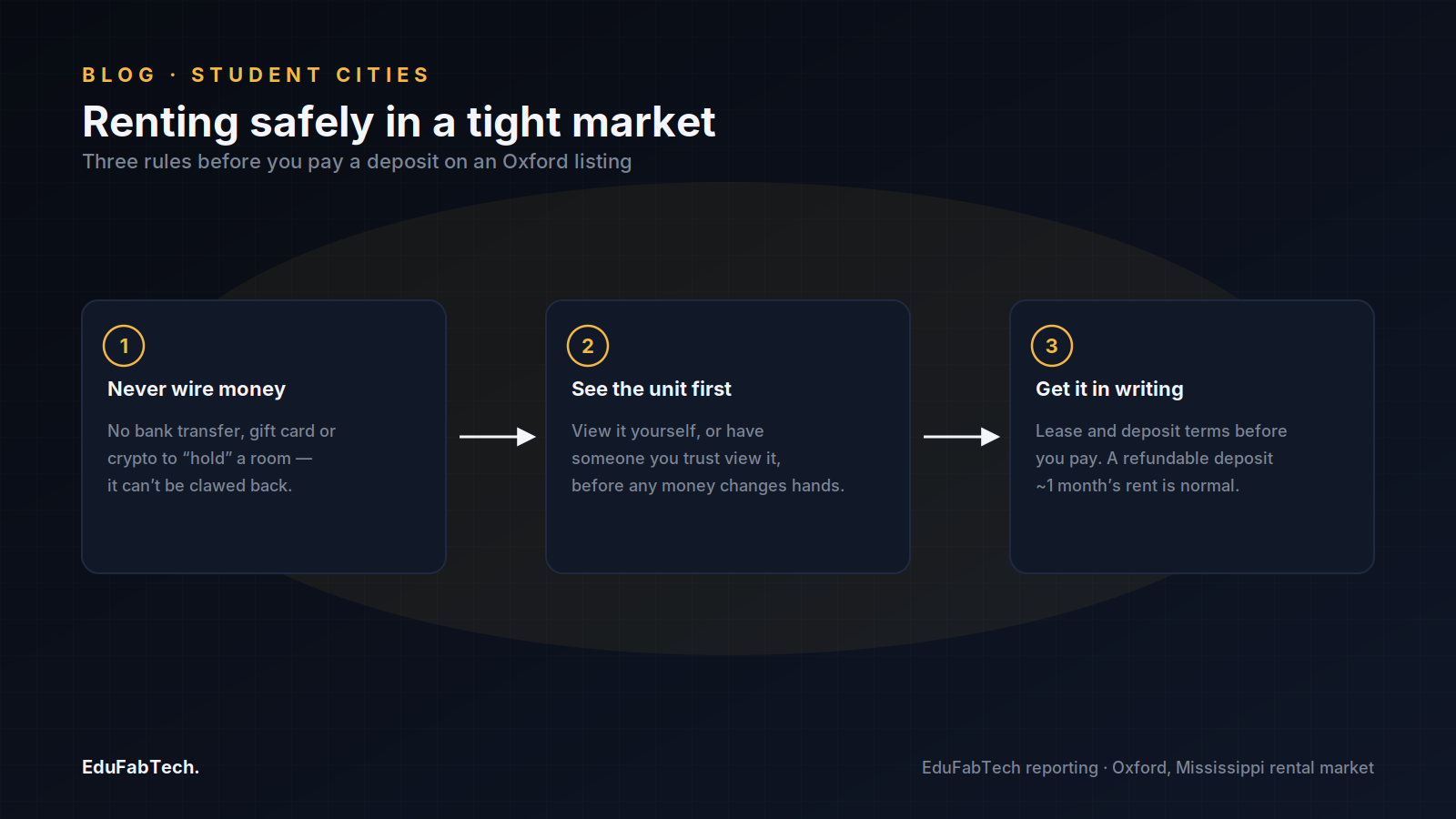
Three rules cover almost all of it. Never send money by bank wire transfer, gift card or cryptocurrency to hold a room — no legitimate Oxford landlord or complex needs payment in a form you cannot claw back, and a request for one is itself the warning sign. See the actual unit, or have someone you trust see it, before any money changes hands; for the big managed complexes this is routine, and for a private house it should be too. And get the lease and the deposit terms in writing before you pay, so you know what is normal: a refundable security deposit roughly equal to a month's rent is ordinary, a demand to pay several months up front to a stranger is not. EduFabTech's rooms listings and the broader listings near the University of Mississippi are starting points, not a substitute for seeing the place.
Furnishing a room cheaply, and the markets
Because so many leases turn over at the same time each summer, Oxford produces a predictable flood of second-hand furniture and household goods every July and August as students move out. That churn is the cheapest way to furnish a room: buy from the people leaving rather than from a shop. EduFabTech keeps Oxford-specific pages for second-hand things, for second-hand furniture, and for items being given away free — the last of which fills up fastest at the end of a lease cycle.
For food and local goods, Oxford has a genuine market culture rather than just supermarkets. The Oxford Community Market, a nonprofit certified farmers' market, runs year-round and sells local produce and goods; Visit Mississippi lists it at the Old Armory Pavilion on University Avenue (visitmississippi.org). It is worth building into a weekly routine both for the food and because it is one of the few regular points where the town and the university genuinely mix. Thrift and resale options exist too, including a Salvation Army store out on West Oxford Loop, though you will often do better buying directly from departing students.
Working while you study
If you are an international student on an F-1 visa, the rules on work are set by U.S. federal immigration policy, not by the university, and they are strict. The Department of Homeland Security's Study in the States guidance states plainly that F-1 students may work on campus but "may not work more than 20 hours per week when school is in session" (studyinthestates.dhs.gov). On-campus jobs — in dining, the libraries, departments or athletics — are the normal route, and off-campus work generally requires specific authorisation such as Curricular or Optional Practical Training tied to your programme. This is a summary, not legal advice: confirm your own situation with the university's international office and the DHS page before you take any job, because a mistake here affects your visa status.
Domestic students face no such immigration limit and can work in town as well as on campus. Either way, campus employment is the simplest to combine with classes, and current openings — on campus and around Oxford — are collected on EduFabTech's Oxford jobs page.
Libraries and places to study
The main academic library is the J.D. Williams Library on campus, and its hours are generous during term: the university's library calendar lists it as open 7:30am to midnight Monday through Thursday, 7:30am to 5pm on Friday, and noon to midnight on Sunday, with extended hours during finals (calendar.lib.olemiss.edu). Inside you will find quiet carrels, reservable group study rooms, public computers, free wireless and a coffee shop; the separate Science Library keeps shorter weekday hours for those working in the sciences.
Beyond the libraries, the Square's cafés fill with students during the day, and the campus itself is dotted with informal study spots — the Grove in good weather, the student union, departmental lounges. If you want to find a specific desk or a quiet room rather than wander, EduFabTech lists study spaces in Oxford, and the events page is useful for the study-group and workshop side of term.
Getting around Oxford
Oxford's great practical advantage for students is its bus network. Oxford-University Transit, known as OUT, is operated jointly by the city and the university and runs a web of city routes, campus shuttles and dedicated student-housing routes linking the apartment complexes to campus and the Square (outransit.com). Crucially, it is fare-free: the operator states there is currently no bus fare to board, so you do not need a fare card or cash to use it. For a student without a car, that turns the ring of complexes around town into realistic places to live, because the housing routes are built precisely to connect them to campus.
The limits are the limits of a small town. OUT concentrates its service on the academic day and the housing complexes; it also runs reduced Saturday, Sunday and after-dark routes, but coverage thins in the late evenings and anywhere off-route (outransit.com). Oxford is flat enough and compact enough that a bike covers most of what matters, and the Square-to-campus core is walkable. But if your life extends much beyond the university's orbit, you will feel the absence of a car more than you would in a bigger city.
What is good, and what is hard
The good is real. Oxford is small, walkable and genuinely attractive, built around one of the better-known town squares in the American South, with a strong literary and musical culture for a place its size and a fare-free bus system that makes car-free life workable. Rents, judged against the national picture, are moderate — the census median gross rent of $1,071 a month (2020–2024) is well below figures in large coastal college towns (census.gov). And because the university dominates the town, student life is not a subculture tucked into a corner; it is the main event.
The hard is the flip side of the same facts. A town of about 27,000 residents hosting a student body of similar size is a town under pressure: housing turns over on a rigid annual cycle, the best-located units go early, and football weekends swamp the Square and the roads. Choice in shops, restaurants and nightlife is narrower than in a city, and amenities thin quickly at the edges of town. Mississippi summers are long, hot and humid, and spring brings severe-weather season to the region. And for anyone arriving from abroad, Oxford's isolation — a drive from the nearest large airport, limited transit beyond the bus network — can feel confining until you have sorted out how you will move around.
A checklist for the first weeks
- Do not pay to "hold" anything unseen. No wire transfer, gift card or crypto for a room — see the unit first and get the lease and deposit terms in writing.
- Sort transport early. Learn your nearest OUT housing route and campus shuttle; the system is fare-free, so there is nothing to buy, only a map to learn (outransit.com).
- International students: see the international office before working. On-campus work is capped at 20 hours a week when school is in session under DHS rules (studyinthestates.dhs.gov); confirm your status before taking any job.
- Furnish from the move-out churn. Watch the end-of-lease second-hand and free-stuff listings in July and August rather than buying new.
- Claim a study base. Learn the J.D. Williams Library hours and book a group room when you need one (calendar.lib.olemiss.edu).
- Build in the market. The Oxford Community Market is a cheap, local weekly fixture worth a standing slot in your schedule.
A quick question for readers
Do you work part-time while you study?
Many students work to pay the bills. See how common it is — and how many hours people really do.
Pick an answer, create a free account in a minute, and your vote counts. Already a member? Sign in
Comments 0
CommentNo comments yet. Members start the conversation.
Source: University of Mississippi
Sources (5)
- University of Mississippi. 2026-2027 Housing Rates & Administrative Charges. University of Mississippi, 2026. olemiss.edu ↗ · checked 14 Oct 2026
- University of Mississippi. UM Reaches Record Enrollment for Third Straight Year. University of Mississippi, 2025. olemiss.edu ↗ · checked 14 Oct 2026
- U.S. Census Bureau. QuickFacts: Oxford city, Mississippi. U.S. Census Bureau, 2025. census.gov ↗ · checked 14 Oct 2026
- U.S. Department of Homeland Security. Working in the United States (F-1 students). Study in the States, DHS, 2026. studyinthestates.dhs.gov ↗ · checked 14 Oct 2026
- Oxford-University Transit. Route Schedules & Information. Oxford-University Transit, 2026. outransit.com ↗ · checked 14 Oct 2026