Studying in San Luis Obispo: universities, housing and student life
A practical, honest guide to studying in San Luis Obispo, California — Cal Poly, where students live, what rooms cost, how to get around, and what the town asks of your budget.
A small city with a large university on its shoulder
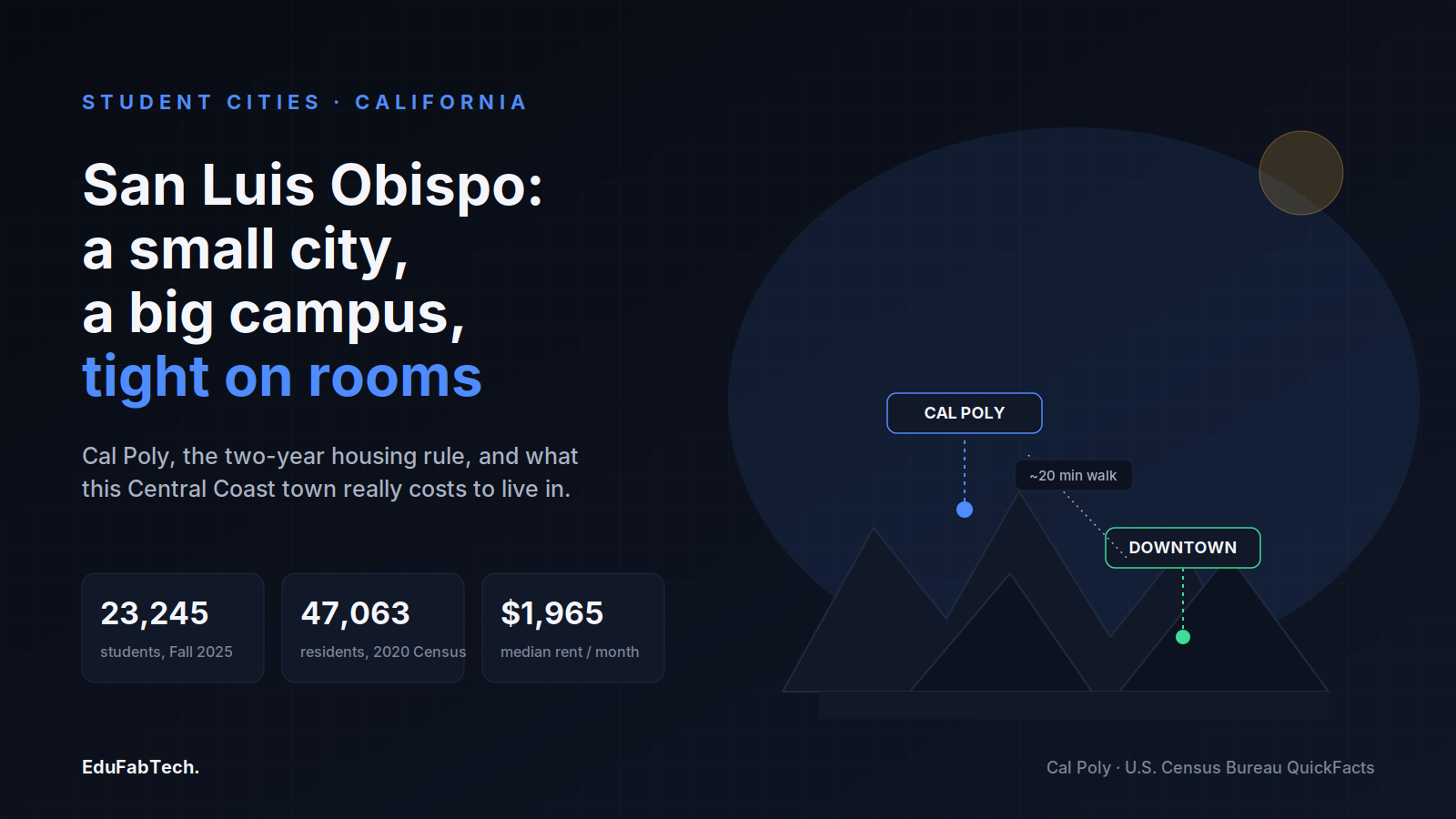
San Luis Obispo sits almost exactly halfway along California's Central Coast, a point Cal Poly itself describes as "halfway between Los Angeles and San Francisco" on its about page. The town is small — the 2020 Census counted 47,063 residents — and it is wrapped by hills: the chain of ancient volcanic peaks called the Nine Sisters, with Bishop Peak and Cerro San Luis rising straight out of neighbourhoods on the west side. Downtown is compact and walkable, built around the 18th-century Mission San Luis Obispo de Tolosa and the creek that runs through Mission Plaza. The Pacific is about fifteen minutes west by car, at Avila and Pismo beaches.
What makes this a student town is the ratio. A university of more than twenty thousand people is grafted onto a city that would otherwise be a quiet county seat, and the campus occupies the whole northern edge of town, climbing into the foothills and the agricultural land Cal Poly farms. Walk south from the main entrance and within twenty minutes you are among the shops of Higuera and Marsh Streets; walk north and you are in cattle country. That closeness shapes everything about student life here — the short commutes, the competition for rooms, and the way the city's calendar bends around the academic year.
This guide covers the universities, the two-year housing rule and where rooms open up after it, how to furnish a place cheaply, getting around, study spaces, part-time work, costs you can verify, and the honest trade-offs of a beautiful but expensive town. You can browse current student listings for the city on EduFabTech's San Luis Obispo pages.
The universities: Cal Poly and a community college on the hill
The dominant institution is California Polytechnic State University (San Luis Obispo), founded in 1901. Cal Poly's own Facts and Figures page reports 23,245 undergraduate and graduate students in Fall 2025, a student-to-faculty ratio of 19:1, and a structure of "six colleges and one maritime academy." Its teaching identity is "Learn by Doing" — a trademarked phrase the university traces back to its founding — which in practice means lab-, studio- and project-heavy courses across its polytechnic programmes.
Two of those colleges are national draws in their own right and worth naming. The Cal Poly San Luis Obispo College of Architecture and Environmental Design (San Luis Obispo) runs studio-based programmes in architecture, landscape architecture, city and regional planning, architectural engineering and construction management, and its students spend long hours in design studios that run their own clock. The Cal Poly San Luis Obispo College of Engineering (San Luis Obispo) is one of the largest parts of the university, spanning disciplines from aerospace and mechanical to computer and software engineering, and it is the reason a lot of international applicants look at this town at all. Both are colleges within the single university rather than separate campuses, so you apply to Cal Poly by major; if you are weighing listings near the university, EduFabTech keeps a page for California Polytechnic State University.
The other local option is Cuesta College, the public community college whose main campus sits on State Route 1 about six miles northwest of town, toward Morro Bay. It grants associate degrees and certificates and is a common, far cheaper route for the first two years before transferring into a four-year programme; many SLO residents start there. Because its main campus is outside the city proper, most of this guide is written around Cal Poly, where the housing pressure and the student culture are concentrated.
Where students live, and the two years you cannot opt out of
The single most important fact for an incoming Cal Poly student is the residency rule. Cal Poly's University Housing states plainly on its two-year residency page that "all Cal Poly students are required to live in campus housing for their first two years," with narrow exemptions — among them students who are military veterans, married or with dependent children, financially independent, or living locally with a parent or guardian in San Luis Obispo County. So for most undergraduates the first two years are decided for you: residence halls and the campus apartment villages (Cerro Vista, Poly Canyon Village, and the yakʔitʸutʸu complex named in the Northern Chumash language).
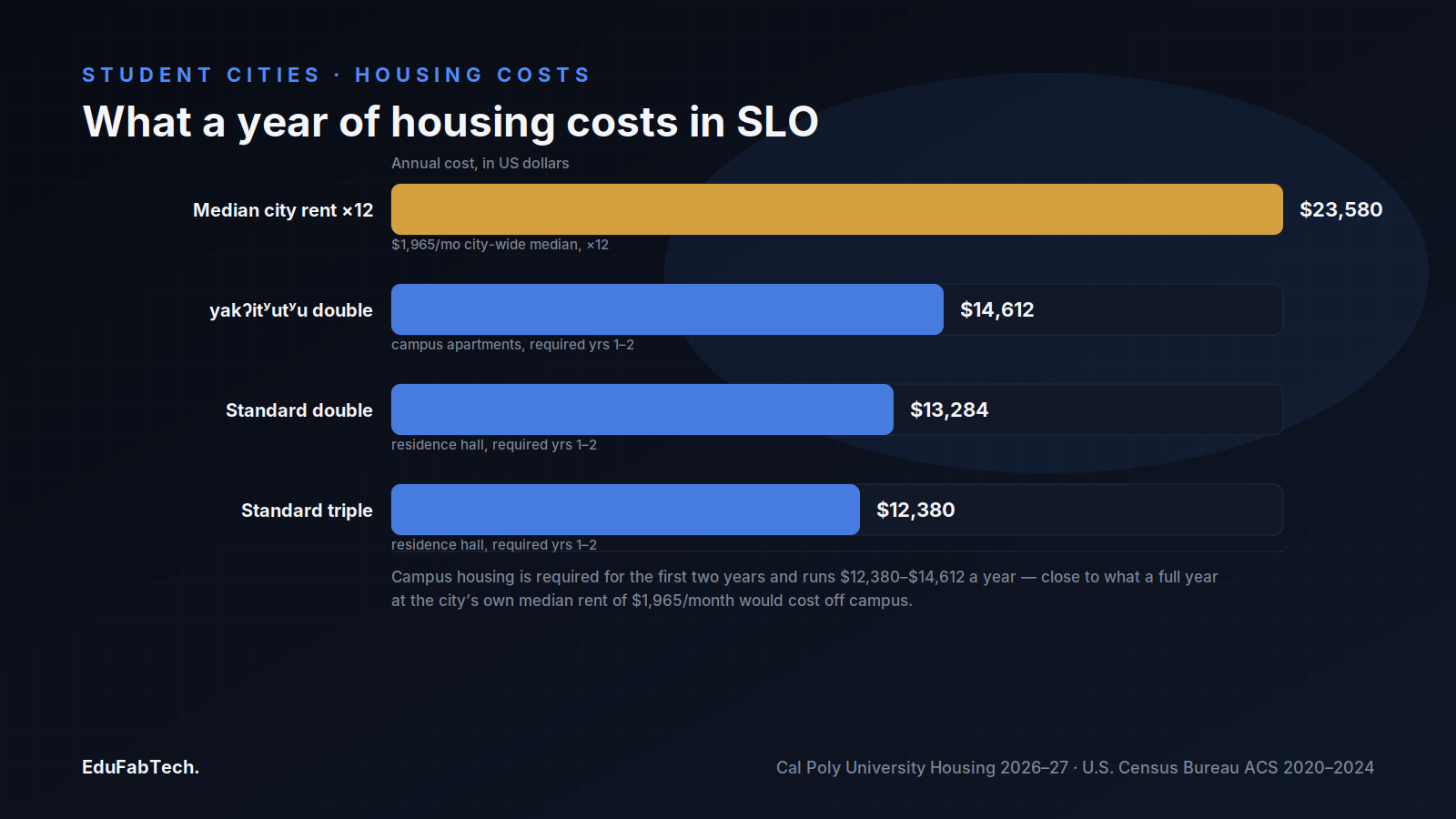
That matters for budgeting, because on-campus housing here is not cheap. Cal Poly's 2026-27 first-year housing fees list a standard residence-hall double room at $13,284 for the academic year and a triple at $12,380, for a license period running 18 August 2026 to 23 May 2027; a double in the yakʔitʸutʸu halls is listed at $14,612. First-year students on campus are also required to carry a dining plan on top of that. Those are full-year figures, not monthly rent, and they do not include the winter break.
After the required two years, students spread into the town. The neighbourhoods closest to campus — along California Boulevard, Foothill Boulevard and the streets behind them — are dense with shared houses and older apartments, and they fill first. Further out, the Laguna Lake area to the west and the newer developments toward the southern edge of town trade a longer commute for slightly more space. The honest picture is a tight market: the U.S. Census Bureau's QuickFacts put the median gross rent in San Luis Obispo city at $1,965 a month (2020-2024 American Community Survey five-year estimate), and roughly three in five housing units in the city are renter-occupied, so you are competing with a lot of other tenants for a limited stock. Current rooms and sublets are listed on EduFabTech's rooms page.
Finding an off-campus room without losing your deposit
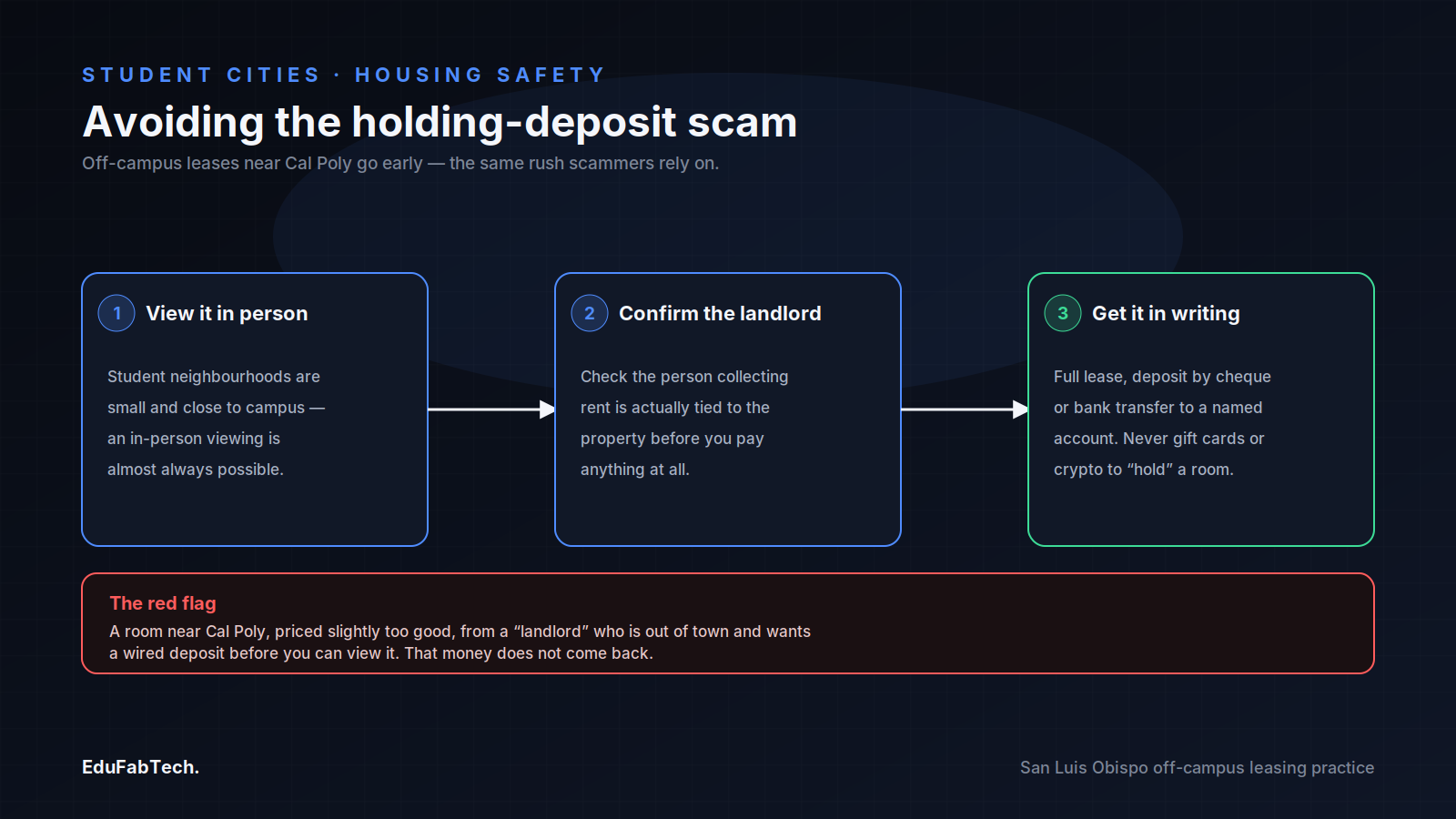
Off-campus leasing in SLO tends to start early — many houses near campus are advertised for the following September as early as the preceding winter — which creates exactly the pressure that scams exploit. The usual pattern here is a listing for a room near Cal Poly at a price that looks slightly too good, posted by someone who claims to be out of town and asks you to send a holding deposit before you can view it. Do not. No legitimate landlord in San Luis Obispo needs money wired to "hold" a room you have never seen.
Protect yourself with a few habits that are specific to this town. See the place in person, or have someone you trust walk through it — the student neighbourhoods are small and close to campus, so an in-person viewing is almost always possible. Confirm the person collecting rent is actually tied to the property before you pay anything. A security deposit and first month's rent paid by a traceable method (a cheque or bank payment to a named account) is normal; a request for a bank transfer, gift cards or cryptocurrency to secure a room is the clearest sign of a scam, and that money does not come back. Get the full lease in writing and read what it says about the deposit, subletting over summer, and the number of tenants allowed. California's standard protections — including limits on how large a residential security deposit can be and timelines for returning it — are worth checking against your lease before you sign.
Furnishing a room cheaply, and the Thursday market everyone goes to
When students leave at the end of spring, the town fills with second-hand furniture, and the cheapest way to furnish a room is to catch that churn in June. Thrift and charity shops around town turn over household goods steadily, and the end-of-year move-out is when desks, chairs and kitchenware are given away or sold cheaply. EduFabTech aggregates local second-hand things, used furniture and free-to-collect items for the city.
The civic event that defines San Luis Obispo is the Downtown SLO Farmers' Market, held every Thursday evening along Higuera Street between Osos and Nipomo Streets. Downtown SLO, which runs it, describes a certified, year-round market with produce stands, food vendors and live music, open from 6 p.m. (until 9 p.m. in the summer months and 8:30 p.m. in winter). It is as much a weekly social gathering for students as it is a grocery run — a reliable, cheap source of fresh fruit and vegetables and a good way to get a feel for the town in your first week. It is free to walk through, and it is genuinely part of the student calendar here rather than a tourist sideshow.
Getting around: the free campus bus and the trains out of town
You do not strictly need a car to be a Cal Poly student, which is unusual for a California town this size. The city's bus system, SLO Transit, is fare-free for Cal Poly students: the university's Transportation & Parking Services confirms on its RTA and SLO Transit page that "SLO Transit bus service is free to Cal Poly students, faculty, and staff with a valid Cal Poly ID." Routes loop between campus, downtown and the main residential corridors, so a PolyCard covers most everyday trips.
For travel around the wider county — to Pismo Beach, Morro Bay or Paso Robles — the San Luis Obispo Regional Transit Authority (RTA) runs the regional routes; the same Cal Poly page notes that RTA passes are earned through a commute-rewards programme (logging alternative trips to claim a subsidised pass) rather than being free outright, so check the current terms before you rely on it. The town is also flat enough in its core that cycling is practical, and many students keep a bike. For longer trips, San Luis Obispo station is served by Amtrak's Pacific Surfliner and Coast Starlight lines, giving a car-free route south toward Santa Barbara and Los Angeles or north toward the Bay Area.
Libraries and places to study
The central study building is the Robert E. Kennedy Library on campus, which reopened in September 2025 after a renovation Cal Poly's news office reports cost $78 million — its first major remodel since it debuted in 1981. Cal Poly describes the refreshed building as "the largest library between Santa Barbara and Santa Cruz," with a 24-hour study zone ("Hub24") expanded onto its first and second floors, new group-study rooms, service points and an enlarged café, as set out in the university's reopening announcement. The 24-hour levels are reached with an active PolyCard, which makes the library the default late-night workspace for students who do not want to study at home.
Beyond the library, the compact downtown gives students a scattering of cafés within walking distance of campus, and the city's own public library sits a few blocks off Mission Plaza for anyone who wants a quieter room away from the university crowd. EduFabTech lists bookable desks and quiet rooms on its study spaces page.
Working while you study
Part-time work is how many students close the gap between SLO's rents and their budget, but the rules differ sharply by immigration status, and this is not legal advice — always confirm with your own adviser. For international students on an F-1 visa, the U.S. Department of Homeland Security's Study in the States guidance explains that on-campus employment is generally permitted but limited to 20 hours per week while school is in session, and that off-campus work normally requires specific authorisation arranged with a recommendation from your Designated School Official (DSO) and approval from USCIS before you start. Treat your DSO in Cal Poly's international office as the first stop before accepting any job; working outside what your status allows can jeopardise it.
In a university town this size, the realistic on-campus options are dining halls, the library, labs, administrative offices and research assistantships; off campus, the downtown restaurants, cafés and shops hire students, subject to the authorisation rules above. Local listings for student jobs are collected on EduFabTech's jobs page.
What is good, and what is hard
What is good about San Luis Obispo is easy to see within a day. It is small, safe-feeling and walkable; the climate is mild and dry for most of the academic year; the campus and the beaches and the hills are all within reach without a car; and the Thursday market and downtown give the town a real social centre rather than a strip of chain stores. Cal Poly's hands-on teaching and strong engineering and design programmes are a genuine draw, and the free campus bus removes a cost that students in most American towns simply have to pay.
What is hard is mostly money and supply. This is an expensive town for its size: a median gross rent near $1,965 a month (U.S. Census QuickFacts, 2020-2024) in a small market means off-campus rooms are scarce and leased far in advance, and the two-year on-campus requirement, while it guarantees you a place, locks in a four- or five-figure annual housing bill you cannot shop around. The town is geographically isolated — it is a long drive or a train ride to a major airport or a big city — which some students find peaceful and others find limiting. And the very things that make SLO pleasant, its size and its desirability, are what keep housing tight. Going in with a clear budget and an early search is the difference between enjoying the place and struggling in it.
A short checklist for your first weeks
- Sort housing status first. If you are a first- or second-year student, confirm your on-campus assignment and dining plan through Cal Poly University Housing; if you are past the two-year requirement, start your off-campus search months ahead and never pay to "hold" an unseen room.
- Get your PolyCard early. It is your key to the 24-hour levels of Kennedy Library and your free pass on SLO Transit.
- Learn the Thursday market. It is the cheapest fresh food in town and the fastest way to meet people in your first week.
- If you are an international student, see your DSO before working. Confirm the 20-hour on-campus limit and any off-campus authorisation through Cal Poly's international office and the DHS Study in the States guidance.
- Furnish in June if you can. The end-of-year move-out is when desks, chairs and kitchenware are cheapest or free — watch the second-hand and free-to-collect listings.
- Decide about a car honestly. You can live car-free in the core on the bus, the bike and the train, but weigh that against trips out of the county.
A quick question for readers
Do you work part-time while you study?
Many students work to pay the bills. See how common it is — and how many hours people really do.
Pick an answer, create a free account in a minute, and your vote counts. Already a member? Sign in
Comments 0
CommentNo comments yet. Members start the conversation.
Source: California Polytechnic State University (San Luis Obispo)
Sources (5)
- California Polytechnic State University. Facts and Figures. Cal Poly San Luis Obispo, 2025. calpoly.edu ↗ · checked 15 Oct 2026
- Cal Poly University Housing. 2026-27 First-Year Student Housing Fees. Cal Poly San Luis Obispo, 2026. housing.calpoly.edu ↗ · checked 15 Oct 2026
- Cal Poly University Housing. Two-Year Residency Requirement. Cal Poly San Luis Obispo, 2026. housing.calpoly.edu ↗ · checked 15 Oct 2026
- U.S. Department of Homeland Security. Working in the United States. Study in the States, 2026. studyinthestates.dhs.gov ↗ · checked 15 Oct 2026
- Cal Poly Transportation & Parking Services. RTA and SLO Transit. Cal Poly San Luis Obispo, 2026. afd.calpoly.edu ↗ · checked 15 Oct 2026