Studying in Savannah: universities, housing and student life
A practical guide to Savannah's universities, where students live, second-hand furnishing, part-time work rules, libraries, transport and costs — with every figure sourced.
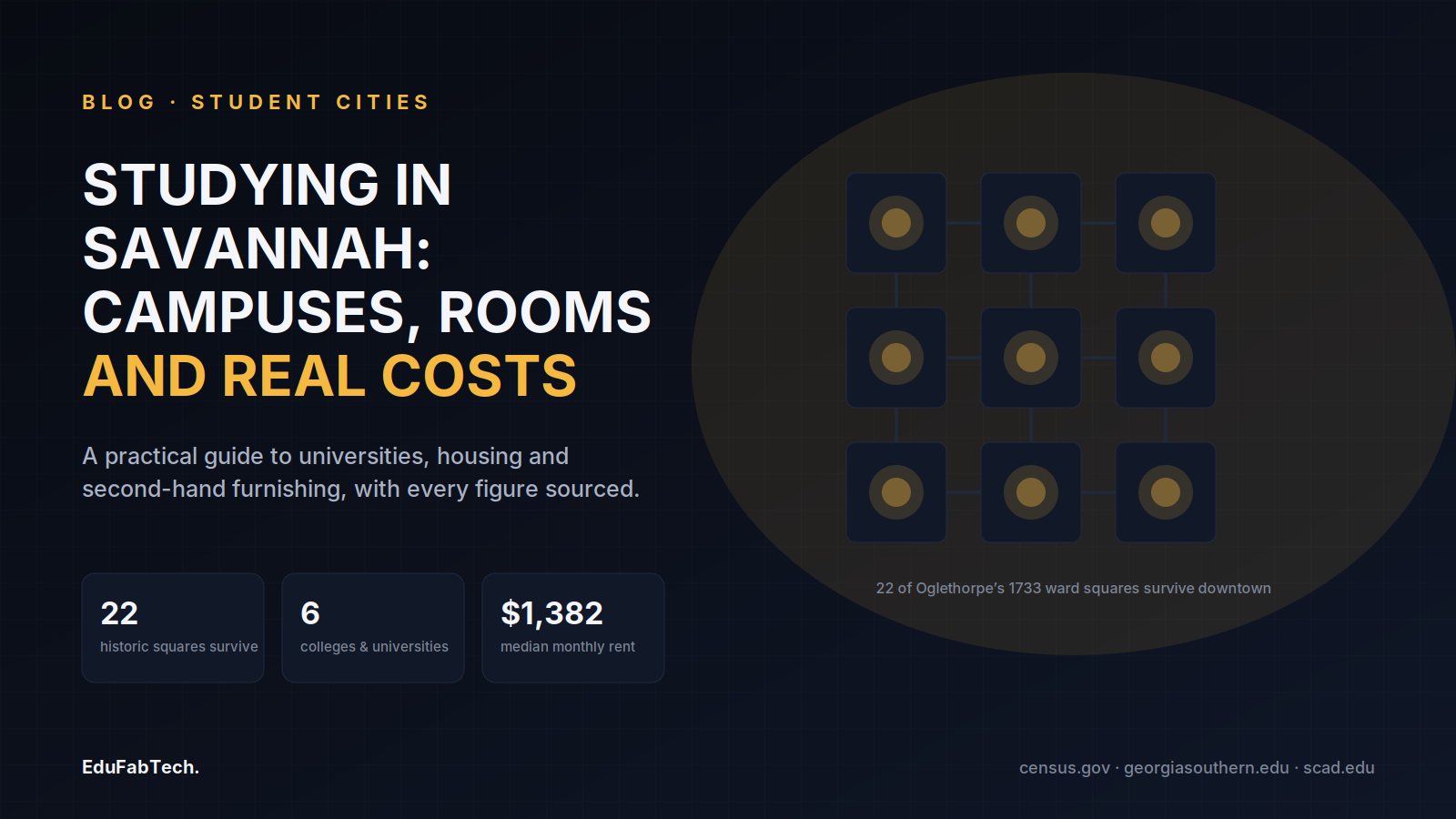
Savannah is unusual among American student cities because its oldest campus is the street plan itself. James Oglethorpe laid the colony out in 1733 as a grid of wards built around public squares, and twenty-two of those squares survive inside what is now one of the largest National Historic Landmark Districts in the United States. Students here do not file onto one enclosed campus; at the Savannah College of Art and Design they walk between converted department stores, old armories and cotton warehouses, crossing live-oak squares hung with Spanish moss to get from one class to the next. A few miles south and east, the public universities sit on their own grounds. The result is a city where the student population is woven through ordinary neighbourhoods rather than walled off from them.
That geography shapes almost every practical decision you will make — where to rent, how long your commute runs, whether you need a bus pass or a bike. Savannah has a genuine mix of institutions: a large private art and design university, a historic public land-grant university, a regional public campus, a career-focused technical college, a health-and-business-oriented private university, and a small graduate college in the humanities. Each draws a different kind of student, and each sits in a different part of town.
Before committing to anywhere, it is worth seeing the full range of what is listed locally. EduFabTech keeps city-specific pages for Savannah — start with all student listings in the city and narrow from there.
The universities, one by one
The Savannah College of Art and Design (SCAD), a private non-profit university founded in 1978, is the institution most visitors associate with the city. Its own site describes a campus of restored historic buildings spread across downtown rather than a single site, with the Jen Library occupying a former 1920s department store on Broughton Street (scad.edu). SCAD teaches art, design, film, architecture, fashion and related fields, and its presence is the main reason you will see students sketching in squares and carrying portfolios through the historic district.
Georgia Southern University–Armstrong Campus is the public option most students mean when they talk about going to "Armstrong." Georgia Southern's own page places the campus between downtown Savannah and the Georgia coast, set within an arboretum, and highlights a 15-to-1 student-to-faculty ratio with strengths in the health professions and coastal research (georgiasouthern.edu). The campus sits on Abercorn Street Extension on the Southside, where Lane Library serves as its academic hub (georgiasouthern.edu/library). Armstrong became part of Georgia Southern after the two universities consolidated.
Savannah State University (SSU) is the oldest of the city's public institutions. Its own pages record that it was established in 1890 and is the oldest public historically Black university in Georgia (savannahstate.edu); the University System of Georgia profile adds that it grew out of the 1890 Morrill land-grant legislation (usg.edu). The campus lies along the coastal salt marshes a few miles southeast of downtown, and its Asa H. Gordon Library holds the university archives. Its programmes are organised into colleges, including the College of Business Administration.
South University traces its Savannah campus to 1899 and treats it as its flagship, offering degrees from the associate to the doctoral level in fields such as business, nursing, pharmacy, psychology, criminal justice and public health (southuniversity.edu). It is a smaller, professionally focused private university rather than a traditional residential college.
Savannah Technical College is the public, career-focused institution. It is accredited by the Southern Association of Colleges and Schools Commission on Colleges to award associate degrees, diplomas and technical certificates across fields from aviation maintenance and automotive technology to culinary arts, cybersecurity and dental hygiene (savannahtech.edu). For students who want a trade credential or a lower-cost route into a four-year programme, it is the obvious starting point.
Ralston College is the city's newest and smallest degree-granting institution, running an intensive one-year Master of Arts in the Humanities that begins with a term in Greece and continues in Savannah; its first cohort started in 2022 (ralston.ac). It is worth knowing that Ralston is still working through accreditation with the New England Commission of Higher Education (neche.org), which matters for anyone relying on federal financial aid or on a credential's recognisability elsewhere.
One name you may see but cannot enrol in for a degree is Georgia Tech-Savannah: the Institute's own page describes the Savannah site as a centre for professional and continuing education rather than traditional degree programmes (pe.gatech.edu). It is useful for short courses and professional certificates, not for a bachelor's or master's.
From the squares to the Southside: where students live
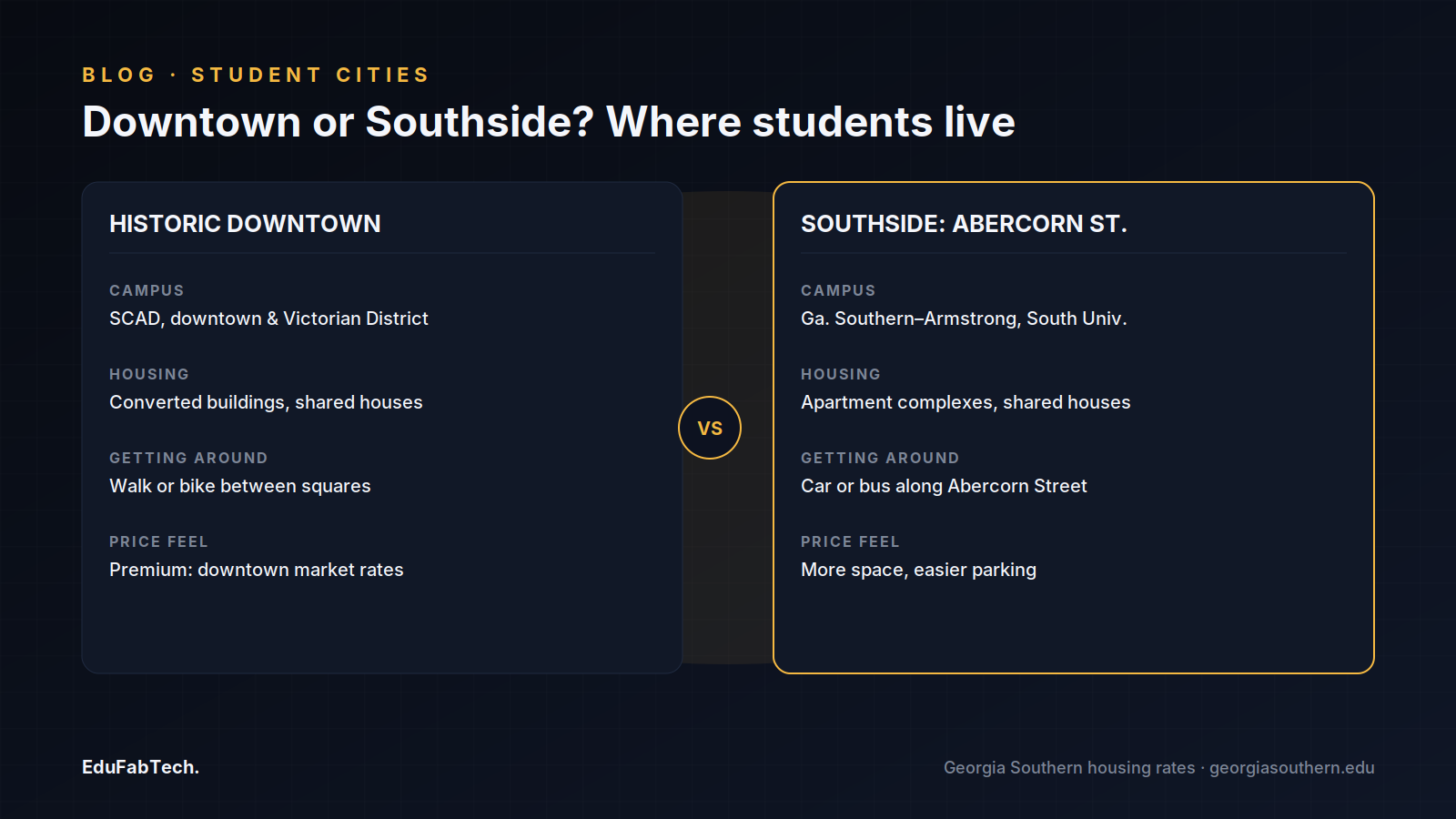
Because the campuses are so spread out, there is no single student quarter. SCAD students cluster in and around the Historic District and the Victorian District just south of it, within walking or cycling distance of scattered classroom buildings — the trade-off being older housing stock and downtown prices. The Thomas Square / Starland District and the blocks around Forsyth Park are popular with students who want to stay central but a little cheaper. Armstrong and South University students tend to look further out on the Southside, along and off Abercorn Street, where apartment complexes and shared houses are more plentiful and parking is easier; Savannah State students often stay near the east-side campus or in midtown.
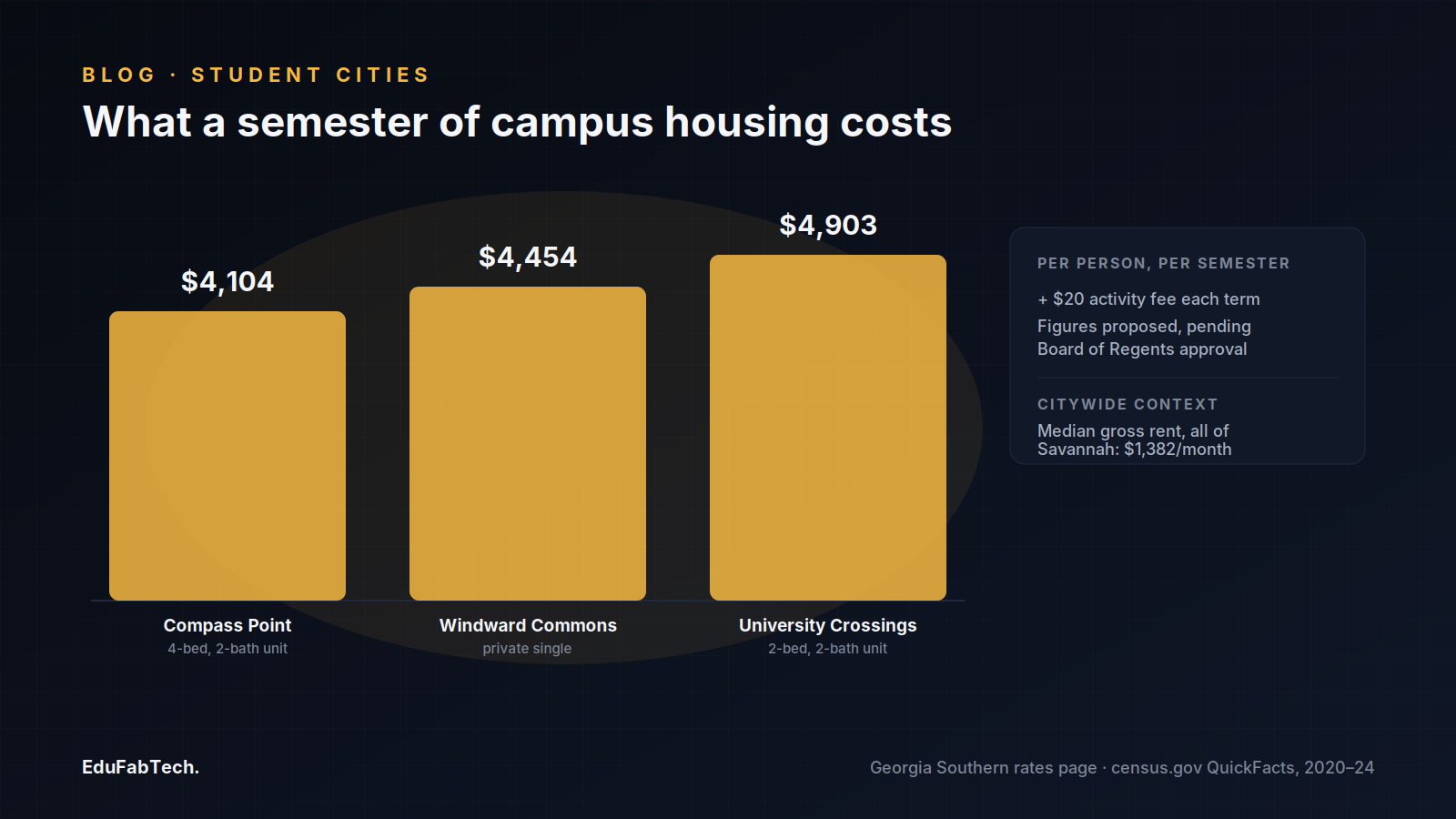
University-run housing is the simplest first move, especially in a first year. Georgia Southern operates residence halls on the Armstrong campus; its rates page lists costs per person per semester such as a Windward Commons private single at $4,454, a four-bed, two-bath unit in Compass Point at $4,104, and a two-bed, two-bath unit in University Crossings at $4,903, with an added $20 activity fee per semester and the note that the figures are proposed pending Board of Regents approval (georgiasouthern.edu). Those are per-semester numbers, so a full academic year roughly doubles them. SCAD and Savannah State run their own residences; check each university's housing office directly for current figures rather than trusting third-party estimates.
For the private market, the city's own rent level is the context that matters. The U.S. Census Bureau's QuickFacts for Savannah city reports a median gross rent of $1,382 for the 2020–2024 period (census.gov) — a whole-market figure covering families as well as students, but a reasonable anchor against which to judge a room in a shared house. To browse what is currently on offer around the city, EduFabTech lists rooms and places to stay in Savannah, and you can filter by proximity to a campus, for example near the Savannah College of Art and Design, the Armstrong campus or Savannah State University.
Leases and rental scams in a tourist city
Savannah's rental scams follow the city's own pressure points. The historic-district squeeze — limited housing in the walkable core, a steady churn of SCAD arrivals, and a tourist economy full of short-term lets — is exactly where fake listings thrive. The classic version is a charming downtown apartment photographed from a holiday rental, priced slightly below the market, with a "landlord" who is conveniently out of town and wants a holding deposit before you can view it.
The defences are concrete and local. See the actual unit in person, or send someone you trust, before any money changes hands; a real Savannah landlord or leasing office will let you walk a vacant unit. Be wary of a downtown place listed well under the going rate, and of anyone who insists on handling everything remotely during the rush before fall term. Never send money by bank wire, gift card or cryptocurrency to "hold" a room — those payments are effectively irreversible, and no legitimate local lease requires them. Read the lease for the deposit amount and the move-out conditions before signing, and keep every payment on a traceable method with a receipt. If a deal only works if you pay today, that urgency is the warning.
Furnishing a room on the cheap
Once you have a room, Savannah rewards the patient second-hand shopper. Keller's Flea Market, at 5901 Ogeechee Road on the city's west side, opens Saturdays and Sundays from 8 a.m. to 6 p.m. with hundreds of stalls selling everything from furniture and antiques to kitchenware (exploregeorgia.org). For larger items, the Coastal Empire Habitat for Humanity ReStore at 701 Martin Luther King Jr. Boulevard accepts and resells donated furniture, appliances and housewares (habitatsavannah.org) — a desk, a bookshelf or a sofa from there costs a fraction of new, and the proceeds fund local housing.
For food rather than furniture, the Forsyth Farmers' Market sets up at the south end of Forsyth Park every Saturday from 9 a.m. to 1 p.m., rain or shine; it gathers more than 70 farmers, growers and local food producers (forsythfarmersmarket.com). It is a cheap way to eat well and an easy place to meet people outside your own department. EduFabTech also keeps running lists of second-hand things, second-hand furniture and things given away free in Savannah, which are worth checking in the weeks when leases turn over and students leave usable items behind.
Working while you study
Local students can take the usual mix of campus jobs, café and retail work in the tourist economy, and term-time hours that fit around classes; EduFabTech's jobs and part-time work page collects local openings. International students face a stricter regime, and the rules come from federal immigration authorities, not the university. The U.S. Department of Homeland Security's Study in the States guidance states that an F-1 student generally may not work more than 20 hours per week while school is in session, and that on-campus and off-campus work both require prior approval from the school's Designated School Official (studyinthestates.dhs.gov). Training options such as Curricular Practical Training and Optional Practical Training are governed separately through the Student and Exchange Visitor Program and U.S. Citizenship and Immigration Services. This is a summary, not legal advice: before you take any job, confirm your specific situation with your university's international student office and the official DHS source above.
Libraries and places to study
Each university has its own library. SCAD's Jen Library on Broughton Street offers group study rooms, computer labs and reservable spaces (scad.edu); Georgia Southern's Lane Library anchors the Armstrong campus (georgiasouthern.edu/library); and Savannah State's Asa H. Gordon Library serves students on the east-side campus. Beyond the campuses, the public Live Oak Public Libraries system gives anyone in Chatham County a free place to work: its flagship Bull Street Library at 2002 Bull Street, near Forsyth Park, has recently extended its weekday evening and Saturday hours (liveoakpl.org). A public library card is useful for students who want quiet desk space on weekends without trekking back to campus. For a wider set of options, see EduFabTech's study spaces and desks in Savannah.
Getting around: the bus, the dot and the ferry
Savannah's public transport operator is Chatham Area Transit (CAT). Its fare page lists a local cash fare of $1.50, a day pass at $3.00 and a monthly pass at $50.00, and confirms that the downtown "dot" shuttle and the Savannah Belles Ferry across the river are both free (catchacat.org). For students specifically, CAT's student page states that, beginning with the 2026-2027 school year, students need a CAT Student Pass and pay a discounted fare of $0.75 per ride (catchacat.org). The free dot shuttle is genuinely useful if you live or study downtown, and the free ferry links River Street with the convention-centre side of the river.
That said, Savannah is a car-oriented city once you leave the historic core. The Southside campuses and the more affordable apartments are a real distance from downtown, bus frequencies are modest, and many students end up with a bike for the flat, walkable centre or a car for everything else. Factor the commute into any housing decision: a cheaper room on the Southside can cost you an hour a day on the bus.
What is good, and what is hard
The good is distinctive. Few student cities are as walkable and as beautiful at their centre as Savannah's grid of squares, and the concentration of art, film and design students gives downtown a creative energy out of proportion to the city's size. The coast, the marshes and Tybee Island's beach are close. Living costs, while rising, remain below those of the big coastal metros, and the second-hand economy is deep.
The hard parts are equally real. The climate is subtropical: summers are long, hot and intensely humid, and the Atlantic hurricane season runs from June through November, which means a real chance of storm warnings and evacuations during the fall term. Downtown housing is limited and competitive, pushing cheaper options out to the Southside and lengthening commutes on a bus network that is useful but not dense. The same tourism that animates the historic district also crowds it and fuels the rental scams described above. And degree-granting status varies: before you enrol anywhere, confirm the institution's accreditation for the credential you want.
A short checklist for your first weeks
- Confirm your institution and programme are accredited for the credential you need — especially at a newer college.
- If you want university housing, apply early through your university's own housing office and use its published rates, not third-party estimates.
- View any private room in person before paying, and never wire money, buy gift cards or send crypto to "hold" a place.
- Check the real commute from a prospective room to your campus by bus, not just the map distance.
- If you are an international student, meet your Designated School Official before taking any job and follow the DHS rules on the 20-hour limit.
- Get a CAT Student Pass if you will use the bus, and learn the free dot shuttle and ferry routes if you are downtown.
- Get a Live Oak Public Libraries card for weekend study space off campus.
- Furnish from Keller's Flea Market and the Habitat ReStore, and watch EduFabTech's free-stuff and second-hand listings at the end of each term.
- Have a hurricane plan: know your evacuation zone and your university's emergency notifications before the season peaks.
A quick question for readers
Do you work part-time while you study?
Many students work to pay the bills. See how common it is — and how many hours people really do.
Pick an answer, create a free account in a minute, and your vote counts. Already a member? Sign in
Comments 0
CommentNo comments yet. Members start the conversation.
Source: Georgia Southern University
Sources (5)
- Georgia Southern University. Housing Rates (2026-2027). Georgia Southern University, 2026. georgiasouthern.edu ↗ · checked 12 Oct 2026
- Chatham Area Transit. Fares & Passes. Chatham Area Transit, 2026. catchacat.org ↗ · checked 12 Oct 2026
- U.S. Department of Homeland Security. Working in the United States (F and M students). Study in the States, DHS, 2026. studyinthestates.dhs.gov ↗ · checked 12 Oct 2026
- Savannah State University. Why SSU. Savannah State University, 2026. savannahstate.edu ↗ · checked 12 Oct 2026
- Forsyth Farmers' Market. Forsyth Farmers' Market. Forsyth Farmers' Market, Inc., 2026. forsythfarmersmarket.com ↗ · checked 12 Oct 2026