Studying in Scranton: universities, housing and student life
A practical, sourced guide to being a student in Scranton, Pennsylvania — its four-year universities, where rooms come from, what they cost, work rules, libraries and getting around on COLTS.
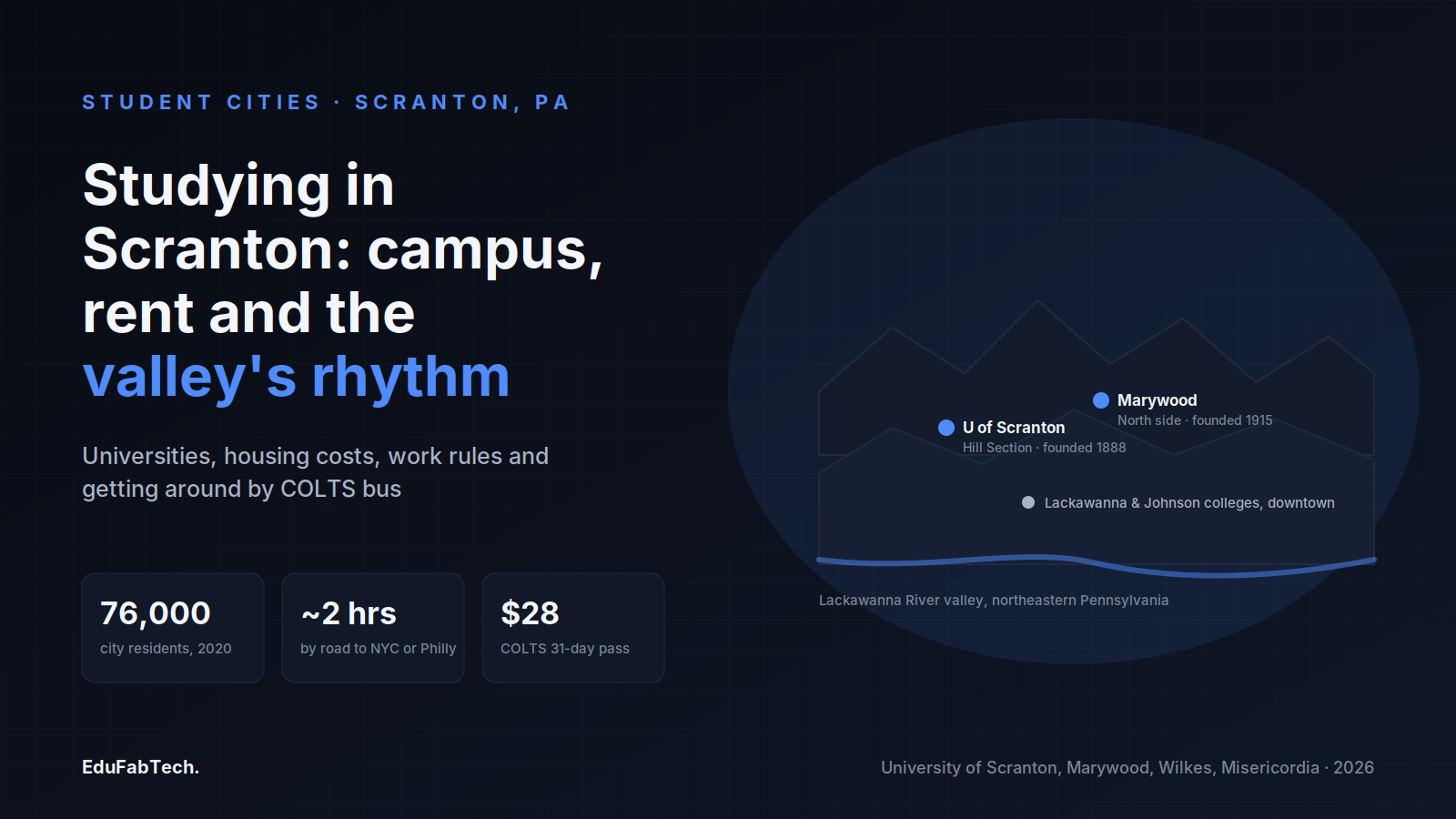
Scranton sits in the Lackawanna River valley of northeastern Pennsylvania, a narrow corridor pinched between the Moosic Mountains and the plateau that climbs toward the Pocono region. The city grew up on anthracite coal and the railroads that carried it, and the old grid still shows it: tight blocks of brick and frame row houses climbing the hillsides, a downtown of early-twentieth-century office buildings around Courthouse Square, and the restored rail yards of Steamtown cutting through the middle. Locals still call it the Electric City, a nickname from the era when streetcars first ran through its streets.
For a student, the useful thing about Scranton is scale. It is a real city with a downtown, but a compact one, and four-year campuses sit within a short drive of each other up and down the valley. The U.S. Census Bureau counted about 76,000 residents in the city at the 2020 census, and New York and Philadelphia are each roughly two hours away by road — close enough to reach a major city for a weekend, far enough that rents and daily costs are nothing like coastal ones.
It is worth setting expectations early. Winters here are genuinely cold and snowy, the housing stock is old, and public transport is built around daytime commuting rather than late nights. Those are the trade-offs you accept in exchange for a cheaper, slower, more walkable college town. The sections below work through the universities, finding a room, furnishing it, working, studying, moving around, and what it all costs — with sources you can check.
The campuses, from the Hill Section to Dallas
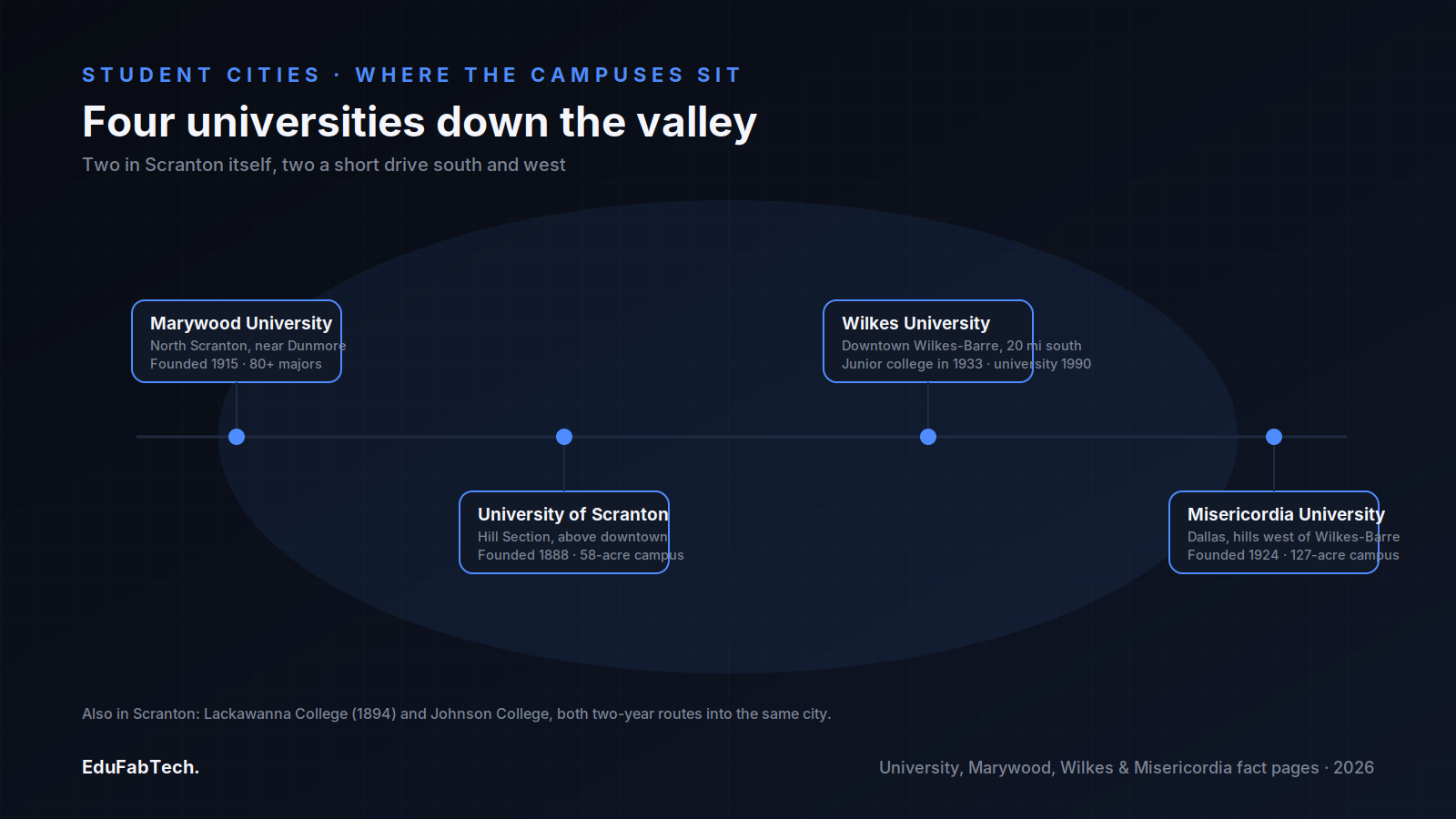
The University of Scranton is the largest presence in the city itself. According to the university's Get the Facts page, it was founded in 1888 as Saint Thomas College, has been entrusted to the Society of Jesus since 1942, and occupies a 58-acre campus on the Hill Section directly above downtown, serving about 4,600 undergraduate and graduate students. It is a Catholic, Jesuit institution, and that shapes everything from its service programmes to the academic calendar; it offers programmes across the health professions, business, the sciences and the liberal arts.
Marywood University lies a couple of kilometres north, on the north side of the city near the Dunmore line. Marywood's location page places its campus in this residential part of Scranton; it was founded in 1915 and is sponsored by the Congregation of the Sisters, Servants of the Immaculate Heart of Mary. Among its 80-plus majors it offers programmes in architecture, art and design, education and the health sciences, and its leafy campus feels distinct from the University of Scranton's more urban blocks.
Two more four-year universities sit within commuting distance down the valley, which matters if you are weighing programmes across the region. Wilkes University is in downtown Wilkes-Barre, about 20 miles south; per the university's history page it began as a junior college in 1933, became independent in 1947 and reached university status in 1990, and it runs pharmacy, nursing and engineering programmes. Misericordia University is in Dallas, Pennsylvania, in the hills west of Wilkes-Barre; its Fast Facts page records a founding in 1924 by the Religious Sisters of Mercy, a 127-acre campus, and a long emphasis on the health professions. Reaching either from Scranton realistically means a car or a regional bus connection.
Two further Scranton colleges are worth knowing even if you enrol elsewhere. Lackawanna College, which traces its origins to 1894 and is now based in downtown Scranton per its about page, grants associate and bachelor's degrees and professional certificates and is a common, lower-cost route into higher education. Johnson College, described on its about page as a private two-year technical college, concentrates on hands-on associate programmes in the trades, transportation, industrial technology and health. Between them they widen the options in the city well beyond the four-year campuses.
Where students find a room
Most first-year students at the University of Scranton and Marywood live on campus, and that is the simplest start: you get a known cost, a lease that matches the academic year, and a short walk to class. From the second year on, many students move into the surrounding blocks. The neighbourhoods students gravitate to are the Hill Section immediately around the University of Scranton, the streets of Green Ridge near Marywood, and the older districts just off downtown. These are mostly subdivided row houses and two- and three-unit homes rather than purpose-built student towers, so no two flats are alike.
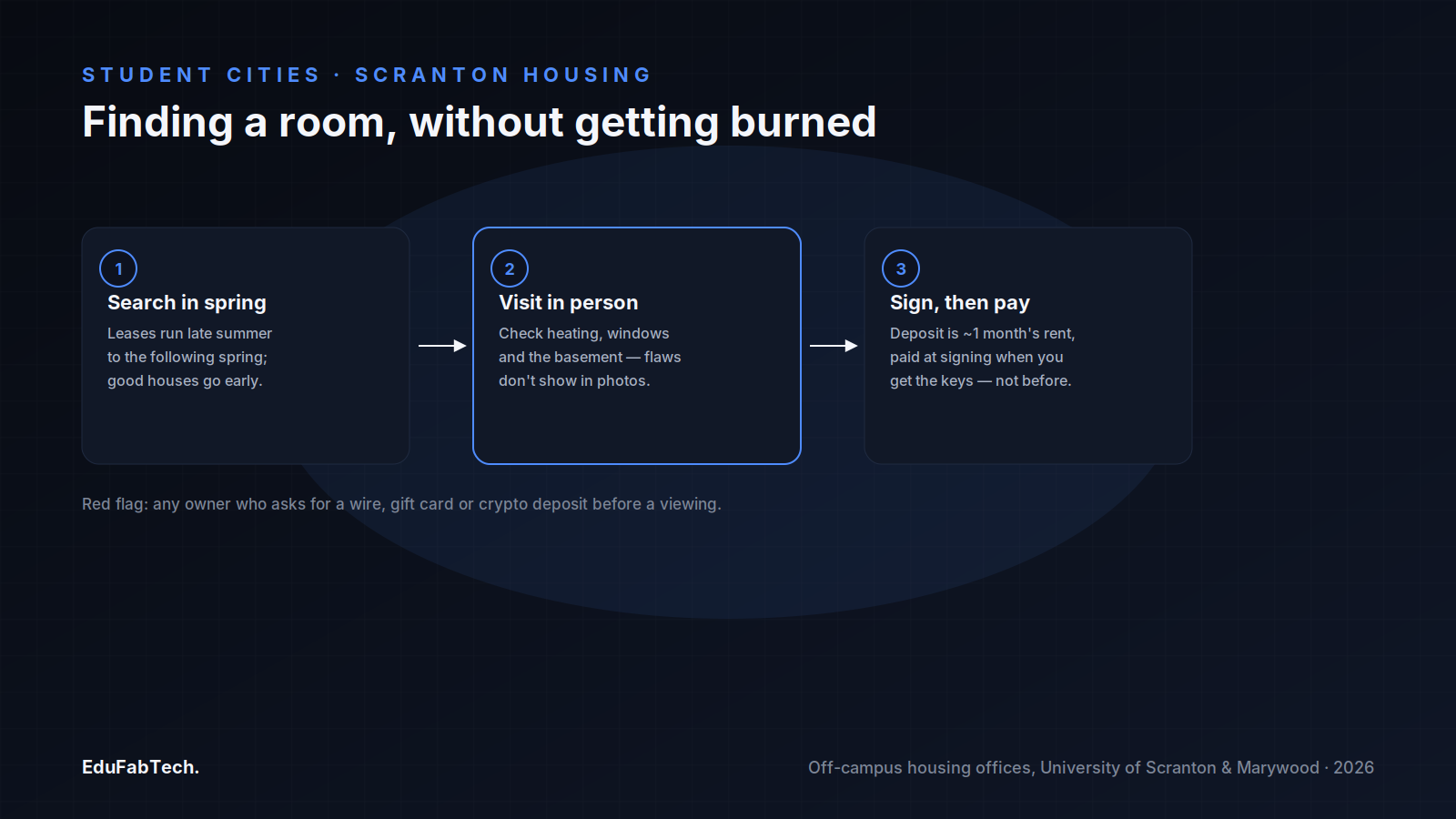
The rhythm of the market is seasonal. Leases for houses near the campuses tend to run from late summer to the following spring, and the better ones are spoken for months ahead, so the time to look for the next academic year is the preceding spring. Before you pay anything, see the place in person — Scranton's housing is old, and the things that bite in January are a tired heating system, single-glazed windows and a damp basement, none of which show up in photographs. Both main universities run off-campus housing offices that can point you toward landlords other students have used; start there rather than with an anonymous listing.
On the safety point, be specific. Rental scams here follow the national pattern: a too-cheap room, an owner who is conveniently out of town, and pressure to send a deposit to "hold" it before you can visit. A normal arrangement in Scranton is a security deposit of about one month's rent, paid when you sign a lease and see the keys — not before. Never send money by bank wire, gift card or cryptocurrency to reserve a place you have not stood inside. If a listing will not allow a viewing, treat that as the end of the conversation. EduFabTech keeps city-specific listings at rooms in Scranton and a broader set of student listings at everything in Scranton, and campus-adjacent options near the biggest school at near the University of Scranton.
Furnishing a room without spending much
Scranton is good territory for second-hand furnishing, partly because of its drive-in flea market culture. The Circle Drive-In Flea Fair in neighbouring Dickson City, documented by the regional tourism bureau Visit NEPA, runs on Sundays from mid-March through mid-November and is described as the largest flea market in northeastern Pennsylvania — the place to pick up a desk, a lamp or a set of plates for a few dollars. Dickson City, a short ride up the valley on Route 6, also has the area's cluster of thrift and resale shops, including a Goodwill store. Downtown, the Scranton Public Market on the second floor of the Marketplace at Steamtown gathers local makers and food vendors under one roof. For listings you can browse before you arrive, EduFabTech collects second-hand things in Scranton.
Working part-time, and the rules for international students
The local economy that hires students leans on healthcare, retail, food service and the universities themselves; on-campus jobs in dining, libraries and offices are often the easiest first paid work. If you are an international student, the rules are not optional, and the authoritative source is the US government. U.S. Immigration and Customs Enforcement, which runs the Student and Exchange Visitor Program, states on its employment page that F-1 students may work on campus up to 20 hours per week while school is in session and full-time during breaks, and that on-campus work does not require separate authorisation from USCIS, though you must coordinate with your Designated School Official first. Off-campus work tied to your studies — Curricular Practical Training and Optional Practical Training — has its own conditions and approvals. This is general information, not legal advice: confirm your own situation with your university's international-student office before you accept any job. EduFabTech's jobs in Scranton page lists local part-time openings.
Libraries and places to read
Each campus has its own library — the Weinberg Memorial Library at the University of Scranton and Marywood's own library among them — and those are where most students do their serious work, with study rooms and long hours around exams. Off campus, the city's grand public library is the Albright Memorial Library on Vine Street, a nineteenth-century building that is part of the Lackawanna County Library System; a library card opens up quiet desks and public computers at the Albright and its branch libraries. For a change of scene when the campus libraries are full, EduFabTech tracks study spaces in Scranton.
Getting around on COLTS
Public transport in and around the city is run by the County of Lackawanna Transit System, known as COLTS, whose buses serve Scranton and the surrounding towns of Lackawanna County and connect with neighbouring Luzerne County service. On its passes page COLTS lists (2026) a 31-day student pass at US$28 and a 10-ride student pass at US$7.85 for riders with a valid student ID — well below the adult 31-day pass of US$60 — alongside a US$4 day pass. Students at the University of Scranton can largely live on foot, since the campus, downtown and the nearest shops are within walking distance; Marywood is reachable by COLTS routes through the north of the city. Getting reliably to Wilkes or Misericordia, or doing a late shift anywhere, is much easier with a car, because the bus network is built around daytime hours rather than nights and Sundays.
What a year costs, with the figures
The most concrete housing numbers come from the universities themselves. The University of Scranton's 2026–2027 residence and dining rate schedule lists a standard (Class AA) double room at US$4,972 per semester and an unlimited meal plan at US$3,340 per semester; single rooms and apartment-style units cost more, and lighter meal plans less. For off-campus comparison, the U.S. Department of Housing and Urban Development set the FY2026 Fair Market Rent for the Scranton–Wilkes-Barre, PA metropolitan area — effective from 1 October 2025 — at US$863 for a studio, US$1,028 for a one-bedroom and US$1,252 for a two-bedroom per month; a flat shared between two or three students brings the per-person figure well down. Transport is a small line item by comparison: at the COLTS 2026 student rate of US$28 for 31 days, a term of bus travel is modest.
The honest trade-offs
What is good about Scranton for a student is real. It is affordable by US standards, with rents far below the big coastal metros; it is compact and walkable, especially around the University of Scranton; it has genuine city texture — a downtown, museums, Steamtown, a minor-league ballpark — without big-city prices; and New York and Philadelphia are close enough for an occasional trip. The student population keeps parts of the city lively through the year.
What is hard is equally real. Winters are long, grey and snowy, and the hills make them harder; if you are coming from a warm climate, budget for serious cold-weather clothing from the start. The housing is old, so insulation and heating bills matter. Public transport thins out in the evenings and on Sundays, which makes a car close to necessary if you study at a regional campus or work late. And this is a mid-sized city in a region that lost much of its industry, so the range of graduate jobs and big-city amenities is narrower than in a major metro. None of this is a reason to stay away; it is a reason to arrive prepared.
A checklist for the first weeks
- Confirm your housing in writing, and if you are off campus, see the place in person before paying a deposit of more than about one month's rent.
- Never send money by wire, gift card or cryptocurrency to hold a room you have not visited.
- Get a Lackawanna County Library System card and find the hours of your campus library.
- Buy a COLTS student pass with your ID, and learn the routes between your home, campus and downtown.
- If you are an international student, meet your Designated School Official before taking any job, and read the ICE employment rules yourself.
- Furnish from the Circle Drive-In Flea Fair and local thrift shops before buying anything new.
- Prepare for winter early — warm clothing, boots and a plan for getting to class in snow.
- Check EduFabTech's Scranton listings for rooms, second-hand goods and part-time work as you settle in.
A quick question for readers
Do you work part-time while you study?
Many students work to pay the bills. See how common it is — and how many hours people really do.
Pick an answer, create a free account in a minute, and your vote counts. Already a member? Sign in
Comments 0
CommentNo comments yet. Members start the conversation.
Source: University of Scranton
Sources (4)
- University of Scranton. Residence Life and Housing — 2026-2027 room and board rates. University of Scranton Catalog, 2026. catalog.scranton.edu ↗ · checked 13 Oct 2026
- County of Lackawanna Transit System. Passes and Fares. COLTS, 2026. coltsbus.com ↗ · checked 13 Oct 2026
- U.S. Immigration and Customs Enforcement. Employment (F and M students). ICE / SEVP, 2026. ice.gov ↗ · checked 13 Oct 2026
- U.S. Department of Housing and Urban Development. FY2026 Fair Market Rents Schedule. HUD User, 2026. huduser.gov ↗ · checked 13 Oct 2026