Studying in Spokane: universities, housing and student life
A practical, sourced guide to EWU in Cheney, Whitworth, WSU's health-sciences campus, and the housing, work, transport and costs that shape student life in eastern Washington's largest city.
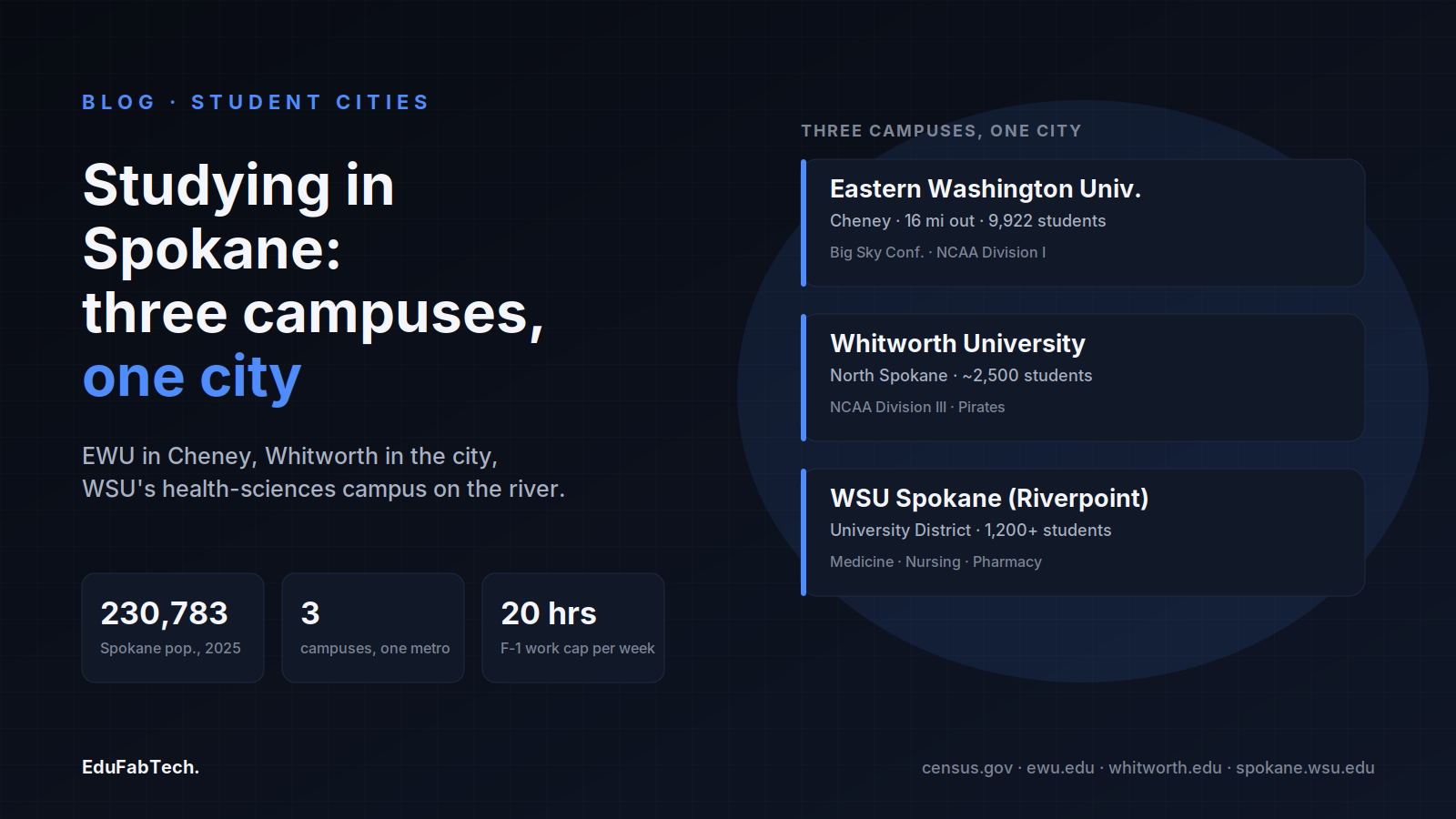
Spokane sits on the Spokane River in the far east of Washington state, close enough to the Idaho line that many students treat Coeur d'Alene as a weekend trip rather than another state. The river runs straight through the centre, dropping over the falls beside Riverfront Park — the ground that hosted the 1974 World's Fair — and the city built itself up the slopes on either side, most visibly onto the South Hill. The U.S. Census Bureau's QuickFacts puts the city's population at about 230,783 (July 1, 2025 estimate) (census.gov), which makes it the largest city in eastern Washington and the anchor of the Inland Northwest.
For a student, the first thing to understand is that Spokane's campuses are not in one place. One is in a separate small town sixteen miles out; one is on the wooded north edge of the city; one is a health-sciences campus wedged between downtown and the river. Where you study decides almost everything else — which bus you catch, which neighbourhood you can afford, whether you even need the car that eastern-Washington winters make tempting.
The universities, from Cheney to the river
Eastern Washington University is the big undergraduate institution, and it is not in Spokane proper — its 300-acre main campus is in Cheney, a town roughly sixteen miles south-west. EWU's own About page says it was founded in 1882, enrolled 9,922 students in fall 2025, and now describes itself as a polytechnic university built around hands-on, applied learning — a direction its Board of Trustees approved in May 2024 (ewu.edu/about). It is a Division I school — the Eagles play in the Big Sky Conference — and a large share of first-years live on the Cheney campus rather than commuting from the city.
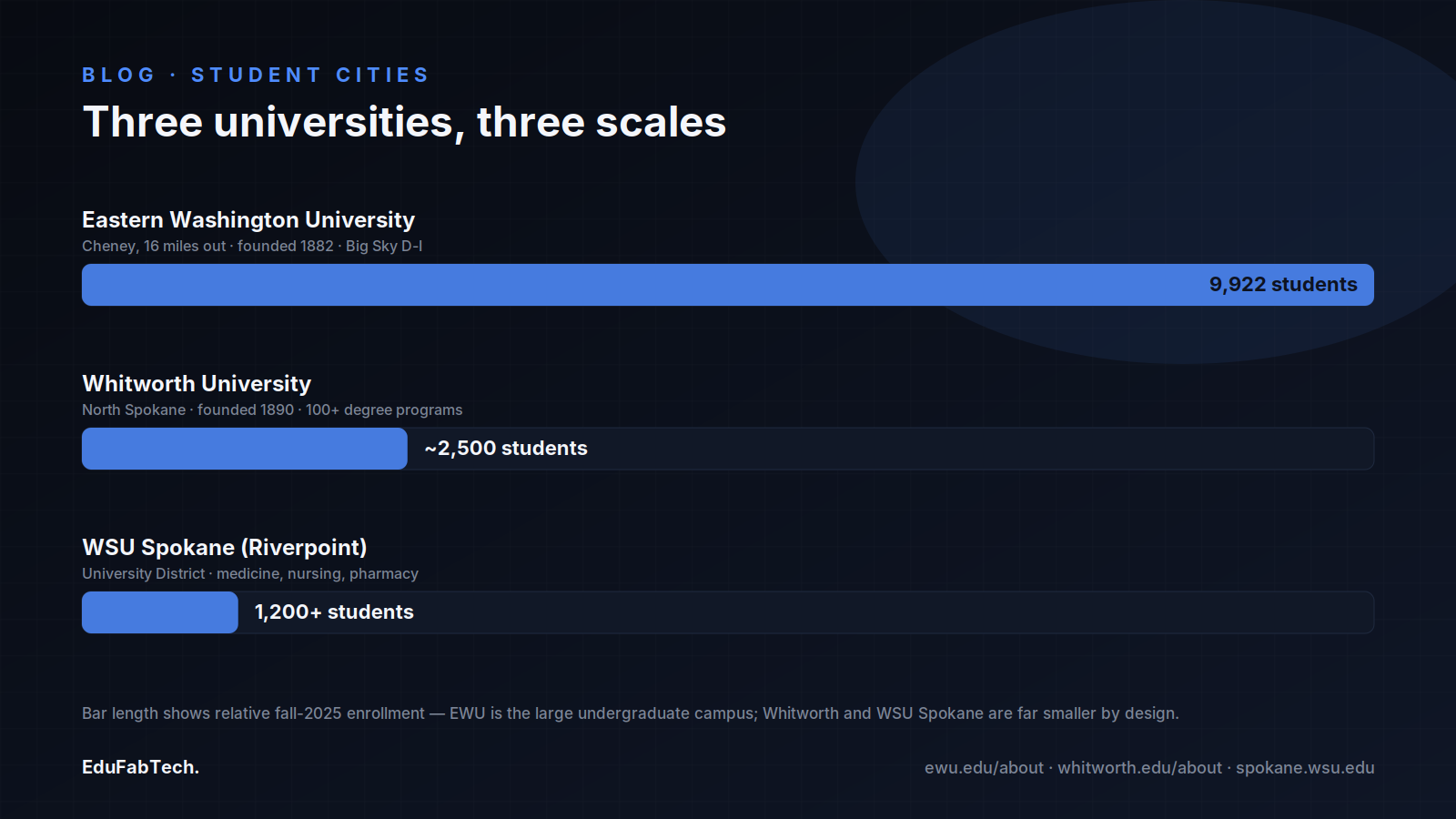
Whitworth University is the one actually inside the city, on the quieter north side. Whitworth's About page describes a 200-acre campus of "classic brick buildings, tall pines and open green areas," founded in 1890, enrolling roughly 2,500 students, and offering "more than 100 undergraduate and graduate degree programs" (whitworth.edu/about). It is a Christ-centred, Presbyterian-affiliated liberal-arts institution — worth knowing if that framing matters to you either way — and it competes in NCAA Division III as the Pirates. A new PACCAR engineering building was built out on that campus, so the sciences are expanding, not shrinking.
Washington State University Spokane is different in kind: it is WSU's health-sciences campus, and it grants graduate and professional degrees rather than running a broad undergraduate programme. Its own site describes it as the university's health-sciences campus, home to 1,200-plus students, and names its three colleges — the Elson S. Floyd College of Medicine, the College of Nursing, and the College of Pharmacy and Pharmaceutical Sciences (spokane.wsu.edu). The campus, long known as Riverpoint, sits in the University District on the south bank of the river just east of downtown, and it is shared ground: EWU runs some of its own health-sciences programmes from the same district. If you are coming to Spokane for nursing, pharmacy or medicine, this riverside cluster — not Cheney, not the north side — is where your days will happen.
Where students end up living
Housing choices follow the three campuses. EWU students split between on-campus residence halls in Cheney and rentals in the town itself, which is small, walkable and built around the university; living in Cheney means a short walk to class but a bus or car ride to Spokane's jobs and nightlife. Whitworth draws students into north Spokane — the blocks around Hawthorne and the Country Homes and Mead edges of the city — where houses rather than apartment towers dominate. The University District and the near-downtown neighbourhoods (Browne's Addition and the East Central area, plus the newer Kendall Yards development across the river) suit the health-sciences crowd and anyone who wants to be on a frequent bus line.
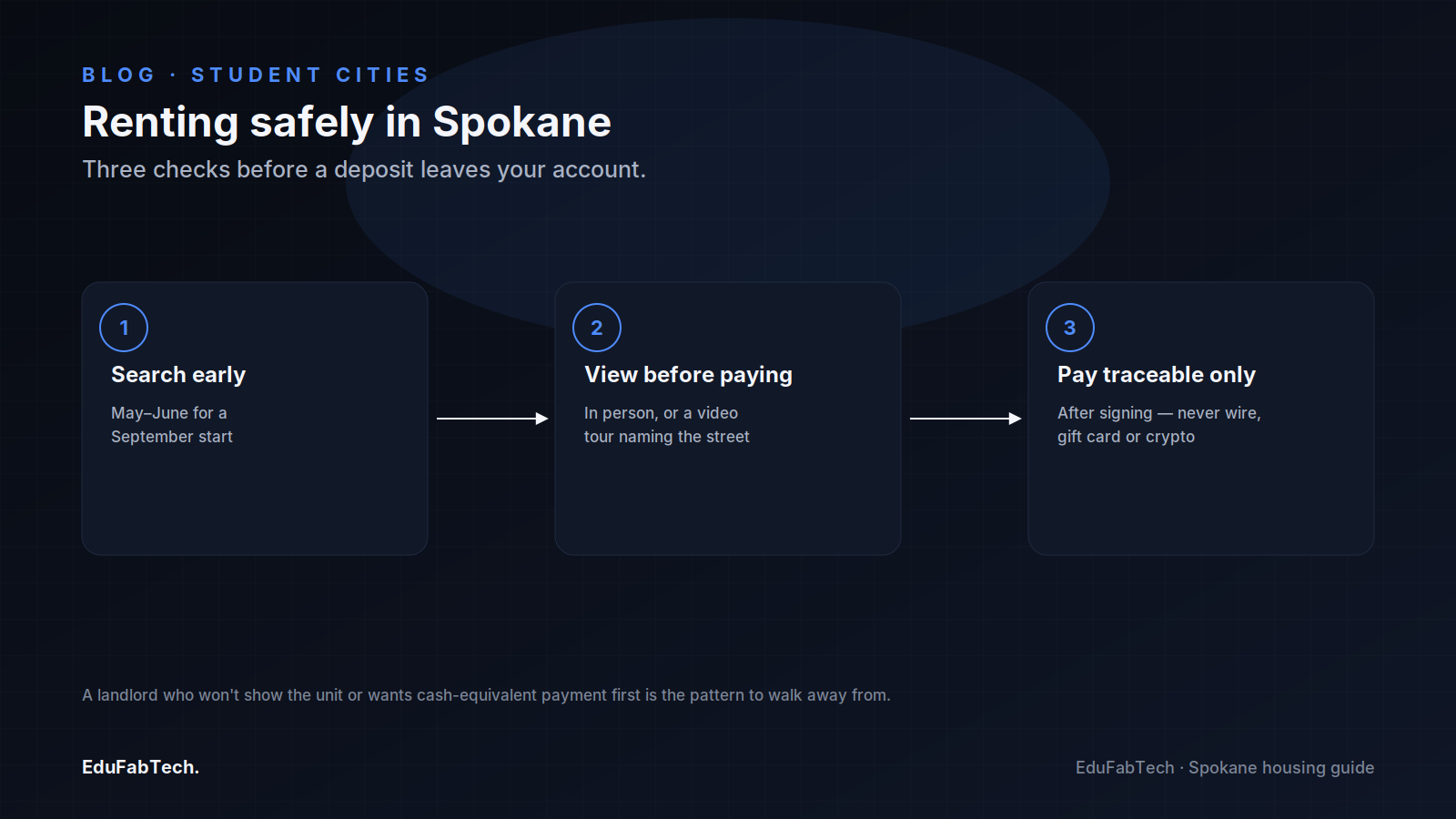
Typical student housing here is one of three things: a university residence hall with a meal plan attached; a room in a shared house, which is how most undergraduates economise; or a studio or one-bedroom apartment, which is the most expensive route. Start looking earlier than feels necessary — for a September start, serious searching in May or June, because the better shared houses near Whitworth and in the South Hill go before term. Our local listings for the city are gathered at /in/united-states/spokane, with rooms specifically at /in/united-states/spokane/rooms; if a particular campus is fixed for you, /near/eastern-washington-university, /near/whitworth-university and /near/washington-state-university-spokane narrow it down.
Before you pay anything, see the actual room. Check that the heating works — Spokane winters are genuinely cold and a badly heated house is a real cost, not a theoretical one. Ask who pays for heat and water, read the lease for how the deposit is returned, and confirm the landlord can show you a current lease and keys to that specific unit, not a lookalike.
Paying a deposit without getting cheated in Spokane
Rental scams in Spokane follow the national pattern but cluster around student timing. They appear most where demand spikes — August listings near Whitworth and in the University District, and "available now" posts aimed at international arrivals who cannot visit first. The usual trick is a too-cheap room, a landlord who is conveniently out of state or overseas, and pressure to "hold" the place before anyone else grabs it. The safeguard is simple and absolute: never send money by bank wire, gift card or cryptocurrency to reserve a room you have not seen. A real Spokane landlord will let you view the unit — in person or by a live video walk-through naming the street — and will take a deposit through a normal, traceable, receipted method after you sign. If someone refuses a viewing, invents a reason the keys cannot be shown, or wants cash-equivalent payment immediately, walk away. If you are abroad and cannot visit, ask your university's housing or international-student office to help verify an address before you commit any money.
Furnishing a room: Trent Avenue thrift and the summer markets
Furnishing cheaply is easy in Spokane because the city has a strong second-hand culture. Global Neighborhood Thrift & Vintage, at 919 E Trent Ave, is the one worth knowing first: it is a non-profit social enterprise that employs and trains people who came to the United States as refugees (global-neighborhood.org), and its floor of books, clothes and household goods is genuinely cheap. For produce and local makers in the warmer months, the city runs a cluster of seasonal markets listed by Visit Spokane (visitspokane.com): the Spokane Farmers Market at 2195 W 2nd Avenue (Wednesdays and Saturdays), the Perry Street Thursday Market on the South Hill at 924 S Perry, the Emerson-Garfield Farmers Market on the north side, and the summer Kendall Yards Night Market on Wednesdays. These sell food more than furniture, but they are where you meet the neighbourhood you have moved into. For the rest of a room, EduFabTech keeps city-specific pages for second-hand things, furniture and items people are simply giving away — the last of which fills up at the end of each term when leases turn over.
Working while you study
Rules on part-time work depend entirely on your immigration status, and this is guidance, not legal advice — confirm your own case with your university's international-student advisers. For students on an F-1 visa, the U.S. Department of Homeland Security's official Study in the States guidance states that you "may not work more than 20 hours per week when school is in session" and that on-campus work should begin with your Designated School Official (DSO), who can issue a letter of approval (studyinthestates.dhs.gov). Those limits, and the categories such as Curricular and Optional Practical Training, are defined federally and change from time to time, so the DSO — not a forum post — is the authority to ask. Domestic students face no such cap. On-campus jobs in Cheney, library and lab work on the Riverpoint campus, and the ordinary retail and hospitality economy of a mid-sized city are the common openings; EduFabTech's local board is at /in/united-states/spokane/jobs.
Where to actually study
Each campus has its own library, but the civic option is good enough to mention on its own terms. The Spokane Public Library's downtown Central branch, at 906 W Main Ave overlooking the river and the Monroe Street Bridge, reopened after a major renovation with five reservable study rooms, a co-working space in its Business Lab, 66 public computers and free Wi-Fi (spokanelibrary.org/downtown). It is a short walk from the University District, open late enough on weekdays to be useful, and free, which matters when you want somewhere neutral and quiet that is not your shared kitchen. Beyond that, the river path and Riverfront Park give you somewhere to decompress between sessions. More study spots and desks listed by students are at /in/united-states/spokane/study-spaces.
Getting around on STA
Public transport is run by the Spokane Transit Authority (STA), and it reaches all three campuses, including a route out to Cheney. STA's fare pages set the standard adult fare at $2.00 and the reduced fare at $1.00, and introduce a Connect card with daily fare-capping — spend $4 (the price of two trips) in a day and the rest of that day's rides are free (spokanetransit.com). Worth knowing for younger students: STA says riders 18 and under ride free, using a no-cost Rider's License Connect card that you can pick up at the STA Plaza downtown or at participating libraries. University students above that age pay the standard fare unless their campus has its own pass arrangement, so check with your institution before assuming a discount. Spokane is a car-friendly city and many students do keep one, but the combination of the free-under-18 policy and fare-capping makes the bus a real option, especially for the downtown-and-river district.
Costs, and the honest trade-offs
The clearest housing figure comes from EWU's own pricing page: for the 2026–2027 year, a shared double room in a Cheney residence hall with the base meal plan is listed at $5,038.55 for the fall 2026 quarter, with winter and spring each at $4,737.20 — about $14,512.95 across the three quarters for room and board (ewu.edu/housing/pricing). For the private market, the U.S. Census Bureau's QuickFacts reports a median gross rent of $1,215 across Spokane city on the 2020–2024 American Community Survey, with median household income at $70,064 over the same period (census.gov) — a reminder that a single student's budget sits well below the household figures rents are set against.
What is good about Spokane for a student is concrete. It is cheaper than Seattle or the Washington coast; it is a real city with a river, parks and an arts scene rather than a campus in a field; and the outdoors — skiing, lakes, trails — are genuinely close. What is hard is also concrete. The campuses are scattered, so there is no single student quarter where everything is a walk away; the sixteen-mile gap between Cheney and the city means EWU students in particular choose between cheap small-town life and the pull of Spokane. Winters are long and cold, which raises heating bills and makes the car-versus-bus decision real. And like most mid-sized American cities, the rental supply tightens in late summer, so the students who search early get the better rooms.
The first few weeks: a checklist
- Fix which campus you belong to — Cheney, the north side or the Riverpoint/University District — before you sign anything, because it decides your commute.
- If you are an international student, meet your Designated School Official early to confirm what work, if any, you may do.
- See the room in person or by live video before paying; never wire money, buy gift cards or send crypto to hold a place.
- Get an STA Connect card and, if you are 18 or under, the free Rider's License; learn your campus route and its last evening departure.
- Register at the Central Library for a study spot that is free and warm when your house is neither.
- Furnish from Global Neighborhood Thrift and end-of-term giveaways before buying anything new.
- Budget for heat: eastern-Washington winters are a line item, not an afterthought.
- Check the city's events listings in your first fortnight — it is the fastest way to stop being a stranger in a scattered city.
A quick question for readers
Do you work part-time while you study?
Many students work to pay the bills. See how common it is — and how many hours people really do.
Pick an answer, create a free account in a minute, and your vote counts. Already a member? Sign in
Comments 0
CommentNo comments yet. Members start the conversation.
Source: Eastern Washington University
Sources (5)
- Eastern Washington University. Housing Pricing (2026–2027). Eastern Washington University, 2026. ewu.edu ↗ · checked 14 Oct 2026
- Whitworth University. About Whitworth. Whitworth University, 2026. whitworth.edu ↗ · checked 14 Oct 2026
- Washington State University Spokane. WSU Spokane (Health Sciences). Washington State University, 2026. spokane.wsu.edu ↗ · checked 14 Oct 2026
- Spokane Transit Authority. Fares Overview. Spokane Transit Authority, 2026. spokanetransit.com ↗ · checked 14 Oct 2026
- U.S. Census Bureau. QuickFacts: Spokane city, Washington. U.S. Census Bureau, 2025. census.gov ↗ · checked 14 Oct 2026