Studying in Stillwater: Oklahoma State, Langston, housing and student life
A practical guide to studying in Stillwater, Oklahoma — its two universities, where students live, how to rent safely, what it costs, and the honest trade-offs of a prairie college town.
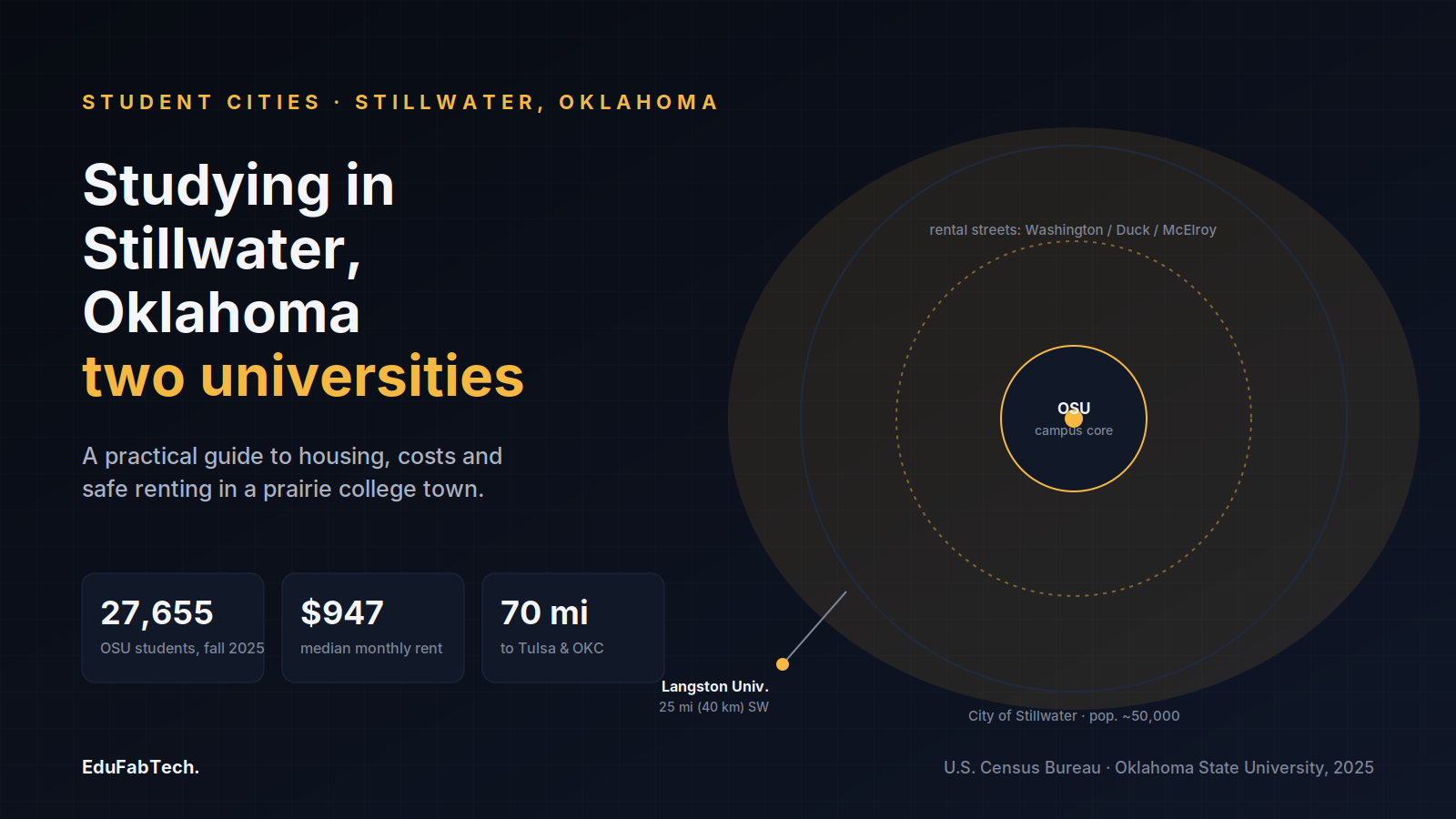
Stillwater sits on the red-dirt prairie of north-central Oklahoma, in Payne County, roughly equidistant from Tulsa and Oklahoma City — about 70 miles (110 km) from each. The 2020 census counted 48,394 residents, and the U.S. Census Bureau now estimates the city at close to 50,000 (U.S. Census Bureau QuickFacts). That makes it a genuine college town: when Oklahoma State University is in session the student body is a sizeable fraction of everyone in town, and when it empties for the summer you feel the difference on Washington Street and at the grocery checkout.
The city grew up around the land-grant college, and the campus is still the gravitational centre. Orange is everywhere — "America's Brightest Orange" is OSU's own slogan — and the rhythm of the academic calendar, home football Saturdays at Boone Pickens Stadium, and move-in week shape the whole town. For a student arriving from another state or another country, the practical questions are the same ones everywhere: who teaches here, where do I sleep, how do I eat and get around without a car, and what will it actually cost. This guide answers those with figures you can check.
A quick word on geography, because it decides almost everything else. Stillwater is compact and flat, the campus is on the north-west side near Theta Pond and the stadium, and the student-heavy rental streets fan out to the west and south of it. There is no rail and no big-city transit network — the single most useful fact about moving here is that the local bus is free with a student card, which is covered below.
Oklahoma State, Langston, and what studying here feels like
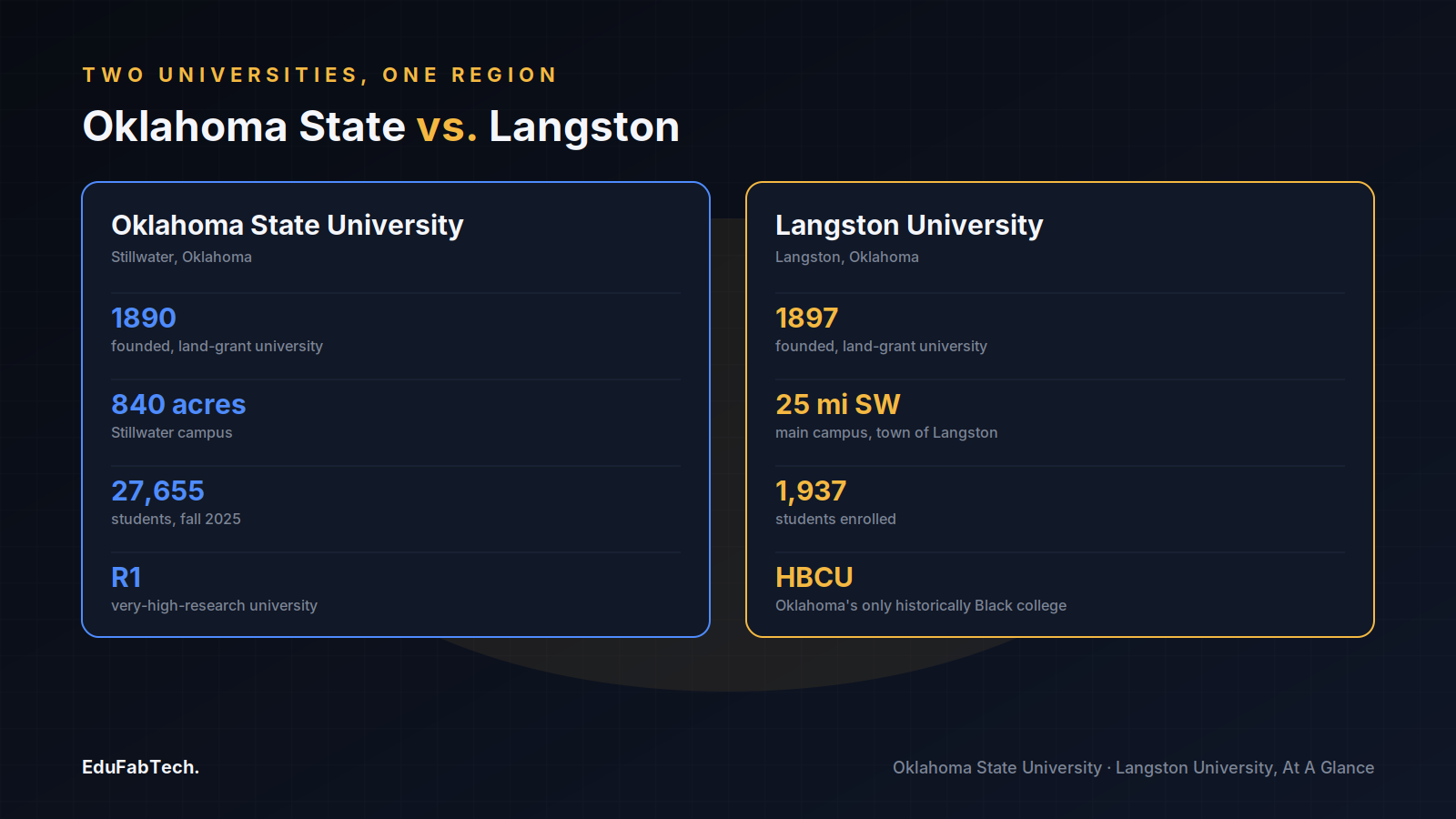
Oklahoma State University is the anchor. OSU describes itself as a land-grant university founded in 1890, with a Stillwater campus of about 840 acres and a modified-Georgian red-brick architecture that gives the core of campus its uniform look (Oklahoma State University, About the University). It is organised into colleges including Agriculture; Arts and Sciences; Spears Business; Education and Human Sciences; and Engineering, Architecture and Technology, and it is classified as a very-high-research ("R1") doctoral university. In fall 2025 OSU reported a record 27,655 students on the Stillwater campus (Oklahoma State University, 2025). In practice that means large introductory lectures, strong agriculture, engineering and veterinary programmes, and a campus that functions almost as its own district, with dining, a student union, health services and the library all within a walkable core. The Oklahoma State University College of Arts and Sciences is the home of most first-year general-education courses, so nearly every undergraduate takes classes in it whatever their major.
Langston University is the second degree-granting university tied to this area, though its main campus is not in Stillwater itself — it is in the town of Langston, about 25 miles (40 km) to the south-west, in Logan County. Langston, founded in 1897, is Oklahoma's only historically Black college or university and a land-grant institution, enrolling roughly 1,937 students and offering some 40 bachelor's programmes along with associate, graduate and a doctoral degree in physical therapy (Langston University, At A Glance). It is a smaller, more residential and rural setting than OSU, and the two are different worlds despite their proximity; a student choosing between them is choosing between a very large research university and a small HBCU with a close-knit campus. If you are weighing listings around either, EduFabTech keeps them at /near/oklahoma-state-university and /near/langston-university.
On-campus halls and their 2026–27 rates
Living in a residence hall is the simplest first-year option, and OSU, like many US universities, expects most first-year students to live on campus unless they qualify for an exemption — check the Residential Life requirements before assuming you can rent off campus in year one. The halls cluster on the north and east edges of campus, a short walk from the library and union.
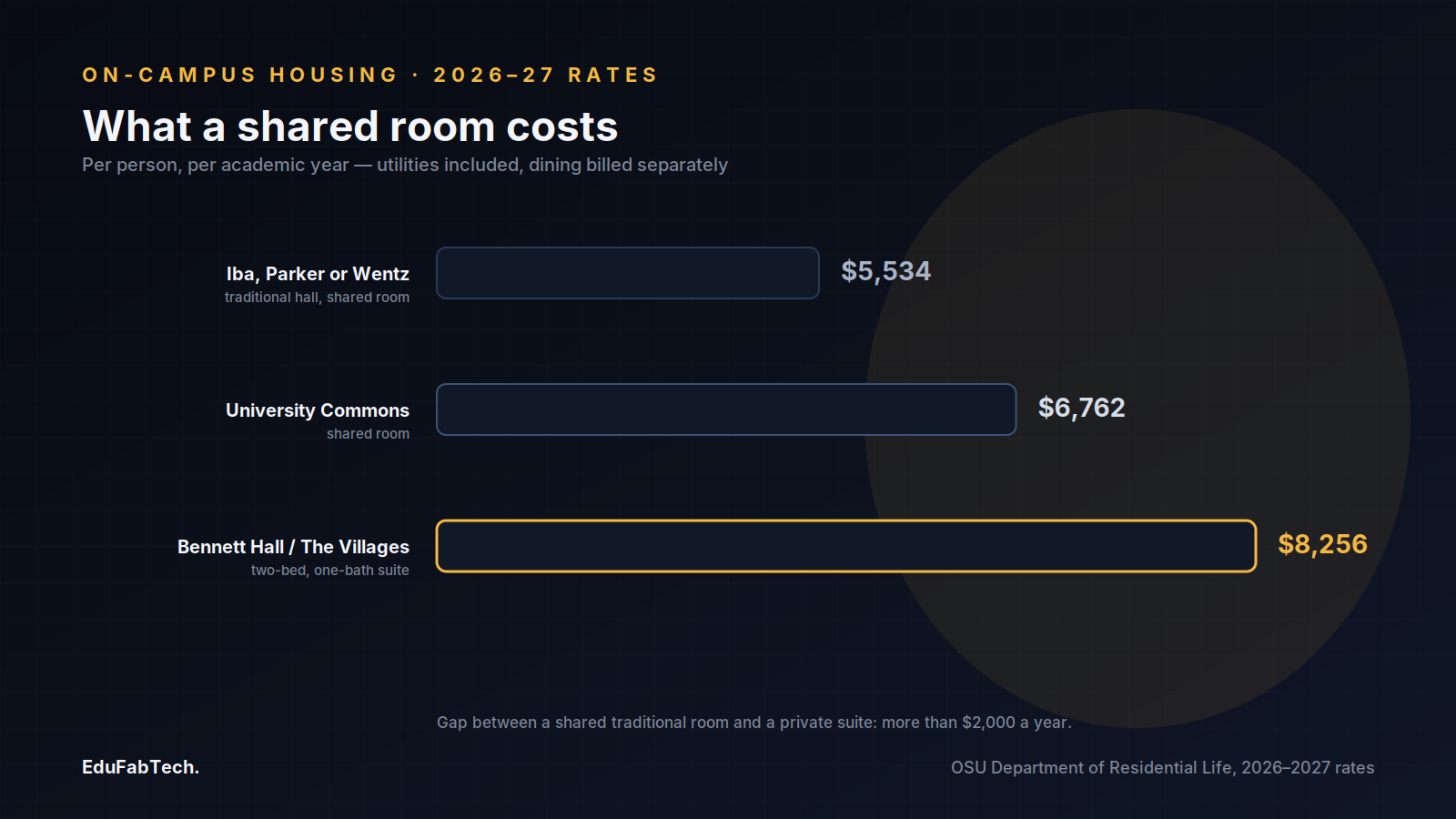
OSU's Department of Residential Life publishes its rates openly. For 2026–2027 it lists US$5,534 per academic year for a shared room in the traditional Iba, Parker or Wentz halls, rising to US$6,762 for a shared room in University Commons and US$8,256 for a two-bed, one-bath suite in Bennett Hall or The Villages; private rooms cost more in each category (OSU Department of Residential Life, 2026–2027 rates). Those figures are per person and include utilities; dining plans are billed separately. Reading the fee page yourself is worth it, because the gap between a shared traditional room and a private suite is more than US$2,000 a year — real money against a tight budget.
The off-campus ring, and renting there without losing a deposit
After first year, most students move into the belt of apartment complexes and rental houses west and south of campus — the streets off Washington Street, Duck Street and McElroy, and the newer complexes along the city's south and west edges. Leases here usually run twelve months and are signed in the spring for an August start, so the realistic search window is roughly January to April for the following academic year; by summer the best-located units near campus are gone. Rents in Stillwater are modest by US standards: the Census Bureau's QuickFacts put the median gross rent across the whole city at US$947 a month for 2020–2024 (U.S. Census Bureau), though a room in a shared student house near campus can sit below that and a new one-bedroom above it.
Rental scams in a town like Stillwater almost always follow the same pattern: a listing for a house or apartment at a price a little below everything else, a "landlord" who is conveniently out of state or travelling, and a request to wire a deposit or holding fee before you have seen the place. Do not send money that way. A legitimate Stillwater deposit is normally one month's rent, paid by cheque or card after you have signed a written lease and, ideally, seen the unit in person or had someone you trust view it. Never pay a deposit by bank wire, gift card or cryptocurrency to "hold" a room — those payments cannot be recovered, and no honest local landlord in Stillwater needs them. If you are abroad and cannot visit, ask for a live video walk-through, confirm the address exists on a map, and be wary of anyone who refuses. Student rooms and shares listed for the city are collected at /in/united-states/stillwater/rooms.
Furnishing a room for almost nothing
A Stillwater rental is usually unfurnished, so the first week often involves finding a bed, a desk and a few pots. The most reliable local source of cheap furniture is the Stillwater Habitat for Humanity ReStore at 505 East 18th Avenue, which sells donated furniture, appliances, home goods and building materials to the public at well below retail, with stock that changes constantly (Stillwater Habitat for Humanity). For food, produce and local goods, the Stillwater Farmers' Market runs at the Prairie Arts Center on South Duck Street — Saturday mornings from April through October and Wednesday mornings from May through October, moving indoors in winter (Stillwater Farmers' Market).
The other great furnishing season is the end of the academic year. When leases end in late July and early August, departing students leave behind usable furniture, and move-out giveaways are common in the apartment complexes near campus. It is worth walking those streets in the last week of July with a friend and a vehicle. EduFabTech gathers the city's second-hand furniture, including move-out giveaways, at /in/united-states/stillwater/furniture.
Working while enrolled
Part-time work in Stillwater mostly means on-campus jobs — dining, the library, labs, the union — plus retail and food service in town. For domestic students the limits are a matter of time management; for international students they are a legal condition of staying in status, so the rules matter.
Oklahoma State's Office of International Students and Scholars sets out the basics: a student on an F-1 visa may work on campus up to 20 hours per week while classes are in session and full-time during official school breaks, and must obtain an OSU on-campus work permit before starting (Oklahoma State University, Office of International Students and Scholars). These are federal rules administered through the Student and Exchange Visitor Program, not local policy, and anything beyond on-campus work — Curricular Practical Training or Optional Practical Training — needs separate authorisation arranged through your Designated School Official. This is not legal advice; confirm your own situation with the ISS office before you accept any job. Current openings students post locally are at /in/united-states/stillwater/jobs.
Where people actually study
The centre of study life is the Edmon Low Library, the landmark building with the clock tower at the head of the Library Lawn. It stays open 24 hours a day, five days a week during the fall and spring semesters, and has group study rooms — equipped with whiteboards and screens — that students can reserve online or at the circulation desk (Oklahoma State University, Edmon Low Library). Beyond the library, the Student Union has quieter corners, and most colleges keep their own study spaces for their students.
Off campus, the Stillwater Public Library at 1107 S. Duck Street is a genuine alternative when the university buildings are packed around exams. It issues free library cards to local residents who show photo ID and proof of a Stillwater address, and it offers study rooms, Wi-Fi and digital collections (City of Stillwater, Stillwater Public Library). It keeps evening hours midweek and shorter weekend hours, so it suits a late-afternoon session rather than an all-nighter. More desks and quiet spaces posted by students are listed at /in/united-states/stillwater/study-spaces.
Getting around: The Bus, a bike and the drive to the cities
Stillwater's public transport is The Bus, the OSU/Stillwater Community Transit system, operated by the university but open to everyone. For students it is one of the city's best bargains: all fixed-route service is fare-free to OSU students, faculty and staff who show a valid OSU ID card. The general public pays US$0.75 a trip, with a reduced US$0.35 fare for seniors, youth, riders with disabilities and Medicare cardholders, and the buses run Monday to Friday from 6:20 a.m. to 10:30 p.m. during the academic year (Visit Stillwater). The route network is modest — a handful of campus and city routes — and there is no weekend fixed-route service, which is the catch worth planning around.
Because the city is flat and small, many students simply cycle or walk; the core of campus to the nearest off-campus housing is a ten-to-fifteen-minute walk. The gap that defines life here is the one beyond the city limits: there is no commuter rail, and Tulsa and Oklahoma City are each about 70 miles away by highway, which in practice means a car (yours or a friend's) for anything the town itself cannot supply. Stillwater Regional Airport has limited commercial flights, but most long trips start with that highway drive.
The honest ledger: what is easy and what is hard
What Stillwater does well for students is affordability and scale-free convenience. Rents are low by national standards — that US$947 median gross rent (U.S. Census Bureau, 2020–2024) is well under what students pay in coastal college towns — the campus is walkable, the bus is free with an ID, and a town built around one university means student life, events and services are easy to find rather than scattered across a metropolis. The sense of a shared calendar, oriented around OSU, is real.
What is hard is mostly about isolation and weather. Without a car, the lack of weekend transit and the 70-mile distance to the nearest cities can feel confining, and job options off campus are limited to a small-town economy. Oklahoma summers are long and hot, and the state sits in a part of the Great Plains prone to severe spring storms and tornado watches — worth knowing when you choose housing and sign up for the city's emergency alerts. And the same seasonality that empties rooms cheaply in August also means the town quiets markedly in summer, which some students love and others find dull.
First two weeks: a short checklist
- Settle your room first. If you are in a hall, confirm move-in and check the Residential Life rates and dates; if off campus, read the full lease and keep a copy before paying anything.
- Get your OSU ID card — it is your free pass on The Bus and your access to the library and study rooms.
- International students: visit the Office of International Students and Scholars early to sort your on-campus work permit and understand the 20-hour rule before taking a job.
- Walk (or ride a bus route) from your room to the Edmon Low Library and the Student Union so you know your daily path before classes start.
- Furnish cheaply: check the Habitat ReStore on East 18th Avenue and the move-out giveaways near campus in the first week.
- Stock the kitchen at the Saturday Farmers' Market on South Duck Street.
- Sign up for the city and university emergency-alert systems — Oklahoma's spring storm season is not something to meet unprepared.
- If you do not have a car, make a plan for the occasional trip to Tulsa or Oklahoma City, since weekends have no fixed-route bus.
None of this is unique to being new in Stillwater, but the particular shape of it — a free campus bus, cheap rent, a long summer lull and a long drive to anywhere bigger — is. Learn those four things in your first fortnight and the rest of student life here falls into place.
A quick question for readers
Do you work part-time while you study?
Many students work to pay the bills. See how common it is — and how many hours people really do.
Pick an answer, create a free account in a minute, and your vote counts. Already a member? Sign in
Comments 0
CommentNo comments yet. Members start the conversation.
Source: U.S. Census Bureau
Sources (5)
- Oklahoma State University. About the University. Oklahoma State University (Academic Catalog), 2025. catalog.okstate.edu ↗ · checked 11 Oct 2026
- Langston University. At A Glance. Langston University, 2025. langston.edu ↗ · checked 11 Oct 2026
- Oklahoma State University. Current Housing Rates (2026–2027). OSU Department of Residential Life, 2026. reslife.okstate.edu ↗ · checked 11 Oct 2026
- U.S. Census Bureau. QuickFacts: Stillwater city, Oklahoma. U.S. Census Bureau, 2024. census.gov ↗ · checked 11 Oct 2026
- Visit Stillwater. OSU/Stillwater Community Transit (The Bus). Stillwater Convention & Visitors Bureau, 2026. visitstillwater.org ↗ · checked 11 Oct 2026