Studying in Tulsa: universities, housing and student life
A practical, honest guide to studying in Tulsa, Oklahoma — its universities from midtown to Greenwood, where students live, what a room costs, how to get around, and what is genuinely hard about the city.
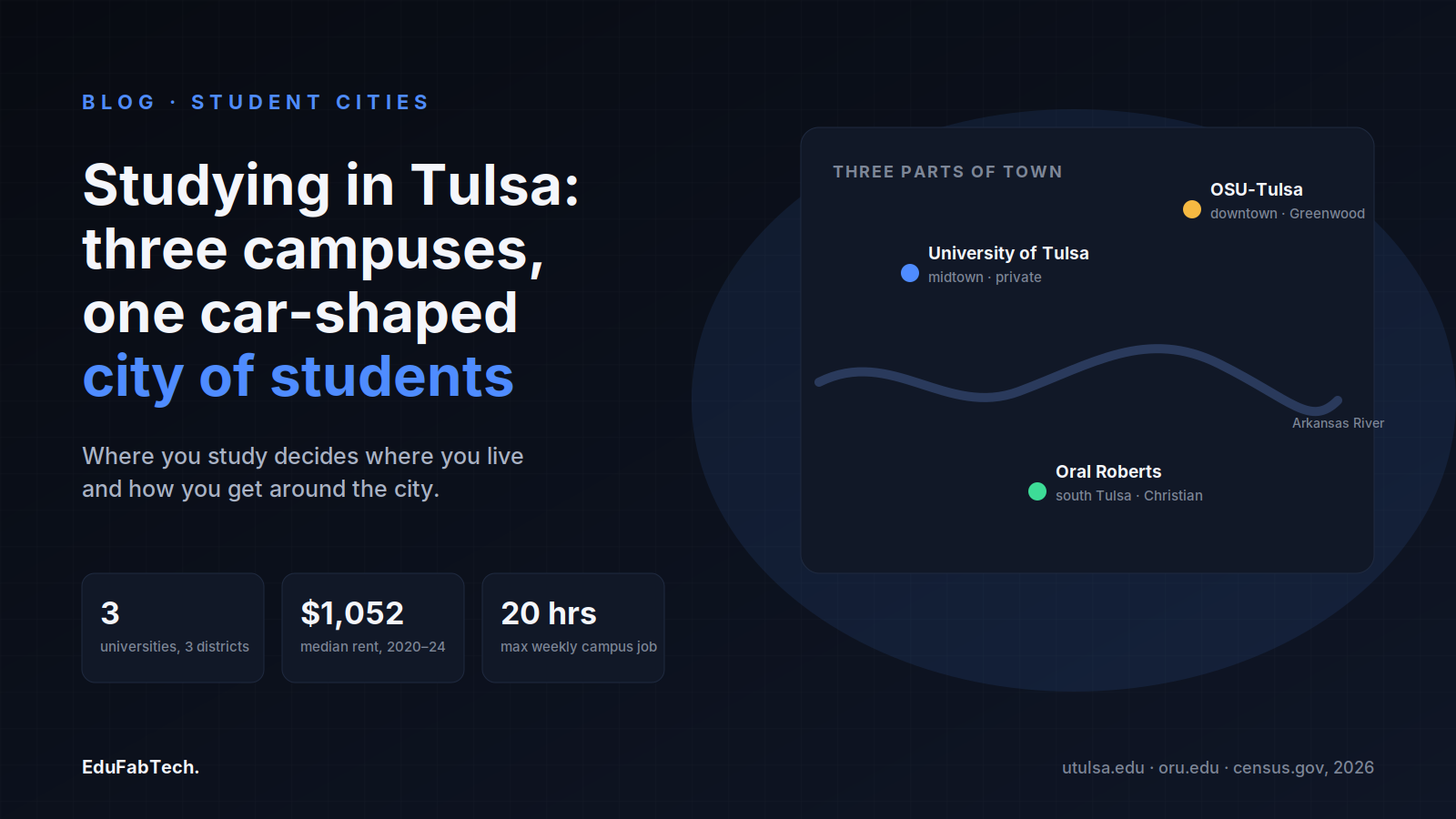
Tulsa sits on a bend of the Arkansas River in northeastern Oklahoma, where the flat farmland to the east meets the low Osage hills to the northwest. The oil money of the 1920s left it an unusually dense core of Art Deco buildings downtown, and Route 66 still runs through the city along Eleventh Street. For a student, the first thing to understand is that Tulsa is spread out and car-shaped: the universities sit in three different parts of town, and the distance between them is real. Where you study largely decides where you live and how you get around.
The three institutions that enrol most degree students are very different animals. The University of Tulsa is a small private research university in leafy midtown. Oral Roberts University is a Christian university on a distinctive modernist campus in south Tulsa. Oklahoma State University–Tulsa is a public branch campus downtown, in the historic Greenwood District. Add a career college and an aviation school, and Tulsa's student population is more varied than its size suggests.
This guide walks through those campuses, the neighbourhoods students pick, how to rent a room without being cheated, where to furnish it cheaply, the rules that apply to part-time work, the libraries and buses, and what a year honestly costs. Figures are dated and attributed so you can check them against the source yourself.
Four campuses, four different lives
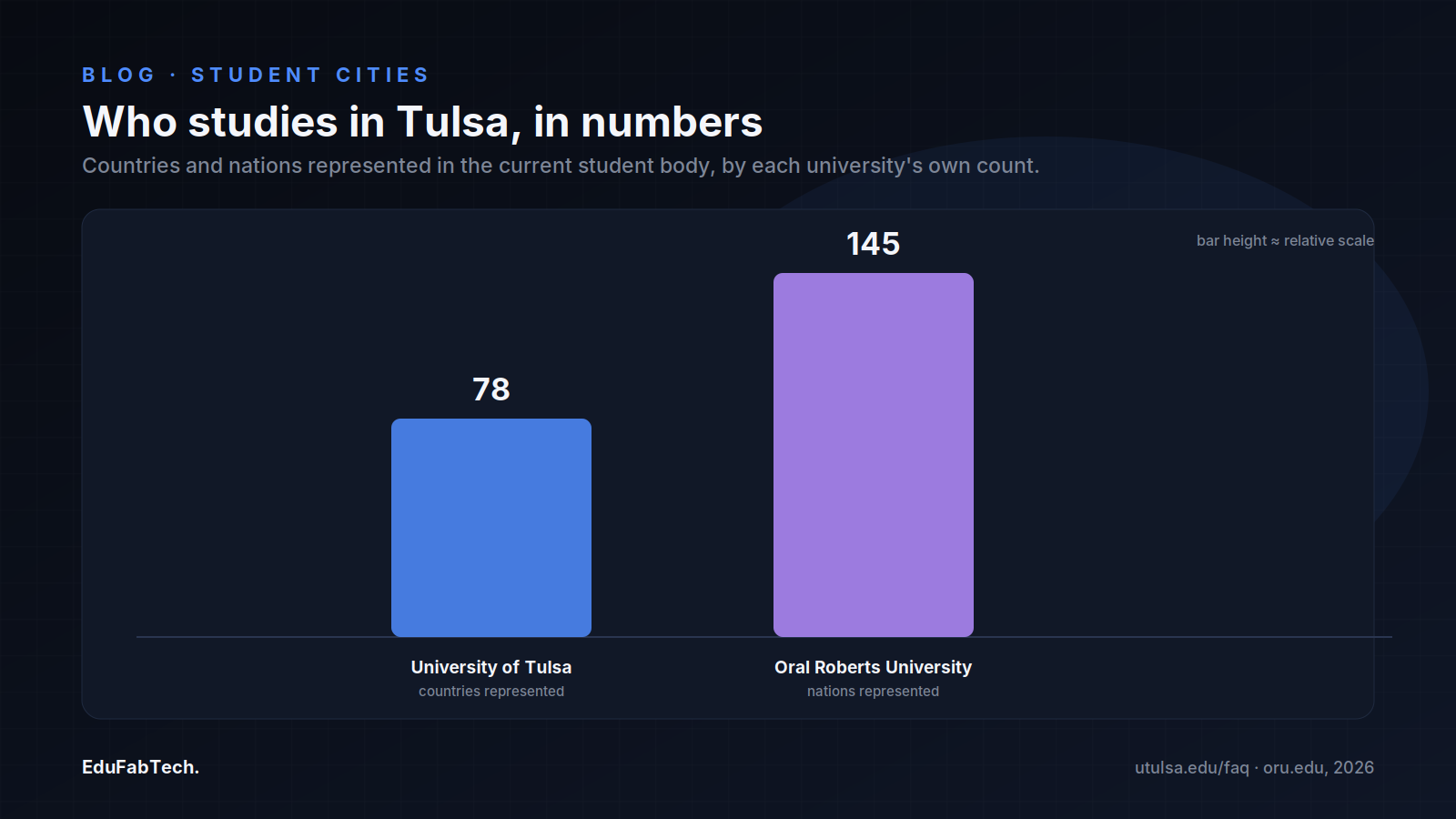
The University of Tulsa (TU) is the private research university most international applicants hear about first. Its own FAQ page (utulsa.edu, 2026) places the campus at 800 S. Tucker Drive in midtown on roughly 200 acres, reports an average class size of 12, and names engineering, business, cybersecurity and health sciences as its stronger fields, with students drawn from 78 countries (utulsa.edu/faq). It is small and walkable, which suits students who want to know their professors but should be weighed against the price tag of a private university.
Oral Roberts University (ORU) is a Christian, largely residential university at 7777 S. Lewis Avenue in south Tulsa. ORU's own general-information page (oru.edu, 2026) says it was founded in 1963 by Oral Roberts, enrols over 5,051 students and draws them from 145 nations (oru.edu). The campus is unmistakable — gold-mirrored towers and the Prayer Tower — and student life is organised around residence "wings" rather than Greek fraternities. Prospective students should read ORU's lifestyle commitments carefully before applying, because they shape daily life there.
Oklahoma State University–Tulsa (OSU–Tulsa) is the public option, a branch of the OSU system in downtown's Greenwood District. For most of its history it taught only upper-level and graduate students, but Oklahoma State's news service reported in 2025 that the campus would begin admitting first- and second-year students, so a full four-year OSU degree can now be earned in Tulsa (news.okstate.edu). It grants OSU bachelor's, master's and doctoral degrees, and its downtown location puts students next to Greenwood's history and the growing arts district.
Two more schools matter to specific students. Clary Sage College is a private career college at 3131 S. Sheridan Road offering programmes in cosmetology, barbering, esthetics, nail technology, massage therapy, and interior and fashion design; associate degrees are available through its sister school, Community Care College (clarysagecollege.com). Spartan College of Aeronautics and Technology, at 8820 E. Pine Street, trains pilots and aircraft technicians, offering associate degrees in aviation maintenance, flight and avionics and a bachelor's in technology management (spartan.edu/tulsa) — relevant given Tulsa's long aviation and aerospace industry.
Where students live, and what a room costs
Housing in Tulsa clusters by campus. Around TU, the practical neighbourhoods are Kendall-Whittier (immediately north and east of campus), the Cherry Street and Fifteenth Street corridor, and further out toward Brookside and Maple Ridge. Around ORU, students take apartments in south Tulsa near 71st and 81st Streets. Downtown and the near-east side suit OSU–Tulsa students, with the Pearl District and the edges of Greenwood within reach. Tulsa is a low-rise city, so "student housing" usually means a room in a shared house or a unit in a garden-style apartment complex rather than a tower block.
On-campus, the clearest dated figure comes from the University of Tulsa's own 2026–27 housing rates page. A double-occupancy room in its lowest tier (Tier 1, which includes halls such as John Mabee and Lottie Jane) is listed at $4,658 per person, per semester, rising through the tiers to $6,515 per person for an apartment-style Tier 5 room (utulsa.edu, 2026). Meal plans are charged separately. For the private rental market, the U.S. Census Bureau's QuickFacts put the median gross rent in Tulsa city at $1,052 a month over the 2020–2024 period (census.gov) — a citywide figure across all households, not a student-specific one, but a useful anchor. By big-city standards that is low, and it is one of Tulsa's real advantages.
Start looking earlier than feels necessary. Leases on the better rooms near TU and in Cherry Street turn over in late spring and early summer for an autumn move-in; by August the good ones are gone. If you are arriving from abroad and cannot view in person, ask your university's housing or international-student office whether they keep a vetted list, and consider a short-term arrangement for the first few weeks so you can see places with your own eyes before committing.
Renting safely in Tulsa
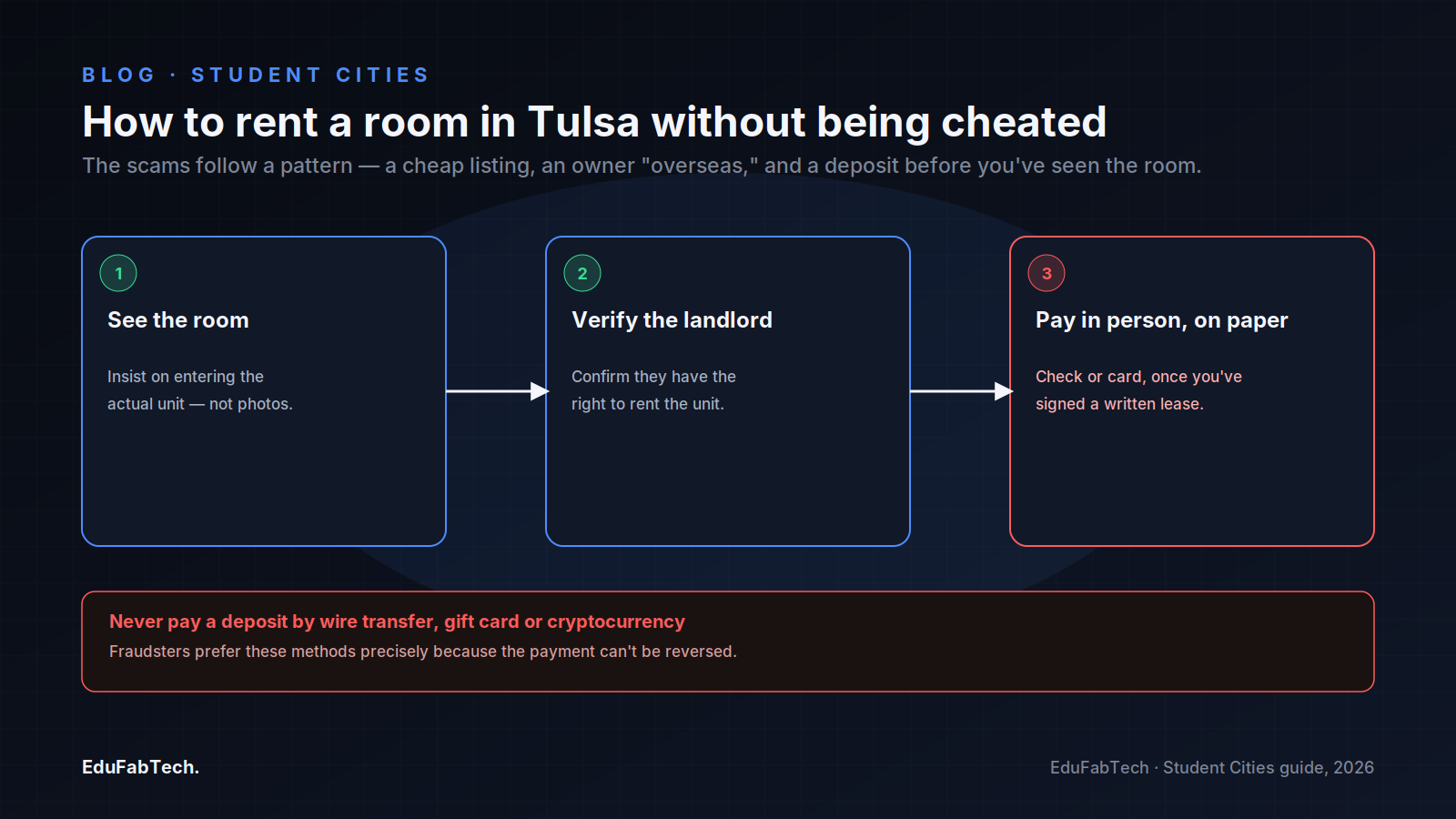
The scams that catch students here follow a pattern. A "landlord" lists a real-looking house — often in a desirable midtown street near TU, or a south-Tulsa complex near ORU — at a rent that is slightly too good, says they are out of state or overseas, and asks you to secure it with a deposit before viewing. Never send money to hold a room you have not entered. In Tulsa a normal arrangement is a security deposit of about one month's rent plus the first month, paid by cheque, card or bank payment to a named person or company once you have seen the unit and signed a written lease.
Treat these as firm rules: insist on seeing the actual room, not photographs; confirm the person showing it has the right to rent it; and never pay a deposit by bank wire transfer, gift card or cryptocurrency, which are the methods fraudsters prefer precisely because they cannot be reversed. If a listing pressures you to pay before viewing, walk away. Tulsa's winters bring occasional ice storms and its summers are hot and humid, so it is also worth checking heating, cooling and insulation before you sign — comfort here is seasonal, not theoretical.
Furnishing a room on little money
Because so much Tulsa housing is unfurnished, the second-hand economy matters. The best-known regular market is the Tulsa Flea Market at Expo Square (the fairgrounds on East 21st Street), which runs on Saturdays and is a reliable source of furniture, kitchenware and oddments. For food and local produce, the Tulsa Farmers' Market — long known as the Cherry Street market — now sets up in the Kendall-Whittier district on Saturday mornings in the warmer months (tulsafarmersmarket.org). Thrift shops are scattered along the main east–west commercial streets; the end of each semester, when students move out, is the cheapest time to pick up desks, chairs and small appliances.
If you would rather sort this out before you arrive, EduFabTech keeps Tulsa listings for second-hand furniture and things given away free.
Working while you study
Part-time work rules depend on your immigration status, and this is an area to read from the source rather than from hearsay. The U.S. Department of Homeland Security's Study in the States service states that an F-1 student doing on-campus employment "may not work more than 20 hours per week when school is in session" (studyinthestates.dhs.gov). Off-campus work — including Curricular Practical Training and Optional Practical Training — generally needs prior authorisation from your Designated School Official and, in many cases, from U.S. Citizenship and Immigration Services. This is not legal advice; confirm your own situation with your university's international-student office and the official DHS pages before you accept any job. Domestic students face no such limits, and campus jobs — library desks, dining halls, labs — are the usual starting point. EduFabTech's Tulsa jobs listings collect local part-time openings.
Libraries, desks and quiet corners
Tulsa's public study infrastructure is genuinely good. The Tulsa City-County Library's Central Library downtown is a renovated five-storey building with private and group study rooms, a maker space and a digital-literacy lab, all free to use (tulsalibrary.org); the system runs a Central Library plus regional branches and many neighbourhood branches across the county, so there is usually one near wherever you live. On the TU campus, McFarlin Library offers quiet reading rooms, carrels in the stacks and bookable individual and group study rooms (libraries.utulsa.edu); check its posted hours, which change around exam periods. For a quick scan of desks and quiet spaces across the city, see EduFabTech's Tulsa study-spaces listings.
Getting around — and why most people still have a car
Tulsa's buses are run by MetroLink Tulsa (the Metropolitan Tulsa Transit Authority), and the single best fact for students is this: MetroLink's College Program lets students from participating institutions ride any MetroLink bus free, by showing a pre-downloaded GoPass virtual pass or a MetroLink student ID card. The participating schools named on its own page are the University of Tulsa, Tulsa Community College, Tulsa Tech, Tulsa Welding School, Community Care College and NYU Tulsa (metrolinkok.org). To set it up, contact your school's student-life office for the GoPass or ID card. Riders without a college pass buy fares through the GoPass app or in cash; MetroLink's fares page lists the options, from short passes to a 31-day pass (metrolinkok.org/fares).
Be realistic about the limits. Tulsa was built around the car, bus routes are not dense, and evening and weekend service is thin, so the free pass is most useful if you live and study along a well-served corridor. Many students end up with a bike or a car. If you can live within walking or cycling distance of your campus — very doable around TU and downtown — you will save both money and frustration.
The honest ledger: what is good, what is hard
What is good: the cost of living is low for a city of its size, with that citywide median rent of $1,052 (U.S. Census Bureau, 2020–2024) well below the coastal norm. The riverfront Gathering Place park, a revived downtown arts scene, live music and a serious food culture give Tulsa more to do than outsiders expect. Campuses are small and personal, especially at TU. And Greenwood — once known as Black Wall Street — makes OSU–Tulsa's downtown setting a place with real historical weight.
What is hard: the city is spread out and public transport is limited, so without a car your options narrow quickly. The climate asks something of you — hot, humid summers, and winters that can deliver ice storms; Tulsa sits within the broad zone of Oklahoma that sees severe spring thunderstorms and the occasional tornado, so learn the local warning sirens and your building's shelter plan. And a private university like TU is expensive; the low rents outside campus are part of what makes the overall sum work for many students.
A checklist for your first two weeks
- Visit your university's housing and international-student offices in person; register with your Designated School Official if you are on a visa.
- Set up the GoPass app and ask student life for your MetroLink College Program pass or ID card before you need to travel.
- If you have not already signed a lease, view rooms in person first; pay a deposit only after seeing the place and signing, and never by wire, gift card or crypto.
- Get a Tulsa City-County Library card — it unlocks the Central Library's study rooms and the branch nearest you.
- Plan one Saturday for Expo Square's flea market and, in season, the Tulsa Farmers' Market to furnish and stock your room.
- Check your housing's heating and cooling, and find your building's severe-weather shelter point before the first storm warning.
- Browse EduFabTech's Tulsa rooms and listings near the University of Tulsa for what is available right now.
A quick question for readers
Do you work part-time while you study?
Many students work to pay the bills. See how common it is — and how many hours people really do.
Pick an answer, create a free account in a minute, and your vote counts. Already a member? Sign in
Comments 0
CommentNo comments yet. Members start the conversation.
Source: The University of Tulsa
Sources (5)
- The University of Tulsa. Housing Options & Rates. The University of Tulsa, 2026. utulsa.edu ↗ · checked 13 Oct 2026
- MetroLink Tulsa. College Program. Metropolitan Tulsa Transit Authority, 2026. metrolinkok.org ↗ · checked 13 Oct 2026
- U.S. Census Bureau. QuickFacts: Tulsa city, Oklahoma. U.S. Census Bureau, 2024. census.gov ↗ · checked 13 Oct 2026
- U.S. Department of Homeland Security. Working in the United States — Study in the States. U.S. Department of Homeland Security, 2025. studyinthestates.dhs.gov ↗ · checked 13 Oct 2026
- Oral Roberts University. General Information About ORU. Oral Roberts University, 2026. oru.edu ↗ · checked 13 Oct 2026