Studying in Waco: universities, housing and student life
A practical, sourced guide to studying in Waco, Texas — Baylor and the city's other campuses, where to live, what it costs, how to get around and the honest trade-offs.
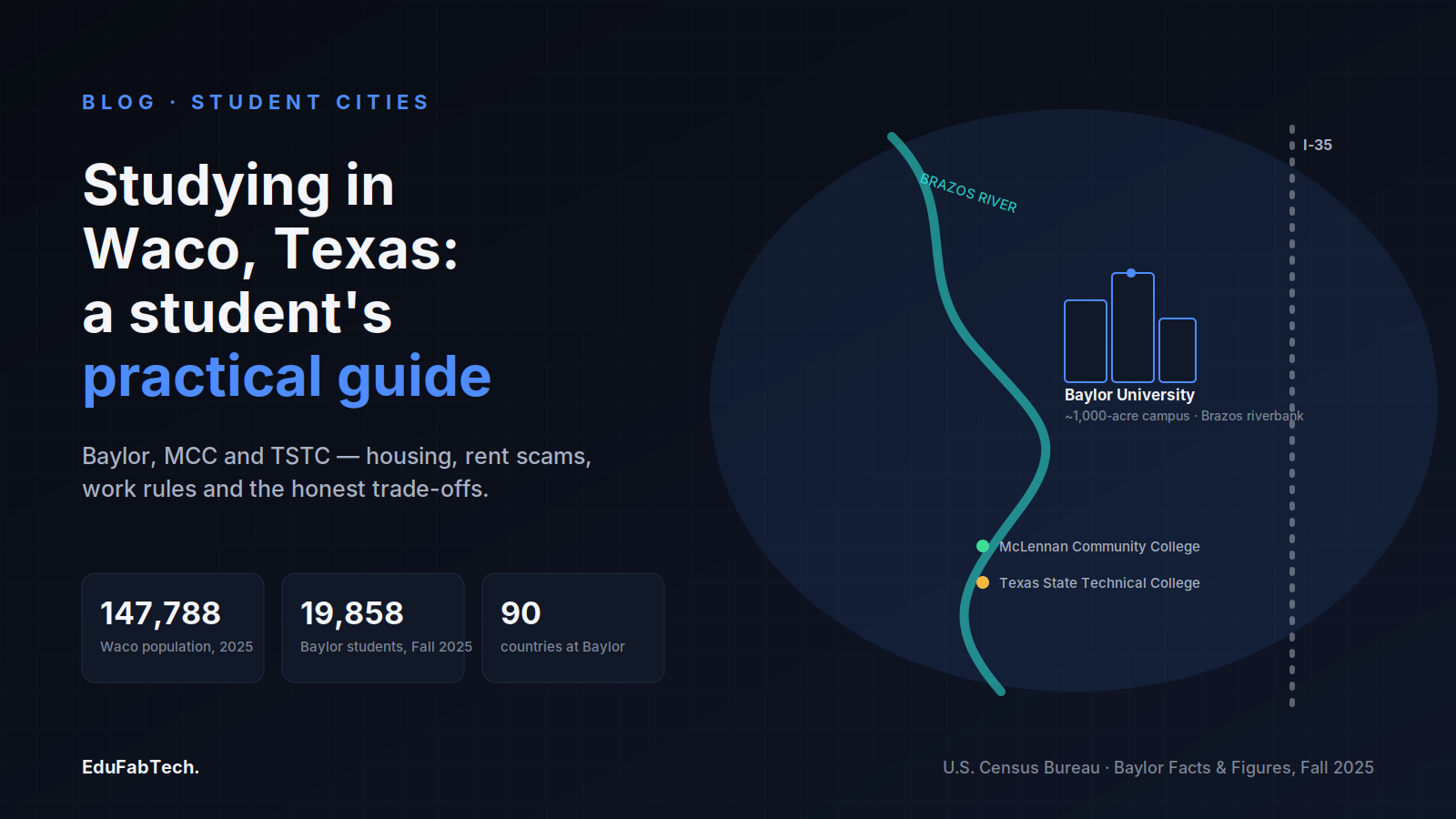
Waco sits almost exactly halfway along Interstate 35 between the Dallas–Fort Worth metroplex and Austin, wrapped around a bend of the Brazos River in Central Texas. For most students the city means one institution above all: Baylor University, whose campus runs along the river's western bank. But Waco is also a two-year and technical town, and the mix of a large private university, a community college and a technical college gives the student population here a wider range than the Baylor football crowds suggest.
This guide is for anyone weighing a move here — a first-year from elsewhere in Texas, a transfer student, or someone arriving from abroad on a student visa. It covers the campuses, where people actually live, how to rent without being cheated, what things cost with the figures attached to their sources, and the parts of Waco life that are genuinely harder than the brochures let on.
A word on scale: the U.S. Census Bureau's QuickFacts for Waco city, Texas put the population at 147,788 as of 1 July 2025. That makes Waco a mid-sized city — large enough to have a bus network, a public library system and several colleges, small enough that students and long-time residents share the same grocery stores and the same stretch of I-35.
Baylor, McLennan Community College and TSTC
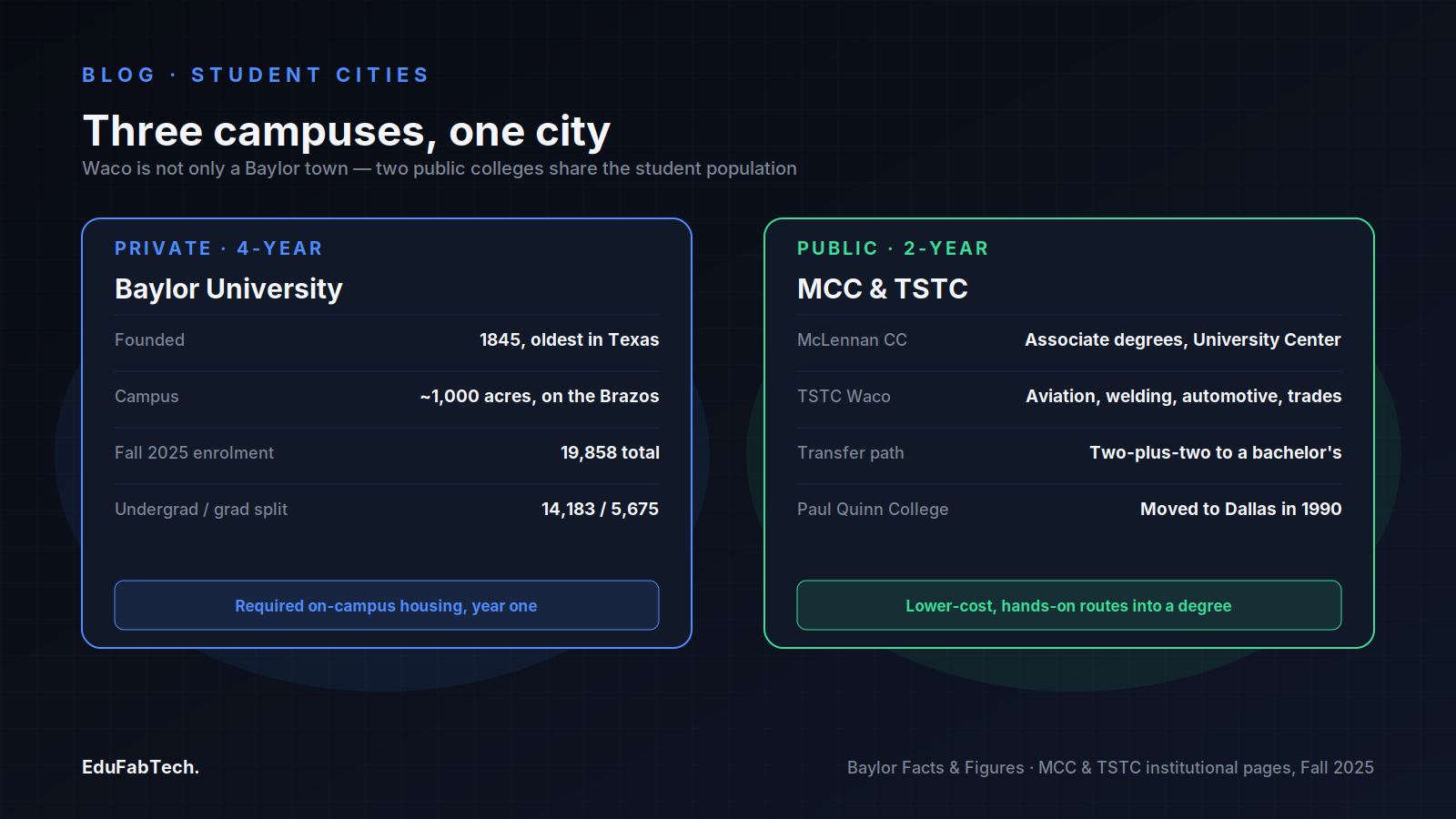
Baylor University is the anchor. According to the university's own Facts & Figures page, Baylor was chartered in 1845 by the Republic of Texas and is the oldest continually operating university in the state, with an approximately 1,000-acre campus on the Brazos River. The same page reports a total Fall 2025 enrolment of 19,858, split between 14,183 undergraduate and 5,675 graduate and professional students. It is a private Baptist university — the religious character is visible in required chapel and in the residential colleges — and Baylor says its undergraduates come from all 50 states and, per its Fall 2025 enrolment release, 90 countries. Degrees span the arts and sciences, business, engineering, nursing, law and a theological seminary.
Two public institutions share the city and matter a great deal to students who are not at Baylor. McLennan Community College (MCC) is a public two-year college on the north side of town granting associate degrees and certificates; its University Center partnership lets students finish a bachelor's or master's from partner universities without leaving Waco. Texas State Technical College (TSTC) runs a large Waco campus built around hands-on fields — aviation maintenance and pilot training, welding, automotive and industrial systems — and grants associate degrees and certificates. If your plan is a trade, a two-plus-two transfer, or a cheaper first two years, MCC and TSTC are the reason Waco is a student town and not simply a Baylor town.
One note for readers who find older references: Paul Quinn College, which was based in Waco from 1877, relocated to Dallas in 1990 and grants its degrees there now — so it is not a Waco option today.
Where students live
At Baylor, your first year is decided for you. The admissions office's Housing & Dining pages state that first-year students are required to live on campus for their first two semesters, in one of three community types: first-year communities, living-learning centres, or residential colleges. Two residential colleges (Brooks and Teal) ask for a two-year commitment, so read the contract before you choose them. Exemptions exist — chiefly for students who are 21 before classes start, are married, have dependants, or graduated from a McLennan County high school and live with a parent in the county.
After the first year, students scatter. The heaviest off-campus student concentration is the grid of streets immediately south and east of campus, between the university and I-35, where older houses and purpose-built apartment blocks sit within walking or cycling distance of class. Quieter, leafier options lie a little further out — the early-twentieth-century streets of Castle Heights, and the Austin Avenue corridor toward downtown, which law and graduate students favour. Further from campus, rents fall but you will need a car or a reliable bus route.
Start looking early. On-campus contracts and the best-located off-campus houses go first in late winter and spring for the following autumn; by midsummer the walkable units near campus are thin. For listings and rooms in the city, EduFabTech keeps a Waco page at /in/united-states/waco and a rooms section at /in/united-states/waco/rooms, and listings close to campus at /near/baylor-university.
Renting without being scammed in Waco
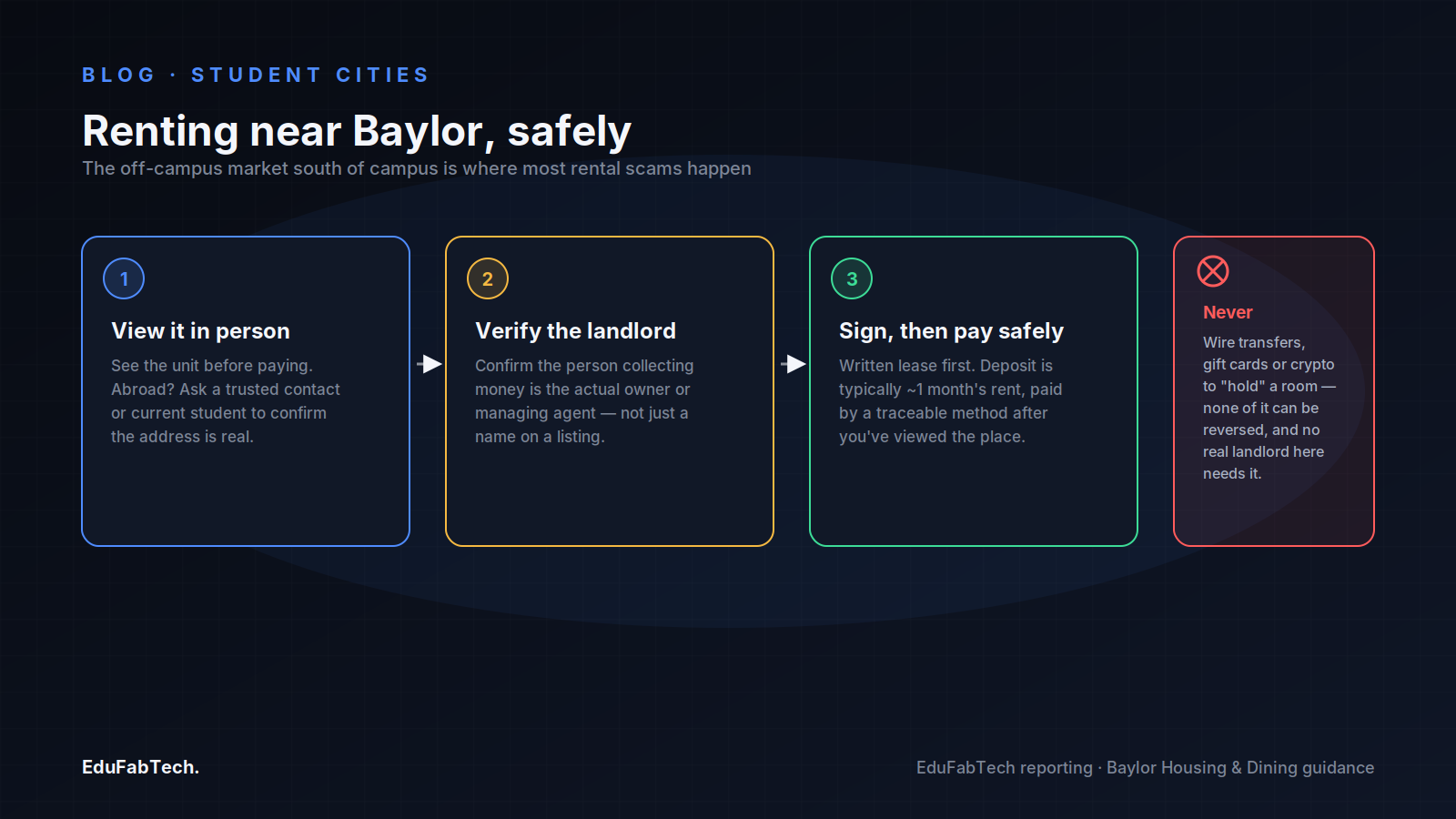
The off-campus market just south of Baylor is where most rental trouble happens here, because demand is seasonal and concentrated: a lot of students chase the same walkable houses in a short window, and that is exactly the pressure fake "landlords" exploit. The pattern is familiar — an unusually cheap house near campus, a person who cannot meet you because they are "out of town," and a request to send a deposit before you have seen the place.
Protect yourself with a few Waco-specific habits. See the unit in person before paying anything; if you are still abroad, ask someone you trust in Waco, or a current student, to view it and confirm the address is a real rentable property and not a photo lifted from a sale listing. Confirm the person collecting money is actually the owner or the managing agent. A normal arrangement here is a signed written lease and a security deposit — often around one month's rent — paid only after you have viewed the place, by a traceable method. Never wire money, buy gift cards, or send cryptocurrency to "hold" a room: those payments cannot be reversed, and no legitimate Waco landlord needs them. Get every promise about furniture, utilities and move-in date in writing.
Furnishing a room: thrift stores and markets
Waco is a good place to furnish a room cheaply because it has a dense cluster of charity and resale stores. Heart of Texas Goodwill Industries runs several shops in the area, including an outlet where goods are sold by the pound — useful for clothes and kitchenware on a tight budget. The Salvation Army operates a thrift store in town, and Habitat for Humanity's ReStore sells donated furniture, appliances and household goods, with proceeds funding local home-building. Between them you can kit out a first apartment for a fraction of retail; the trade-off is that stock is unpredictable, so go often rather than once.
For food and a sense of the city, the Waco Downtown Farmers Market runs every Saturday morning (9am–1pm), year-round, at Bridge Street Plaza, 200 E. Bridge Street downtown. It is the reliable weekly market students mention. EduFabTech also lists second-hand goods and giveaways for the city at /in/united-states/waco/second-hand, furniture at /in/united-states/waco/furniture and free items at /in/united-states/waco/free-stuff, which are worth checking at the end of each semester when departing students give things away.
Working while you study
If you are an international student on an F-1 visa, the rules on work are set by U.S. federal authorities, not by the university or employer, and they are strict. The Student and Exchange Visitor Program, run by U.S. Immigration and Customs Enforcement, states on its Employment pages that F-1 students may generally work on campus up to 20 hours per week while school is in session (and full time during official breaks), and that on-campus employment does not require separate work authorisation from USCIS. Off-campus work, including internships in your field, generally needs prior authorisation through Curricular Practical Training (CPT) or Optional Practical Training (OPT), arranged with your school's designated school official before you start. This is not legal advice: confirm your own situation with Baylor's International Student and Scholar Services, who serve as your DSO, and rely on the official ICE and USCIS pages rather than second-hand summaries.
For domestic students, Waco's student jobs are the usual mix — campus dining and libraries, retail, food service and tutoring — plus seasonal work around the city's tourism, which has grown sharply in the past decade. Local part-time listings are collected at /in/united-states/waco/jobs.
Libraries and places to study
Baylor's main study building is Moody Memorial Library, the larger of the two connected central libraries (Moody and Jesse H. Jones) at the heart of campus, with long weekday hours and extended or 24-hour access around exams. Baylor students also have the Texas Collection and specialist libraries for law and other fields.
Off campus, the city's public system is the Waco-McLennan County Library. Its Central Library at 1717 Austin Avenue is open, per the library's City of Waco page, Monday to Wednesday 10am–8pm, Thursday to Saturday 10am–6pm and Sunday 1–5pm, with branches elsewhere in town. A public library card is free to residents and gives you quiet desks, wi-fi and printing without a university login — handy for MCC and TSTC students and for anyone who wants a study spot away from campus. More desks and study spaces around the city are listed at /in/united-states/waco/study-spaces.
Getting around
Public transport is run by the Waco Transit System, a City of Waco department. Its fares page lists a full fixed-route fare of $1.50 per single ride, a day pass at $3 and a 31-day pass at $40, with reduced $0.50 fares for seniors, Medicare and disabled riders. The part that matters most to students: the same page states that Waco ISD, MCC, TSTC and Baylor students ride free on the fixed routes by showing a valid school student ID — no extra pass or Waco Transit ID needed. Students from other schools pay $1.00 per ride or $20 for a 31-day pass. Baylor also runs its own free campus shuttle, the Baylor University Shuttle (B.U.S.).
In practice, Waco is a car-oriented city, and the fixed-route network is modest compared with buses in larger places; off-peak frequencies and evening coverage are limited, so many students who live beyond walking distance keep a bicycle or a car. If you are choosing a neighbourhood without a car, check which route serves it and how late it runs before you sign a lease.
What it costs, and what is hard
Housing is the figure to pin down first. Baylor's Campus Living & Learning office publishes its Residence Hall Room Rates for 2026–2027, which run from $4,165 per semester for a triple room with a community bath up to $6,620 per semester for an apartment-style single, with most standard double rooms in the $4,720–$5,090 range per semester; some communities add program fees of roughly $100–$350 per semester, and a meal plan is separate. Those are per-semester figures, so double them for a year and add dining.
Off campus, the city-wide benchmark is the U.S. Census Bureau's QuickFacts for Waco, which reports a median gross rent of $1,165 per month for 2020–2024 and a median household income of $54,365 (in 2024 dollars) over the same period. Student rents near campus can sit above the citywide median because of location and demand; the figure is a floor for expectations, not a quote. These are the only two reliable, dated housing numbers to lean on — Baylor's own rate sheet and the Census median — so treat any other figure you see as an estimate until you can source it.
The honest trade-offs: Waco's cost of living is lower than Austin's or Dallas's, which is a real advantage, and the compact core near Baylor is walkable. Against that, the city is spread out and built for driving, so without a car you are tied to a thin bus network; the off-campus rental market near campus is tight and seasonal; and Central Texas summers are long and hot, with high temperatures common well into the autumn term. Waco's national profile has risen with tourism, which brings crowds and traffic downtown on weekends but also more part-time work. It is a quieter place than a big metro — a plus for study, a minus if you want a large city's nightlife and transit.
A checklist for your first weeks
- Sort housing against the rules: if you are a Baylor first-year, confirm your on-campus assignment; otherwise view any off-campus place in person before paying, and never wire a deposit or pay by gift card or crypto.
- Bring your student ID and ride the fixed-route buses free if you are at Baylor, MCC or TSTC; otherwise budget $1.00–$1.50 per ride or a 31-day pass.
- Get a free Waco-McLennan County Library card for off-campus study space, wi-fi and printing.
- International students: meet Baylor's International Student and Scholar Services early, and read the ICE and USCIS employment rules before taking any job.
- Furnish from Goodwill, the Salvation Army and the Habitat ReStore, and watch end-of-semester giveaways; shop the Waco Downtown Farmers Market on Saturday mornings.
- If you live beyond walking distance, confirm your bus route's evening hours — or plan for a bike or car.
- Check EduFabTech's Waco pages for rooms, jobs and local events as you settle in.
A quick question for readers
Do you work part-time while you study?
Many students work to pay the bills. See how common it is — and how many hours people really do.
Pick an answer, create a free account in a minute, and your vote counts. Already a member? Sign in
Comments 0
CommentNo comments yet. Members start the conversation.
Source: Baylor University
Sources (5)
- Baylor University. Facts & Figures. Baylor University, 2025. about.web.baylor.edu ↗ · checked 14 Oct 2026
- Baylor University Campus Living & Learning. Residence Hall Room Rates 2026-2027. Baylor University, 2026. cll.web.baylor.edu ↗ · checked 14 Oct 2026
- U.S. Census Bureau. QuickFacts: Waco city, Texas. U.S. Census Bureau, 2025. census.gov ↗ · checked 14 Oct 2026
- City of Waco. Transit System and Fares. City of Waco, 2026. waco-texas.com ↗ · checked 14 Oct 2026
- U.S. Immigration and Customs Enforcement. Employment (Student and Exchange Visitor Program). ICE, 2026. ice.gov ↗ · checked 14 Oct 2026