Studying in Williamsburg: universities, housing and student life
A practical, sourced guide to William & Mary, nearby Christopher Newport, and the cost of living, housing, work rules and transport in a small Virginia city where the campus and a colonial capital share the same streets.
A colonial capital that works as a campus town
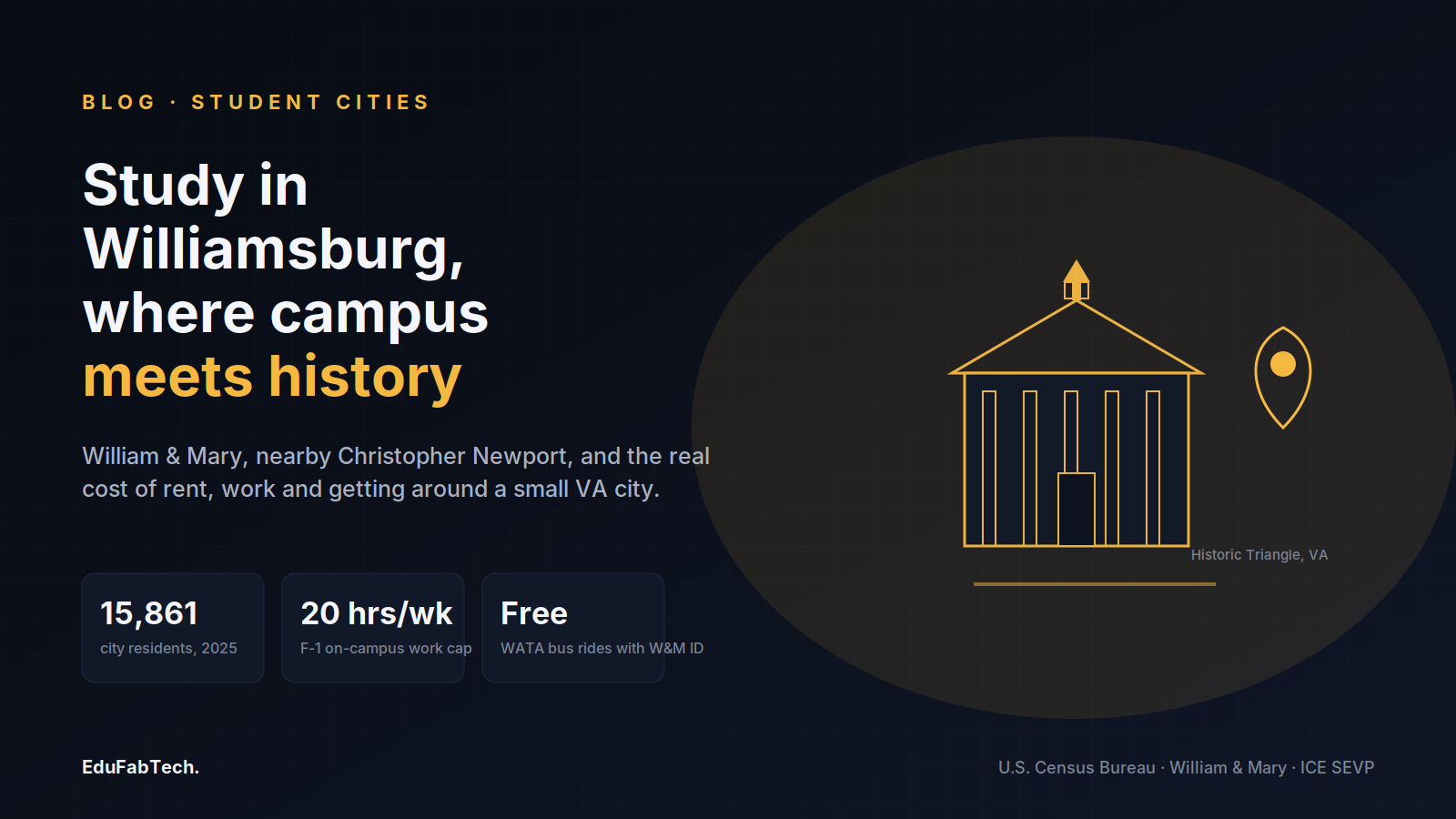
Williamsburg sits on the Virginia Peninsula, the strip of land between the James and York rivers that locals call the Historic Triangle, alongside Jamestown and Yorktown. It is a small place: the U.S. Census Bureau's QuickFacts put the city's population at 15,861 as of its July 2025 estimate (census.gov). Most college towns grew up around a university; Williamsburg did it the other way around, as the capital of colonial Virginia before the seat of government moved inland, and the restored historic district now wraps around a campus that has stood here since the seventeenth century.
That history is not background scenery here. Colonial Williamsburg's reconstructed Duke of Gloucester Street — closed to traffic, worked by costumed interpreters and the odd horse-drawn carriage — runs a short walk from lecture halls, and students cut through it daily. The practical consequence for anyone studying here is a town built for about fifteen thousand residents and several million tourists a year, which shapes rents, jobs and how busy the centre feels in summer. The student population leans heavily on one institution, with a second within a half-hour drive.
The universities: William & Mary, and Christopher Newport nearby
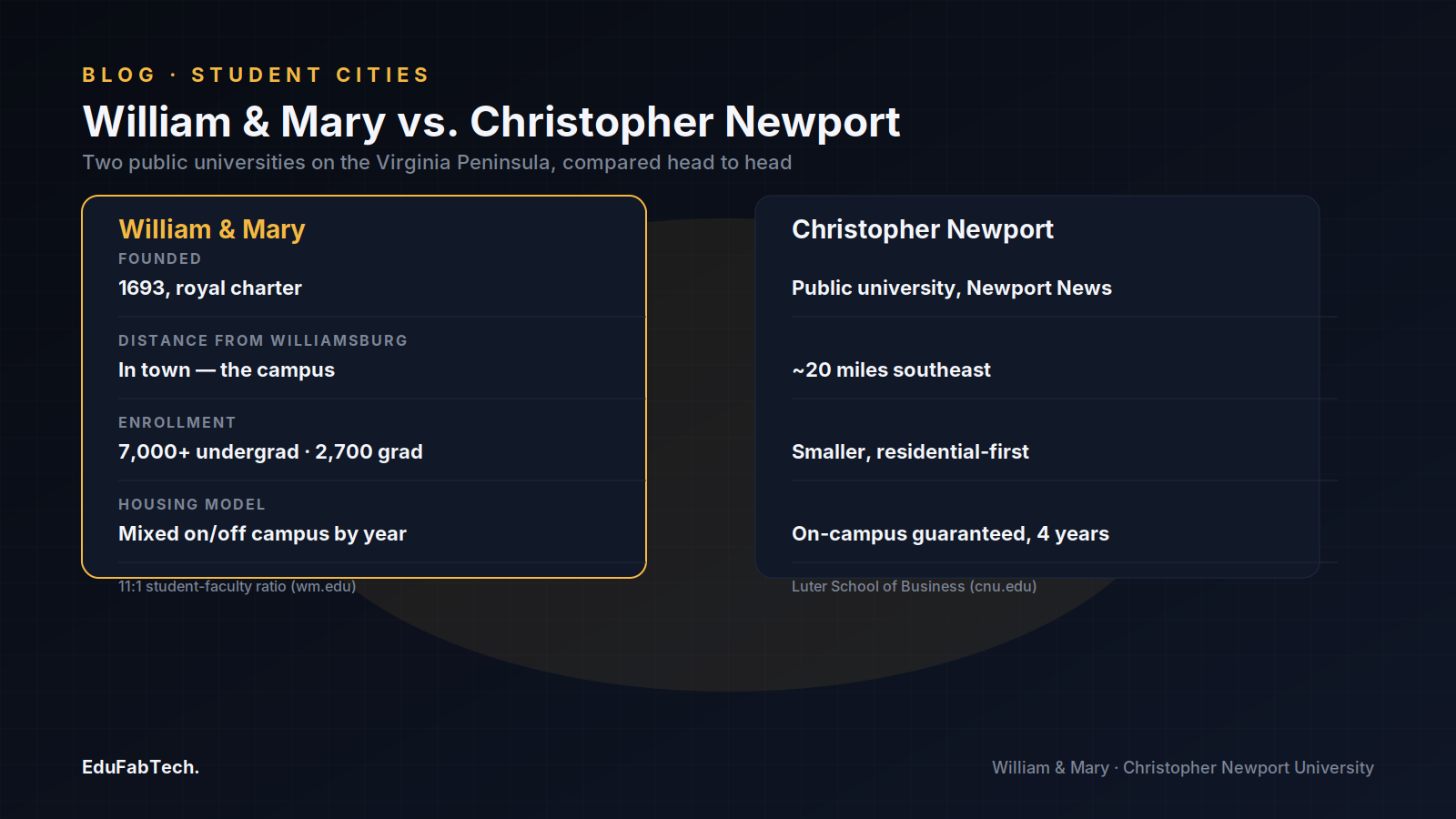
The College of William & Mary is the city's centre of gravity. A public research university founded under a royal charter issued by William III and Mary II in 1693, it is among the oldest institutions of higher education in the country, and its own figures describe more than 7,000 undergraduates and about 2,700 graduate students (wm.edu). The campus steps back in time as you walk west: the Ancient Campus around the Wren Building gives way to the Sunken Garden, then to twentieth- and twenty-first-century science buildings and residence halls off Jamestown and Richmond roads. It is known for a strong undergraduate liberal-arts core, its law and business schools, and a long list of alumni in American public life. Teaching tends to be small-group; the university's undergraduate admission page reports a student-faculty ratio of 11:1 (wm.edu).
Christopher Newport University (CNU) is the other option most Williamsburg-area students weigh, about 20 miles southeast in Newport News. It is a smaller public university with a tightly managed residential model: CNU states that it guarantees on-campus housing to incoming first-year students for their next three years, and expects undergraduates to live on campus (cnu.edu). It is known for liberal arts and its Luter School of Business. Further down the Peninsula, in Hampton, is Hampton University, a historically Black private university founded in 1868 as Hampton Institute — worth knowing about if you are comparing Peninsula campuses, though it is a 30-to-40-minute drive and a different city.
Where students live, and finding a room without being scammed
At William & Mary, first- and second-year students mostly live in college housing, from the older halls near the Sunken Garden to apartment-style buildings such as Ludwell and the Graduate Complex. Upper-year students increasingly move off campus, and this is where local geography matters. The three corridors students know are Richmond Road running northwest past fraternity houses and older rentals, Jamestown Road toward the river, and New Town and Midtown, newer mixed-use developments a couple of miles out with purpose-built apartments. Because the city is small and tourist-facing, the off-campus rental stock is thinner than in a big university city, and the good listings near campus go early — start looking a full semester ahead for the autumn intake.
Rental scams in Williamsburg follow the pattern you see in any tight, seasonal market: a too-cheap room advertised with stock photos, a "landlord" who is conveniently out of town, and pressure to send a deposit to hold it before you have seen anything. The defence is simple and local. View the actual unit in person, or send a friend who is already on campus; meet whoever collects the money; and check the address against a map before you pay. A normal arrangement in Virginia is a signed lease with a security deposit capped by state law at no more than two months' rent, paid by a traceable method. Never wire a deposit, buy gift cards, or send cryptocurrency to "reserve" a room for someone you have not met — no legitimate landlord in this town requires that. William & Mary's off-campus housing office and the international students office can both sanity-check a lease before you sign; use them.
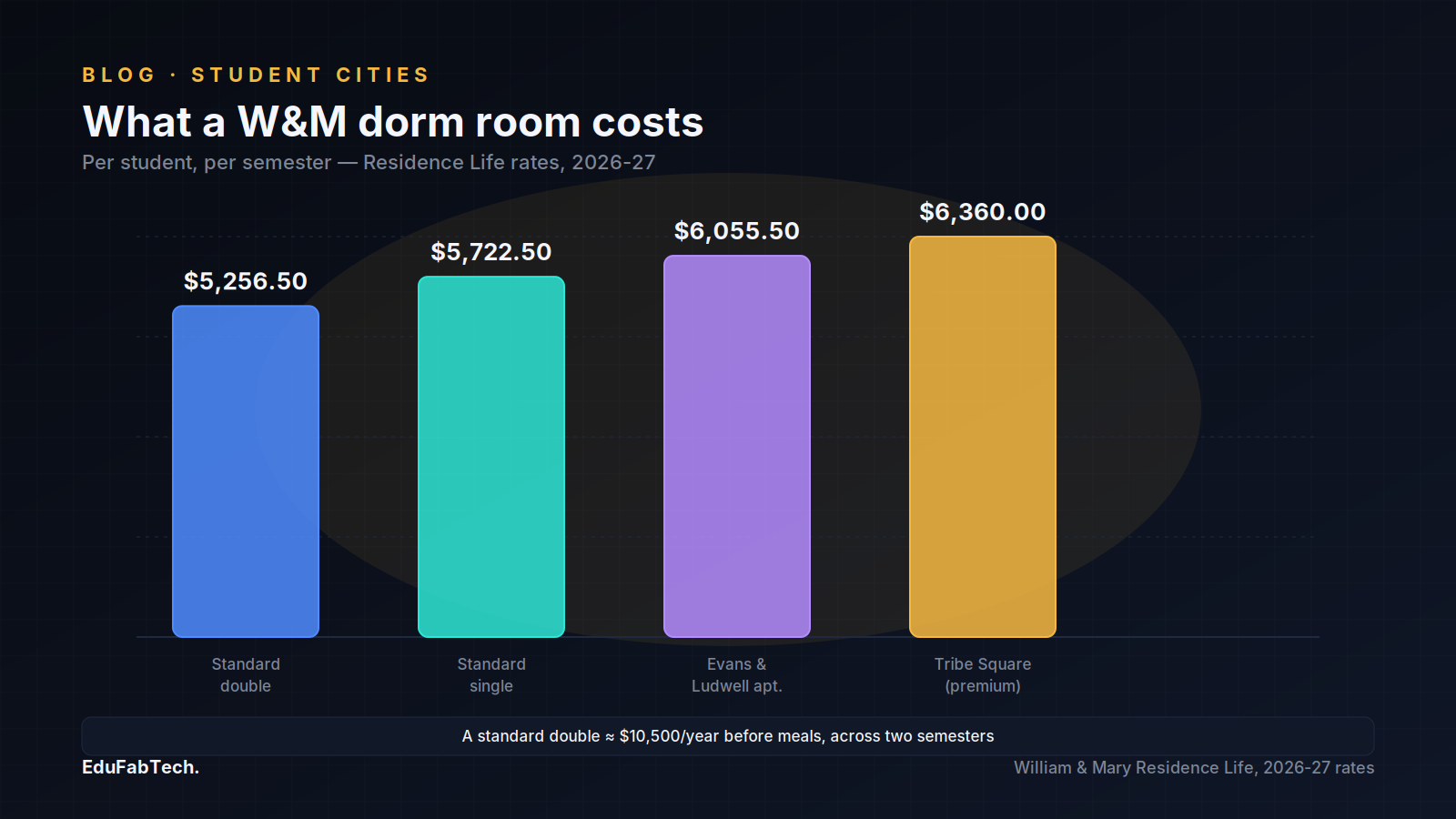
On cost, the most reliable dated number is the university's own. For 2026-27, William & Mary's Residence Life office lists a standard double room at $5,256.50 per student per semester and a standard single at $5,722.50, with newer premium halls and Tribe Square at $6,360.00 and the Evans and Ludwell apartments at $6,055.50 (wm.edu). Those figures are per semester, so a standard double works out to roughly $10,500 for the academic year before meals. Off-campus rents vary too much by corridor and roommate count to quote a single reliable figure, which is exactly why the dorm rate is the honest anchor to budget against.
Furnishing a room cheaply: the ReStore and the Saturday market
You do not need to buy new to fill a room here. The anchor for second-hand furniture is the Habitat for Humanity ReStore at 1303 Jamestown Road, a short hop from campus and run by Habitat for Humanity Peninsula and Greater Williamsburg, which sells donated and gently-used furniture, appliances, home accessories and building materials at a fraction of retail (habitatpgw.org). Goodwill of Central and Coastal Virginia also runs a Williamsburg store with the usual rotating mix of clothing, kitchenware and the occasional desk. Between those two, a solid-wood desk or a dresser is a weekend errand, not a shopping trip.
For food and the rhythm of the town, the Williamsburg Farmers Market runs seasonally on Saturdays from 8:00 a.m. to noon in Merchants Square, the shopping block between the historic district and campus, with more than 40 Virginia vendors (merchantssquare.org). It is produce and prepared food rather than furniture, but it is the cheapest way to learn the place and is walkable from most student housing. If you would rather see what other students are selling or giving away as they move out, EduFabTech keeps city-specific listings for second-hand things, furniture and free stuff in Williamsburg.
Working while you study
Part-time work is possible but constrained, and the rules depend on your immigration status rather than on the city. International students on an F-1 visa may, with their school's approval, work on campus up to 20 hours per week while classes are in session and full-time during official breaks, according to U.S. Immigration and Customs Enforcement's Student and Exchange Visitor Program (ice.gov). Off-campus work generally requires separate authorisation — Curricular Practical Training or Optional Practical Training — which U.S. Citizenship and Immigration Services describes in its policy manual on practical training (uscis.gov). This is a pointer to the official sources, not legal advice: before you take any job, confirm the specifics with your Designated School Official at William & Mary's or CNU's international office, because a misstep on employment can affect your status. On-campus roles — library desks, dining, research and administrative jobs — are the usual starting point because they are built to fit the F-1 rules. EduFabTech also lists local part-time work in Williamsburg.
Libraries and places to study
The main study building is Earl Gregg Swem Library at William & Mary, which offers 27 reservable group-study rooms across its first three floors, bookable two hours at a time through the library's LibCal system, plus individual Zoom cubes and a media centre (libraries.wm.edu). Term-time hours run late on weeknights, so it is where most of campus ends up before exams. If you want quiet away from the student crowd, the town's public system is genuinely good: the Williamsburg Regional Library runs the Williamsburg Library at 515 Scotland Street and the James City County Library on Croaker Road, serving the city, James City County and York County (wrl.org); its own records note it was named the 2023 Virginia Library of the Year by the Virginia Library Association (wrl.org). A public library card is free to residents of the service area and gives you desks, Wi-Fi and meeting rooms without a university ID. More desks and study spaces around town are listed on EduFabTech's study-spaces page.
Getting around without a car
Williamsburg is compact enough to walk or cycle for most campus errands, and the public option is unusually generous to students. The Williamsburg Area Transit Authority (WATA) runs the local buses, and its fare table lists William & Mary students, faculty and staff as riding free with a valid university ID; for everyone else a single ride is $1.50 and an all-day pass is $3.00 (gowata.org). WATA's routes connect campus to Merchants Square, New Town, the outlet shopping and points down the Peninsula, which matters if your apartment is in Midtown rather than on Richmond Road. There is no rail or metro system; for trips to Richmond, Norfolk or Washington you are looking at intercity bus, Amtrak from the Williamsburg Transportation Center, or a car. For day-to-day student life, the free WATA bus plus a bicycle covers most of what you need.
What is good, and what is hard
The good is real. Williamsburg is safe, walkable and quiet, with a strong flagship university, small classes, good libraries and a free campus bus — a combination that is rare and genuinely pleasant for focused study. The historic district and the rivers are on your doorstep, and the pace suits people who want to read rather than queue. The hard parts are the flip side of being small. The off-campus rental market is thin and seasonal, so rooms near campus are competitive and you must plan early. The town empties of students but fills with tourists in summer, which pushes up prices and can make part-time service jobs feast-or-famine. Without a car, your world is largely the WATA network, and anything beyond the Peninsula takes planning. Winters are mild by American standards but summers are hot and humid. And a fifteen-thousand-person town will feel small to anyone used to a capital city — the nightlife is modest, and "going out" often means Merchants Square or a drive to Newport News. Weigh that honestly against the calm, because for some students the calm is the whole point.
A checklist for the first weeks
- Sort housing before you arrive: if you are not in college housing, view the unit or send someone you trust, and never pay a deposit by wire, gift card or crypto.
- Get your university ID early — it is your free WATA bus fare and your Swem Library and building access.
- Open a Williamsburg Regional Library account; it is free in the service area and gives you a second set of quiet study rooms.
- If you are on an F-1 visa, meet your Designated School Official before taking any job, and keep your work on campus and within 20 hours a week in term time unless authorised otherwise.
- Furnish from the Habitat ReStore on Jamestown Road and the Saturday market rather than buying new.
- Learn two or three WATA routes that link your housing to campus and Merchants Square, and get a bike if you can.
- Browse local listings for rooms and everything else students post in the city on EduFabTech's Williamsburg page, and the listings near William & Mary.
A quick question for readers
Do you work part-time while you study?
Many students work to pay the bills. See how common it is — and how many hours people really do.
Pick an answer, create a free account in a minute, and your vote counts. Already a member? Sign in
Comments 0
CommentNo comments yet. Members start the conversation.
Source: William & Mary Residence Life
Sources (5)
- William & Mary Residence Life. 2026-27 Room Rates. College of William & Mary, 2026. wm.edu ↗ · checked 11 Oct 2026
- Williamsburg Area Transit Authority. Fares and Passes. WATA, 2026. gowata.org ↗ · checked 11 Oct 2026
- U.S. Immigration and Customs Enforcement. Employment (SEVP). ICE, 2026. ice.gov ↗ · checked 11 Oct 2026
- Christopher Newport University. Residency Guarantee. CNU, 2026. cnu.edu ↗ · checked 11 Oct 2026
- U.S. Census Bureau. QuickFacts: Williamsburg city, Virginia. U.S. Census Bureau, 2025. census.gov ↗ · checked 11 Oct 2026