Studying in Winston-Salem: universities, housing and student life
A practical, sourced guide to studying in Winston-Salem, North Carolina — the campuses, where students live, what rooms and the bus cost, and the honest trade-offs.
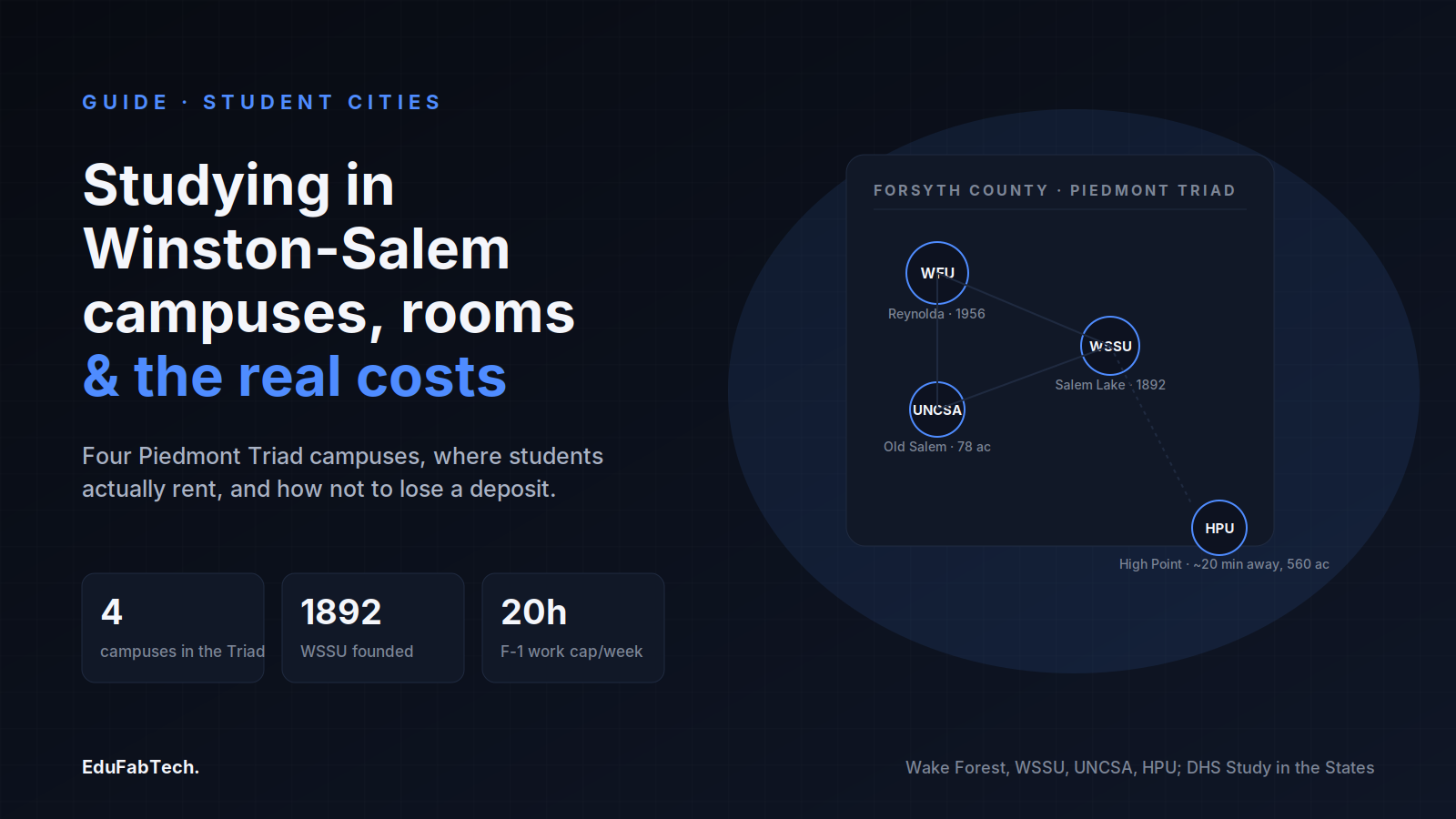
Winston-Salem sits in the Piedmont Triad of North Carolina, a cluster of mid-size cities that also includes Greensboro and High Point. Its name carries its history: the Moravian town of Salem, founded in the eighteenth century, and the nineteenth-century trading town of Winston grew together and formally joined as one municipality. Tobacco built the modern city — the R.J. Reynolds Tobacco Company gave it the nickname "Camel City" — and the old factory district downtown has since been rebuilt around medical research and start-ups rather than cigarettes.
For students, that history matters in a practical way. Three very different public and private institutions share one compact city, and a fourth large campus sits twenty minutes down the road in High Point. You can study an arts conservatory programme, a research-university curriculum, or a historically Black university's nursing degree without leaving Forsyth County. The city is big enough to have a downtown, farmers' markets and a bus network, and small enough that rents are well below those of Charlotte or the Research Triangle.
This guide walks through the universities, where students actually end up living, how to rent without being cheated, what rooms and the bus cost with the sources attached, and the parts of life here that students tend to find frustrating. Where a figure appears, the institution and year appear with it, and the link points at the page that carries the number.
The campuses, and what studying at each is like
Wake Forest University is the private research university most people mean when they say they are "at Wake." Its Reynolda Campus occupies the leafy north-west of the city. According to Wake Forest's own history, the institution accepted an invitation from the Z. Smith Reynolds Foundation to move roughly 100 miles west from the town of Wake Forest to Winston-Salem; construction began in 1952 and the new campus opened in 1956 on land that had been part of the R.J. Reynolds estate, a gift from Charles and Mary Reynolds Babcock (about.wfu.edu/history). The university notes that the campus has kept the look of its original 14 Georgian-style buildings. Reynolda Village and the Reynolda Gardens sit within walking distance, which is part of why the campus feels enclosed and parklike rather than woven into the street grid.
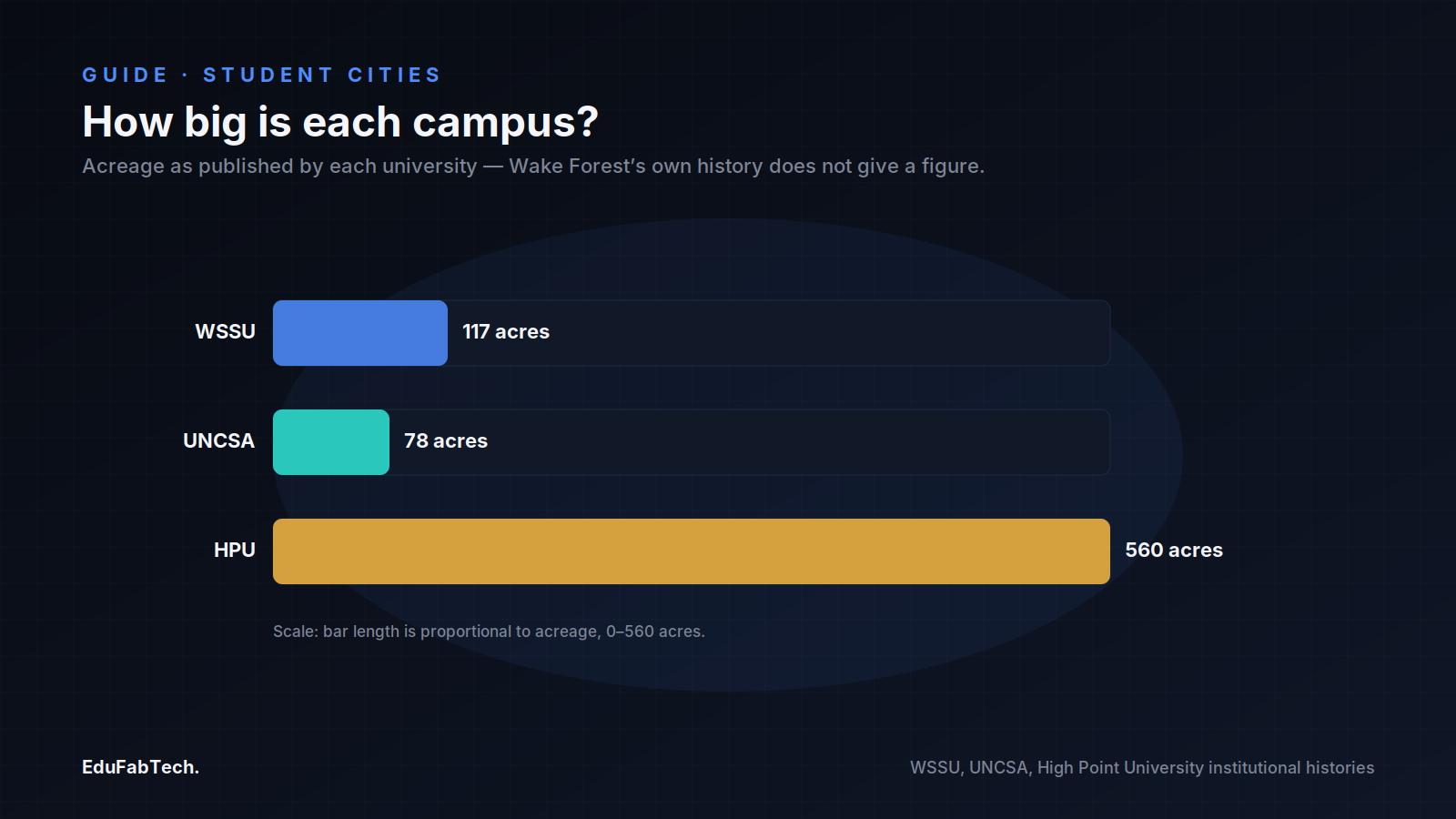
Winston-Salem State University (WSSU) is a historically Black university and a constituent campus of the University of North Carolina system. Its own history records that it was founded on 28 September 1892 by Simon Green Atkins as the Slater Industrial Academy, and that in 1925 it became "the first black institution in the nation to grant degrees for teaching the elementary grades" after being renamed Winston-Salem Teachers College; it joined the 16-campus University of North Carolina on 1 July 1972 (wssu.edu). The same page describes a 117-acre campus with more than 39 buildings overlooking the woodlands of Salem Lake, east of downtown. WSSU is well known for its School of Nursing and its health-sciences programmes.
The University of North Carolina School of the Arts (UNCSA) is unlike the other two. Its Fast Facts page describes it as "America's first public arts conservatory," established in 1963 and opened in 1965, on a 78-acre campus near Old Salem Museums & Gardens, just south of downtown (uncsa.edu). The same page lists five professional schools — Dance, Design & Production, Drama, Filmmaking and Music — and total enrolment of 1,385 in autumn 2025, including 235 high-school students alongside undergraduates and graduate students. Degrees include the Bachelor of Fine Arts and Bachelor of Music; this is a place where your cohort is small and your discipline is intense.
High Point University (HPU) is not in Winston-Salem but in the neighbouring city of High Point, about twenty minutes away. The university's own history records that it opened in 1924 as High Point College, a joint venture of the Methodist Protestant Church and the City of High Point, and that its board renamed it High Point University on 9 October 1991; the same history puts the campus at 560 acres today (highpoint.edu). If you are weighing Triad campuses, it belongs on the list even though it has its own town.
Where students live
Housing patterns differ sharply by campus, so the first question is which one you are attending. Wake Forest is strongly residential: most undergraduates live in university housing on the Reynolda Campus, and the surrounding north-west neighbourhoods — Buena Vista, Ardmore to the south — are quieter and more expensive than the city average. WSSU students cluster closer to downtown and the campus's east side near Salem Lake, where older houses and apartment blocks are more affordable. UNCSA sits in the Washington Park and Old Salem area south of the centre, within reach of the arts venues students actually use.
If you want to live off campus, the belt that students circle most is downtown and its edges — the West End historic district, West Salem near the farmers' market, and the Ardmore streets between Wake Forest and the medical district. Downtown has filled with apartments over the past decade, which suits graduate students and anyone who wants to walk to a café rather than drive. Start looking early: for the autumn term, serious searching in late spring (around May and June) gives you the most listings before the rush. Arriving in August with nothing booked is possible in a city this size, but you will take what is left.
You can browse what is currently available through the EduFabTech city pages — all Winston-Salem student listings and rooms and places to stay — and narrow to the north-west with listings near Wake Forest University.
Renting without losing a deposit
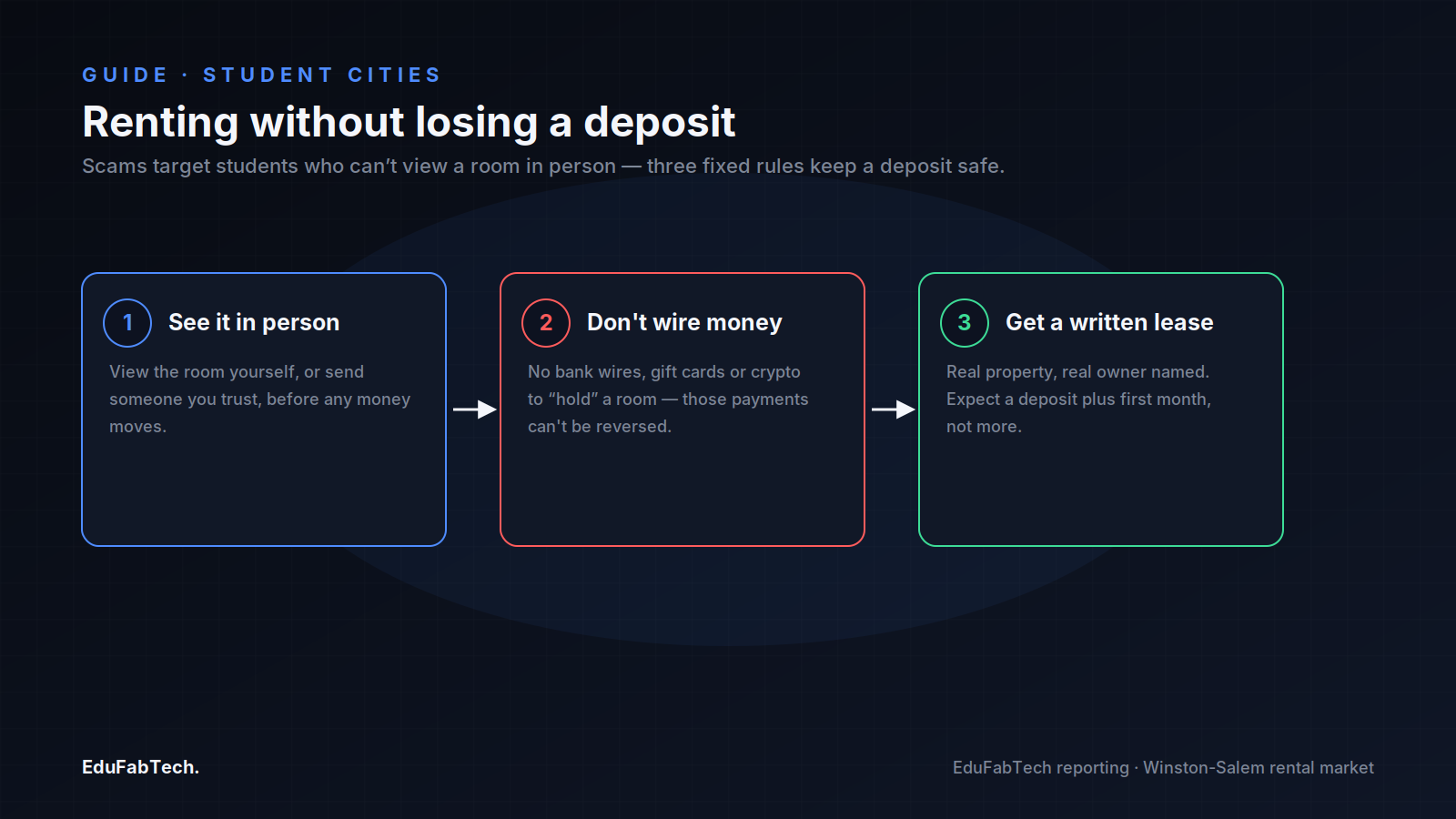
Winston-Salem has a normal American rental market, which means the scams are the normal ones, aimed at exactly the people who cannot easily view a place first — international students and anyone renting from another state over the summer. The classic version is a house copied from a real sales or rental listing, advertised at a suspiciously low rent, with a "landlord" who is travelling or out of the country and asks you to wire a deposit or buy gift cards to "hold" the room sight unseen. The giveaway is almost always the payment method and the refusal to let you in.
Protect yourself with a few fixed rules. See the actual room in person, or have a trusted person see it, before any money changes hands; for the downtown and West End buildings this is easy, and legitimate landlords expect it. Never pay a deposit or first month by bank wire transfer, gift card or cryptocurrency — those payments cannot be reversed, and no honest Winston-Salem landlord needs them to reserve a room. Get a written lease naming the real property and the real owner, and be wary of any "manager" who will only communicate by message and invents reasons you cannot meet. A typical move-in cost here is a security deposit plus the first month's rent; demands far beyond that, paid instantly, are a warning sign, not a lucky deal.
Furnishing a room cheaply, and the markets
Because so many students arrive with a suitcase, second-hand goods move constantly here. Winston-Salem's best-known market is the Cobblestone Farmers Market, a producer-only market in the West Salem area about a mile south of downtown, open Saturdays from 8:30 a.m. to noon, according to Visit Winston-Salem (visitwinstonsalem.com). The same guide lists the Winston-Salem Fairgrounds Farmers Market, open year-round since 1974 with more than 40 vendors on Saturday mornings, and the larger Piedmont Triad Farmers Market just outside Forsyth County, open daily. These are for food and local goods rather than furniture, but they are the easiest way to learn the city's geography on your first weekends.
For actual furnishing — a desk, a lamp, a mattress frame — the city's thrift stores and campus give-away cycles are your friend, especially in August when leases turn over and in May when students leave. On EduFabTech you can watch the local flow of second-hand things that other students are selling or giving away. Buying a desk that another student is throwing out two streets over beats shipping anything in.
Working while you study
If you are an international student on an F-1 visa, the rules on work are federal, not local, and you should read them from the source rather than from a landlord or a friend. The U.S. Department of Homeland Security's Study in the States explains that F-1 students with approval from their Designated School Official may work on campus for up to 20 hours per week while school is in session (studyinthestates.dhs.gov). On-campus jobs — in a library, dining hall or department — are the usual starting point because they do not require separate work authorisation. Off-campus work, including practical training in your field, has its own conditions and approvals, and anyone describing those should be your international-student office, not a blog. This is not legal advice; check your own status with your DSO before you accept any job.
For what is actually posted around the campuses, the EduFabTech jobs and part-time work page is a place to start, but the authorisation question always comes first.
Libraries and places to study
Each campus has its own library, and they anchor where students work. Wake Forest's main library is the Z. Smith Reynolds Library on the Reynolda Campus; WSSU's is the C.G. O'Kelly Library; UNCSA keeps a library geared to performance and design materials. Beyond the campuses, the Forsyth County Public Library runs the public branch system, including a central library downtown, which is open to residents regardless of which university they attend — useful for students living off campus who want a quiet desk closer to home. You can also see student-listed desks and quiet spaces on the EduFabTech study spaces page.
Getting around
City buses are run by the Winston-Salem Transit Authority (WSTA), which operates fixed routes through a downtown transit centre. WSTA's fare page lists a single fare of $1.00, a 30-day pass at $30.00 and a 10-ride pass at $10.00; a reduced half fare — $0.50 single, $15.00 for a 30-day pass, $5.00 for a 10-ride pass — is available to eligible riders with an ID card (wstransit.com/fares). The same page says fares can be paid in cash or through the UMO Mobility App, or bought at the Transit Center. WSTA's published fares do not list a separate university student discount, so budget at the standard rate unless your campus arranges passes directly.
Honestly, Winston-Salem is a car city. The bus network covers the main corridors but runs infrequently on evenings and weekends compared with what students from larger cities expect, and the three campuses are spread across different quadrants. Wake Forest students in particular live a campus-centred life and drive or rideshare for anything further out. If you are coming from abroad without a car, choose housing close to your campus or a frequent route, and treat a trip to High Point or Greensboro as a planned journey rather than a casual hop.
Costs, and the honest trade-offs
The clearest sourced housing figures come from the universities themselves. For 2026–27, Wake Forest's housing office lists per-semester rates of $6,186 for a double room, $7,295 for single and apartment rooms, and $7,579 for Deacon Place, noting the rates are pending board approval (housing.wfu.edu). Winston-Salem State University's residence-hall page, with rates it marks as applying from Fall 2023, ranges from about $3,016.84 per semester for a Moore Hall room to roughly $4,517.27 per semester for its newest suite-style halls (wssu.edu). The gap between the two reflects the difference between a private university and a UNC-system campus more than any difference in the city.
Off campus, the city is relatively cheap by national standards. The U.S. Census Bureau's QuickFacts for Winston-Salem city give a median gross rent of $1,087 for 2020–2024 and a median household income of $59,268 in the same period (census.gov). A shared apartment well under that median rent is realistic here in a way it is not in the biggest Carolina metros — one of the strongest arguments for studying in Winston-Salem rather than Charlotte or Raleigh.
What is good: lower costs than the state's booming metros, three distinct institutions in one place, a walkable downtown that has genuinely revived, and real green space around the Reynolda and Salem Lake areas. What is hard: a transit system built for a car-owning population, campuses scattered far enough apart that there is no single "student quarter," and summers in the North Carolina Piedmont that are hot and humid. For students who want a close-knit campus and a quieter city, those trade-offs are easy. For students who expect a dense, transit-first college town, they are worth facing before you arrive.
A short checklist for the first weeks
- Confirm your room in person before paying, and refuse any request to wire money, send gift cards or pay in crypto to "hold" it.
- If you are on an F-1 visa, meet your Designated School Official before accepting any job, and start with on-campus work (studyinthestates.dhs.gov).
- Decide early whether you can live without a car; if yes, pick housing on a frequent WSTA route and set up the UMO Mobility App or buy a 30-day pass (wstransit.com/fares).
- Get a library card for the Forsyth County Public Library as well as your campus library, so you have a study desk near wherever you live.
- Furnish from the August and May turnover — check local second-hand and give-away listings before buying new.
- Walk a Saturday farmers' market in your first weeks — it is the fastest way to orient yourself in the city and meet people outside your programme.
A quick question for readers
Do you work part-time while you study?
Many students work to pay the bills. See how common it is — and how many hours people really do.
Pick an answer, create a free account in a minute, and your vote counts. Already a member? Sign in
Comments 0
CommentNo comments yet. Members start the conversation.
Source: Wake Forest University Housing
Sources (5)
- Wake Forest University Housing. Rates/Terms — 2026–27 Housing Rates. Wake Forest University, 2026. housing.wfu.edu ↗ · checked 11 Oct 2026
- Winston-Salem State University. Residence Hall Rates. Winston-Salem State University, 2023. wssu.edu ↗ · checked 11 Oct 2026
- Winston-Salem Transit Authority. Fares. City of Winston-Salem, 2026. wstransit.com ↗ · checked 11 Oct 2026
- University of North Carolina School of the Arts. Fast Facts. UNCSA, 2025. uncsa.edu ↗ · checked 11 Oct 2026
- U.S. Census Bureau. QuickFacts: Winston-Salem city, North Carolina. U.S. Census Bureau, 2024. census.gov ↗ · checked 11 Oct 2026