2026 State of the Climate Report: 7 of 16 Planetary Vital Signs at Record Extremes
Published in BioScience on 14 October 2026, the seventh annual assessment finds record carbon dioxide and record fossil fuel burning alongside record renewable electricity growth.
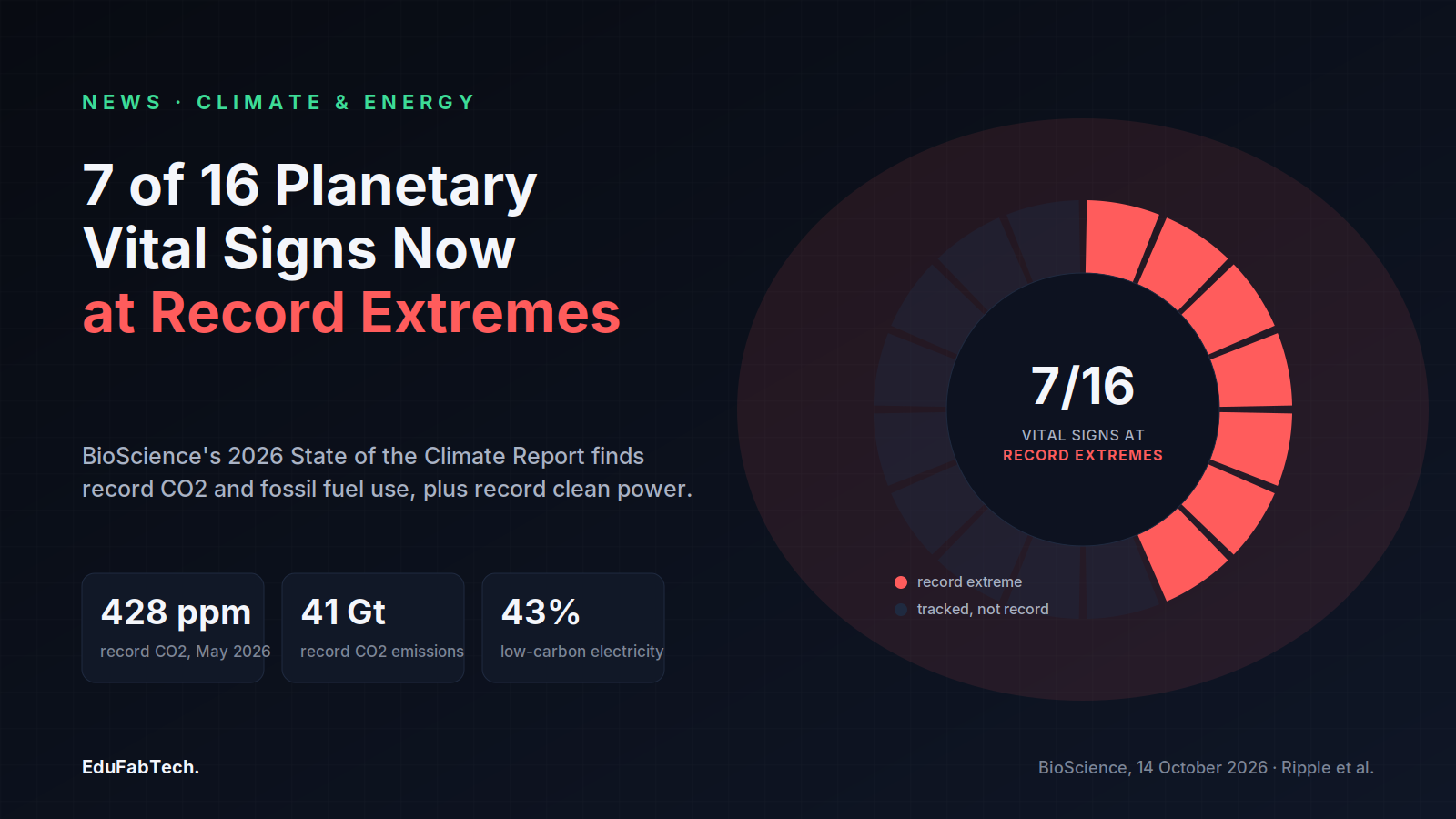
A team of climate scientists led by William Ripple of Oregon State University and Christopher Wolf of Terrestrial Ecosystems Research Associates published the 2026 State of the Climate Report in the journal BioScience on 14 October 2026. The seventh edition of this annual assessment tracks 16 "planetary vital signs" — from atmospheric greenhouse gases to ice-sheet mass and ocean heat — and finds that seven of them are now at record extremes, according to the paper.
The author list spans institutions in the United States, Germany, Spain, China, Australia and India, including Michael Mann, Johan Rockström, Unai Pascual, Chi Xu, Sarah Perkins-Kirkpatrick and Anjal Prakash, among others, according to BioScience (2026). The project grew out of the 2019 "World Scientists' Warning of a Climate Emergency," and this year's edition frames itself around what the authors call "challenges and opportunities" rather than warnings alone.
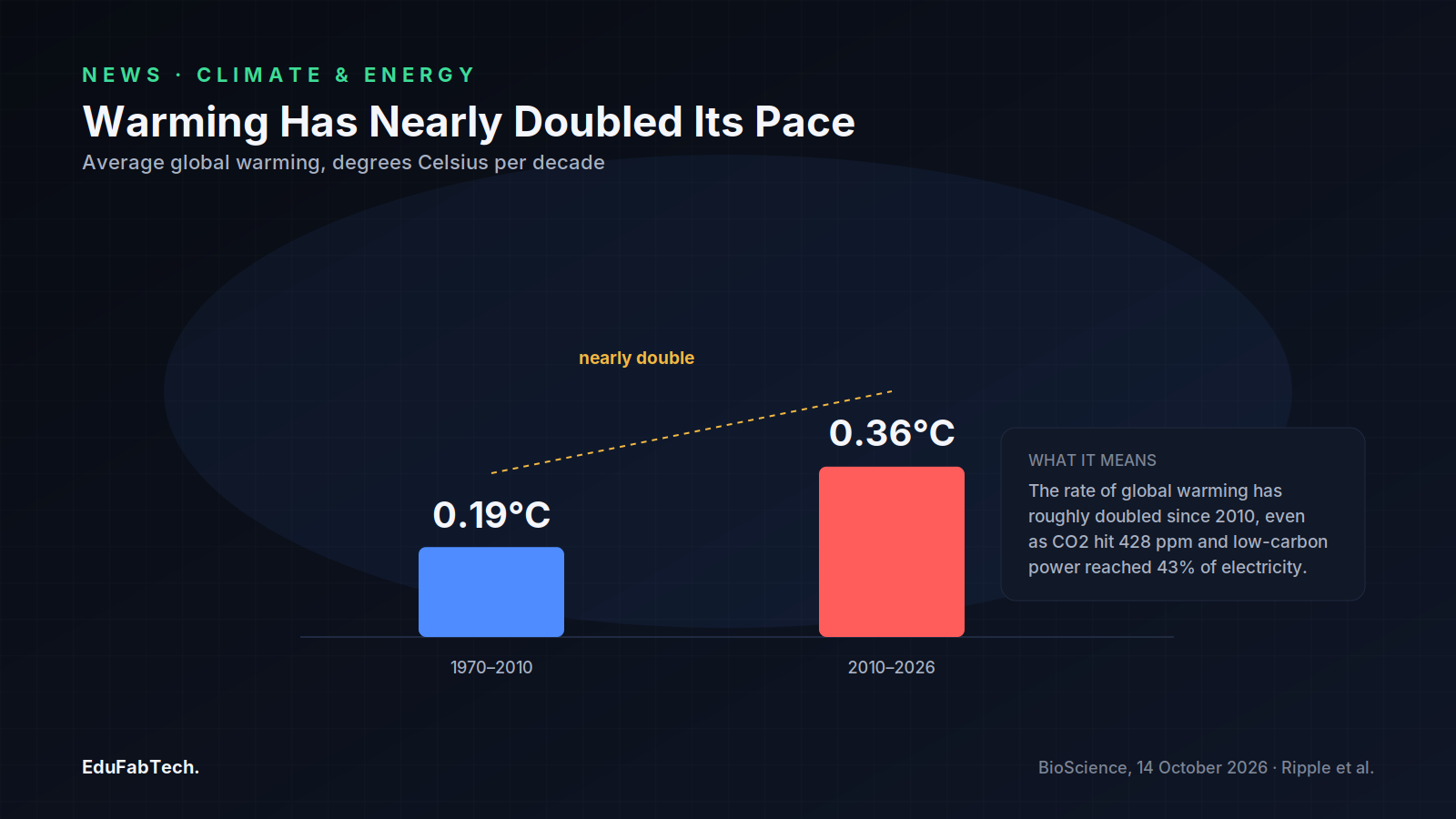
Atmospheric carbon dioxide reached 428 parts per million in May 2026, about 50% above pre-industrial levels, while methane and nitrous oxide also hit record concentrations, the report states. The pace of warming itself is accelerating: average global temperature rose by roughly 0.19°C per decade between 1970 and 2010, and by roughly 0.36°C per decade since, nearly double, according to Oregon State University's summary of the report (2026).
Record fossil fuel use alongside record renewable growth
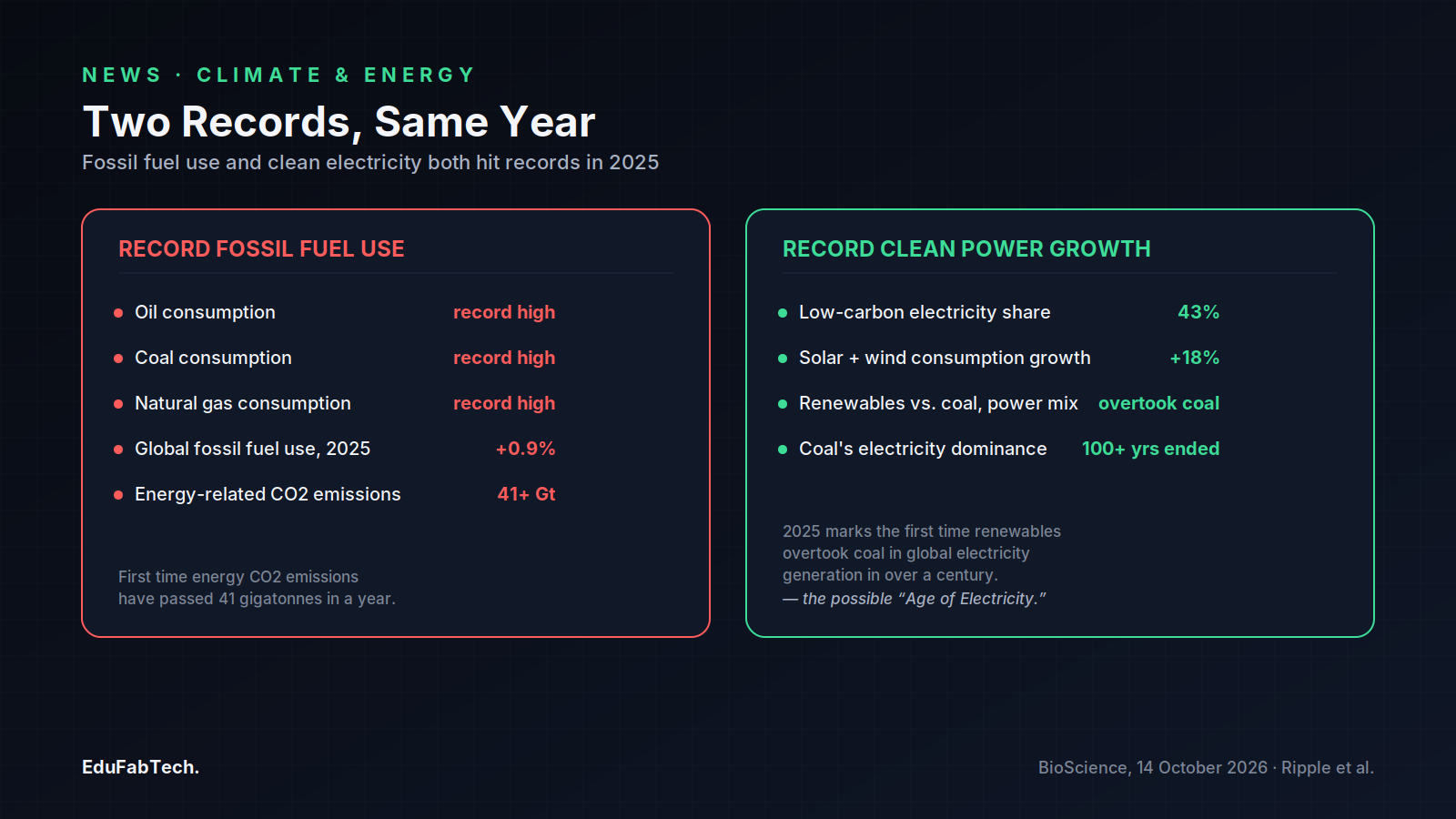
Fossil fuel consumption rose 0.9% worldwide in 2025, with oil, coal and natural gas each reaching record highs individually, and energy-related carbon dioxide emissions surpassed 41 gigatonnes for the first time, according to the report. At the same time, low-carbon sources supplied about 43% of global electricity in 2025, and solar and wind consumption grew by roughly 18% over the year. Coauthor Christopher Wolf described this as a possible turning point: "With low-carbon sources now providing about 43% of global electricity, we may be witnessing the emergence of what we call the 'Age of Electricity,'" he said, quoted by Oregon State University (2026). It marks the first time renewable sources have overtaken coal in global electricity generation in more than a century of coal-dominated power systems, according to the report.
Ice and ocean indicators moved in the opposite direction. The Greenland ice sheet lost roughly 6,000 gigatonnes of mass, a record low, while the Antarctic ice sheet lost more than 2,500 gigatonnes, near-record levels, and sea level stood more than 7 centimeters above the 1993 baseline as ocean pH continued falling, the report states, as detailed by Eos (2026). Global tree cover loss reached 10.8 million hectares in 2025, the third-highest on record, according to Oregon State University (2026) — though the same release notes Brazilian Amazon deforestation has now declined for four consecutive years, one of the report's few improving indicators.
Extreme weather and unequal exposure
The report ties these trends to specific events from the past year: Hurricane Melissa caused 95 deaths, primarily in Jamaica and Haiti, and more than $12.2 billion in damages in October 2025; flooding in Indonesia killed 708 people in November 2025; and a European heatwave in June 2026 caused an estimated 14,000 deaths on a preliminary count, the report states. July 2026 was the hottest month on record in the contiguous United States, and global ocean temperatures also peaked that month, Oregon State University reports (2026).
The authors write that communities least responsible for historical emissions, particularly in the Global South and small island states, are "bearing disproportionately severe and early consequences," raising what they call "fundamental questions of climate justice," according to the report. Ripple summarized the broader pattern bluntly: "Rapid destabilization is now a diagnosis rather than a warning for the future," he said, quoted by Oregon State University (2026).
What it means for students and researchers
For students in environmental science, climate policy and energy engineering, the report functions as a standing dataset: its 16 indicators are published with methodology and sources each year, making them usable in coursework and research projects that track long-run trends rather than single headlines. The split result — record fossil fuel combustion and record low-carbon electricity growth occurring in the same year — is itself a case study for researchers studying energy transitions, since it shows global electricity and global energy demand are not the same system moving at the same speed.
The report's warning about tipping points also matters for research funders and curriculum designers: the authors argue that continued warming at current rates risks triggering feedbacks that "would make climate change increasingly difficult to control," in Ripple's words as reported by Eos (2026). Researchers in climate modeling, adaptation engineering and energy policy are likely to treat this year's split indicators — some improving, most not — as a benchmark for what a global energy transition looks like while still underway, rather than as a finished outcome.
A quick question for readers
How much do you spend on books and course materials per term?
Amounts in US dollars. The results help show how much course materials really cost students.
Pick an answer, create a free account in a minute, and your vote counts. Already a member? Sign in
Comments 0
CommentNo comments yet. Members start the conversation.
Source: BioScience (Oxford University Press)
Sources (3)
- William J. Ripple, Christopher Wolf, Michael E. Mann, Johan Rockström, Unai Pascual, et al.. 2026 State of the Climate Report: Challenges and Opportunities. BioScience (Oxford University Press), 2026. academic.oup.com ↗ · checked 15 Oct 2026
- Oregon State University News and Research Communications. Report: Earth's Climate System Increasingly Unstable, but Signs of Positive Change Emerge. Oregon State University, 2026. news.oregonstate.edu ↗ · checked 15 Oct 2026
- Kip Hansen / Eos staff. 2026 State of the Climate Report Shows a Planet Reaching Its Limits. Eos (American Geophysical Union), 2026. eos.org ↗ · checked 15 Oct 2026