Alberta Referendum Backs a Fee on International Students' Health Care and Schooling
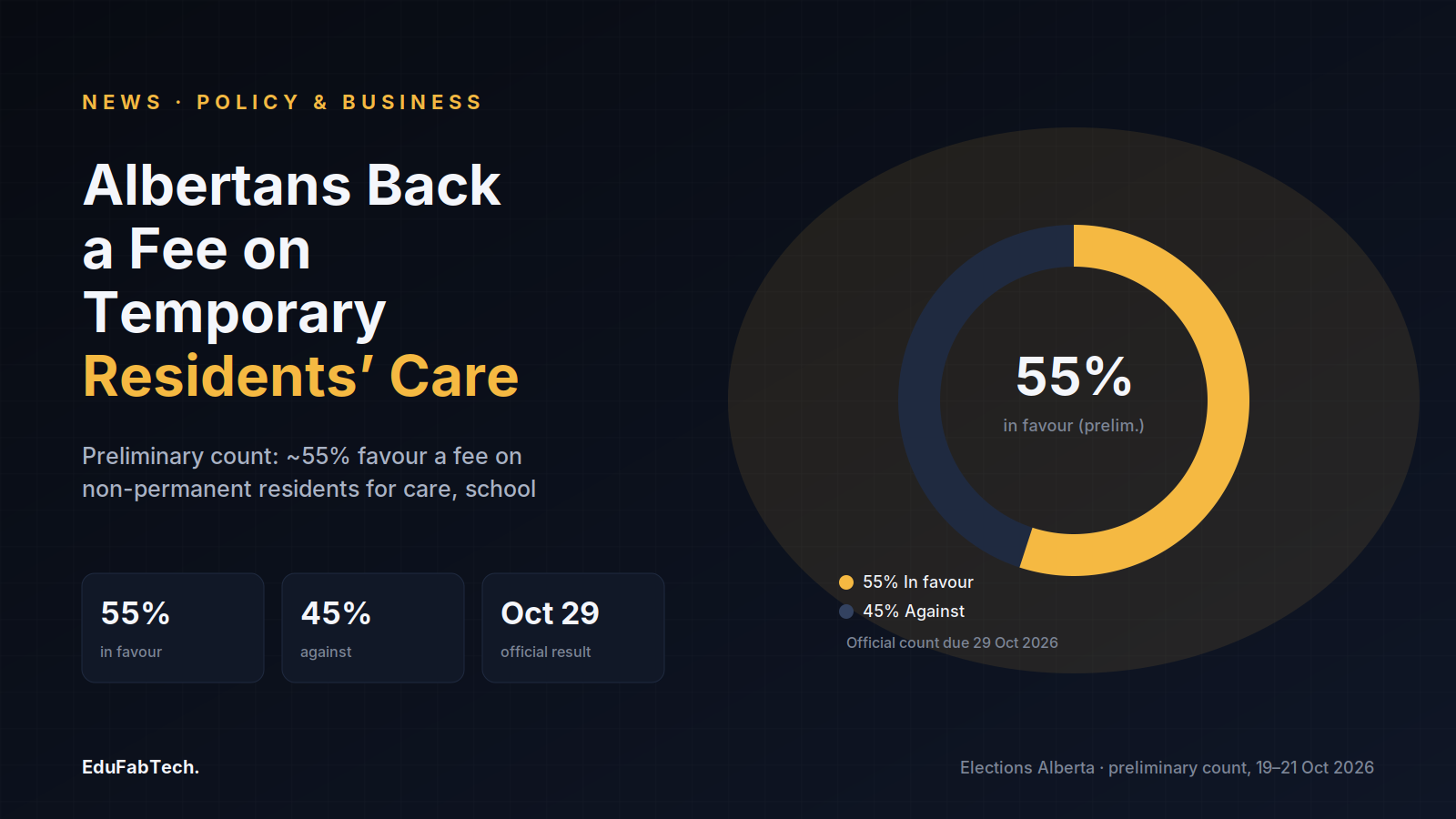
Preliminary counts from Alberta's 19 October 2026 vote show about 55% support for charging non-permanent residents, including international students, for public health care and education, a non-binding result Premier Danielle Smith says will guide policy.
On 19 October 2026, Albertans voted in a ten-question provincial referendum that included a proposal to charge international students, temporary foreign workers and other non-permanent residents a fee for using the province's public health care and education systems. Counting continued into the following days, and Elections Alberta has said official results will be released on 29 October 2026; until then, the figures below are preliminary counts, not a certified outcome.
The question put to voters, as published on Elections Alberta's results portal, read: "Assuming that all Canadian citizens and permanent residents continue to qualify for public health care and education as they do now, do you support the Government of Alberta charging a reasonable fee or premium to individuals with a non-permanent immigration status living in Alberta for their and their family's use of the health care and education systems?" Citizens and permanent residents are explicitly exempted in the question itself; everyone else living in the province on a temporary status is the target.
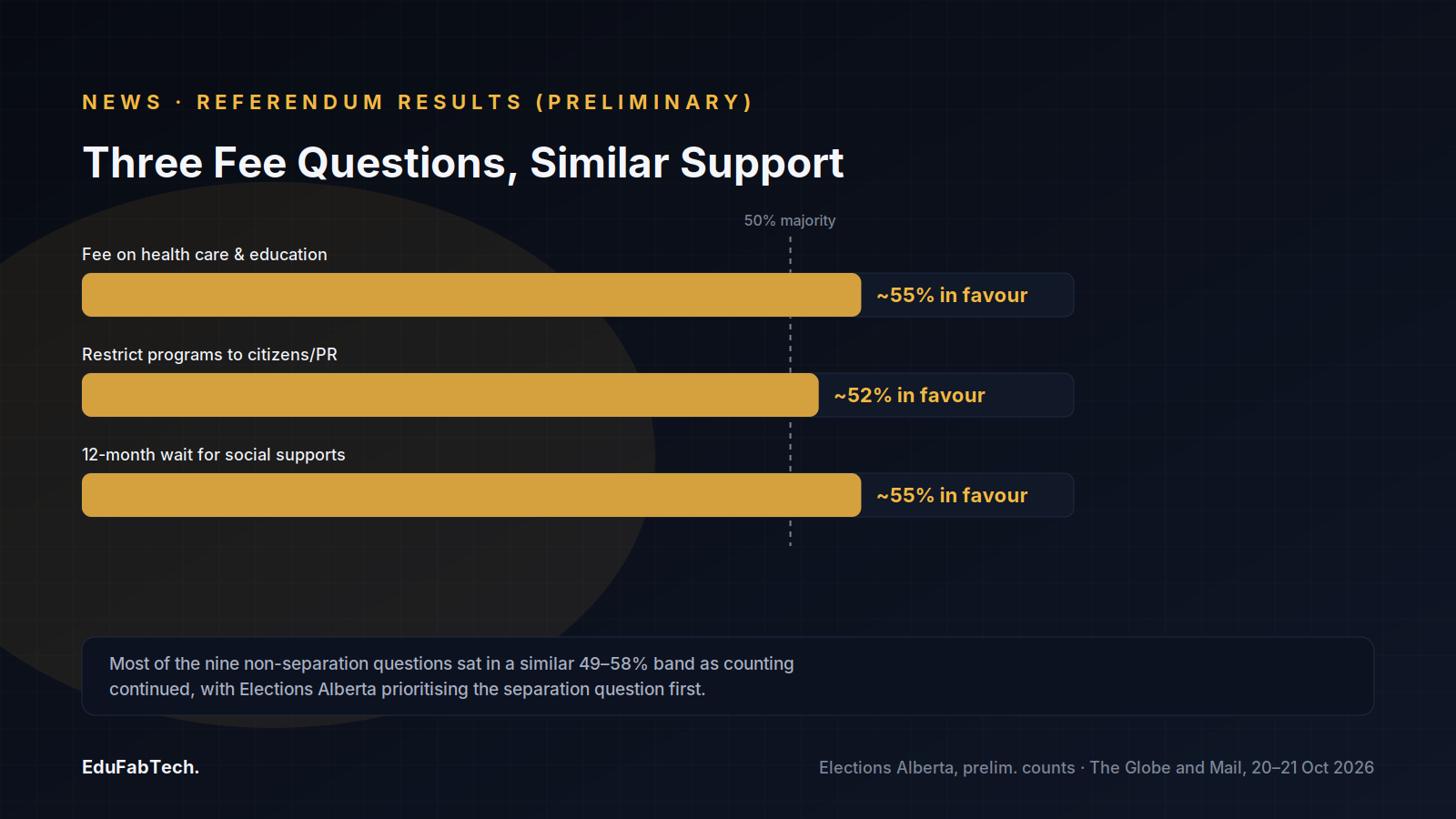
In the days after the vote, with Elections Alberta still counting ballots, preliminary tallies put the health care and education fee question at roughly 55% in favour to 45% against. Two related questions were running at comparable levels: a measure restricting provincially funded health, education and social-service programmes to citizens, permanent residents and people with Alberta-approved status stood at about 52%, and a measure requiring non-permanent residents to live in the province for 12 months before accessing social supports stood at about 55%. The Globe and Mail reported that most of the nine non-separation questions were sitting in a similar 49-to-58-per-cent band as counting continued, with Elections Alberta giving priority to finishing the tally on the separation question first.
Who the question covers, and what it leaves unanswered
"Non-permanent immigration status" is a broad label. A review of the four immigration-related questions by Immigration News Canada ahead of the vote notes that it can include international students enrolled at Alberta's universities, colleges and K-12 schools, temporary foreign workers, people recruited to address labour shortages, their accompanying family members, and people with pending refugee or immigration claims who are legally in Canada — while stressing that the ballot language itself gives no definitive list of which categories would be affected. The ballot also names no dollar figure, no payment schedule, no collection method and no exemption categories within that population — those details would have to come through separate legislation if the government chooses to act.
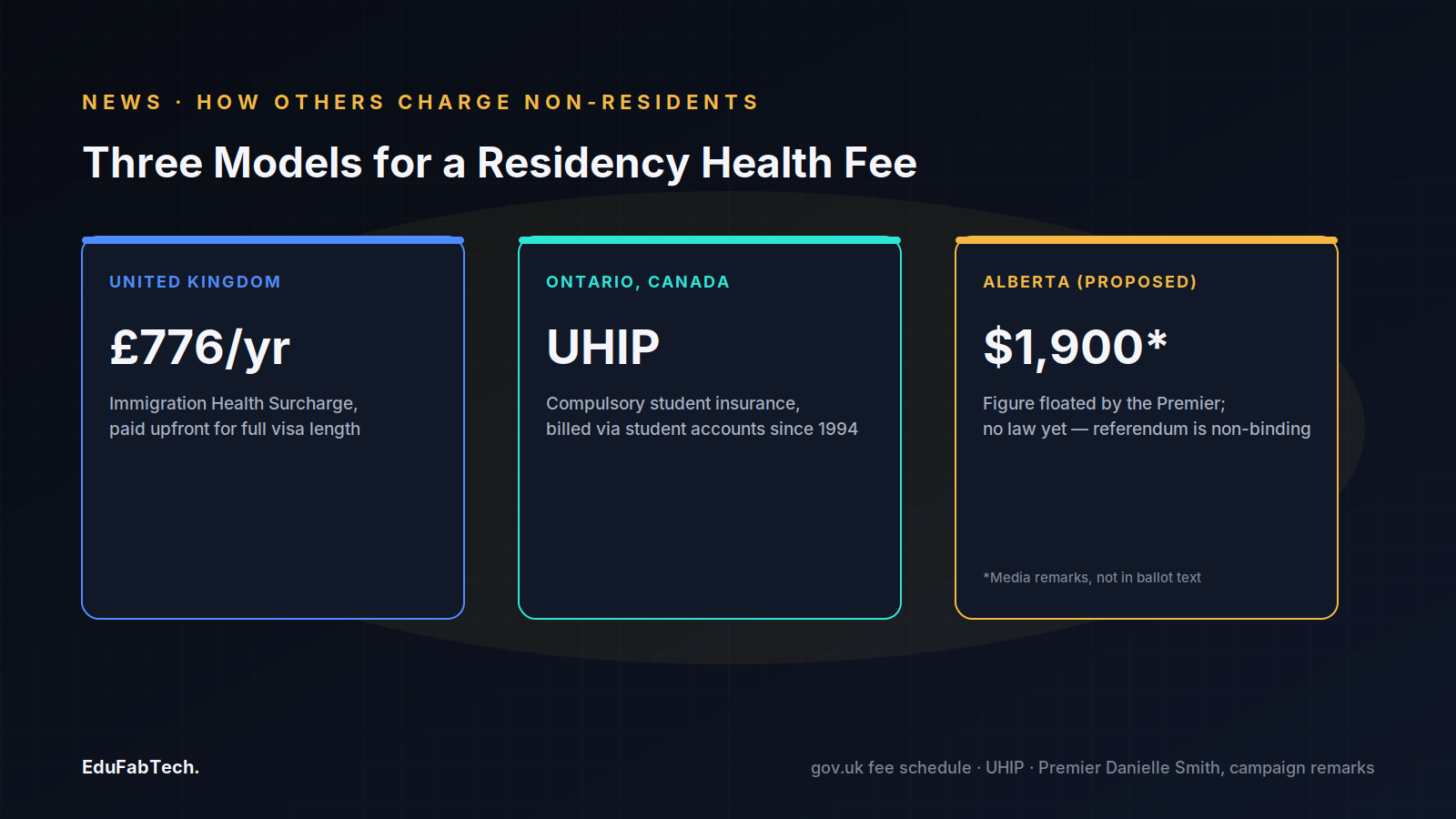
Premier Danielle Smith floated a specific figure, $1,900, in media interviews during the campaign, pointing to the United Kingdom's health surcharge for temporary residents as a comparison, but the number was not written into the question and carries no legal weight, The Globe and Mail reported. This question and the other three immigration-related measures on the ballot are non-binding: a yes vote does not by itself change any fee, rule or eligibility test, a point Elections Alberta made to voters ahead of the vote, as Immigration News Canada reported.
A government reading the results as a mandate
The referendum's other headline question, on starting a legal path toward Alberta independence, was rejected by a wide margin, as Al Jazeera reported on 20 October 2026. Smith has treated the immigration questions as the more consequential outcome of the night: The Globe and Mail reported on 20-21 October 2026 that she intends to use the results to push for immigration changes, including in talks with Ottawa and other provinces, and is likely to bring forward her own proposals only after Alberta's next fixed-date general election, which Elections Alberta's own election calendar sets for 18 October 2027.
What it means for students, and how other countries already do this
For international students currently enrolled in Alberta, the immediate practical change is none: no fee exists yet, and the province has not set a date for legislation. But the vote puts Alberta's debate alongside systems elsewhere that already charge students specifically for health-system access, rather than inventing the idea from nothing. The United Kingdom charges most student-visa holders an Immigration Health Surcharge of £776 a year, paid upfront for the full length of the visa, under the rate currently published on gov.uk's fee page. Ontario, Canada's most populous province, takes a different approach: international students there are required to carry the University Health Insurance Plan, a compulsory scheme created by the province's universities in 1994 and billed automatically through student accounts, rather than a separate government-collected premium of the kind the Alberta question describes, according to UHIP's own account of the plan.
For researchers and institutions watching the count, the open questions are less about politics than about administration: how a per-person or per-family premium would be collected, whether it would apply across all levels of study, and whether any amount set would be low enough to avoid discouraging enrolment outright. None of that is settled by a non-binding vote. What is on the record, pending Elections Alberta's 29 October certification, is that a majority of the Albertans who cast a ballot on 19 October 2026 want their government to try.
A quick question for readers
Do you work part-time while you study?
Many students work to pay the bills. See how common it is — and how many hours people really do.
Pick an answer, create a free account in a minute, and your vote counts. Already a member? Sign in
Comments 3
Comment-
The detail that matters is buried near the end: no dollar figure, no payment schedule, no collection method, no exemptions. That's not a pol…
-
The $1,900 figure is the part that bugs me. It got floated by Smith in interviews, compared to the UK's surcharge, and now it's going to sti…
-
The detail that jumps out is how much weight is being put on a question that specifies nothing. No dollar figure, no collection method, no e…
Join free to read the full comments and reply Comments are between members; an account takes a minute.
Source: Elections Alberta
Sources (3)
- 2026 Provincial Referendum — Unofficial Results. Elections Alberta, 2026. results.elections.ab.ca ↗ · checked 21 Oct 2026
- David Ebner. Albertans Largely Support Measures Aimed at Reducing Immigration, Split on Constitutional Questions. The Globe and Mail, 2026. theglobeandmail.com ↗ · checked 21 Oct 2026
- Alberta Referendum Puts 4 Immigration Changes Up For Vote. Immigration News Canada, 2026. immigrationnewscanada.ca ↗ · checked 21 Oct 2026