Avian R2 Retrotransposons Reach Up to 60% Gene Integration in Human Primary Cells
A Nature Biotechnology brief communication published October 5, 2026 by researchers at the Chinese Academy of Sciences mined 1,139 bird genomes to build a DNA-insertion tool that works without the breaks CRISPR relies on.
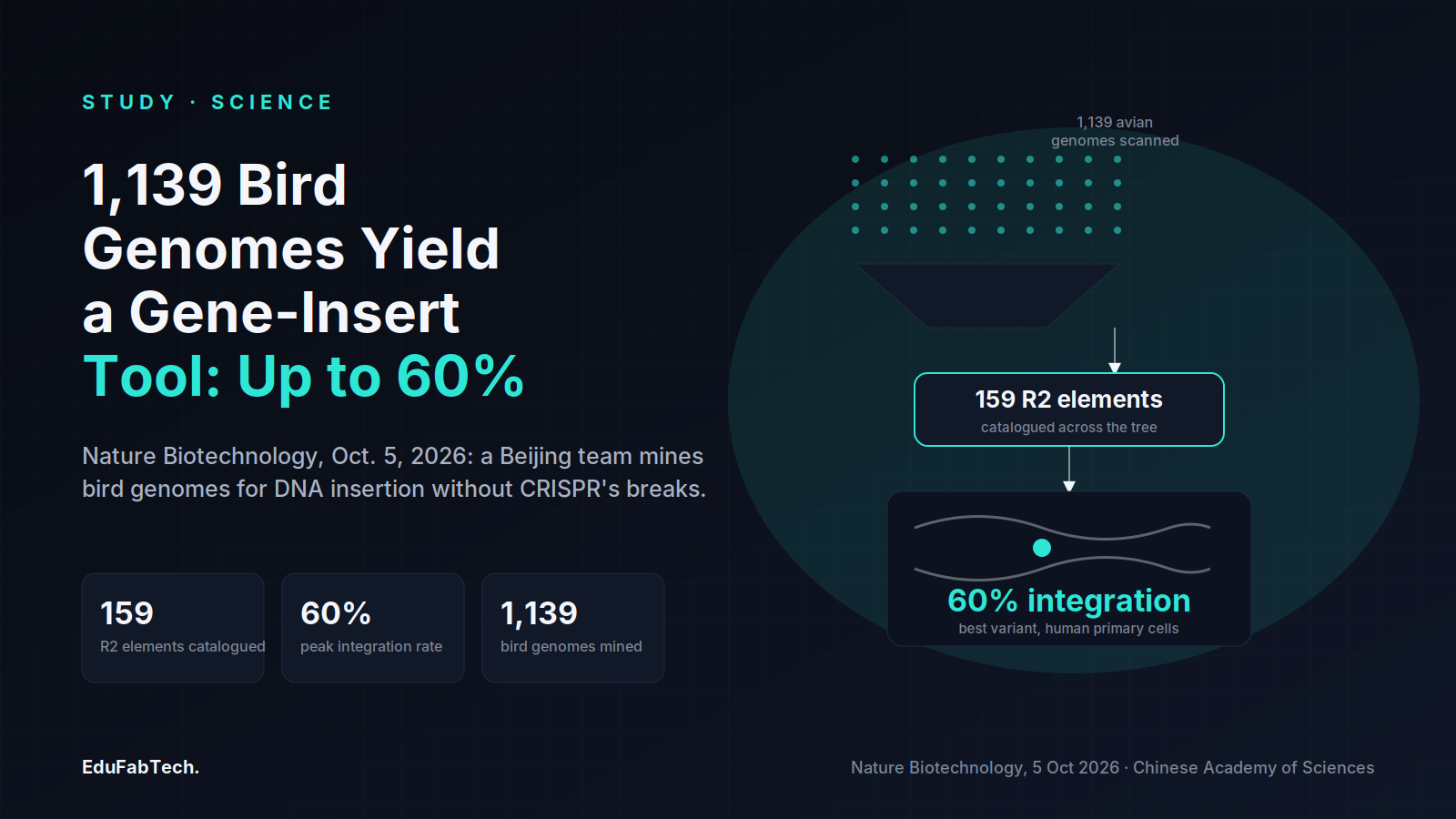
Researchers at the Institute of Zoology, Chinese Academy of Sciences, in Beijing have expanded the toolkit for inserting genes into human DNA without cutting both strands of the double helix at once. In a brief communication published in Nature Biotechnology on October 5, 2026, a team led by corresponding authors Yangcan Chen, Haoyi Wang, Qi Zhou and Wei Li searched 1,139 avian genomes, identified 159 natural R2 retrotransposons, and reported that engineered variants of these elements achieved up to 60% site-specific gene integration across human primary cells.
The paper is a short-format "brief communication" rather than a full research article, and it frames the result as expanding a resource — a toolbox of parts — rather than announcing a finished therapy. Even so, the underlying numbers give researchers a concrete new starting point: a catalogue of 159 characterized elements drawn from across the bird family tree, with documented sequence features in both their protein-coding regions and their untranslated RNA elements.
What the Study Found
R2 retrotransposons are naturally occurring sequences that copy themselves into a specific site in the genome using an RNA intermediate rather than a protein-DNA cutting complex. By surveying genomes from more than a thousand bird species, the Beijing team was able to compare which sequence variations across that diversity correlated with higher integration activity when the elements were transplanted into human cells. The Nature Biotechnology paper reports that the best-performing engineered variants reached up to 60% site-specific integration in human primary cells, a figure the authors present as describing the top end of the variants they tested, not an average across all 159 elements or all cell types.
The approach builds on earlier work from the same Beijing laboratory group, which had previously engineered R2 systems from other species into "all-RNA" gene-insertion tools — meaning the entire editing machinery, including the DNA-cutting protein and the template for the new gene, is delivered as RNA rather than as viral DNA. That all-RNA format is what makes the system compatible with non-viral delivery methods such as lipid nanoparticles, the same class of carrier used in mRNA vaccines.
Why Avoiding a Double-Strand Break Matters
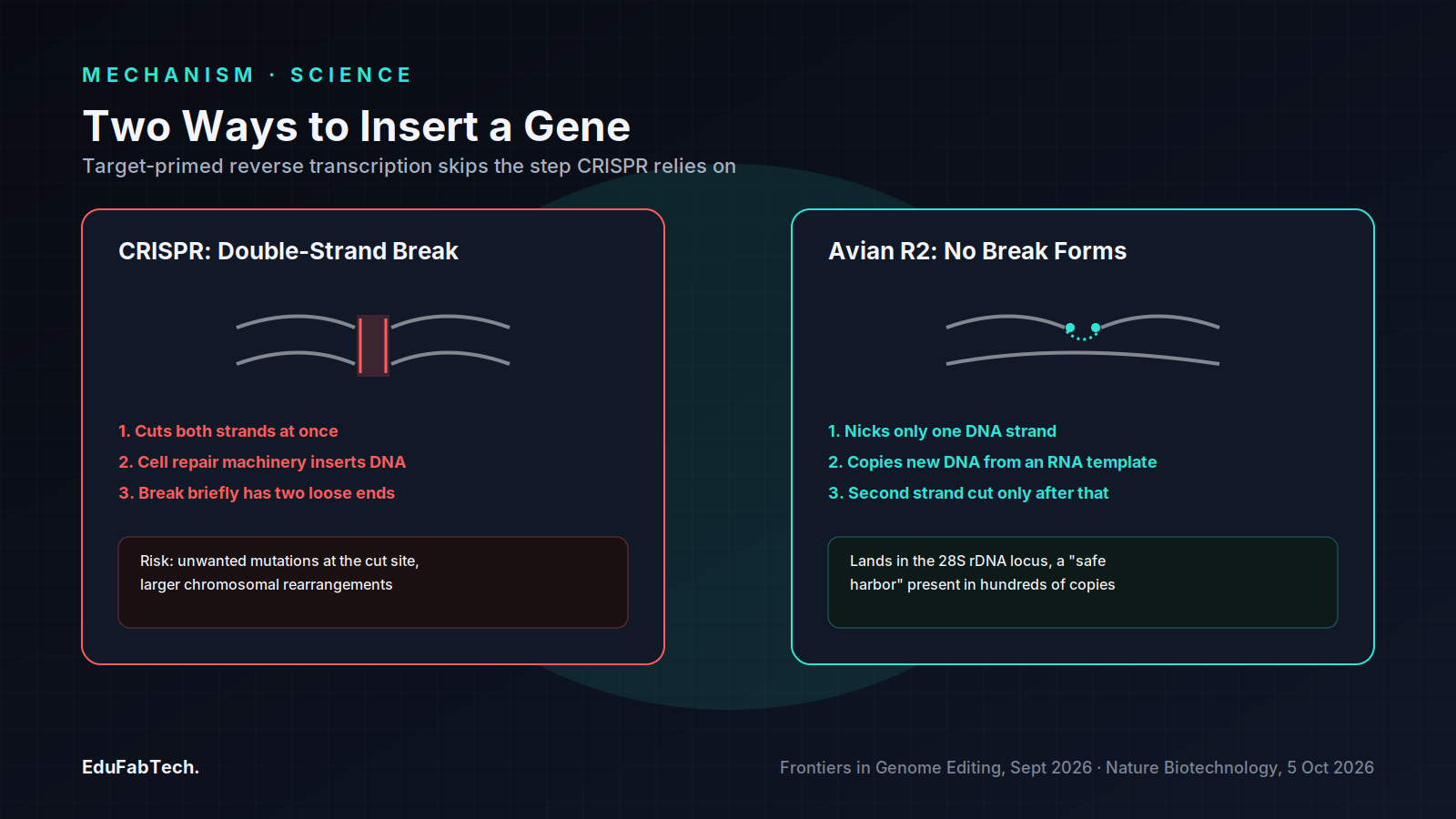
CRISPR-based gene editors typically work by cutting both strands of DNA at a target site at the same time and relying on the cell's own repair machinery to either disable a gene or, for gene insertion, to stitch in new genetic material. A September 2026 review in Frontiers in Genome Editing by Liangzheng Fu, Yachao Wu, Xiaohua Jin and Xu Ma describes how R2 retrotransposons instead use a mechanism called target-primed reverse transcription: the R2 protein first nicks one DNA strand and uses the exposed end to prime synthesis of a new DNA copy directly from an RNA template, and only cuts the second strand afterward, once that new copy is already in place. The result is that a true double-strand break — two severed ends with no new DNA bridging them — never forms, unlike in CRISPR editing.
That distinction matters because double-strand breaks carry their own risks, including unwanted mutations at the cut site and, in some cases, larger chromosomal rearrangements. The Frontiers review also notes that natural R2 elements integrate specifically into the 28S ribosomal DNA locus, a stretch of the genome present in hundreds of copies per vertebrate genome, which the authors describe as "a recognized genomic safe harbor" because disrupting a handful of those copies causes minimal disruption to endogenous gene expression.
From Single Digits to 60%
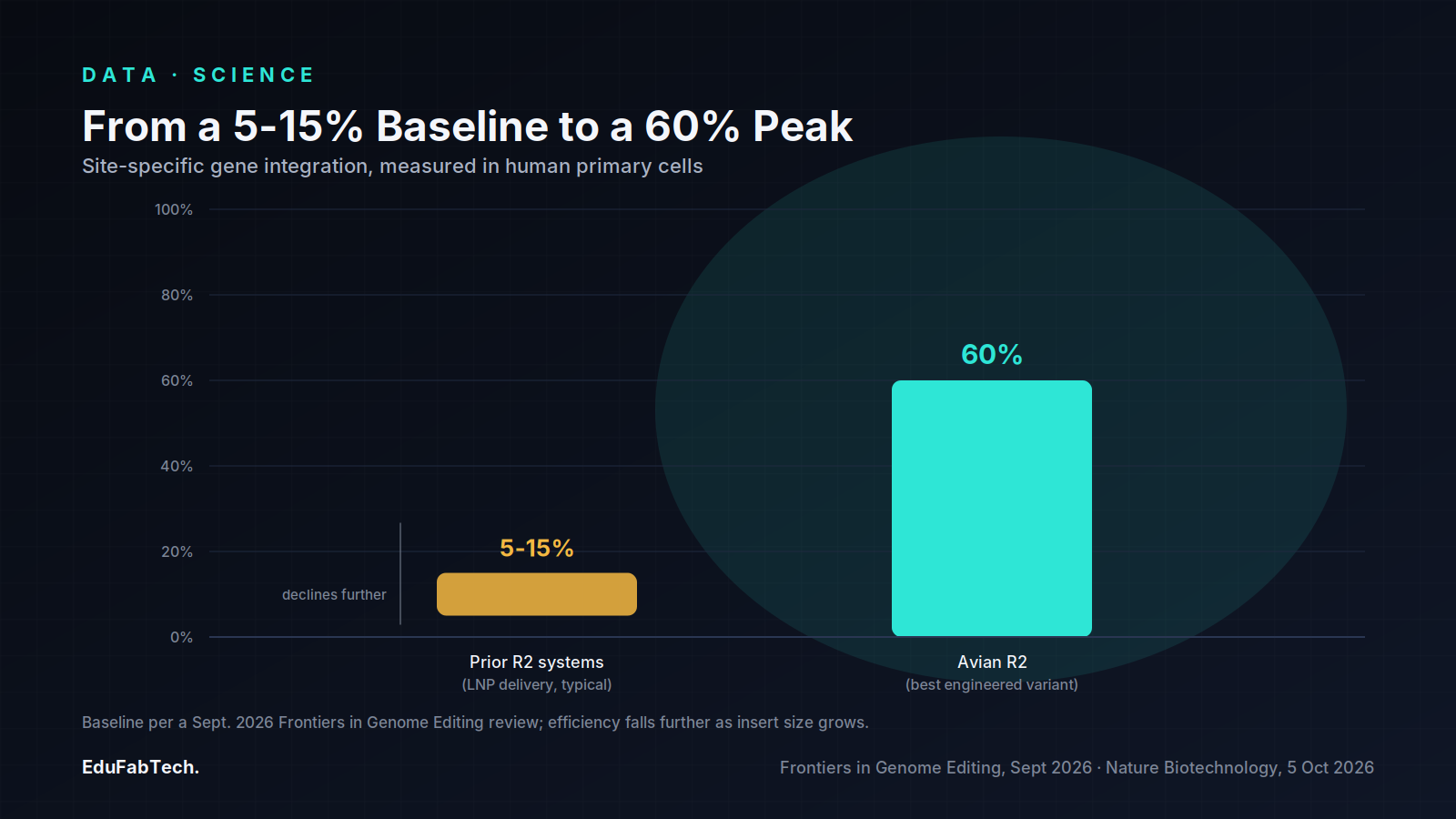
The scale of the reported improvement is easier to judge against where the field stood just weeks earlier. The same Frontiers review states that under lipid-nanoparticle delivery, full-length integration efficiency for R2 systems "typically ranges from 5% to 15%" and declines further as the size of the inserted gene grows, with the long-term stability of transgenes integrated at rDNA loci in proliferating cells "yet to be systematically characterized." Measured against that baseline, a reported ceiling of 60% in human primary cells represents a substantial jump, though it describes the best variant identified among the 159 surveyed, not a typical result researchers should expect to reproduce with every element in the set.
What It Means for Students and Researchers
For researchers working on gene therapy delivery, the practical takeaway is an expanded and better-characterized set of natural parts to engineer from, alongside sequence-level data on which regions of the R2 protein and its RNA elements tend to matter for activity. For students studying genome engineering, the paper is a useful case study in how surveying natural genetic diversity across an entire taxonomic group — in this case, birds — can surface variants that outperform the handful of elements first studied in detail.
The authors' own framing is cautious: the paper describes the work as expanding "the avian R2 resource" and providing "additional tools," language that stops short of claiming a therapy-ready system. Translating a 60% integration rate measured in cultured primary cells into a safe, durable, and scalable treatment for patients would require the kind of long-term stability and in vivo safety data that, per the Frontiers review, the R2 field as a whole has not yet produced.
A quick question for readers
When an article cites a study, do you open the source?
Every claim on this site links to a primary source. We want to know whether readers actually follow those links, or whether they …
Pick an answer, create a free account in a minute, and your vote counts. Already a member? Sign in
Comments 0
CommentNo comments yet. Members start the conversation.
Source: Nature Biotechnology
Sources (2)
- Chen, Y., Hu, Y., Luo, S. et al.. Discovery and engineering of avian R2 retrotransposons for all-RNA-mediated targeted DNA integration in human cells. Nature Biotechnology, 2026. nature.com ↗ · checked 11 Oct 2026
- Fu, L., Wu, Y., Jin, X., Ma, X.. Rewriting the genome: harnessing R2 retrotransposons for precise DNA insertion. Frontiers in Genome Editing, 2026. frontiersin.org ↗ · checked 11 Oct 2026