Canada's Teachers' Union Says a New National AI Literacy Plan Skips the Safety Question
On October 14, 2026, the Canadian Teachers' Federation asked Ottawa to pause parts of its $13-million AI literacy rollout, arguing it trains teachers to adopt AI tools before anyone has shown the tools help students learn.
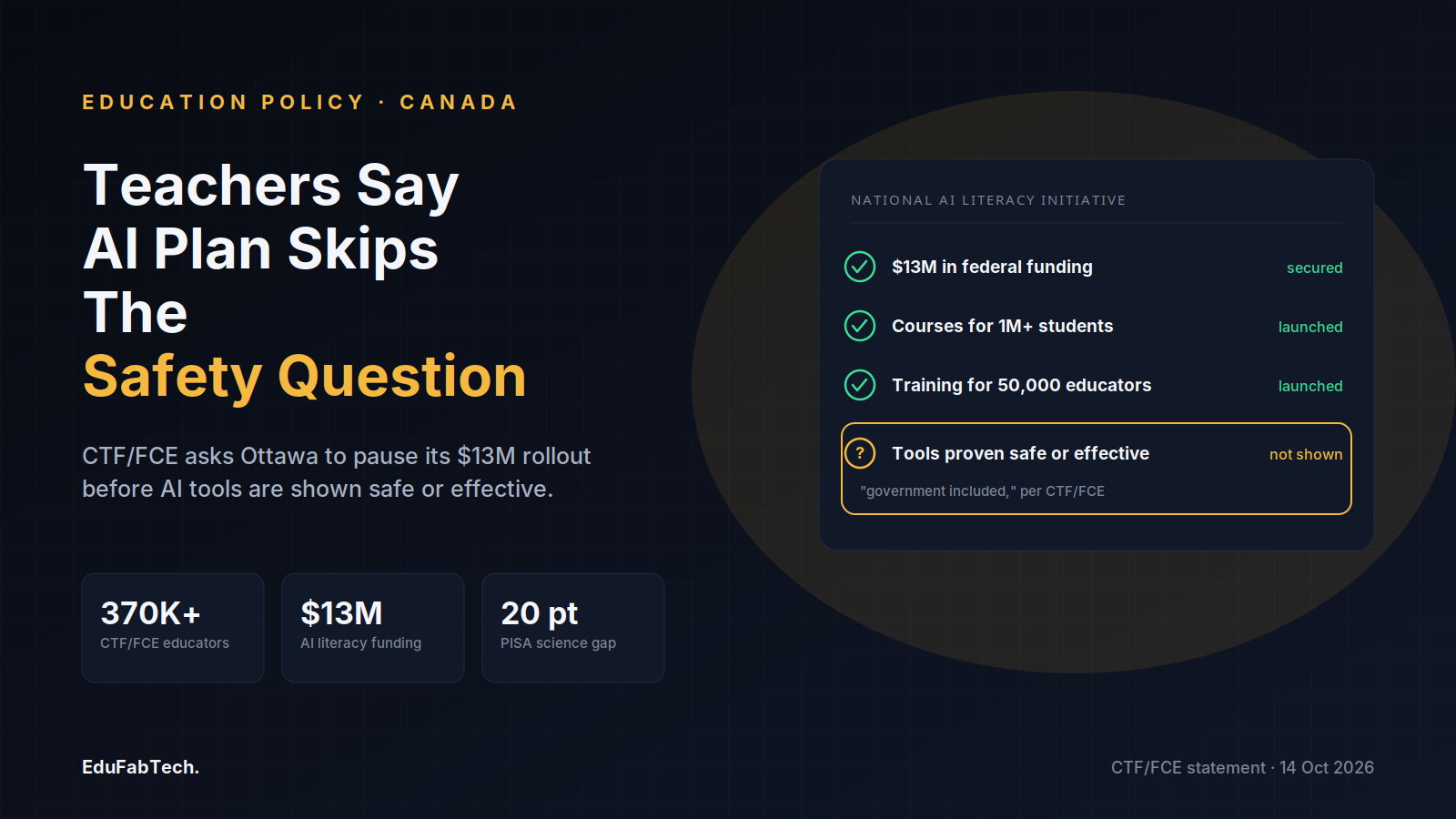
On October 14, 2026, the Canadian Teachers' Federation (CTF/FCE), which represents more than 370,000 educators across 18 member organizations, called on the federal government to pause and reopen for review a national program that is training teachers to bring artificial intelligence into their classrooms. The federation's objection is not to AI literacy itself, which it has long asked Ottawa to fund, but to a program it says asks teachers to adopt AI tools before anyone, "government included," can say whether those tools are safe or actually help students learn, according to the CTF/FCE statement.
What the Initiative Actually Does
The program in question, Canada's National AI Literacy Initiative, was launched on September 9, 2026 by Evan Solomon, the country's Minister of Artificial Intelligence and Digital Innovation, in partnership with the Alberta Machine Intelligence Institute (Amii). Ottawa is putting $13 million into free courses delivered through three streams, for students, educators and the general public, aiming to reach up to one million post-secondary students and more than 50,000 kindergarten-to-grade-12 educators, with institutions able to join starting September 21, 2026, according to the official announcement from Innovation, Science and Economic Development Canada.
The CTF/FCE's complaint centers on one of those streams, a course called "AI for All: Essentials for Educators." Its first chapter, the federation says, puts the responsibility on individual teachers to judge whether an AI tool belongs in their classroom, without the course itself establishing whether the tools are safe or effective in the first place. The federation also notes that Amii's own target, of reaching 50,000 K-12 educators by 2031, comes with no stated plan for measuring whether the training changes outcomes for students.
The OECD Data Behind the Caution
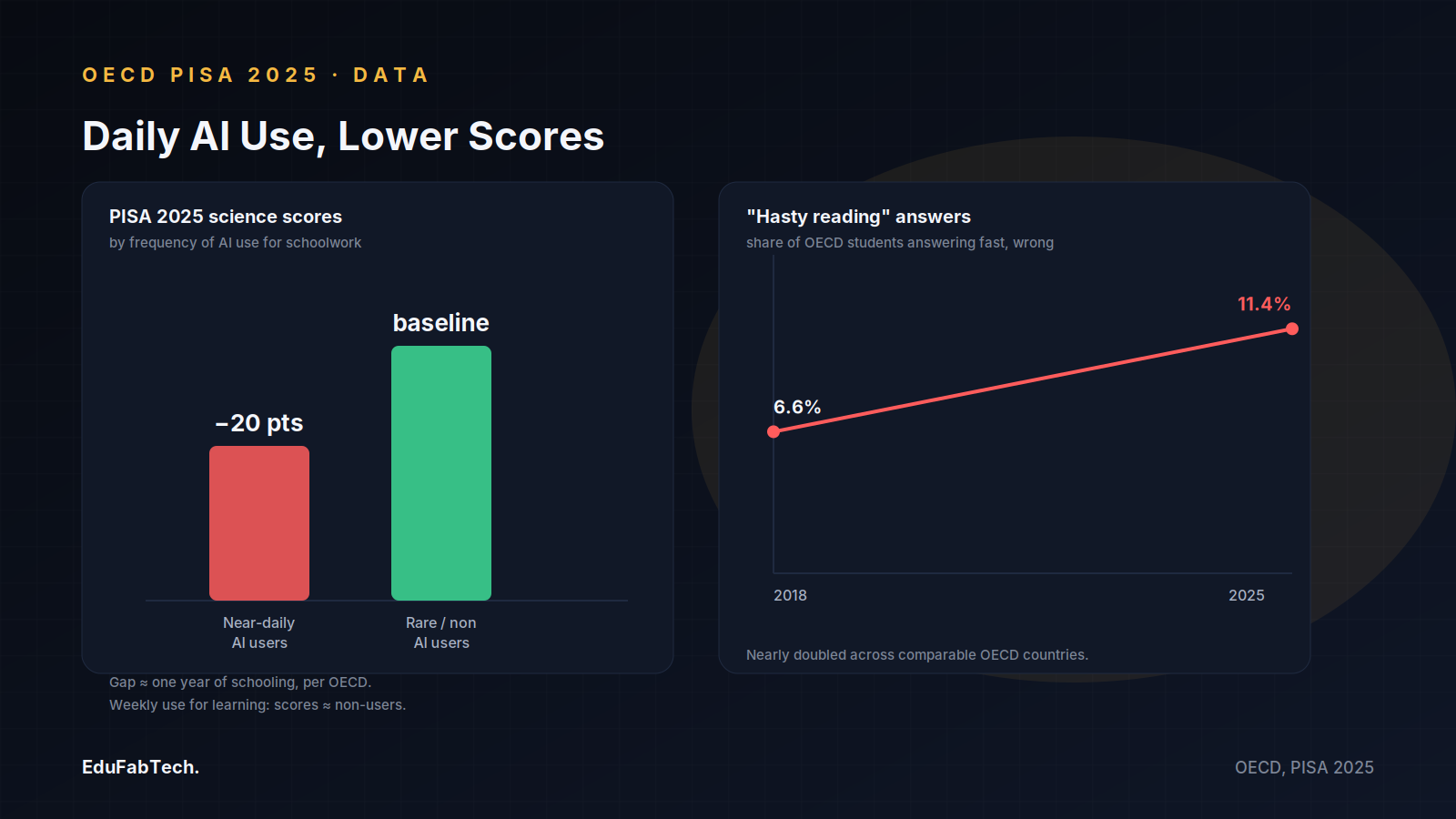
To support its caution, the CTF/FCE points to the OECD's 2025 round of the Programme for International Student Assessment. Fifteen-year-olds who used AI almost daily for tasks like summarizing, drafting or research scored lower in science than students who used it less often or not at all, a gap of roughly 20 points that the OECD compares to about a year of schooling — though the OECD describes this as an association rather than proof that AI use causes the lower scores, since frequent users also differ from others in prior achievement and study habits; students who used AI weekly specifically to help them learn scored about the same as non-users. The same PISA round found that "hasty reading," in which students answer quickly but incorrectly, nearly doubled among OECD countries with comparable data, from 6.6% in 2018 to 11.4% in 2025, according to the OECD's own account of the PISA findings. The federation's president, Clint Johnston, said in the statement that "educators should not be expected to evaluate the safety of complex AI systems that developers themselves struggle to understand," and that a British Columbia survey the federation cites found more than 80% of teachers worried students would become overly dependent on AI or lose critical-thinking skills.
The CTF/FCE is not asking Ottawa to cancel the initiative. Its requests are narrower: open the five chapters of the educators' course to review by teachers across the country before they are finalized, require public, transparent evaluation of whether the training changes anything in classrooms, and make sure AI products reaching schools meet ethical and pedagogical standards before adoption, rather than after.
Three Other Countries, Three Different Bets
Canada's dilemma, teach the tool before anyone can vouch for it, is one other education systems are resolving in different ways. China's Ministry of Education guidelines, in force since September 2025, make AI instruction compulsory from age six through secondary school, with at least eight hours a year on AI basics and ethics, according to Research & Development World's account of the mandate. The guidelines pair that requirement with a restriction: primary pupils are barred from independently using open-ended generative-AI tools, and teachers are barred from using generative AI as a substitute for their own teaching role, according to People's Daily's report on the guidelines. Singapore has gone the opposite direction: the National University of Singapore made a course on applied generative AI compulsory for all incoming undergraduates from the 2026/27 academic year, built around ChatGPT Edu access for students, faculty and staff under a partnership with OpenAI formalized in August 2026, according to the university's own announcement.
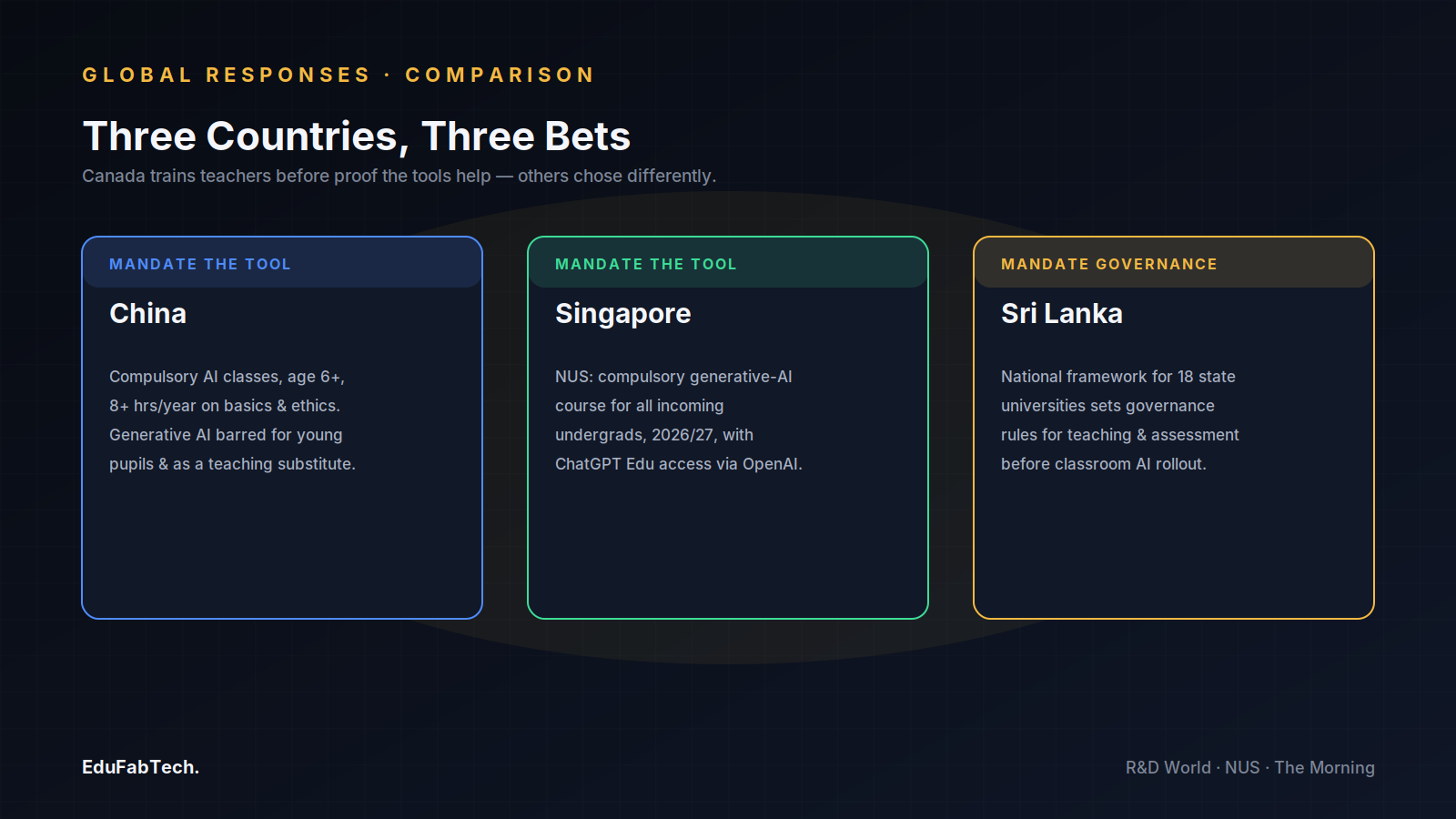
Sri Lanka has taken a third route, publishing a national policy framework for AI in its 18 state universities that sets common governance principles, covering teaching, assessment, research and administration, before widescale classroom rollout. The framework was developed under the technical guidance of Usree Bhattacharya, a University of Georgia specialist in responsible AI in education, and was soft-launched in May 2026 in the presence of Prime Minister Harini Amarasuriya, who also holds the education portfolio, according to The Morning's report on the launch. Each approach answers a different part of the same question: whether to mandate use, mandate caution, or mandate governance first.
What It Means for Students and Teachers
For students, the practical stakes are about what they will be taught to do with AI tools and how soon: write with them, be restricted from them, or wait for a governance framework to settle first. For teachers, the CTF/FCE's objection is that national programs are setting adoption targets and funding timelines well ahead of any public evidence of what helps or harms learning, leaving classroom staff to make judgment calls that neither the companies building the tools nor the governments funding the training have yet made themselves. Whether Ottawa revises the educators' course before it reaches more classrooms will be an early test of how much weight a teachers' federation carries against an already-funded national rollout.
A quick question for readers
Which study method makes things stick for you until the exam?
Research says some methods work far better than others. Vote first, then see whether students agree with the evidence.
Pick an answer, create a free account in a minute, and your vote counts. Already a member? Sign in
Comments 0
CommentNo comments yet. Members start the conversation.
Source: Canadian Teachers' Federation (CTF/FCE)
Sources (3)
- Canadian Teachers' Federation (CTF/FCE). Canadian Teachers' Federation concerned National AI Literacy Initiative puts adoption before safety. GlobeNewswire, 2026. globenewswire.com ↗ · checked 16 Oct 2026
- Innovation, Science and Economic Development Canada. Government of Canada launches National AI Literacy Initiative. Canada.ca, 2026. canada.ca ↗ · checked 16 Oct 2026
- OECD. PISA findings on artificial intelligence use, reading skills and learning. OECD, 2026. oecd.org ↗ · checked 16 Oct 2026