Solengepras 150 mg Cuts Parkinson's OFF Time by 37 Minutes vs Placebo in Phase 3 Trial
Topline results from the 341-patient ARISE trial, announced October 7, 2026, show the GPR6 inhibitor solengepras reduced daily OFF time without raising dopamine levels, though the margin over placebo was modest and the full data are not yet peer-reviewed.
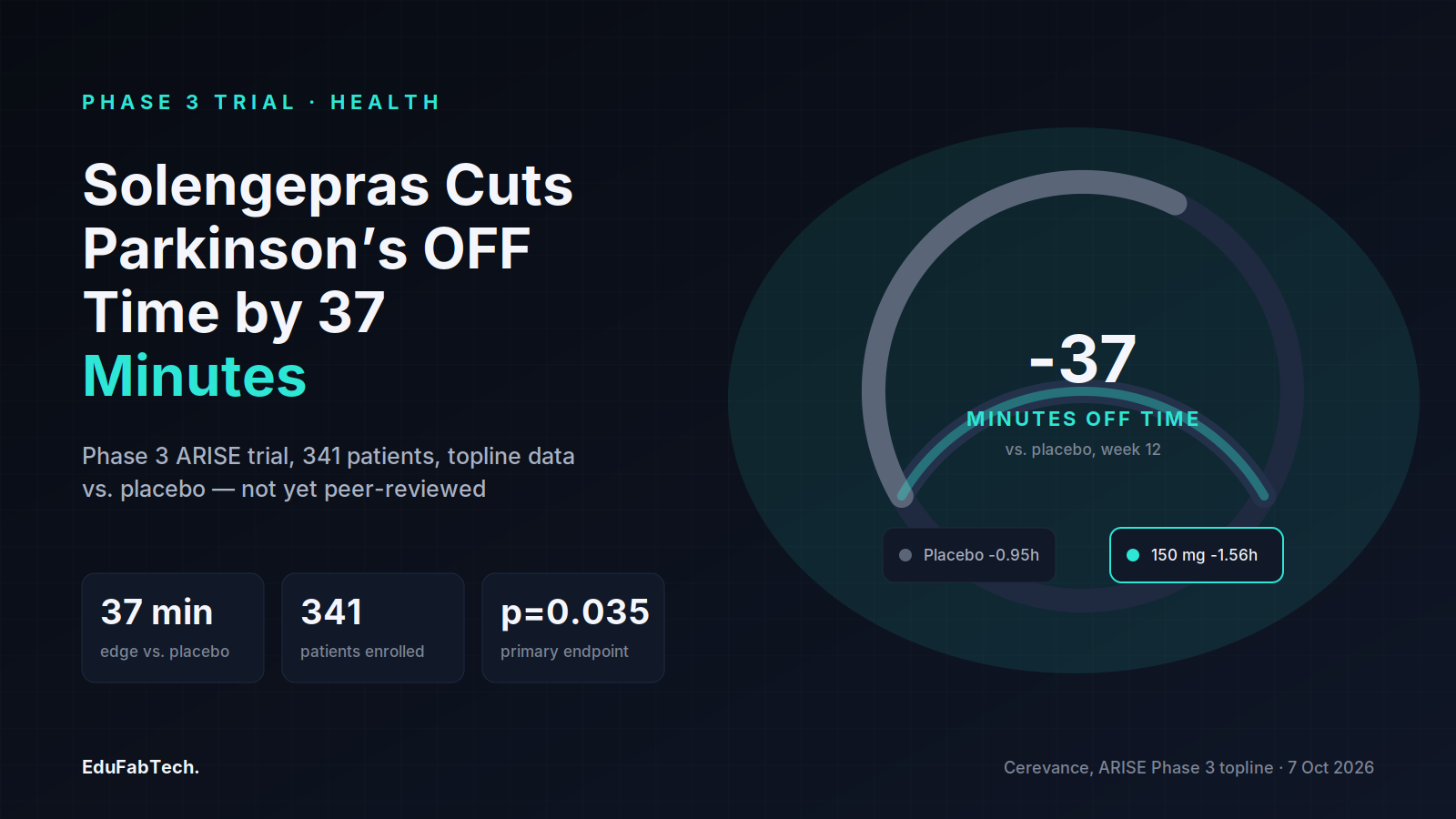
On October 7, 2026, the Boston biotechnology company Cerevance announced topline results from ARISE, a Phase 3 trial of its experimental Parkinson's disease drug solengepras, reporting that the treatment met its primary endpoint by reducing daily "OFF time" — the hours when medication fails to control movement symptoms — compared with placebo. The data were presented the same week at the International Congress of Parkinson's Disease and Movement Disorders in Seoul, according to Cerevance's press release. The figures are topline and have not yet appeared in a peer-reviewed journal.
A Different Target in the Basal Ganglia
Most Parkinson's therapies, including levodopa, work by raising dopamine levels in the brain. Solengepras, also known as CVN424, instead inhibits a receptor called GPR6 on neurons in the striatal indirect pathway, part of the basal ganglia circuit that helps regulate movement, without directly altering dopamine signaling, Cerevance says. The company describes it as a potential first-in-class mechanism for treating the motor fluctuations that emerge as Parkinson's progresses and levodopa's effect becomes less consistent. Cerevance originated as a 2016 joint venture between Takeda Pharmaceutical and Lightstone Ventures, and solengepras is its most advanced clinical program, according to reporting by BioPharma Dive.
ARISE enrolled 341 participants aged 30 and older with Parkinson's disease who had motor fluctuations averaging at least three hours of daily OFF time despite being on stable background therapy. Participants were randomized 1:1:1 to solengepras 150 mg, solengepras 75 mg, or placebo, taken once daily for 12 weeks on top of their usual medication, across trial sites in the United States, European Union, United Kingdom and Australia. Of the 341 enrolled, 311 (91%) completed the 12-week trial, Cerevance reported.
What the Primary Endpoint Showed
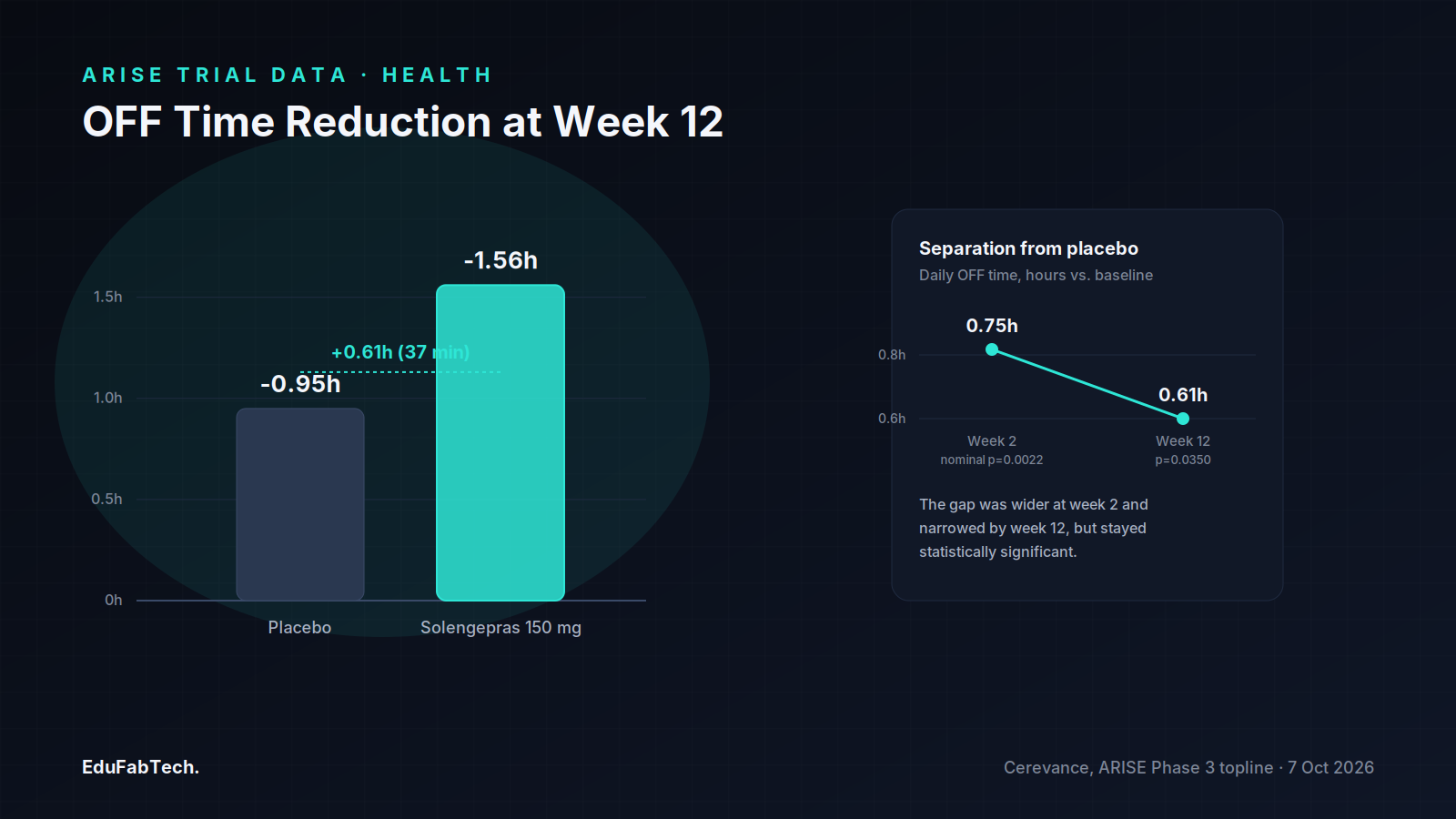
At the 150 mg dose, average daily OFF time fell by 1.56 hours from baseline, compared with a 0.95-hour reduction in the placebo group — a between-group difference of 0.61 hours, or about 37 minutes (p=0.0350), Cerevance reported. The company said the separation from placebo was already visible at the first post-baseline assessment, week 2, where the difference was 0.75 hours (nominal p=0.0022). Trial investigator Robert A. Hauser said in the press release that "OFF time captures only one aspect of the disease" and that the trial was designed to look at several measures together to capture "a fuller picture of a treatment's potential benefits."
Secondary Measures and Safety
Several secondary and exploratory endpoints also favored the 150 mg dose over placebo, each with its own placebo-adjusted difference and nominal p-value, per Cerevance's release: ON time without troublesome dyskinesia improved by 0.60 hours (p=0.0468); scores on the MDS-UPDRS Part II scale for motor experiences of daily living improved by 1.91 points (p=0.0008); daytime sleepiness on the Epworth Sleepiness Scale improved by 0.98 points (p=0.009); and quality of life on the PDQ-39 scale improved by 2.87 points (p=0.012).
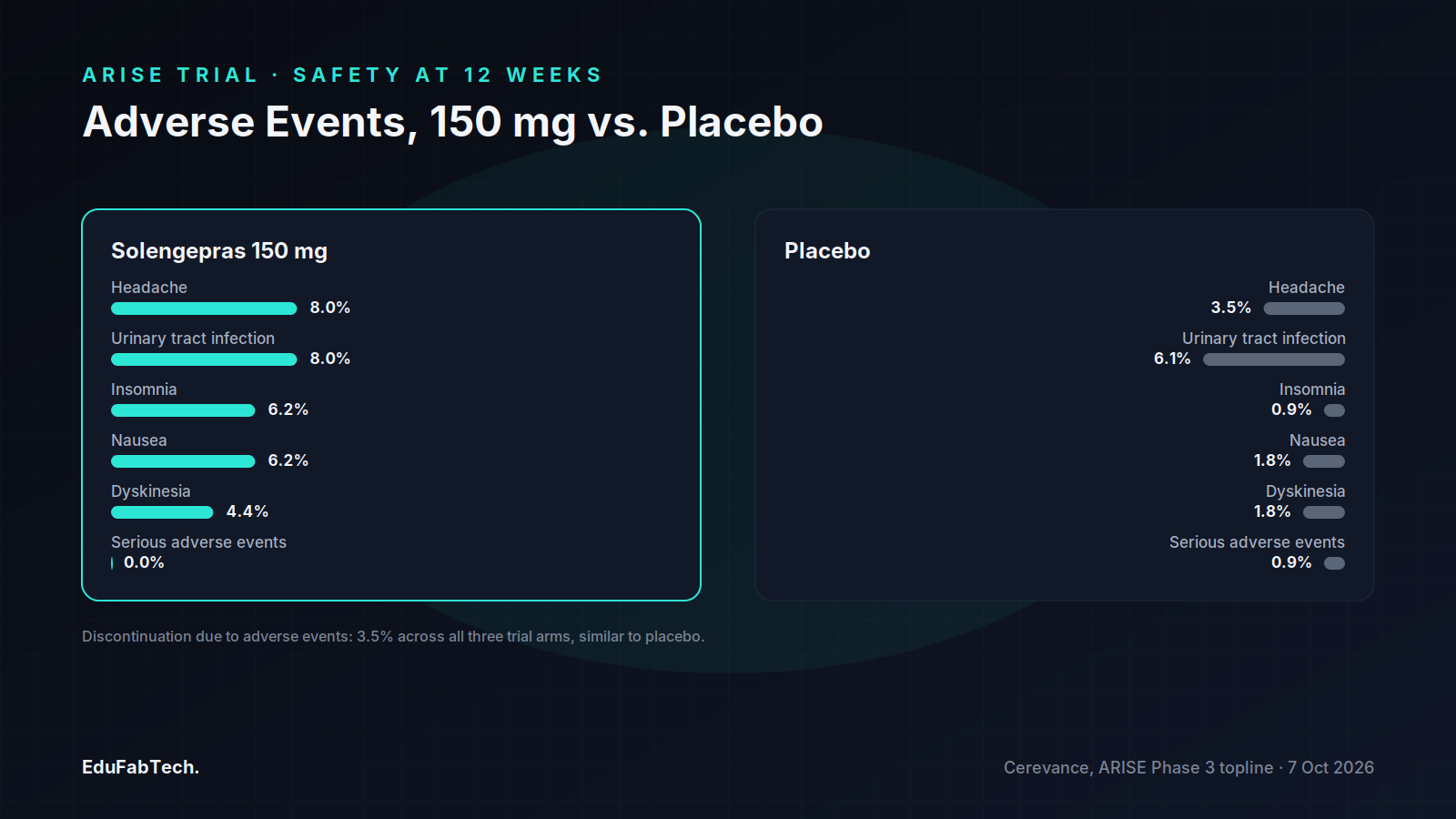
- Discontinuation due to adverse events: 3.5% across all three arms, similar to placebo
- Serious adverse events: none in the 150 mg arm, 1.8% in the 75 mg arm, 0.9% on placebo
- Most common adverse events at 150 mg versus placebo: headache (8.0% vs. 3.5%), urinary tract infection (8.0% vs. 6.1%), insomnia (6.2% vs. 0.9%) and nausea (6.2% vs. 1.8%)
Cerevance and BioPharma Dive both frame the tolerability profile as the trial's other notable finding: because solengepras does not act directly on dopamine receptors, it was associated with fewer of the adverse events — including dyskinesia — typically seen with dopaminergic add-on therapies, according to BioPharma Dive's report. Dyskinesia was still reported in 4.4% of the 150 mg group versus 1.8% on placebo.
What's Missing From the Picture
These are company-reported topline results, not a peer-reviewed publication, and no confidence intervals around the treatment differences have been released publicly. The p-values for most secondary endpoints are described by Cerevance as "nominal," meaning they have not been adjusted for testing multiple outcomes, which can inflate the apparent number of positive findings. The trial also ran for only 12 weeks, so it does not show whether the benefit is maintained over the months or years that Parkinson's patients would take the drug. NeurologyLive's coverage of the same data likewise reports the findings as presented at the Seoul congress, without an independent statistical reanalysis.
Why This Matters Beyond the Headline Number
For researchers and clinicians, the relevant question is less whether a 37-minute difference in OFF time is dramatic on its own, and more whether a non-dopaminergic mechanism can be added to existing therapy without compounding the dyskinesia that dopaminergic drugs cause — a long-standing problem in late-stage Parkinson's management. Cerevance said it now plans to meet with the US Food and Drug Administration to discuss a path toward a New Drug Application, a regulatory step that typically requires the full dataset, including the as-yet-unpublished statistical analyses, to be submitted for review. Readers following drug-development pipelines should treat this release the way any topline trial announcement deserves: as a company's own characterization of its data, worth tracking through to the peer-reviewed paper and the regulatory filing before treating the effect size as established.
A quick question for readers
Which study habit do you think is most overrated?
Some popular habits have little evidence behind them. Which one do you think gets too much credit?
Pick an answer, create a free account in a minute, and your vote counts. Already a member? Sign in
Comments 0
CommentNo comments yet. Members start the conversation.
Source: Cerevance
Sources (3)
- Cerevance. Cerevance Announces Positive Phase 3 ARISE Results: Once-daily Oral Solengepras Meets Primary Endpoint and Demonstrates Motor and Non-motor Benefits in Parkinson's Disease. Cerevance, 2026. cerevance.com ↗ · checked 12 Oct 2026
- Jacob Bell. A Takeda spinout builds case for its Parkinson's drug. BioPharma Dive, 2026. biopharmadive.com ↗ · checked 12 Oct 2026
- NeurologyLive Staff. Solengepras Meets Primary Endpoint in Phase 3 ARISE Trial of Parkinson Disease. NeurologyLive, 2026. neurologylive.com ↗ · checked 12 Oct 2026