Bleached Coral Fully Recovered in Seven Weeks After Touching a Healthy Clone, Study Finds
A Stanford-led trial on 10 coral fragment pairs found contact with a genetically identical healthy coral restored color and symbiotic algae within seven weeks, the fastest recovery yet documented.
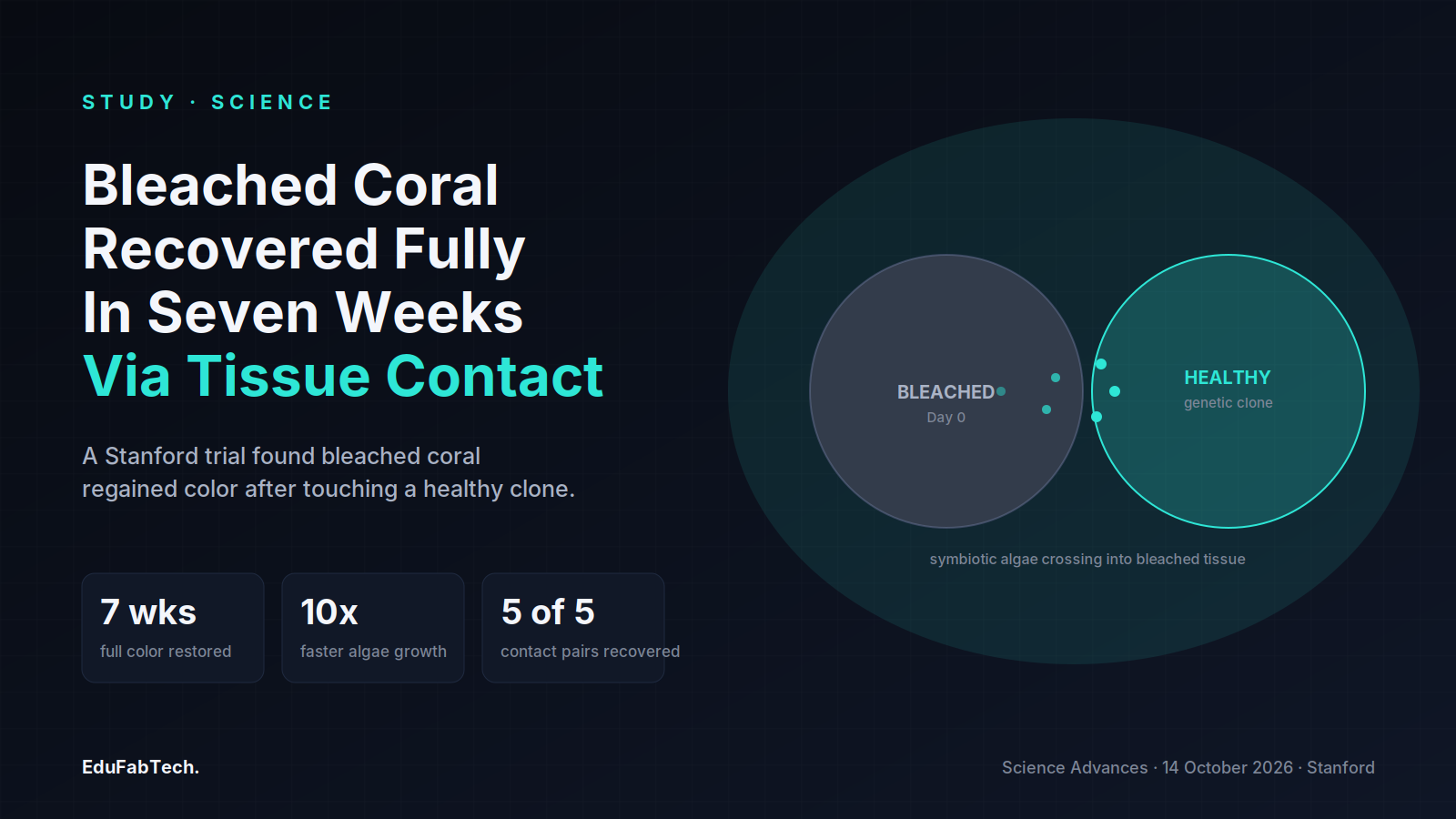
Coral fragments bleached by heat stress fully regained their color and their symbiotic algae within seven weeks of physical contact with a healthy, genetically identical fragment, according to a study published in Science Advances on 14 October 2026 by a team at Stanford's Doerr School of Sustainability. The lead author, PhD student Danny Collins, worked with Fiorenza Micheli and Steve Palumbi, both professors in Stanford's marine sciences program, on an experiment the researchers describe as the fastest documented recovery from coral bleaching.
The idea traces back to an accident in Palumbi's lab in 2025. Two coral fragments cut from the same colony — one bleached, one healthy — tipped over in a tank and ended up touching. Where the tissues met, color began returning to the bleached piece, a sign that the coral's symbiotic algae were coming back. That observation became the basis for a controlled experiment, described on the Stanford Doerr School of Sustainability's announcement of the published findings.
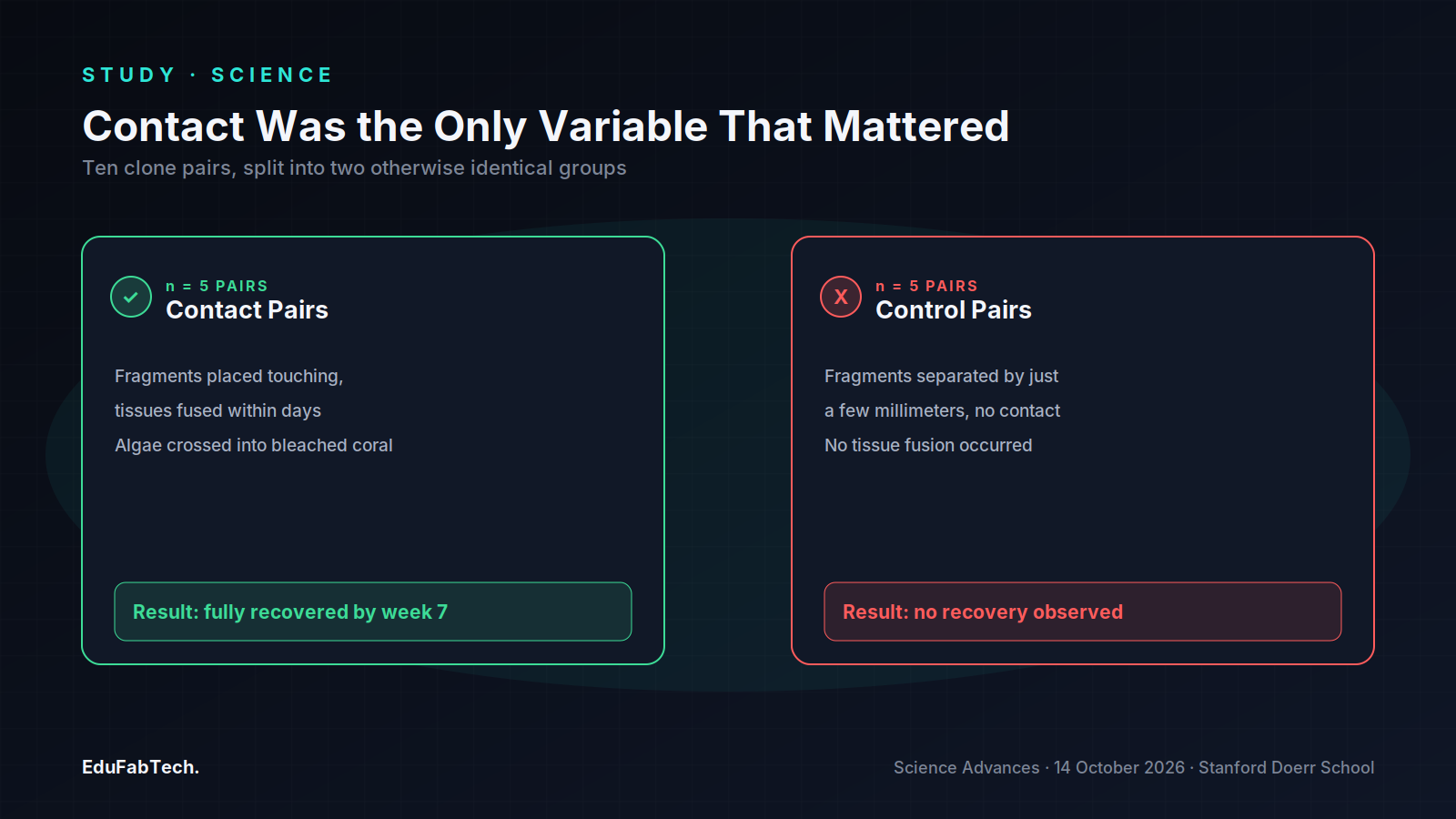
The team set up ten pairs of coral fragments, each pair split from the same parent colony so the two pieces were genetically identical. Five pairs were placed in direct physical contact; five others were separated by gaps of only a few millimeters and served as controls. Only the pairs in contact recovered, according to the study published in Science Advances.
How the recovery unfolds
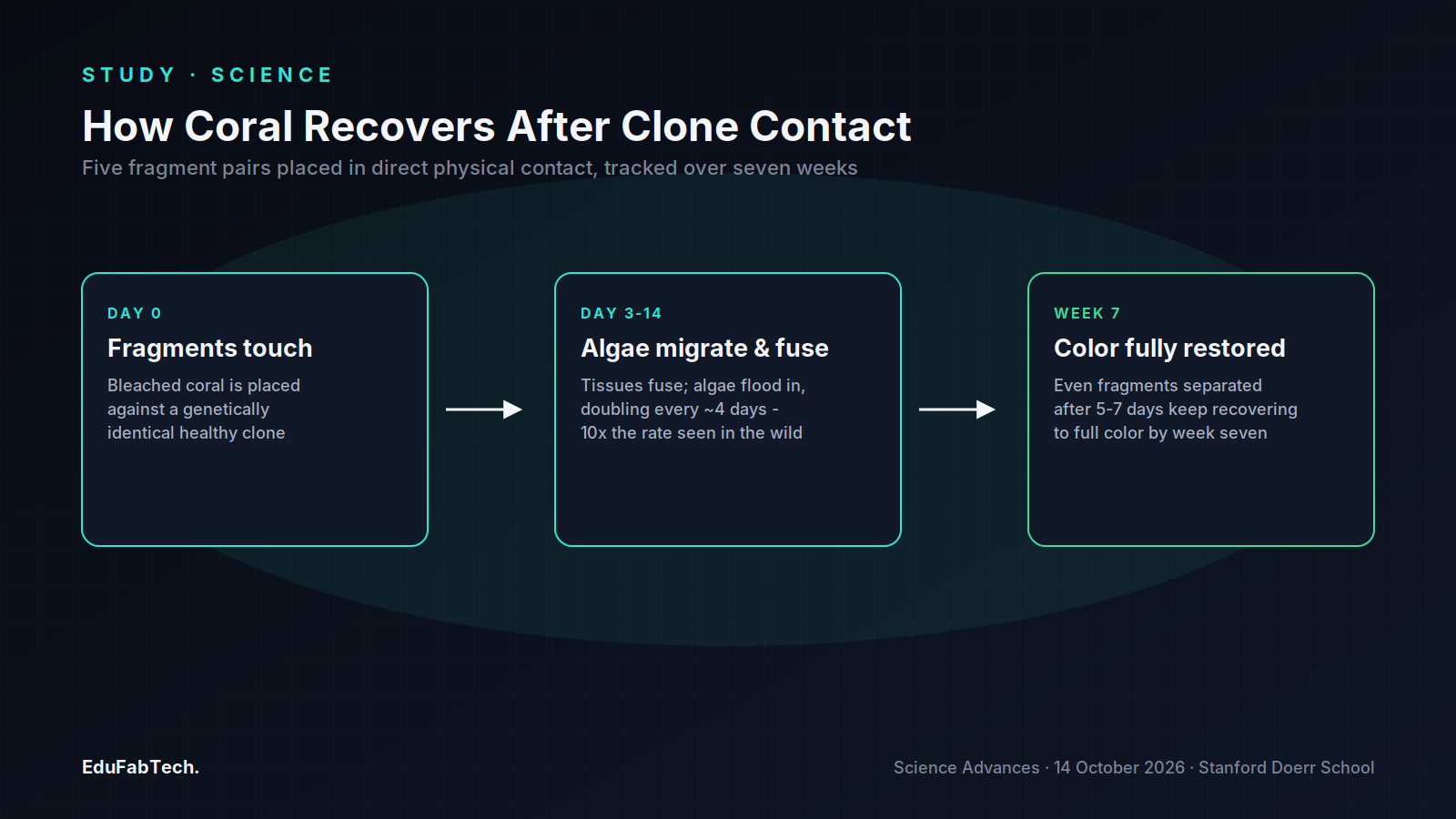
Within three days of contact, beneficial algae began moving from the healthy fragment into the bleached one, the Stanford announcement reports. During the second week, those algae doubled roughly every four days inside the bleached tissue — about ten times faster than replication rates seen in wild corals, according to the same account. Palumbi described the algae's behavior inside the recovering coral directly: "They flood in and start dividing at the fastest rates seen in corals," he told Euronews.
The researchers found that contact did not need to last the full seven weeks to work. Fragments separated after five to seven days of touching kept recovering on their own, reaching full color restoration by the seven-week mark even after the physical connection was removed, per the Stanford release. Microscopy showed that the two genetically identical tissues had fused, opening microscopic channels that let algae and nutrients pass between the fragments — a process the authors attribute to the corals recognizing each other as clones.
Why bleaching recovery is normally so slow
Outside the lab, a bleached coral depends on algae recolonizing it gradually from the surrounding water or from loose cells nearby, a process that can take months and often fails before the coral starves. Micheli put the usual outlook plainly in the Stanford announcement: "Bleached corals are often considered a lost cause because recovery after a heatwave is very slow, if it happens at all." The seven-week recovery documented in this study is, by the authors' own framing, markedly faster than that baseline — but it required a specific, engineered condition that reefs do not provide on their own.
A long way from reef-scale restoration
The method's central limitation is genetic: tissue fusion only happened between fragments that were clones of each other, cut from the same parent colony. As the Stanford announcement states, "the approach requires a genetically identical, healthy copy of every bleached coral, which is not feasible at the scale needed to restore reefs." A real reef contains countless distinct coral genotypes, and there is no practical way to pair every bleached colony with its own healthy twin across hundreds or thousands of square meters of reef.
Collins framed the finding as a reason for cautious optimism rather than a ready-made fix, telling Euronews: "While bleached corals may be dying, they are not dead yet." The team's stated next step, according to the Stanford account, is to find ways of delivering the same beneficial algae to bleached coral without requiring a living genetic clone in direct contact — for instance, isolating and transplanting the algae-carrying cells themselves rather than whole coral fragments.
Why it matters for research and teaching
For students and researchers working on coral symbiosis, the study offers a clean experimental demonstration that a bleached coral's recovery capacity is not fixed by how depleted its algae population has become, but can be sharply accelerated once a sufficient algal source is available nearby. That distinction matters for how recovery timelines are modeled after marine heatwaves, and for where restoration funders — the work was supported by the US National Science Foundation and Stanford's Big Ideas for Oceans grant program, according to the Stanford announcement — might next direct applied research toward algae-delivery methods that do not depend on finding a matching clone.
A quick question for readers
Which study habit do you think is most overrated?
Some popular habits have little evidence behind them. Which one do you think gets too much credit?
Pick an answer, create a free account in a minute, and your vote counts. Already a member? Sign in
Comments 0
CommentNo comments yet. Members start the conversation.
Source: Stanford Doerr School of Sustainability
Sources (3)
- Danny Collins, Fiorenza Micheli, Steve Palumbi, et al.. Rapid recovery of bleached coral through tissue fusion with a healthy clone. Science Advances, 2026. science.org ↗ · checked 21 Oct 2026
- Stanford Doerr School of Sustainability. Stanford scientists discover a way to reverse coral bleaching at record speed. Stanford University, 2026. sustainability.stanford.edu ↗ · checked 21 Oct 2026
- Euronews. They're not dead yet: bleached corals recover in record time after touching healthy clones. Euronews, 2026. euronews.com ↗ · checked 21 Oct 2026