Denmark Moves to Let Universities Screen Bachelor's and Master's Students for Security Risk
Danish university leaders backed a bill, reported October 16, 2026, that would extend existing PhD-level security screening to undergraduate and master's applicants from Russia, China and Iran.
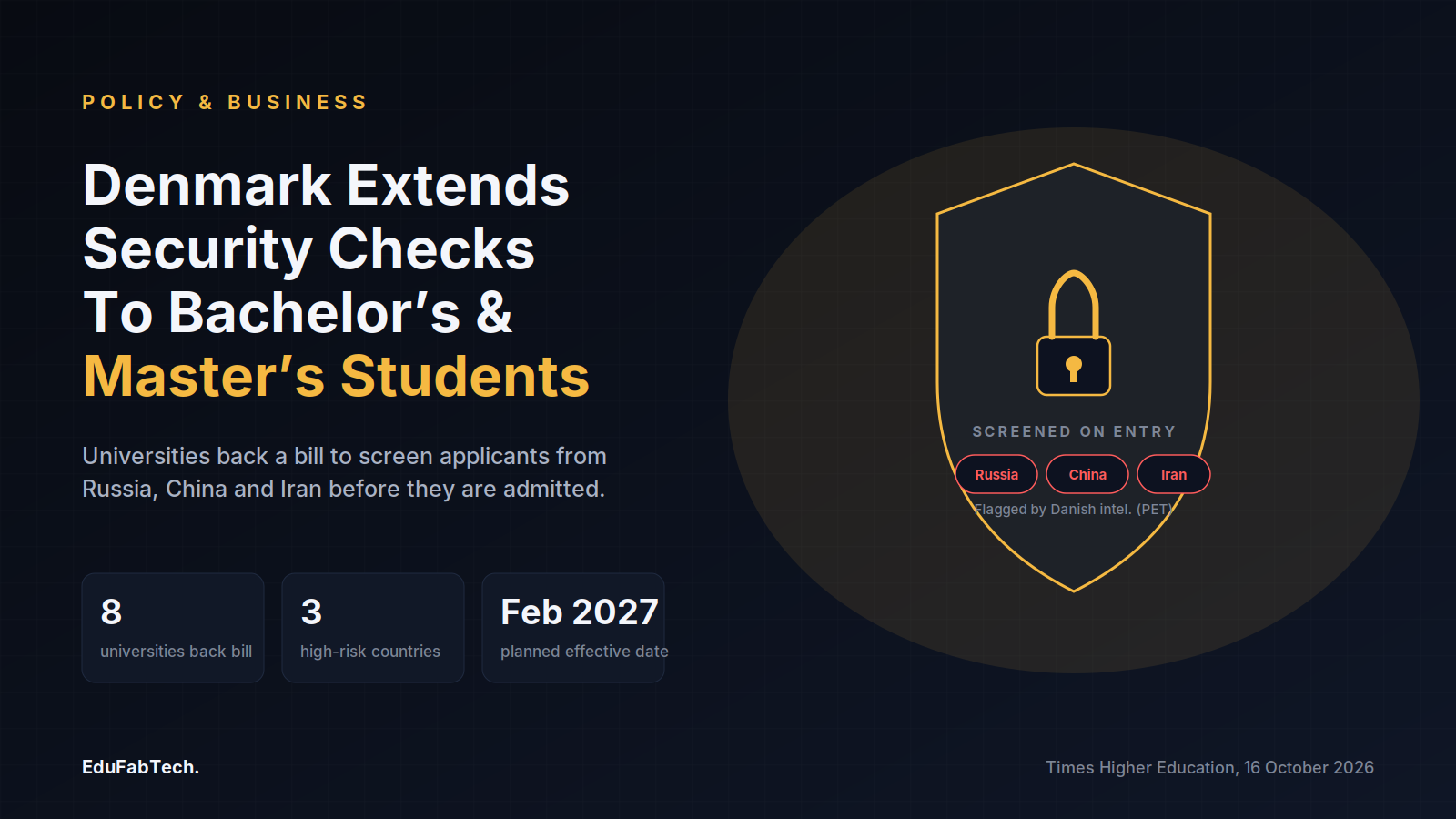
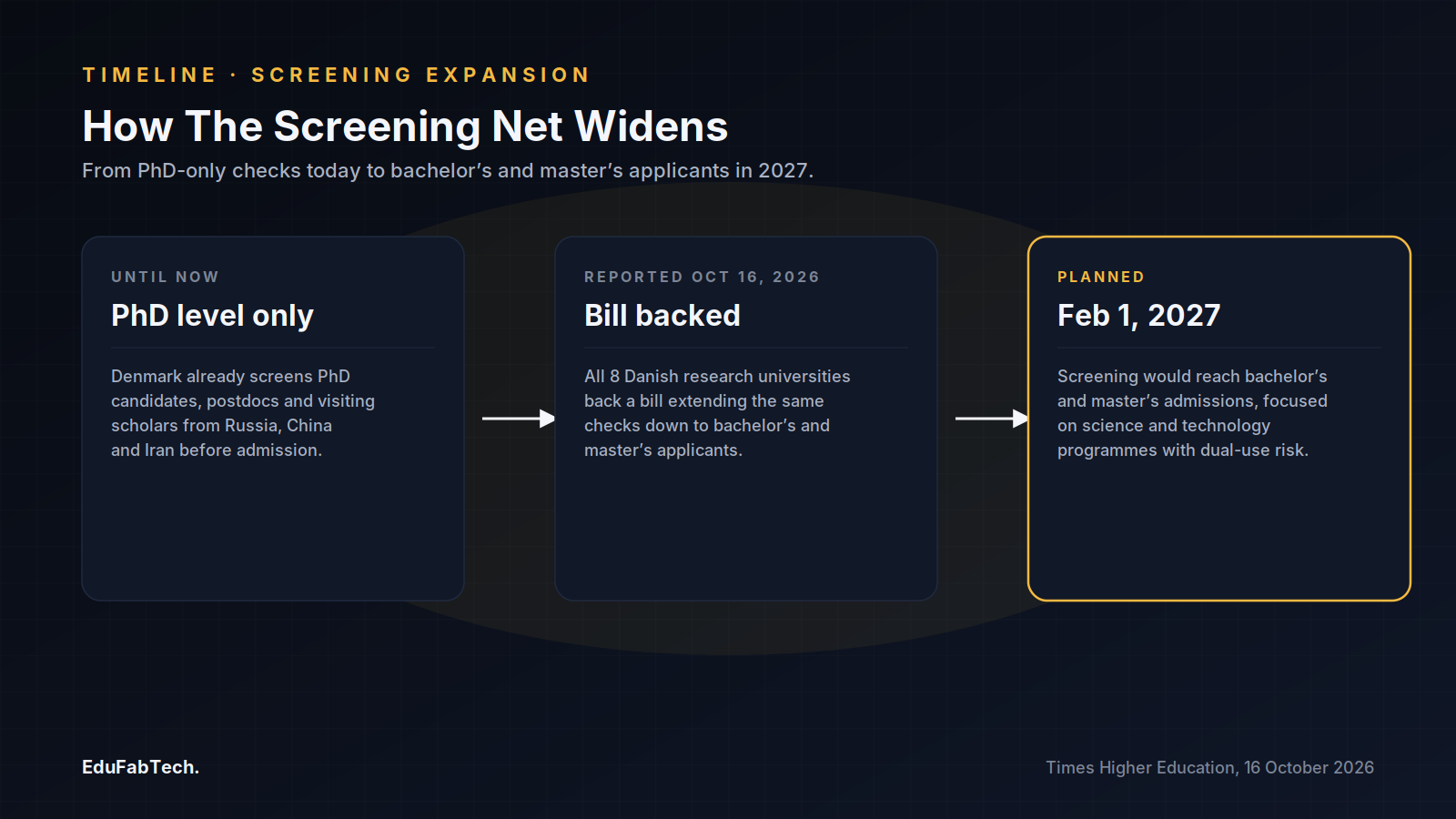
Denmark's eight state-funded research universities have backed a government bill that would let them reject bachelor's and master's applicants from countries judged a national security risk, according to a report published by Times Higher Education on October 16, 2026. The proposal, put out for consultation by Denmark's Ministry of Research, Education and Digitalization and posted on the national hearing portal, would extend background checks that currently apply only to PhD students, researchers and visiting scholars down to undergraduate and master's level, with a planned effective date of February 1, 2027.
Under current Danish law, universities can already screen and reject PhD candidates, postdoctoral researchers and visiting scholars from countries flagged by Danish intelligence as high-risk — currently China, Russia and Iran. Brian Vinter, vice-dean at Aarhus University, told Times Higher Education that extending the same logic to bachelor's and master's students would, if anything, reduce uncertainty for those who are screened in: "This will mean that future students won't have to worry about suspicion once they've been accepted, and they can focus on their studies." He added that the change would likely affect "an extremely small number" of applicants.
The bill's rationale, as reported by Times Higher Education, is that Denmark faces a "complex geopolitical situation with deteriorating threats" and a risk that foreign states "wrongfully try to obtain knowledge." The screening is intended to concentrate on applicants to science and technology programmes where they could encounter dual-use technology or critical infrastructure, rather than applying across all subjects.
Not every university leader backing the bill in principle backs it unconditionally. Kim Brinckmann of the University of Copenhagen's research and information security office told Times Higher Education that the university supports measures that strengthen security "while preserving the fundamental principles of academic freedom, international collaboration and equal treatment," and argued screening decisions should rest on "specific risk assessments rather than nationality alone." Brian Bech Nielsen, chairman of the university association Universities Denmark, framed the shift as a reluctant necessity rather than a policy Danish universities sought: "The geopolitical situation has heightened the need to protect critical knowledge at universities," while stressing that "international students are an important part of Danish universities."
Three Nordic countries, three different answers
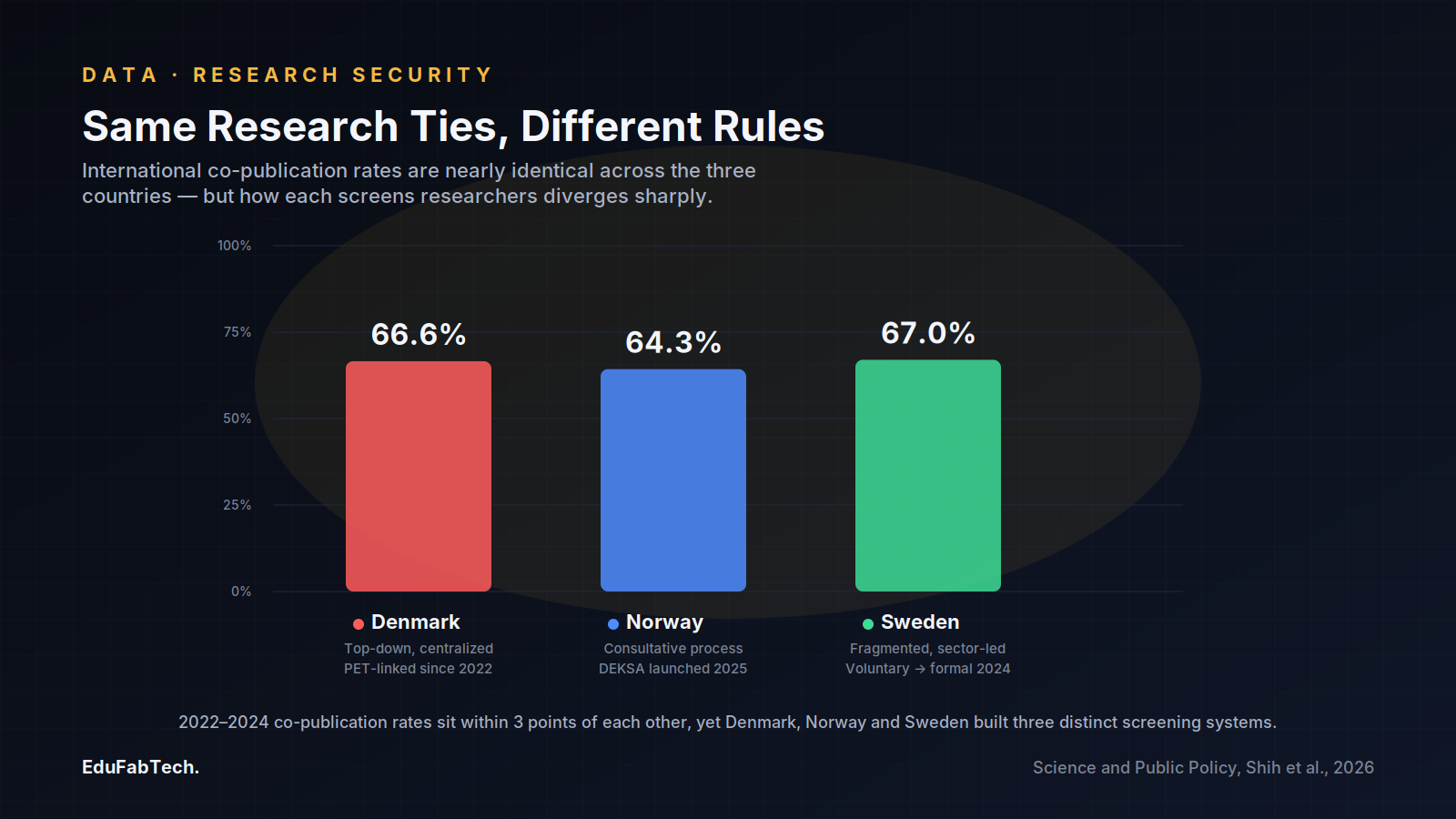
Denmark's approach is not the only way Scandinavian countries have responded to the same pressure, and a comparison published this year shows how differently the three governments have handled it. A study in Science and Public Policy by Tommy Shih, Stine Haakonsson, Kristin Fjæstad and Hans Jørgen Gåsemyr, published in 2026, compares how Denmark, Norway and Sweden have each built research-security systems despite sharing similar research profiles: the study puts international co-publication rates for 2022-2024 at 66.6% for Denmark, 64.3% for Norway and 67% for Sweden.
The study describes Denmark's model as top-down and centralized, built around guidelines issued in 2022 through direct collaboration between universities, the Danish Security and Intelligence Service (PET) and government ministries, with funding applications flagged for red-list collaboration with China, Russia or Iran. Norway, by contrast, took a consultative path: its guidelines followed more than 50 stakeholder meetings and 25 written submissions before being finalized in 2023, and the government set up a dedicated export-control body, DEKSA, in 2025. Norway also signed a new bilateral research agreement with China in 2024, even as it tightened controls elsewhere. Sweden's path was the most fragmented of the three, starting with voluntary 2020 guidelines led by universities and the STINT foundation, with formal government-endorsed rules not arriving until 2024.
The authors conclude that despite near-identical geopolitical pressures and comparable research systems, the three countries ended up with distinct governance patterns, shaped by how centralized each state is and how collaborative or top-down its policymaking process tends to be. For researchers and students weighing where to study or collaborate in Scandinavia, that divergence matters practically: a Chinese, Russian or Iranian applicant to a Danish technical programme now faces a more codified and centrally run screening process than an equivalent applicant in Sweden, where rules are newer and more sector-led, or Norway, where the process built in more consultation before taking effect.
What it means for applicants and collaborators
For prospective students, the practical change is narrow but real: Denmark's existing screening regime, which already affects a small number of PhD and postdoctoral applicants each year, would for the first time reach undergraduate and master's admissions, concentrated in science, technology and dual-use-adjacent programmes. Danish officials expect the numerical impact on overall international enrolment to be limited. But the bill, paired with the Scandinavian comparison, illustrates a broader pattern: research-security rules are no longer confined to classified defence research or senior scientists, and students choosing where to study a sensitive subject may increasingly need to check not just a university's admissions policy but their government's current list of flagged countries and the specific legal mechanism behind it.
A quick question for readers
What is your biggest monthly expense as a student?
Knowing where the money really goes helps new students plan. Your answer helps someone budget.
Pick an answer, create a free account in a minute, and your vote counts. Already a member? Sign in
Comments 0
CommentNo comments yet. Members start the conversation.
Source: Times Higher Education
Sources (3)
- Times Higher Education. Danish deans back screening students from 'high-risk' countries. Times Higher Education, 2026. timeshighereducation.com ↗ · checked 17 Oct 2026
- Danish Hearing Portal (Forsknings-, Uddannelses- og Digitaliseringsministeriet). Forslag om ændring af universitetsloven. hoeringsportalen.dk, 2026. hoeringsportalen.dk ↗ · checked 17 Oct 2026
- Tommy Shih, Stine Haakonsson, Kristin Fjæstad, Hans Jørgen Gåsemyr. As open as possible? Comparing Scandinavian approaches to research security. Science and Public Policy, 2026. academic.oup.com ↗ · checked 17 Oct 2026