Google Cuts Quantum "Magic State" Error Rates 40-Fold on Its Willow Chip
A Science paper published October 15, 2026 shows Google Quantum AI generating the error-corrected T-states needed for universal quantum computing using a fraction of the qubits distillation required.
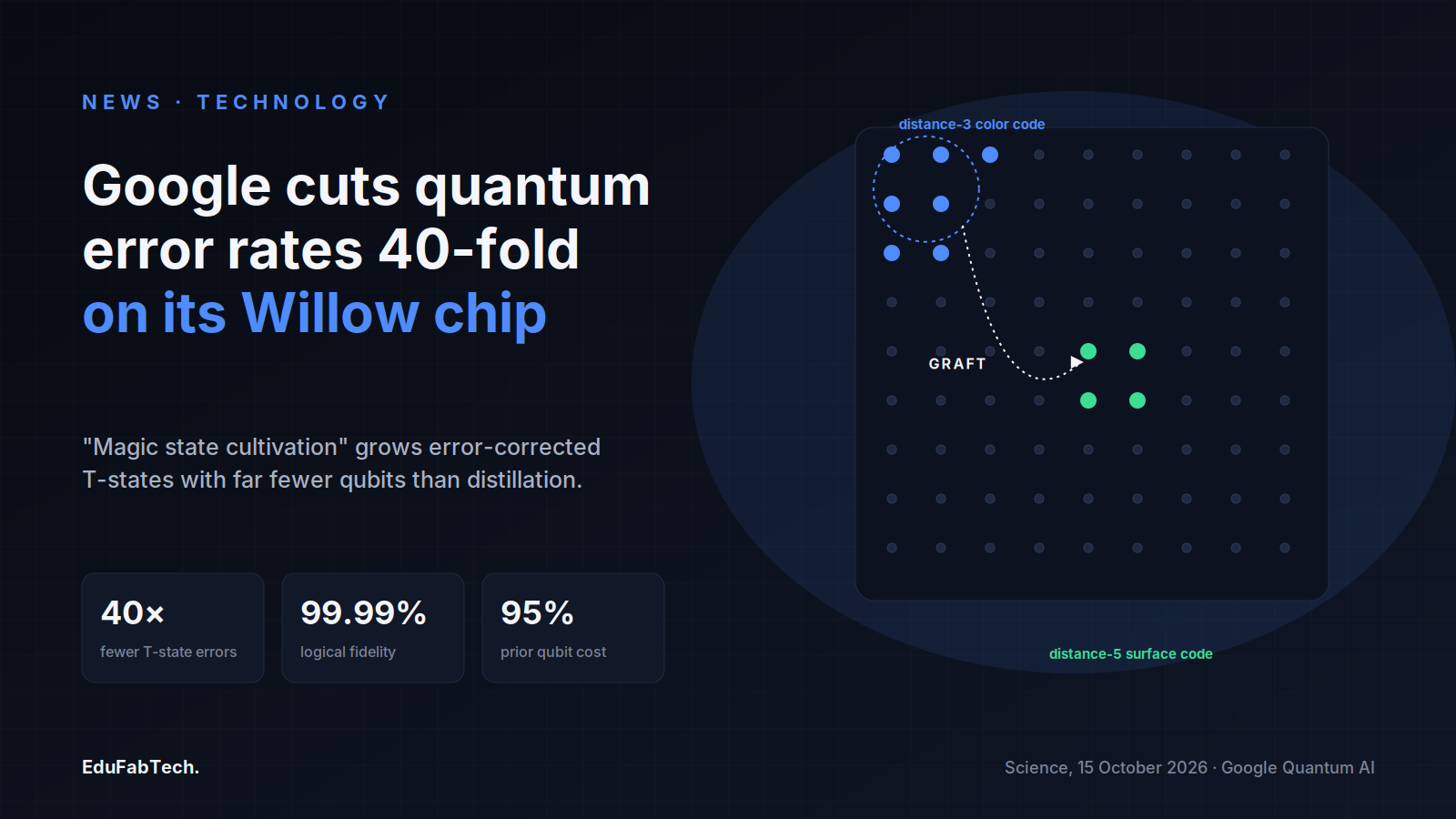
Google Quantum AI reported on October 15, 2026 that it has demonstrated "magic state cultivation" on physical hardware for the first time, generating the error-corrected quantum states that universal, fault-tolerant quantum computers need while using a fraction of the qubits that the standard method, distillation, requires. The result, published in Science, ran on Google's Willow superconducting processor and was reported by the company's own Quantum AI blog.
The states in question are called T-states, or "magic states." They are not needed for the simplest quantum logic gates, but they are required for the handful of non-Clifford operations that let a quantum computer run the specific class of algorithms — including some forms of molecular and materials simulation — that classical computers cannot efficiently replicate. Producing a T-state clean enough to trust in a long calculation has historically meant distilling many noisy copies down to one, a process so resource-hungry that Google's team describes earlier estimates of up to 95% of a fault-tolerant quantum computer's entire physical qubit footprint going toward magic-state production alone, according to the Google Quantum AI blog.
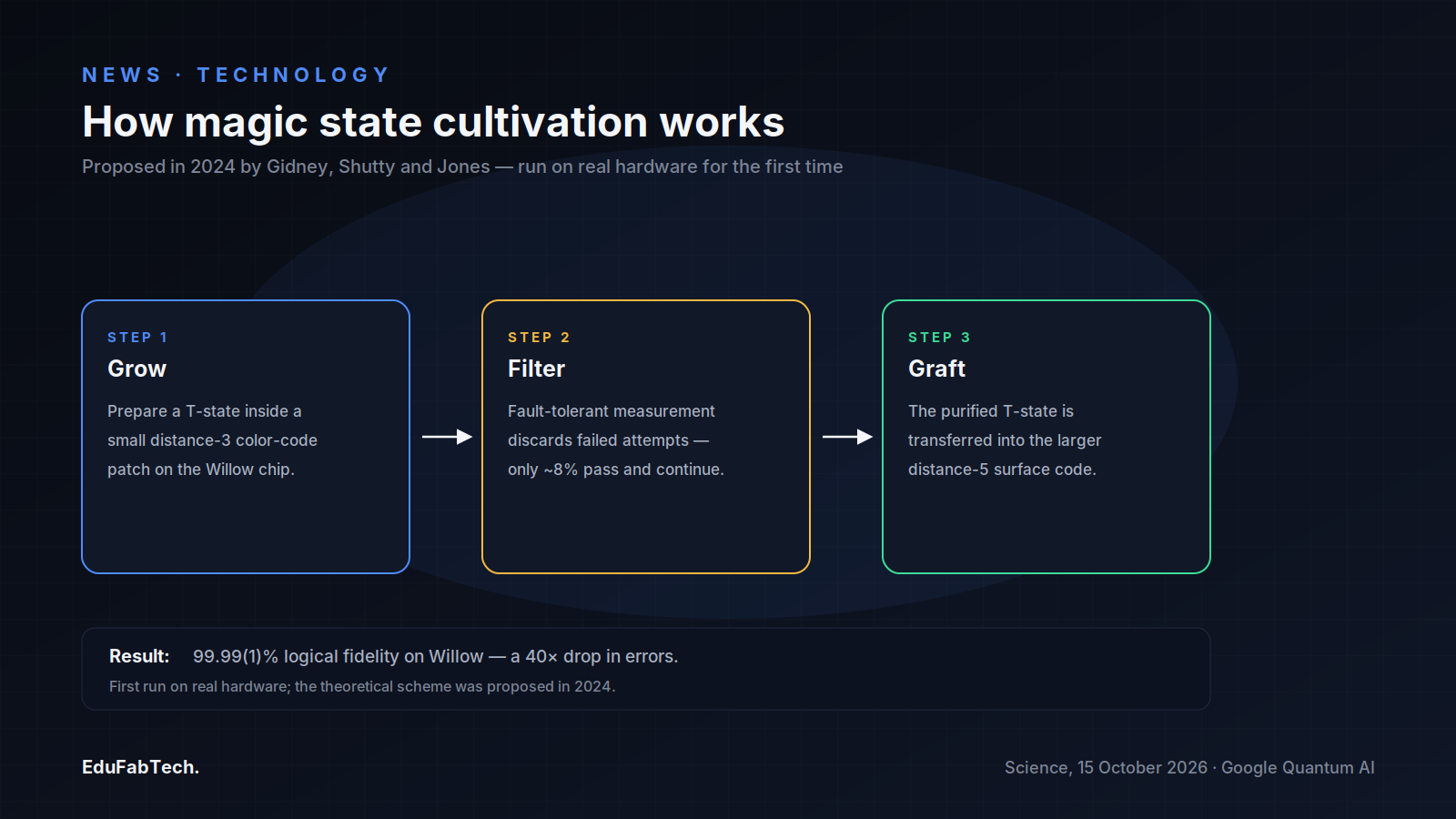
Cultivation, a theoretical scheme Google researchers Craig Gidney, Noah Shutty and Cody Jones proposed in 2024, takes a different route: it grows a T-state directly inside a small region of a quantum error-correcting code — in this case a distance-3 "color code" — and only afterward transfers, or "grafts," the purified result into the larger, distance-5 surface code used for the rest of the computation. The October 2026 paper is the first time this has been run on real hardware rather than simulated, according to the Science paper.
What the numbers show
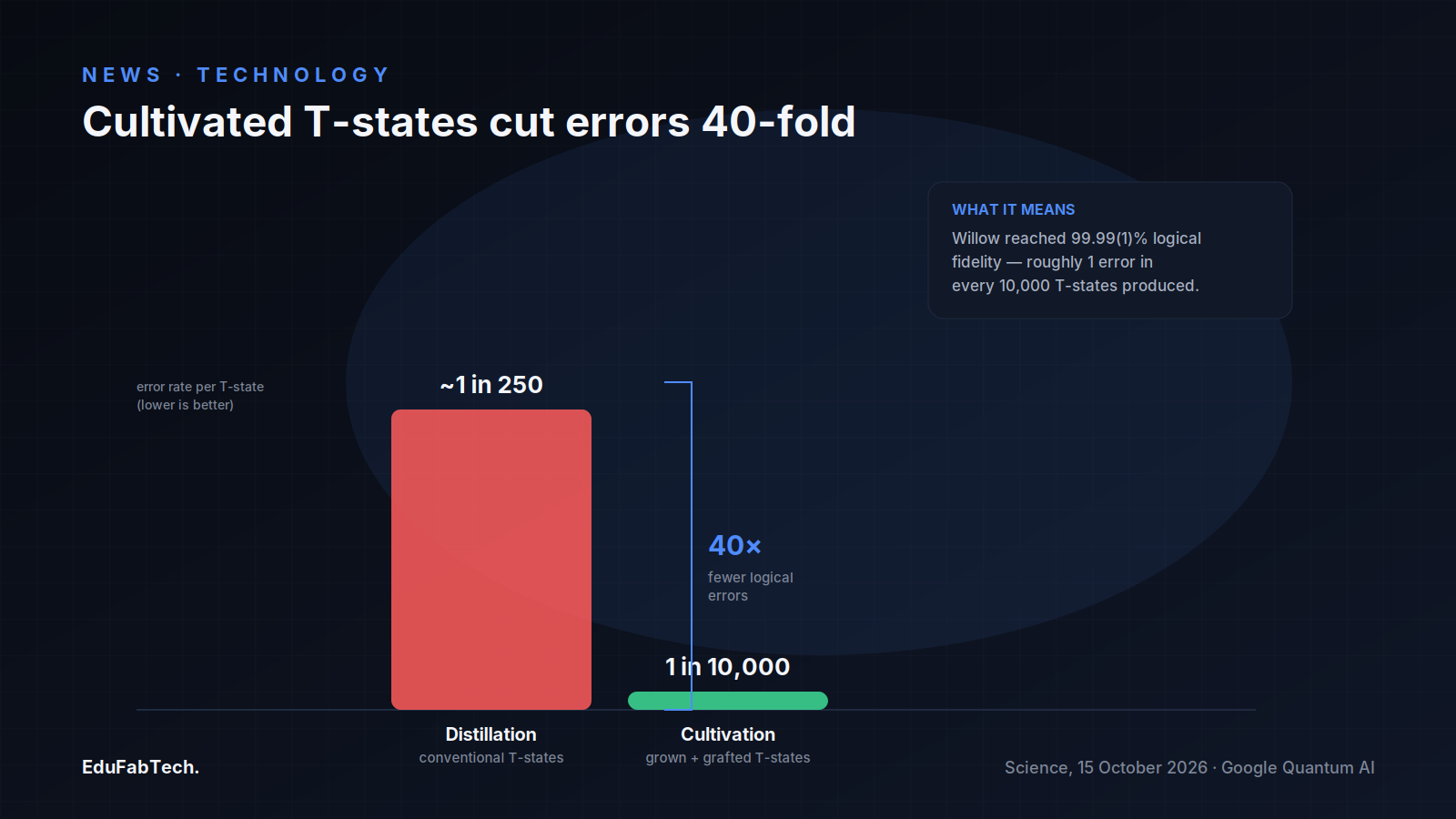
On Willow, the cultivated T-states reached 99.99(1)% logical fidelity, an error rate at or below roughly 1 in 10,000, which Google's team reports as a 40-fold reduction in errors compared with uncultivated states produced the conventional way, per the Google Quantum AI blog. Reaching that fidelity required solving practical problems along the way: a particular kind of noise caused by electrical-equipment drift and temperature variation was corrupting the team's benchmark, producing data that looked physically impossible until a researcher traced it to a flawed assumption in their standard measurement technique. The team added hardware controls to cut the noise and invented a new benchmarking method that uses cultivation to measure itself, according to the same source.
An independent summary from the trade publication Quantum Computing Report adds detail the company blog does not foreground: the protocol keeps only about 8% of its attempts, discarding the rest through fault-tolerant measurement filtering, and the qubit savings come specifically from needing a fraction of the physical footprint that distillation-based protocols required, rather than from a fixed qubit count.
Why the gap to real applications still matters
The 40-fold improvement is real, but it does not, by itself, establish that cultivation is ready for demanding algorithms. Google's own blog post is explicit on this point, writing that the team still needs "to demonstrate magic state cultivation at a larger scale to make it realistic for practical quantum computing, and plenty of technical challenges remain." Cultivation lowers the physical-qubit cost of reaching a given fidelity target; it does not, on its own, show that today's fidelity is high enough for a useful fault-tolerant computer to run algorithms such as drug-interaction simulation end to end.
Google's own framing is correspondingly measured. The company's blog post describes the work as taking "a key theoretical idea and turn[ing] it into an experimentally demonstrated reality," and as a step toward "a useful, error-corrected quantum computer to solve otherwise unsolvable problems" — language that treats this as progress on a known bottleneck rather than a finished solution, per the Google Quantum AI blog.
What it means for students and researchers
For anyone studying quantum information theory, this is one of the first instances where a protocol proposed on paper in 2024 — magic state cultivation — has been validated against the noise of real superconducting hardware within two years, giving students and researchers a concrete dataset to check theoretical overhead estimates against. The Science paper itself is the primary technical record, including the benchmarking methodology the team developed to measure fidelity without a trusted reference state, which is likely to be reused by other groups working on different hardware platforms, such as trapped-ion and photonic processors, that face the same magic-state bottleneck.
For researchers planning compute budgets on near-term fault-tolerant machines, the practical takeaway is that cultivation changes the qubit-overhead side of the ledger, not the fidelity target. Teams designing algorithms that depend on many T-gates — most chemistry and materials simulations fall into this category — still need to track both numbers separately: how many physical qubits a magic state costs to produce, and how clean that state is once produced. Google's result improves the first without yet solving the second.
A quick question for readers
Which skill will matter most for getting a job in 2030?
Everyone has a prediction. Add yours and see what students are betting on.
Pick an answer, create a free account in a minute, and your vote counts. Already a member? Sign in
Comments 0
CommentNo comments yet. Members start the conversation.
Source: Google Quantum AI / Science
Sources (3)
- Google Quantum AI. Cultivating magic states on the Willow processor. Google Blog, 2026. blog.google ↗ · checked 16 Oct 2026
- Craig Gidney, Noah Shutty, Cody Jones, et al.. Demonstrating efficient magic state cultivation on a superconducting processor. Science, 2026. doi.org ↗ · checked 16 Oct 2026
- Quantum Computing Report. Google Quantum AI Demonstrates Magic State Cultivation on Willow Processor in Science Milestone. Quantum Computing Report, 2026. quantumcomputingreport.com ↗ · checked 16 Oct 2026