2024 Graduates Who Stay Abroad Set to Add $1.7tn to Host Economies Over Their Careers, Report Finds
A Studyportals and Cambridge University Press & Assessment report tracking over 500,000 international graduates finds the 2024 cohort who stay abroad will generate $110 billion in their first year and $1.7 trillion over their careers.
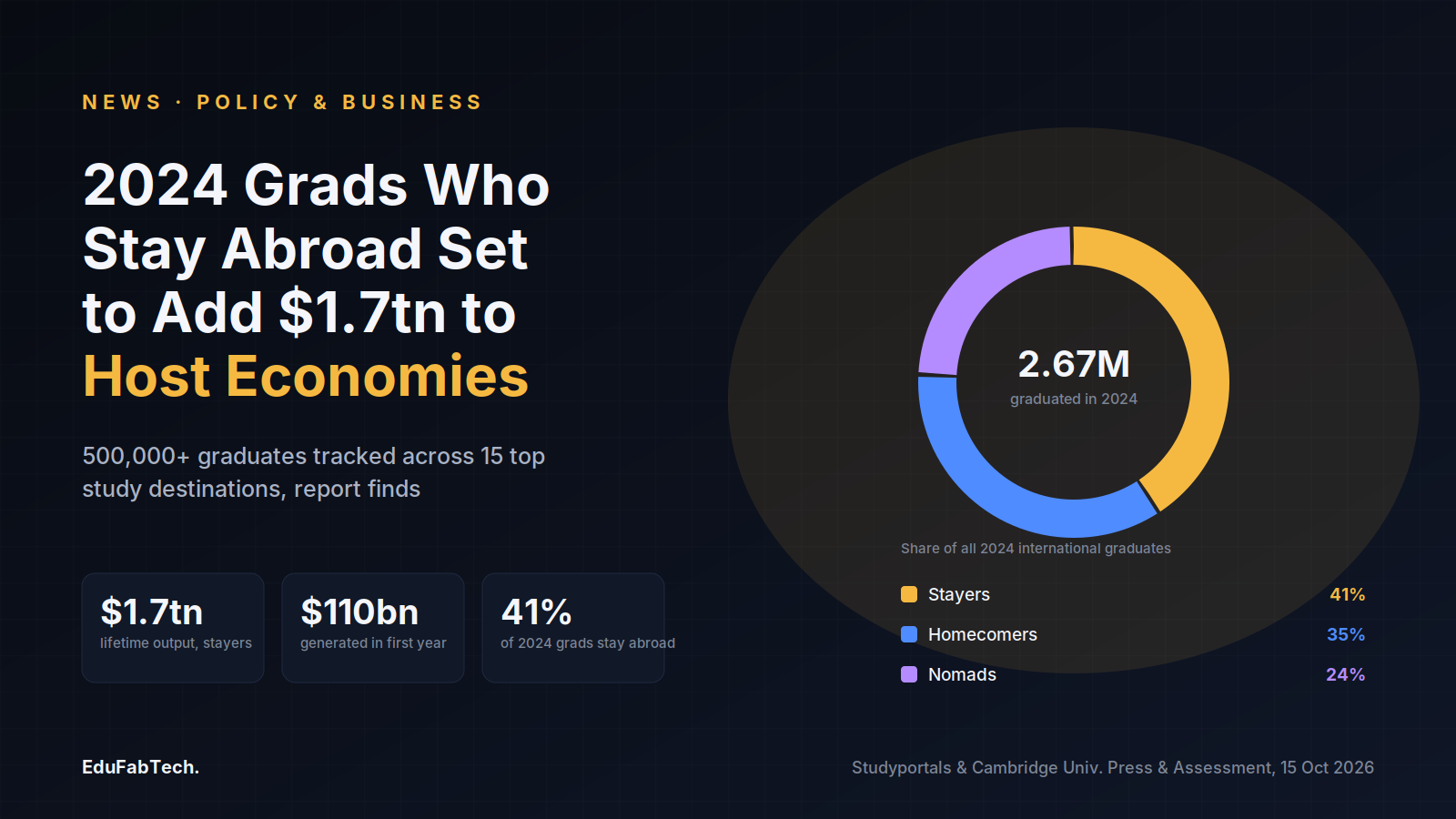
A report released on 15 October 2026 by Studyportals and Cambridge University Press & Assessment estimates that the cohort of international students who graduated in 2024 will generate US$1.7 trillion in economic output over their lifetimes in the countries where they choose to stay and work. The report, Talent Beyond Borders: The Global Impact of International Graduates, argues that the usual way of measuring international education — tuition fees and living expenses paid while studying — misses most of the value these graduates eventually create.
What the dataset covers
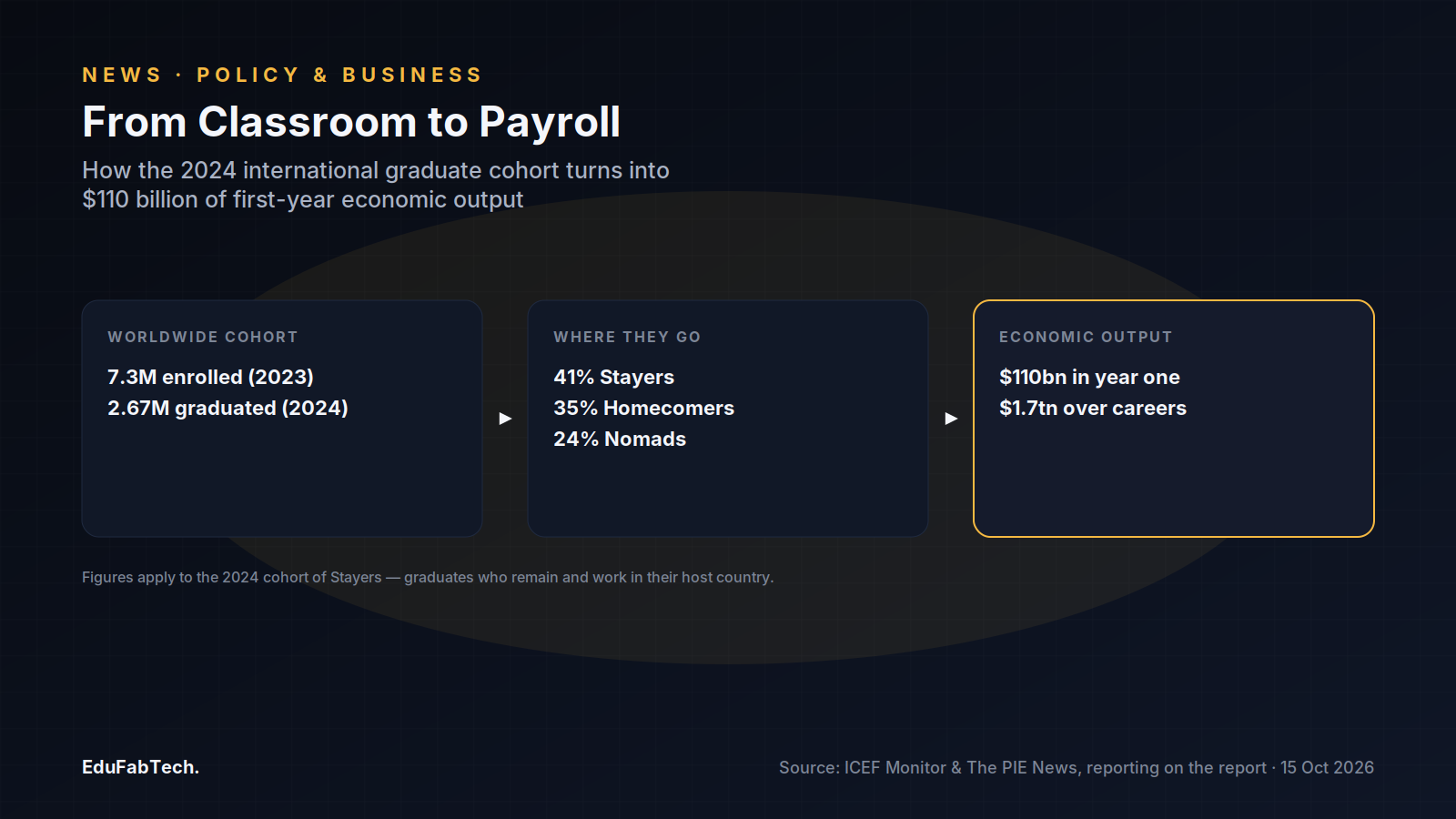
The analysis draws on Studyportals data covering more than half a million international graduates, according to The PIE News, which examined the report. It looks at 15 major study destinations that together host around 60% of the world's internationally mobile students. Of the roughly 7.3 million international students enrolled worldwide in 2023, around 2.67 million graduated in 2024, according to ICEF Monitor's reporting on the report.
Rather than treating "international graduate" as a single category, the report splits that 2024 cohort into three groups based on where they end up working: Stayers, who remain in their study destination; Homecomers, who return to their country of origin; and Nomads, who move on to a third country. ICEF Monitor reports that the study puts Stayers, Homecomers and Nomads at 41%, 35% and 24% of all international graduates respectively.
Where the economic value concentrates
The $1.7 trillion lifetime figure applies specifically to graduates who stay in their host country after finishing their studies, per ICEF Monitor's reporting on the report. In their first year alone, that 2024 cohort of stayers is projected to generate about US$110 billion in economic output, according to the same report.
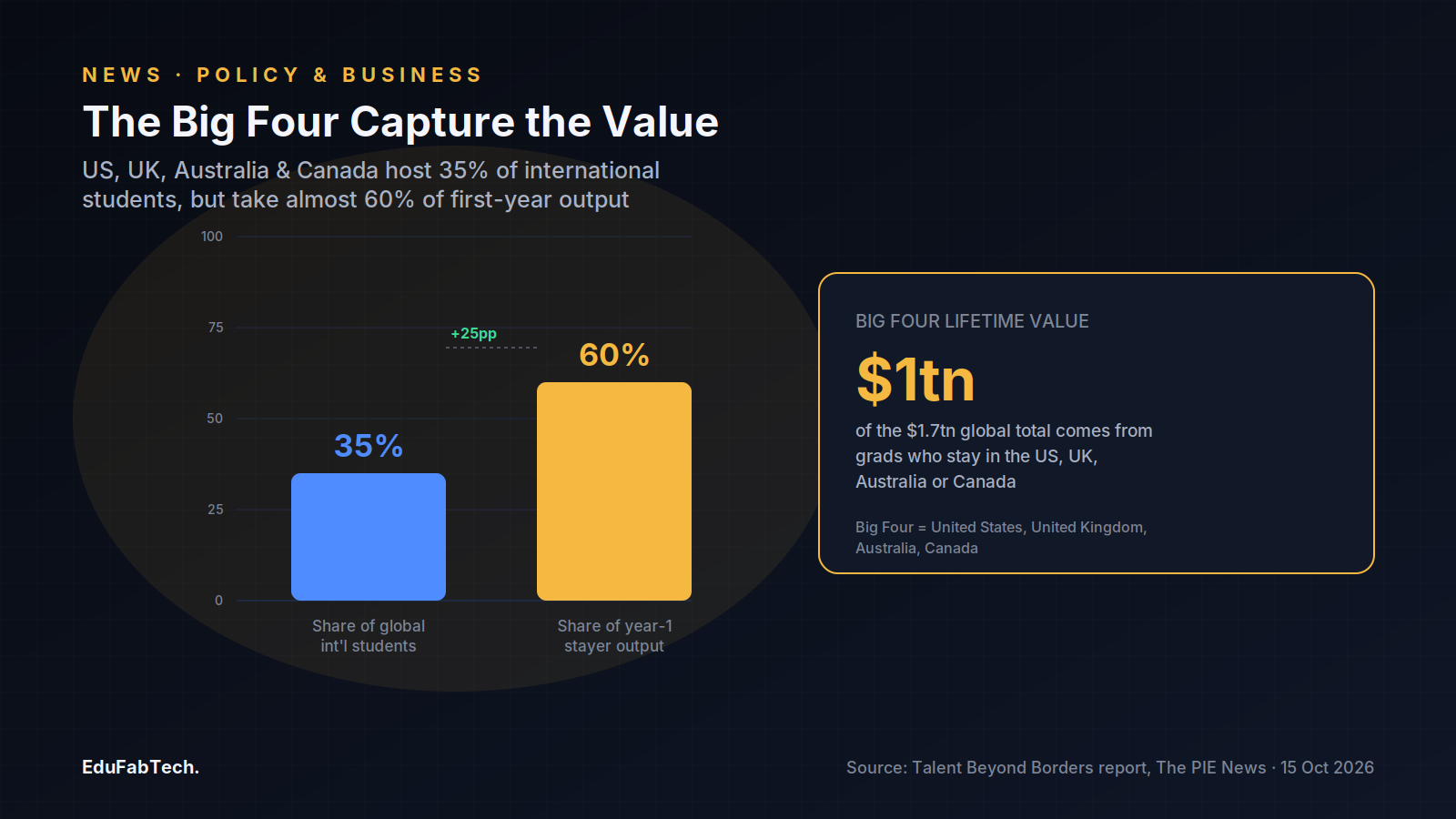
That value is not spread evenly across destination countries. The United States, the United Kingdom, Australia and Canada — described in the report as the "Big Four" — host around 35% of international students globally but account for almost 60% of the first-year economic output from graduates who stay, The PIE News reports. Combined, international students who graduated from the Big Four in 2024 are projected to generate around $1 trillion in lifetime economic value on their own, according to the report's findings as relayed by The PIE News. ICEF Monitor adds that most Stayers end up employed in one of these four countries.
Why the authors say the usual metrics undercount graduates
Edwin van Rest, CEO and co-founder of Studyportals, is quoted by The PIE News saying: "International students are worth so much more as a talent source than they are in tuition fees and local spend." Francesca Woodward, global managing director for English at Cambridge University Press & Assessment, is quoted in the same article: "International students enrich communities, plug vital skills gaps, boost diversity and help build stronger connections between people and countries."
The report's own site frames its three graduate categories — Stayers, Homecomers and Nomads — as different channels through which the skills gained abroad move around the world, rather than treating departure from the host country as a loss of value. The site includes individual graduate accounts illustrating each category, including graduates who moved between Brazil, Germany and the UK, and between The Gambia, Qatar and Germany, among others, according to the report's site.
Why this matters beyond the headline figure
As The PIE News notes, the findings land at a time when the benefits of international student recruitment and graduate retention face heightened political scrutiny in several major destinations. Tayyeb Shah, president of the European Association for International Education, said the research challenges narratives suggesting that international students create greater burdens than benefits for host countries, The PIE News reports. The $1.7 trillion estimate — drawn from projected employment outcomes across 15 destination countries rather than from enrolment or spending data — gives policymakers a different figure to weigh in that debate: what graduates go on to produce in the labour market, rather than what they paid to study.
For students weighing where to study, the three-way split between Stayers, Homecomers and Nomads is also a reminder that the value of an international degree is not confined to the country where it was earned.
A quick question for readers
Do you work part-time while you study?
Many students work to pay the bills. See how common it is — and how many hours people really do.
Pick an answer, create a free account in a minute, and your vote counts. Already a member? Sign in
Comments 0
CommentNo comments yet. Members start the conversation.
Source: Studyportals and Cambridge University Press & Assessment
Sources (3)
- Studyportals and Cambridge University Press & Assessment. Talent Beyond Borders: The Global Impact of International Graduates. talent-beyond-borders.org, 2026. talent-beyond-borders.org ↗ · checked 18 Oct 2026
- ICEF Monitor. One cohort of international graduates will contribute US$1.7 trillion to host country economies throughout their careers. ICEF Monitor, 2026. monitor.icef.com ↗ · checked 18 Oct 2026
- The PIE News. International graduates deliver $1.7tn lifetime boost to host economies. The PIE News, 2026. thepienews.com ↗ · checked 18 Oct 2026