Stanford-Led Blind Test Finds Purpose-Built Methane Satellites Catch 92-100% of Leaks
A year of 481 staged methane releases in Arizona shows dedicated sensors outperform repurposed and general-purpose satellites, while AI-driven analyses of land-scanning data produced most false alarms.
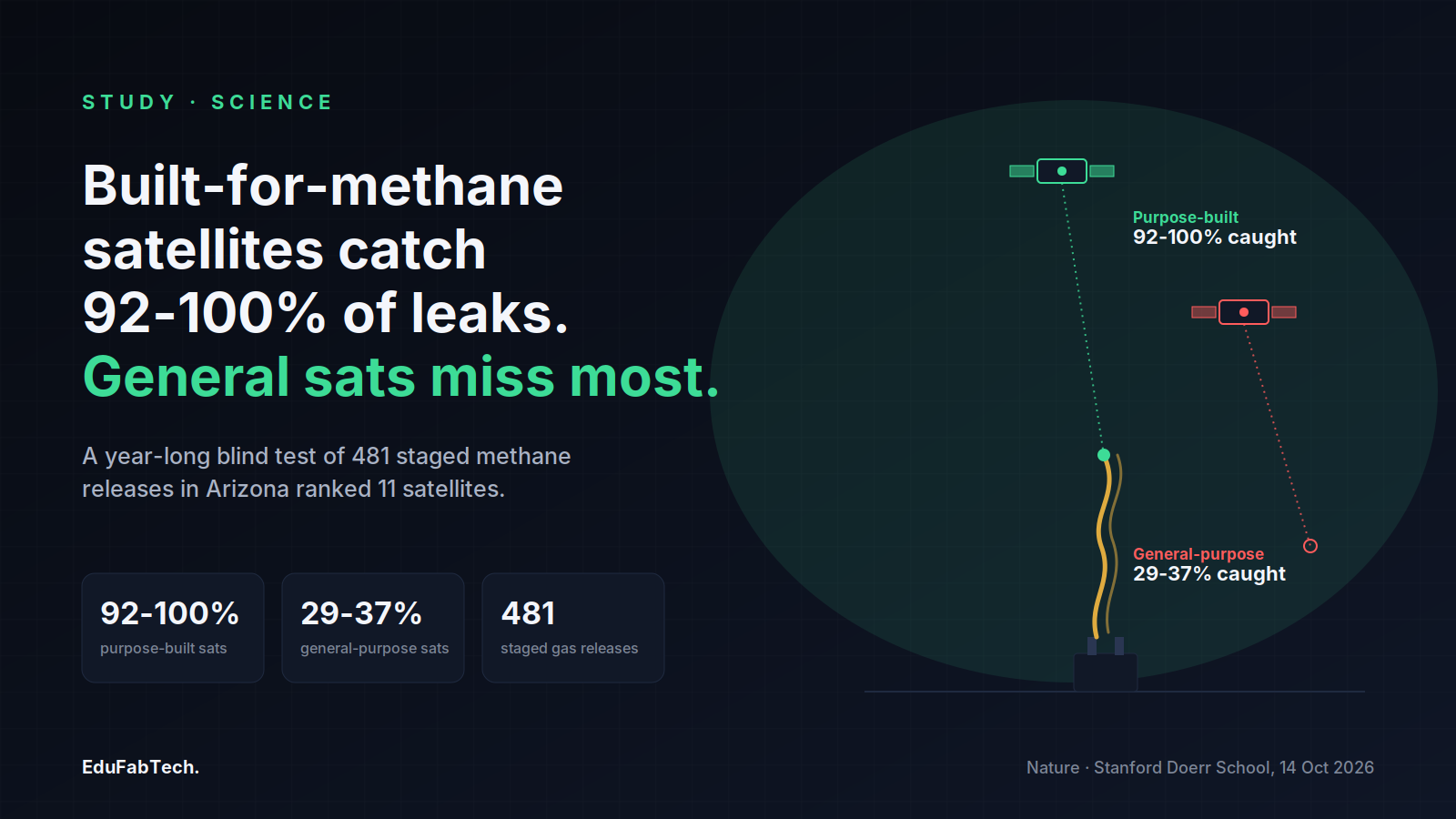
A year-long, single-blind test staged near Casa Grande, Arizona found that satellites built specifically to detect methane caught 92-100% of controlled gas releases on clear days, while general-purpose land-scanning satellites repurposed for the task caught only 29-37%, according to a study published in Nature on October 14, 2026, led by Frances Reuland and Adam Brandt of Stanford University's Doerr School of Sustainability.
The experiment, described in Evaluating space-based methane detection through a one-year blind test, is the largest controlled validation of satellite methane monitoring conducted so far. Over 2025, the researchers released compressed natural gas from trailers at rates of 10 to 1,200 kilograms per hour, 481 times, timed to coincide with overpasses of 11 government, nonprofit and commercial satellites. They added 265 additional overpasses with no gas released at all, to see how often each system raised a false alarm. Fifteen independent analysis teams from nine countries, including Carbon Mapper, NASA's Jet Propulsion Laboratory and Google, submitted more than 2,250 estimates without knowing in advance which passes were real releases and which were blanks.
Purpose-built sensors led, general scanners lagged
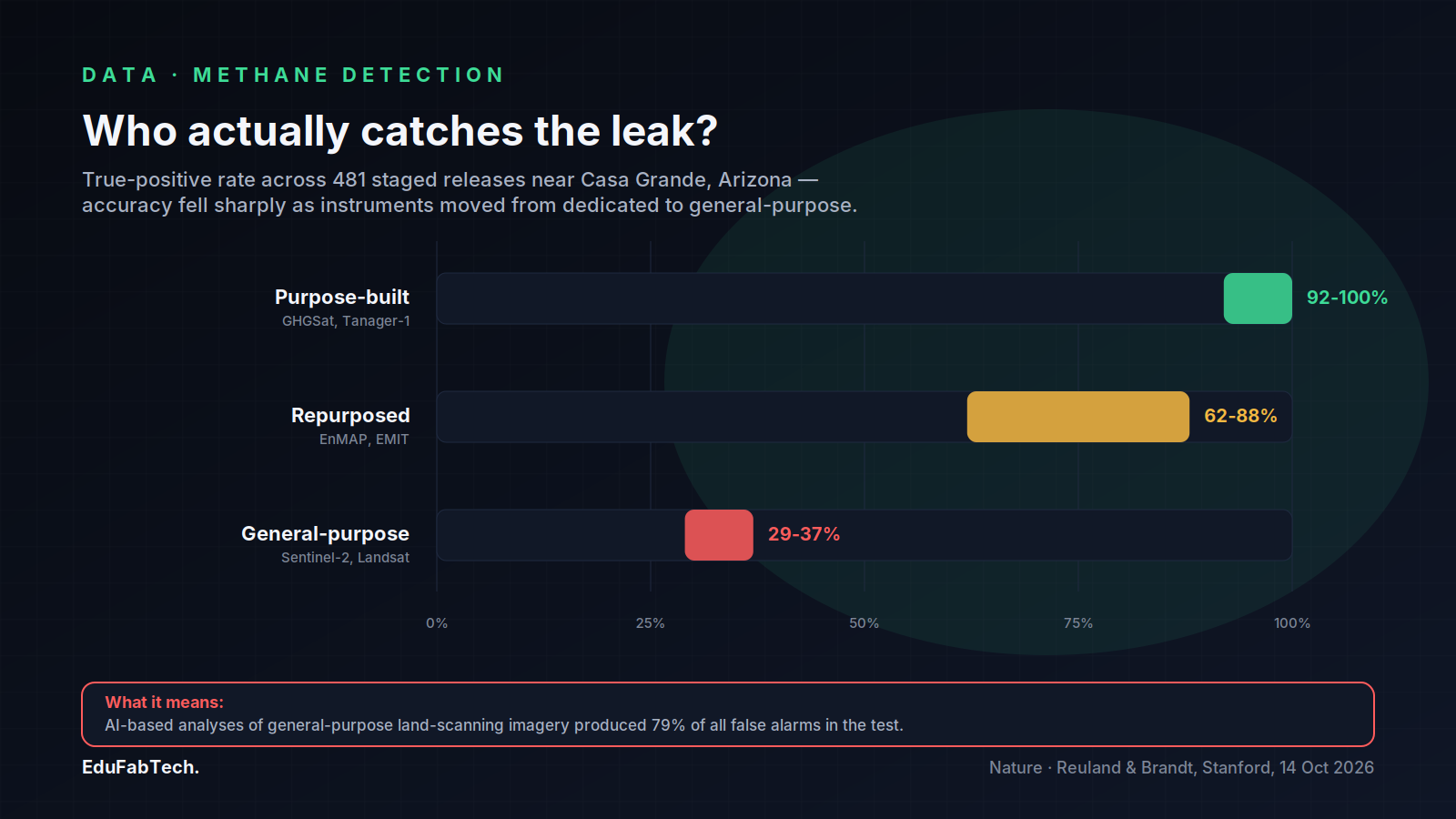
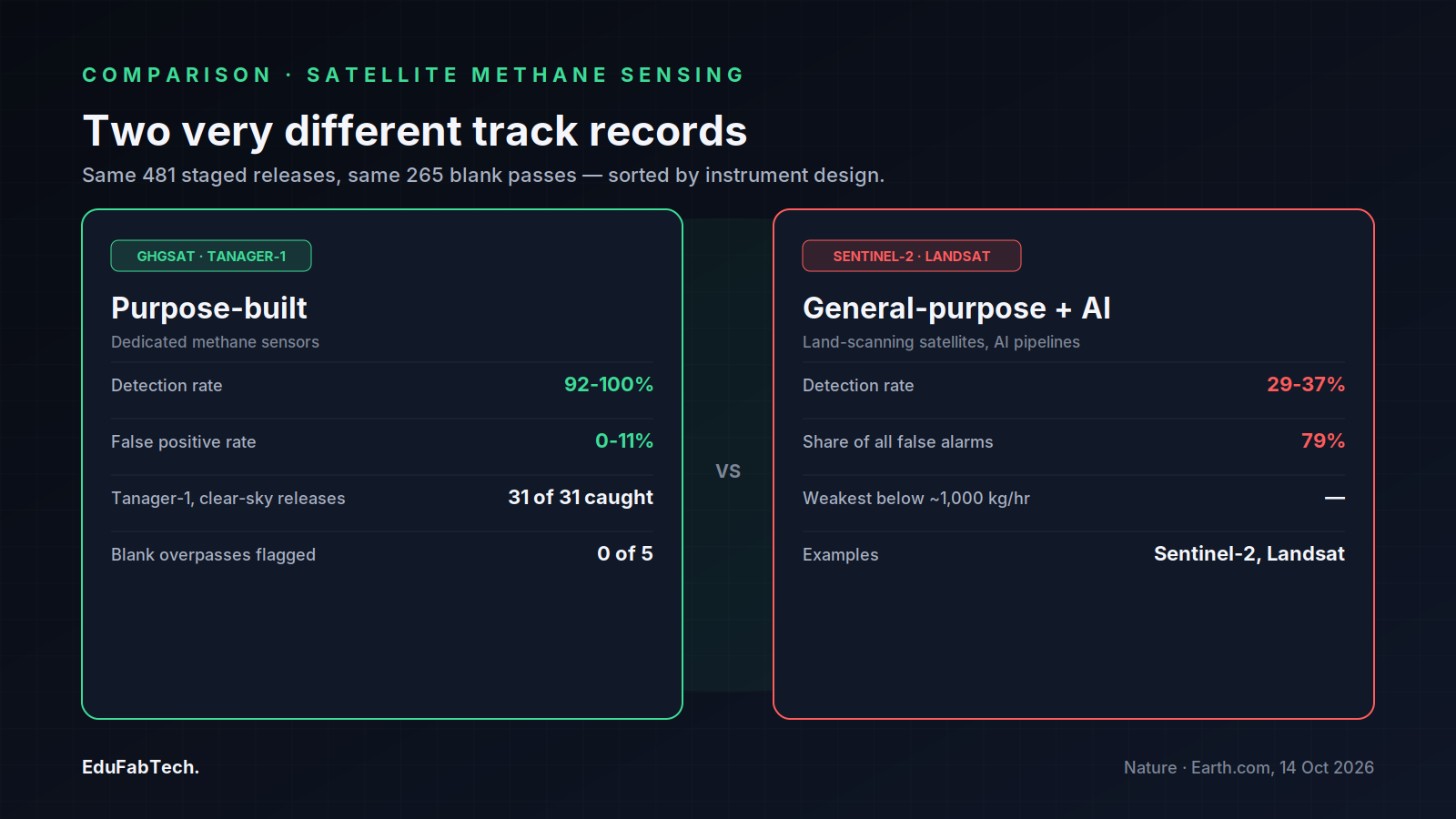
Instruments designed from the outset to track methane, such as the GHGSat constellation and Carbon Mapper's Tanager-1, performed best: a 92-100% true positive rate and a 0-11% false positive rate, according to the Nature paper. Carbon Mapper's Tanager-1 detected every one of the 31 releases that clouds did not obscure during its passes and flagged no false plumes across its five blank overpasses, as reported by Earth.com.
Instruments originally built for other purposes but repurposed for methane sensing, such as Germany's EnMAP and NASA's EMIT, detected 62-88% of releases on clear days. General-purpose land-scanning satellites, including Sentinel-2 and Landsat, caught only 29-37% of releases and performed especially poorly below roughly 1,000 kilograms per hour, according to the Stanford Doerr School of Sustainability summary of the findings.
Quantification accuracy and false alarms
Beyond simple detection, the study measured how accurately each system estimated the size of a leak once it was spotted. For the purpose-built instruments, quantification accuracy carried a slope of 0.83-1.00 against the true release rate, with a mean absolute percentage error of about 44%, the Nature paper reports. Most estimates across all satellite categories landed within roughly 50% of the true release amount. The minimum detectable emission rate for the better-performing systems fell between 50 and 200 kilograms per hour.
False alarms were concentrated in one place: artificial-intelligence-based analyses applied to general-purpose land-scanning imagery accounted for 79% of all false positives recorded during the 265 blank overpasses, the Stanford summary states. Cloud cover disrupted roughly a fifth of all planned satellite-overpass comparisons across every instrument category, including at the Arizona test site chosen specifically for its clear skies, Reuland noted in the Stanford release.
Why the test matters for emissions tracking
Satellite-based methane detection has expanded rapidly as regulators, environmental groups, oil and gas operators, and multilateral bodies have sought faster ways to find and fix "super-emitter" leaks, since methane traps far more heat than carbon dioxide over short timescales. Until this study, however, independent validation of how well these systems perform rested on much smaller tests; an earlier single-blind trial covering nine satellites, cited in the new paper's literature review, used only 82 controlled releases over two months.
"There has been significant skepticism over the years about whether methane tracking really works," Brandt said, according to the Stanford Doerr School of Sustainability. "Our results should give regulators, policymakers, producers of methane, and the general public a lot of confidence moving forward." Reuland added that the dataset gives researchers "orders of magnitude more controlled-source data points than we've ever had before for testing methane detection from space," per the same release.
What the authors flag as unresolved
The authors describe the purpose-built instruments as reliable enough to anchor emissions accounting, while stressing that the result does not vouch for every satellite-based method now in use, according to the Nature paper. The wide performance gap between dedicated sensors and repurposed or general-purpose systems means a detection or a size estimate from a non-specialized satellite, particularly one generated by an AI pipeline, carries meaningfully higher uncertainty and a much higher chance of being a false alarm. Cloud cover remains a limitation for every satellite type tested, cutting into usable coverage even at a site chosen for clear weather, and is especially disruptive in tropical and high-latitude regions, per the Stanford Doerr School of Sustainability. The releases were capped at roughly 1,200 kilograms per hour at a single Arizona desert site, so the authors say performance under different terrain, humidity or larger industrial leak sizes was not directly measured in this round. "How far these desert numbers carry over to the field is still an open question," Brandt told Earth.com.
A quick question for readers
Which study habit do you think is most overrated?
Some popular habits have little evidence behind them. Which one do you think gets too much credit?
Pick an answer, create a free account in a minute, and your vote counts. Already a member? Sign in
Comments 0
CommentNo comments yet. Members start the conversation.
Source: Nature
Sources (3)
- Frances Reuland, Adam Brandt et al.. Evaluating space-based methane detection through a one-year blind test. Nature, 2026. nature.com ↗ · checked 16 Oct 2026
- Stanford Doerr School of Sustainability. Satellites accurately detect methane emissions in large-scale test. Stanford Doerr School of Sustainability, 2026. sustainability.stanford.edu ↗ · checked 16 Oct 2026
- Luis Arrais. Researchers staged hundreds of methane leaks in the Arizona desert to see if satellites could track pollution. Earth.com, 2026. earth.com ↗ · checked 16 Oct 2026