MiniMax M3.1 Flash Tops Rivals on Agent Tests, but Hits 93% Hallucination Rate on One Benchmark
MiniMax's new Flash model cuts agentic AI costs sharply and leads several coding and tool-use benchmarks, but an independent evaluation flagged a steep hallucination rate on one accuracy test.
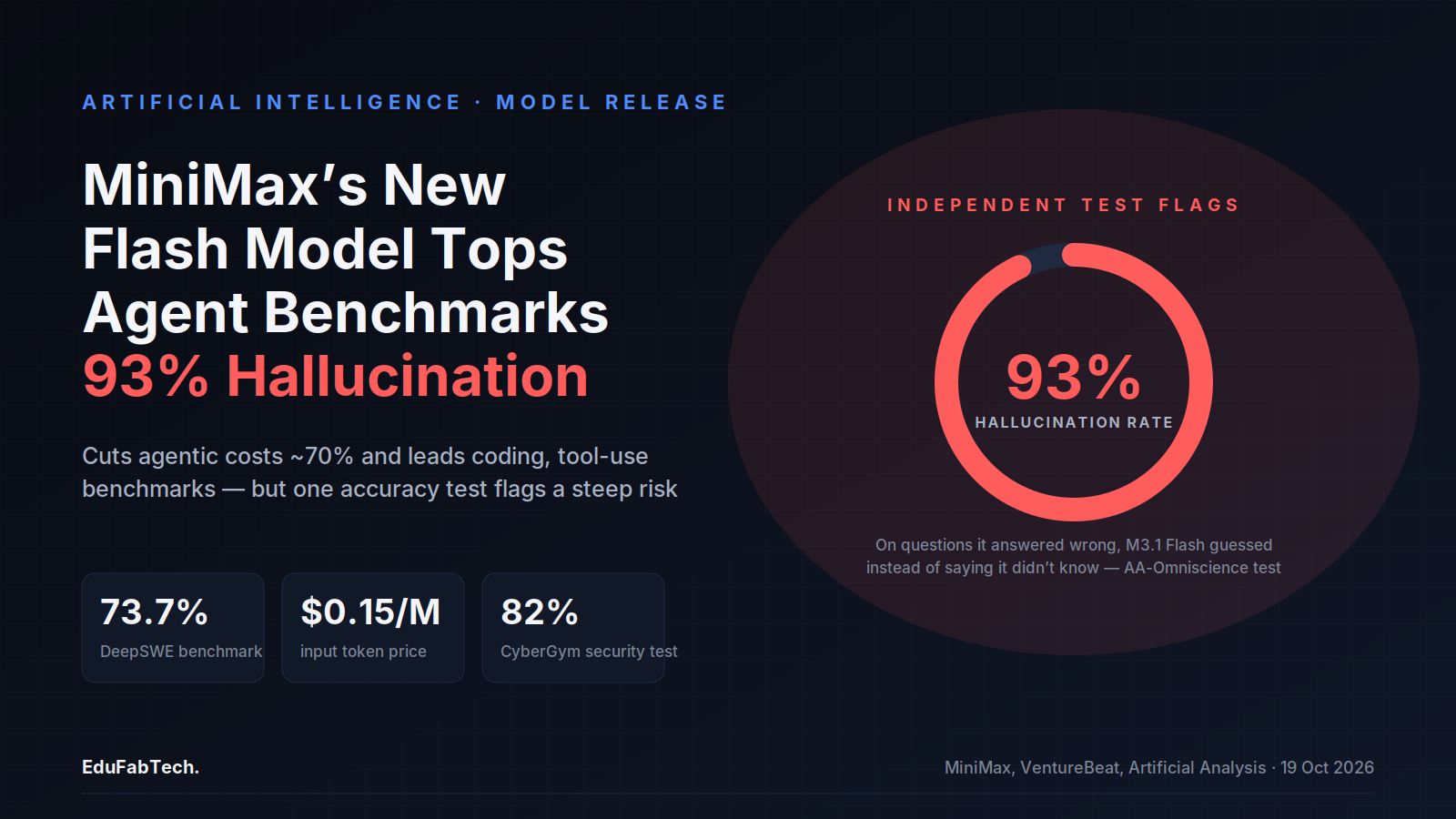
MiniMax, the Chinese AI lab, released M3.1 Flash on 19 October 2026, a faster and cheaper successor to its M3 model aimed at agentic tasks, coding, Computer Use and cybersecurity work, according to the company's announcement. The model is live through the MiniMax API, the company's M Plan subscription and its MiniMax Code developer tool, though the weights themselves are not yet public.
MiniMax prices the model at $0.15 per million input tokens, $0.015 per million cached input tokens and $0.60 per million output tokens, and says it generates "200+ TPS" with median output speeds above 170 tokens per second, according to the company's blog post. VentureBeat reported that the model takes a one-million-token context window and reads both text and images.
The company frames the release around cost: its own figures put usage prices roughly 70% below those of M3, and it pitches the model at high-volume, latency-sensitive agent workloads rather than at open-ended reasoning, per the same post. That positioning matters because agentic workloads — a model repeatedly calling tools, reading files and acting on results — can run up token bills quickly, and a cheaper per-call cost changes who can afford to run them at scale.
The benchmark figures MiniMax reports
MiniMax's own numbers, reported in its announcement and relayed by VentureBeat on 19 October 2026, show the model scoring:
- 73.7% on DeepSWE v1.1, a software-engineering agent benchmark
- 61.7 on OSWorld V2, which tests computer-use agents operating a desktop environment
- 29.6 on Agents' Last Exam
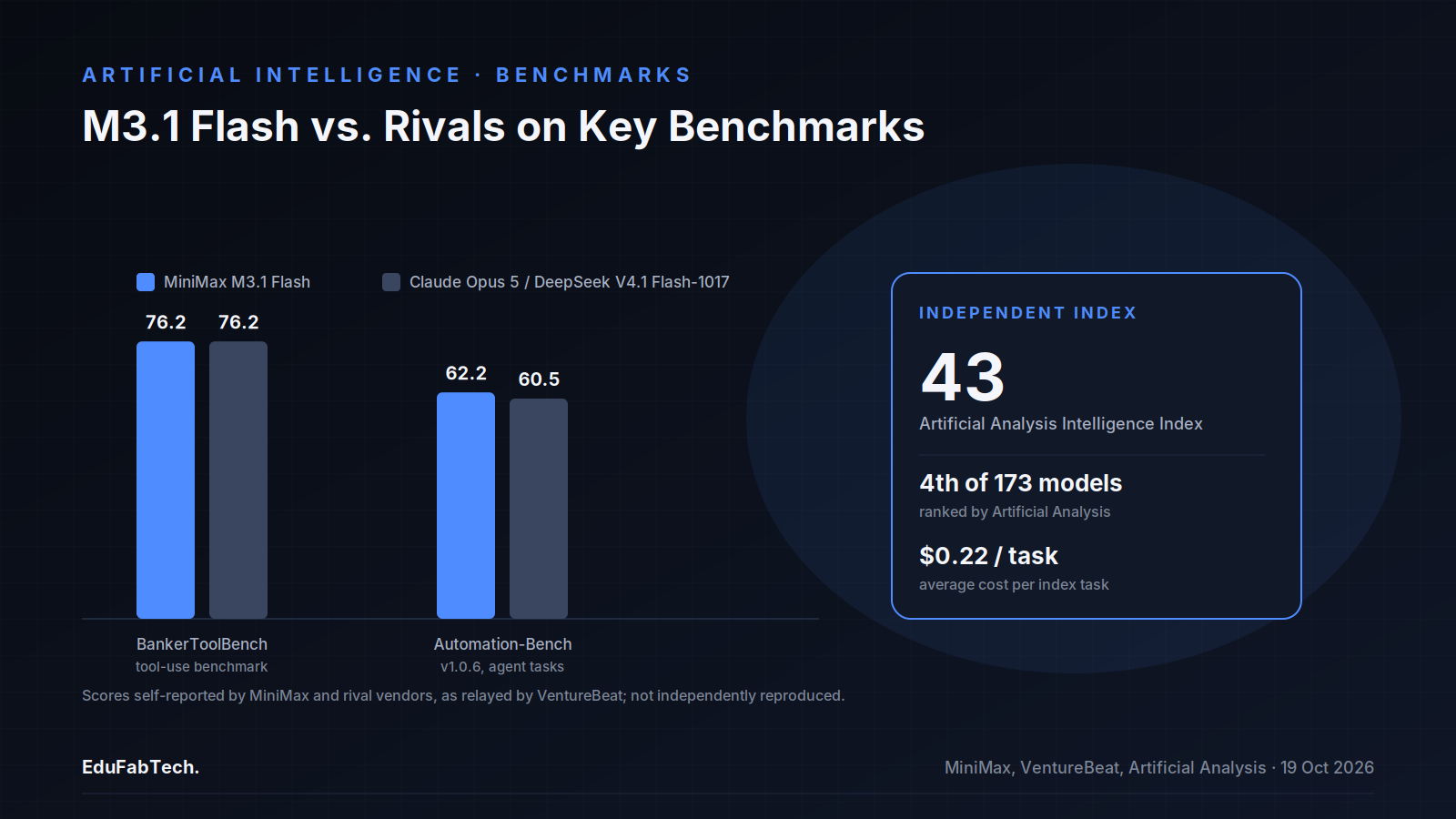
- 76.2 on BankerToolBench, a financial tool-use benchmark, matching the score VentureBeat reports for Anthropic's Claude Opus 5 on the same test
- 82% on CyberGym, a cybersecurity-task benchmark
- 62.2 on Automation-Bench v1.0.6, versus 60.5 that VentureBeat reports for DeepSeek's V4.1 Flash-1017 on the same benchmark
These are all MiniMax's self-reported figures. The company has not published a technical report alongside the launch, so the test conditions behind each score — prompting, number of trials, tool access — are stated by MiniMax rather than independently documented.
What an independent test found
Artificial Analysis, an independent benchmarking firm, ran M3.1 Flash through its own Intelligence Index, a composite of ten evaluations including Humanity's Last Exam, SciCode, Terminal-Bench 4.0 and AA-Omniscience. The firm's model page puts M3.1 Flash at 43 on the index, ranking it 4th of 173 models it has evaluated, at an average cost of $0.22 per Intelligence Index task.
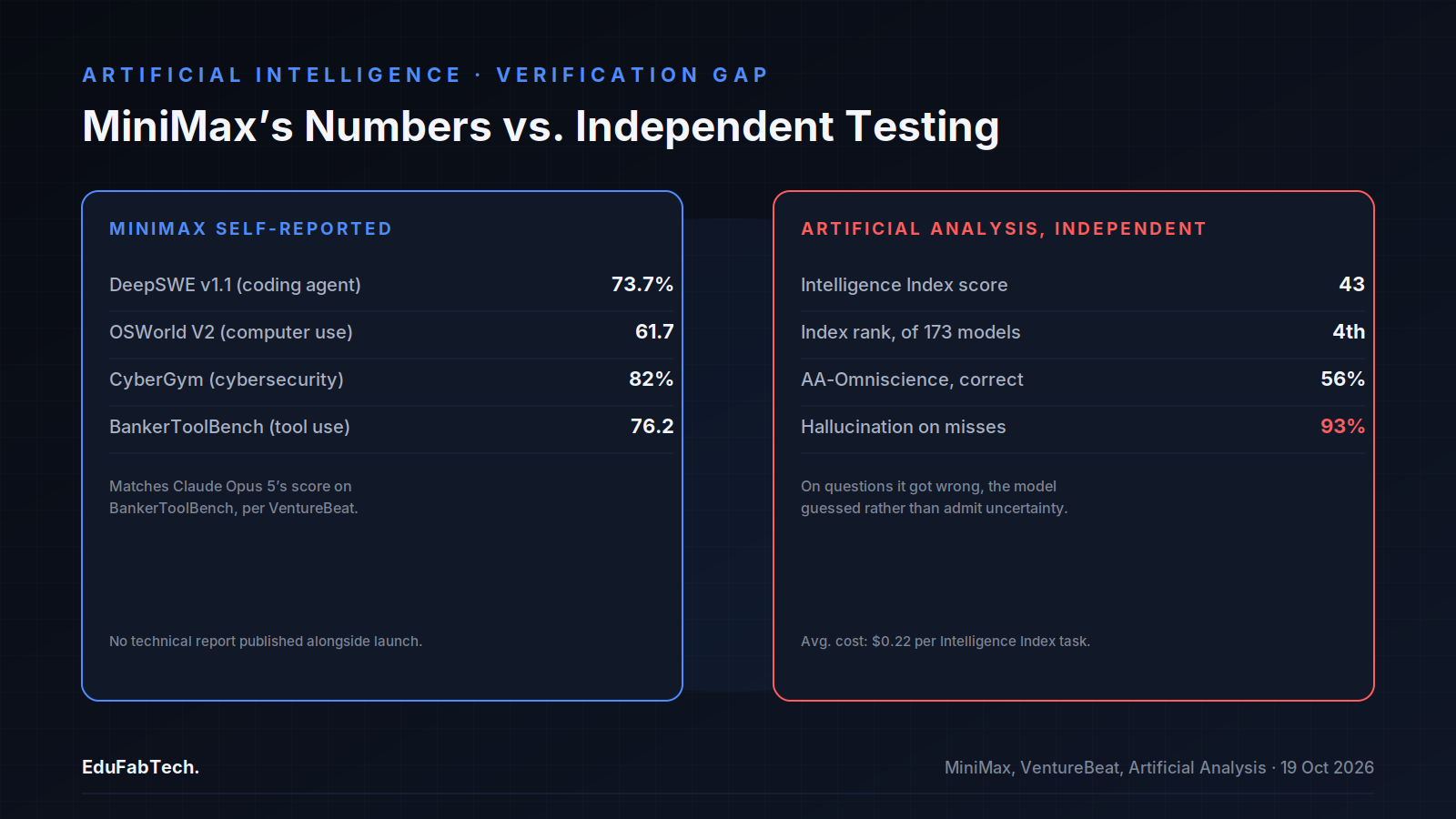
That same independent testing surfaced a reliability problem the company's own post does not mention. VentureBeat reported, citing Artificial Analysis's results, that M3.1 Flash answered 56% of AA-Omniscience factual-accuracy questions correctly, but "demonstrated an exceptionally high tendency to generate incorrect answers rather than acknowledge uncertainty" on the questions it got wrong — a 93% hallucination rate on that benchmark, meaning the model guessed rather than declined to answer in the large majority of cases where it did not know the answer.
Open weights, not yet released
MiniMax's M3 was released as open weights, but M3.1 Flash has shipped first as an API- and subscription-only product. VentureBeat reported that MiniMax said it plans to publish the weights on 23 October 2026, without yet specifying a licence. Until that happens, researchers cannot run the model locally, inspect its architecture or reproduce MiniMax's benchmark claims on their own infrastructure.
Why it matters for students, researchers and developers
For anyone building or studying AI agents on a budget, the headline is price: a model competitive with DeepSeek's V4.1 Flash-1017 and GLM-5.3 Flash on Artificial Analysis's index, at $0.15 per million input tokens, lowers the cost of running long agent loops for coursework, lab experiments or small projects. The one-million-token context window also means a full codebase or a long research conversation can fit in a single call rather than being chunked.
But the hallucination finding is the kind of qualifier that belongs next to any benchmark score before it is used for decisions that depend on factual correctness — retrieval-augmented pipelines, literature summarization, or anything where a wrong-but-confident answer is worse than a refusal. And until the promised 23 October weights land with licensing terms attached, M3.1 Flash remains a model that can only be evaluated through MiniMax's hosted API rather than audited directly.
A quick question for readers
Which skill will matter most for getting a job in 2030?
Everyone has a prediction. Add yours and see what students are betting on.
Pick an answer, create a free account in a minute, and your vote counts. Already a member? Sign in
Comments 0
CommentNo comments yet. Members start the conversation.
Source: MiniMax
Sources (3)
- MiniMax. MiniMax M3.1 Flash: Redefining Agent Performance and Cost. MiniMax, 2026. minimax.io ↗ · checked 21 Oct 2026
- Carl Franzen. MiniMax's new M3.1 Flash beats DeepSeek and Opus 5 on a key business benchmark at lower cost — but with a high hallucination rate. VentureBeat, 2026. venturebeat.com ↗ · checked 21 Oct 2026
- Artificial Analysis. MiniMax-M3.1-Flash - Intelligence, Performance & Price Analysis. Artificial Analysis, 2026. artificialanalysis.ai ↗ · checked 21 Oct 2026