Nature Medicine Study of Over 1 Million Women Finds Menopause Hits as a Body-Wide Cliff
A Weizmann Institute-led analysis of 300 million lab tests finds hormone shifts beginning over a decade before the final period, with most organ changes landing abruptly at it.
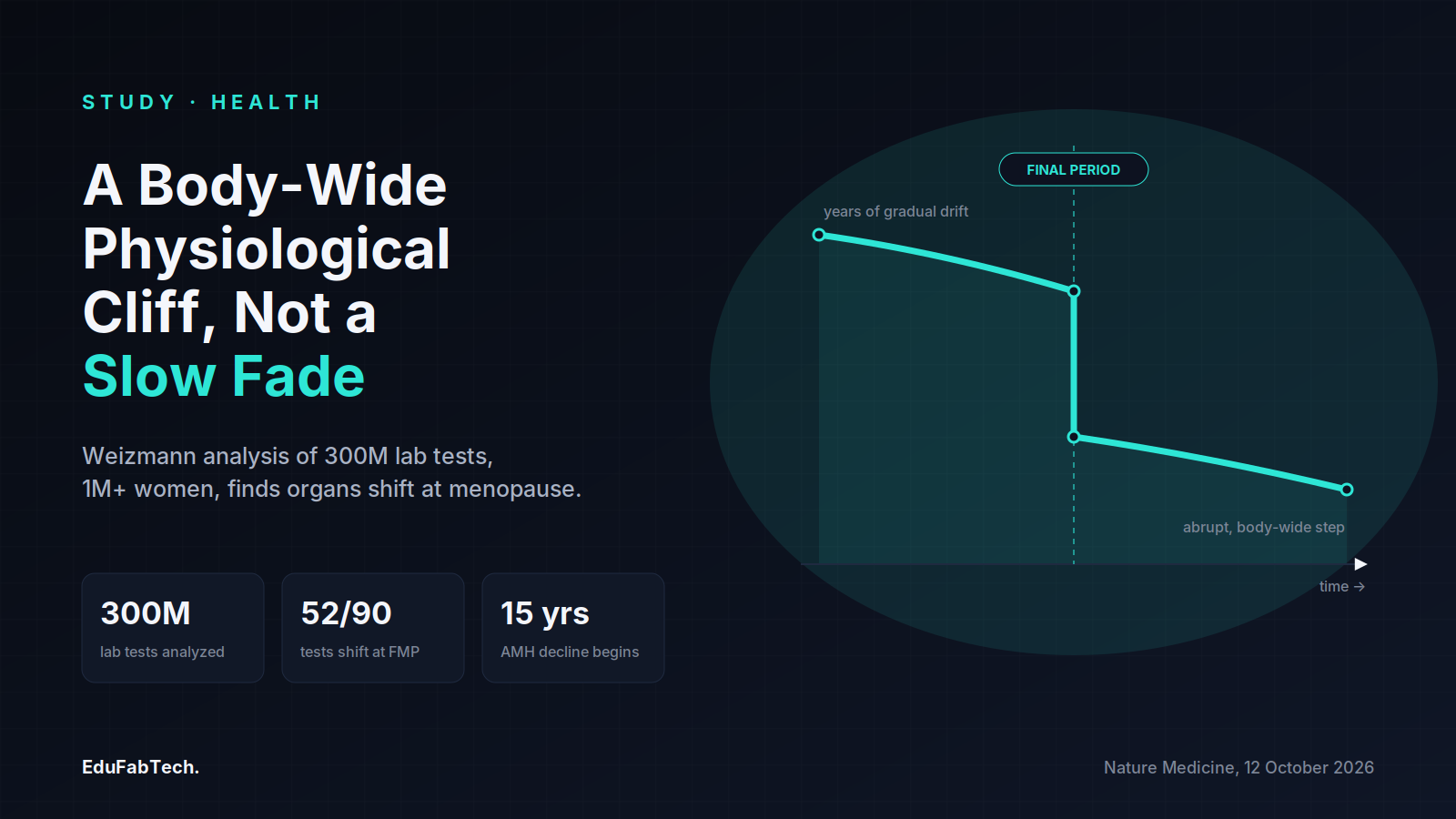
A study published in Nature Medicine on October 12, 2026, reports that menopause does not arrive as a slow physiological fade but as an abrupt, body-wide shift concentrated around the final menstrual period. The analysis, led by Glen Pridham and senior author Uri Alon at the Weizmann Institute of Science in Rehovot, Israel, draws on 300 million laboratory test results from more than 1 million women in two national cohorts in the United States and Israel, collected between 1999 and 2024.
The authors call the pattern a "physiological cliff": a step-like change, landing close to the final menstrual period (FMP), that shows up across endocrine, skeletal, hepatic, renal, inflammatory and lipid measurements rather than in hormones alone. In the US cohort, the team found that 52 of 90 routine lab tests showed a statistically significant abrupt change timed to the FMP, spanning sex hormones, bone markers, liver and kidney function, blood chemistry and blood fats, according to the paper and reporting by Scientific American.
"Menopause is not a slow part of aging. It's an abrupt, body-wide transition," Alon told Scientific American, pointing to estrogen receptors distributed across tissue types as a likely reason the shift reaches bone, liver, kidney and fat metabolism at once rather than staying confined to the reproductive system.
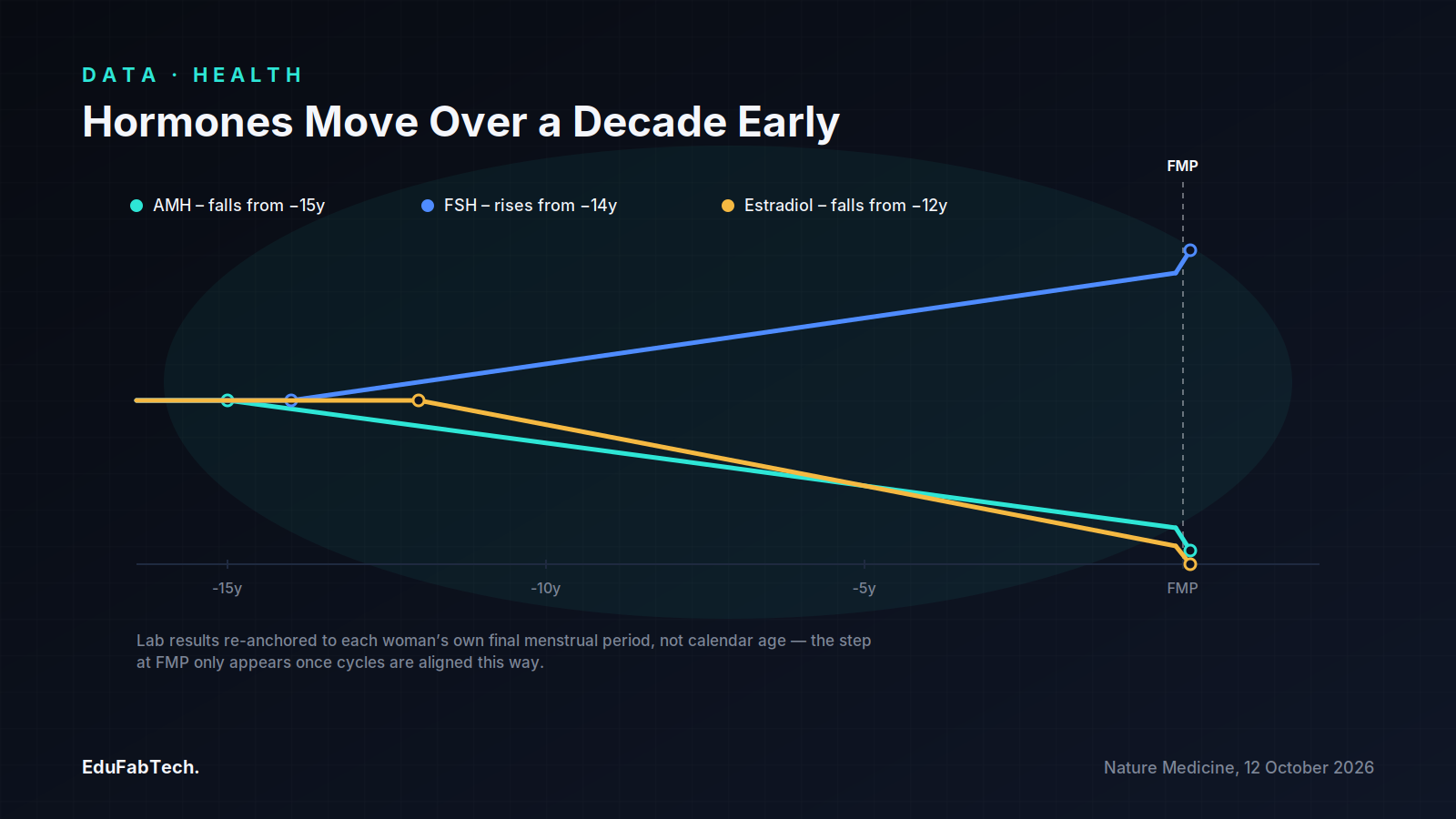
Hormones move years before the period itself stops
Three sex hormones began shifting long before the FMP itself. Anti-Müllerian hormone (AMH) started declining roughly 15 years beforehand, follicle-stimulating hormone (FSH) began rising roughly 14 years beforehand, and estradiol started falling roughly 12 years beforehand, the study and Newsweek's account of it report. That timeline pushes the window in which early endocrine change is detectable back by more than a decade relative to when periods actually stop.
A technique borrowed from astronomy
Cross-sectional health records are a poor fit for tracking a transition that happens at a different age in every woman: averaging test results by calendar age blurs out any sharp change, because women who reach the FMP early get mixed in with women who reach it late. To get around this, Pridham and colleagues adapted a deconvolution approach used in astronomy to sharpen blurred signals, re-anchoring each woman's lab results to her own FMP date rather than her calendar age before averaging across the cohort. That reconstruction is what let the step-like jump emerge from the two national datasets.
The discontinuities were absent in a male comparison group and appeared in both the US and Israeli cohorts, which the authors describe as evidence that the pattern is concordant across populations rather than an artifact of one dataset or healthcare system, according to the Nature Medicine paper.
Where the cliff lands, and where it doesn't
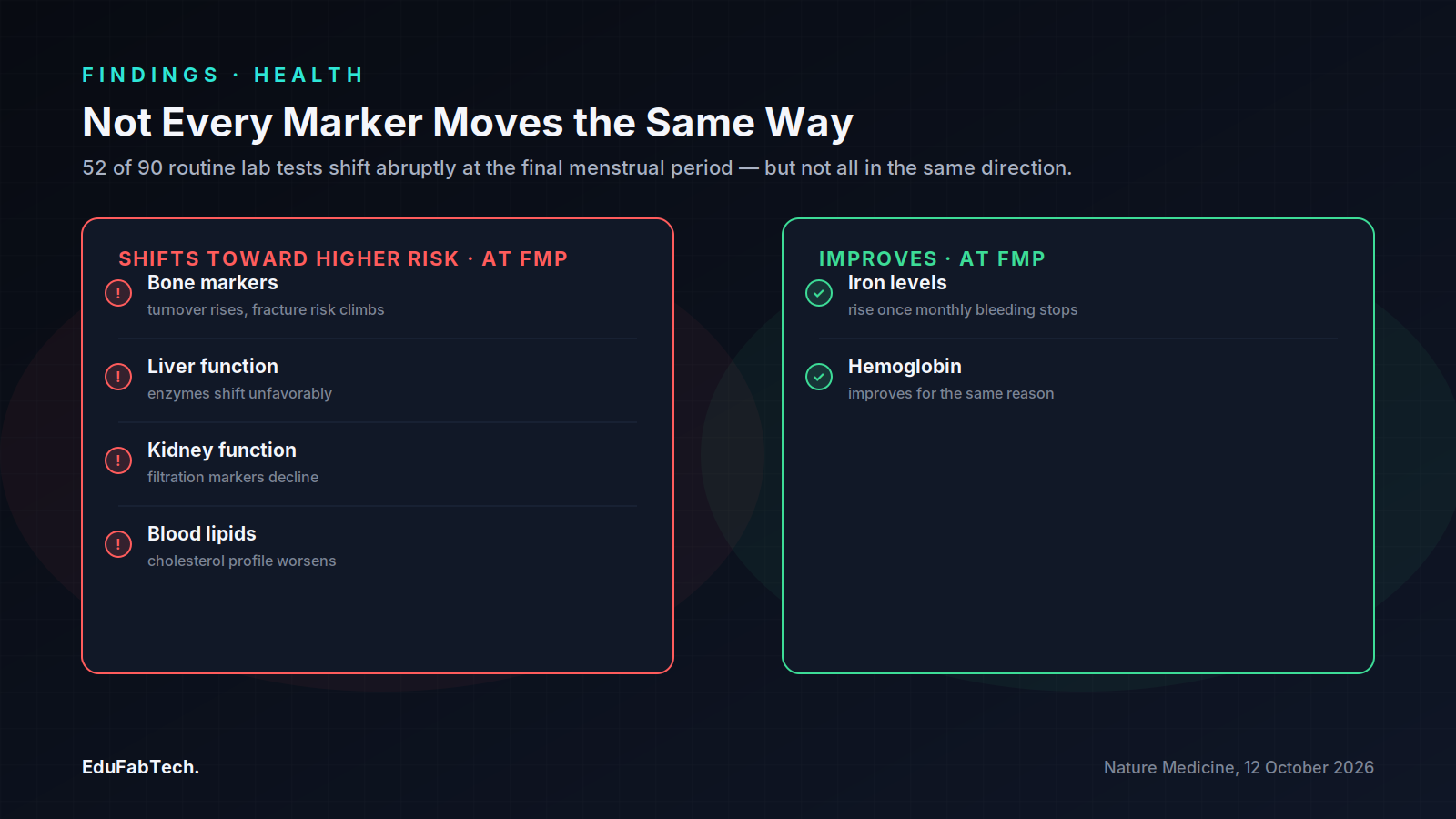
Not every measurement moved the same way. Iron and hemoglobin levels improved at the FMP, consistent with the end of monthly blood loss through menstruation, while bone, liver, kidney and lipid markers shifted in directions associated with higher long-term disease risk, according to the study.
Hormone therapy and its limits
In the subset of women who used menopausal hormone therapy, several of the lab shifts were markedly smaller, with markers related to bone, liver and kidney function most attenuated. The paper reports a strong correlation (r = 0.76) between how large a measurement's typical jump was and how much hormone therapy reduced it. But this comparison is observational: the hormone-therapy users were a small minority of the cohort, and the paper does not establish that therapy caused the smaller jumps rather than reflecting differences between women who chose treatment and those who didn't. Alon told Newsweek the finding "is observational and based on a small minority of women that take [menopausal hormone therapy], and therefore should be taken with a grain of salt," and that because it is only observational, it "requires clinical trials to prove."
What the study does not establish
The authors are explicit that cross-sectional data of this kind cannot fully separate the effects of menopause from ordinary chronological aging, and note incomplete data on key variables along with reliance on self-reported menopause timing — limitations stated in the paper itself. The paper frames its contribution as a reconstruction method and a descriptive map of timing, not a causal account of why the shift happens when it does, or a clinical recommendation.
For researchers, the result is less a single finding than a demonstration that a deconvolution approach can recover a hidden biological transition from large, messy, real-world lab records — the authors suggest the same strategy could apply to other transitions, such as puberty or disease progression, where the timing varies from person to person. For clinicians and the women affected, the more concrete takeaway is that endocrine change associated with menopause is detectable far earlier than symptoms typically prompt a conversation with a doctor, even though this single study does not yet tell them what, if anything, to do about it.
A quick question for readers
Which study habit do you think is most overrated?
Some popular habits have little evidence behind them. Which one do you think gets too much credit?
Pick an answer, create a free account in a minute, and your vote counts. Already a member? Sign in
Comments 0
CommentNo comments yet. Members start the conversation.
Source: Nature Medicine
Sources (3)
- Pridham, G., Hayut, Y., Lavi-Shoseyov, N., et al.. Population-scale reconstruction of menopause dynamics reveals a physiological cliff at the final menstrual period. Nature Medicine, 2026. nature.com ↗ · checked 14 Oct 2026
- Nina Bai / Allison Parshall. What Happens to the Body During Menopause? New Research Hints at a Biological 'Cliff'. Scientific American, 2026. scientificamerican.com ↗ · checked 14 Oct 2026
- Meghan Bartels. Scientists Studied 1 Million Women Before Menopause — One Pattern Stood Out. Newsweek, 2026. newsweek.com ↗ · checked 14 Oct 2026