Norway Moves to End Its NORSTIP Scholarship for Global South Students After 2027
A 2027 budget proposal would let Norway's developing-country scholarship scheme lapse once current students finish, continuing a Nordic-wide pullback from subsidising non-EU study.
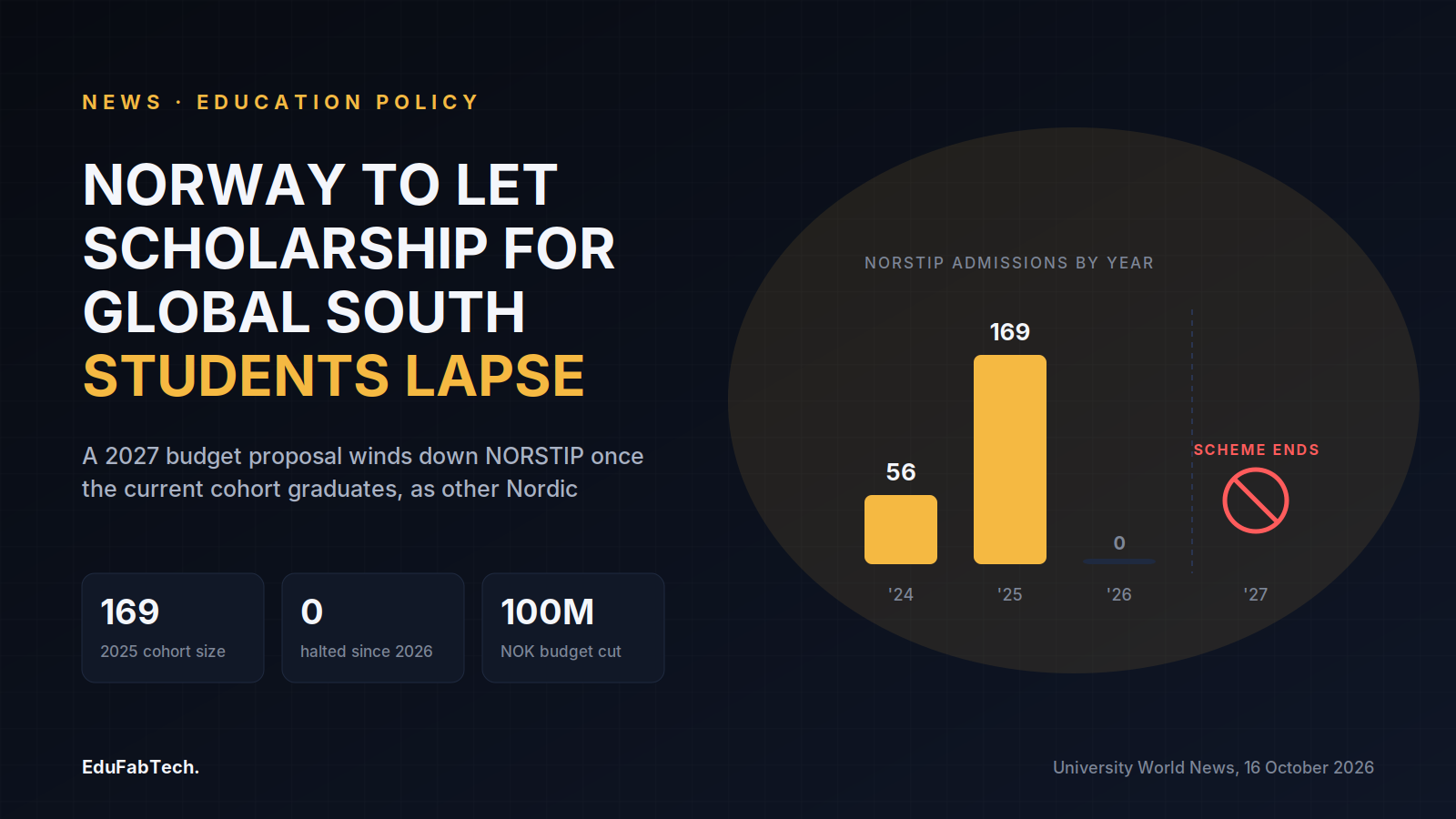
Norway's government has proposed letting its scholarship scheme for students from developing countries, NORSTIP, lapse once currently enrolled students finish their studies in 2027, University World News reported on 16 October 2026. The plan is part of the proposed 2027 state budget and still requires approval by Norway's parliament, the Storting.
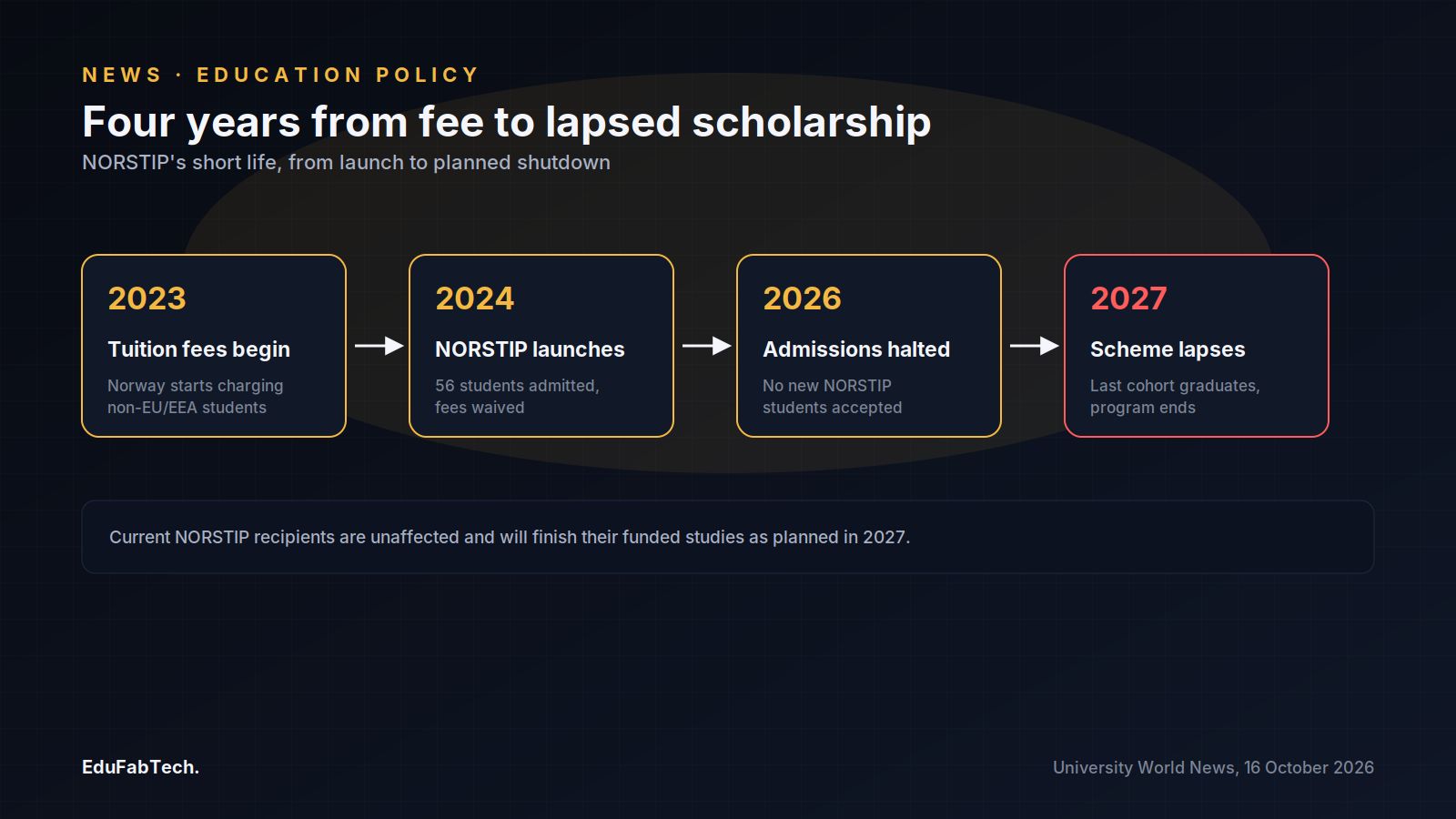
NORSTIP — the Norwegian Programme for Capacity Development through Academic Cooperation — was introduced in 2024, the year after Norway began charging tuition fees to students from outside the EU, the European Economic Area and Switzerland. Scholarship recipients were exempted from those fees and received a monthly stipend matching what Norwegian students can draw from Lånekassen, the State Educational Loan Fund, according to University World News. The scheme admitted 56 students in 2024 and 169 in 2025, but new admissions were halted from 2026, and the government's 2027 budget proposal would wind the programme down entirely once that last cohort graduates. The Norwegian University of Life Sciences (NMBU) alone had admitted 23 NORSTIP students, the report states.
The government's proposed 2027 budget line for this area of education funding is NOK 546.8 million (about $57.38 million), down NOK 100 million from 2026, and University World News reports that funding for the Global Partnership for Education has been removed from that allocation entirely.
Reactions from universities and students
NMBU rector Solve Sæbø told University World News that NORSTIP "was an important measure to counteract the decline" in international enrolment that followed the 2023 introduction of tuition fees. Henriette Reierson Johnstone of the Norwegian Students' and Academics' International Assistance Fund (SAIH) said the Labour Party is "flattening out Norwegian international higher education," while Eva Franko Aas of the National Union of Students in Norway said that "it is now students' financial means that determine who comes to Norway." Ole Petter Ottersen, a former rector of the University of Oslo, called the proposed discontinuation "the last nail in the coffin" for what he described as Norway's tradition of educational openness, the outlet reported.
A longer retreat from free access
NORSTIP was not Norway's first scheme of this kind. University World News notes that a Quota Scheme began in 1994 and was discontinued in the 2016 state budget, after supporting roughly 1,100 students a year from developing countries and Eastern Europe on terms comparable to Norwegian students, including loans that could be forgiven if the graduate returned home. Even earlier, a provision from the late 1970s known informally as the "u-land paragraph" let Global South students enter the loan system through academic cooperation agreements. NORSTIP, introduced in 2024 specifically to offset the new tuition fees, was smaller in scale from the start — and is now set to be smaller still.
Not a Norway-only story
Norway is not acting alone. Across the Nordic region, free tuition for students from outside the EU and EEA has been receding for over a decade: Sweden introduced fees for non-EU/EEA students in 2011 and Finland followed in 2017, before Norway ended its own long-standing exemption in 2023, according to a 2023 overview by the European Association for International Education (EAIE). The same EAIE account reports that Swedish applications from non-EU/EEA countries fell by 80% in the first year after fees were introduced there, though it adds that enrolment later recovered as Swedish institutions expanded scholarships and coordinated recruitment marketing.
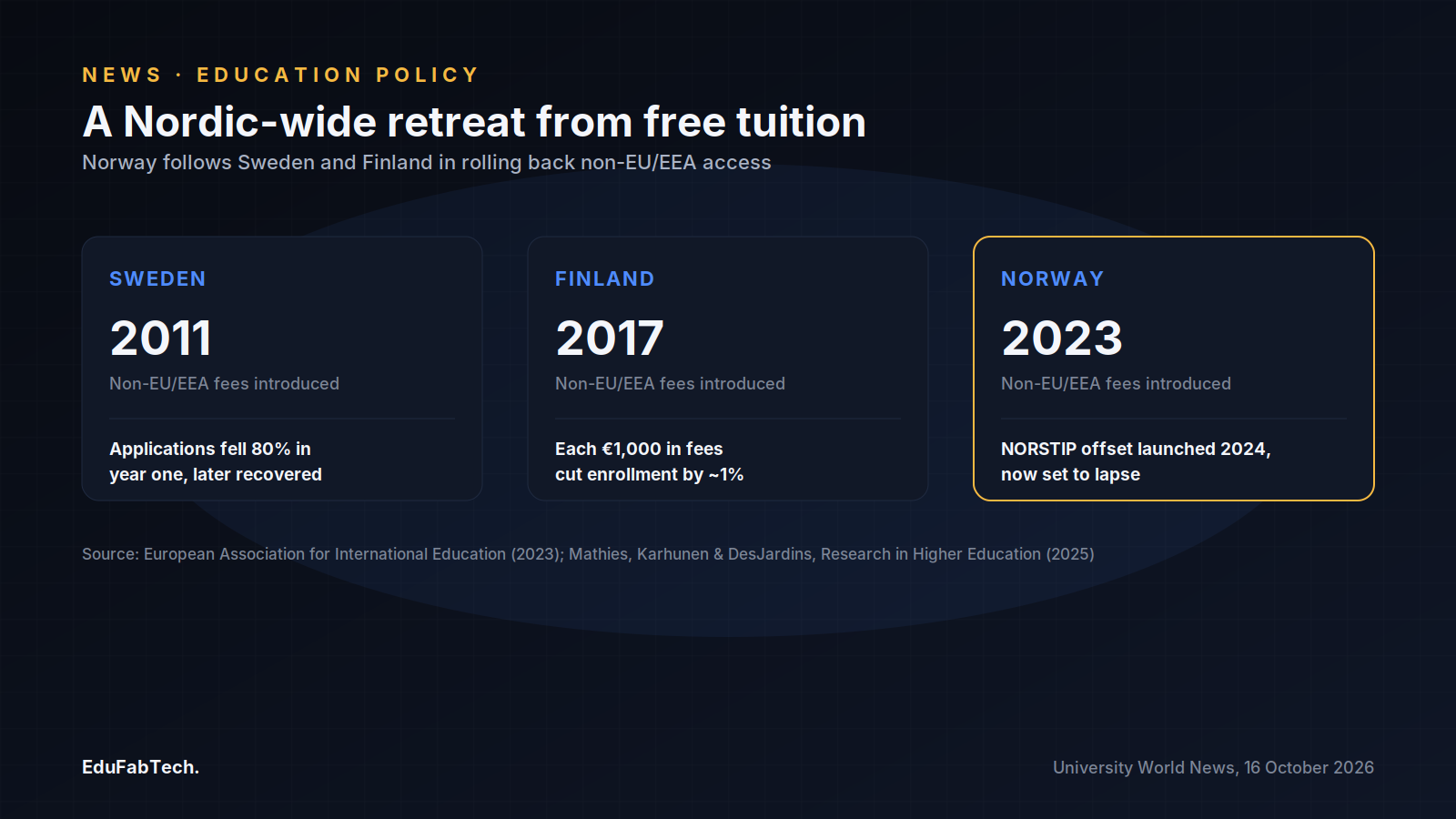
A 2025 study in Research in Higher Education by Charles Mathies, Hannu Karhunen and Stephen L. DesJardins examined what happened in Finland after its 2017 fee introduction. Using national enrolment records, the authors found that, roughly, every €1,000 increase in tuition fees was associated with a 1% loss of fee-paying international students actually enrolling, even though application volumes held steady. The same study found that the student population shifted in composition: enrolment from high-income countries rose relative to lower-middle-income countries, and students from low- and lower-middle-income nations who did enrol were more likely to front-load credits in their first year, a pattern the authors did not find among students from wealthier countries.
What it means for students and researchers
For prospective students from developing countries, NORSTIP's planned closure removes one of a shrinking number of fully funded routes into Nordic higher education that combine a tuition waiver with a living stipend rather than a tuition discount alone. For researchers who study international mobility, Norway's case — introduce fees, launch a small offsetting scholarship, then let the scholarship lapse within a few years — offers a compact, well-documented sequence that mirrors earlier rounds in Sweden and Finland, giving comparative researchers another data point on how quickly offsetting measures get withdrawn once fee regimes are in place. The proposal is not yet final: it must clear Norway's parliament as part of the 2027 budget process, and current NORSTIP recipients are not affected and will complete their funded studies in 2027 as originally planned.
A quick question for readers
Which study method makes things stick for you until the exam?
Research says some methods work far better than others. Vote first, then see whether students agree with the evidence.
Pick an answer, create a free account in a minute, and your vote counts. Already a member? Sign in
Comments 0
CommentNo comments yet. Members start the conversation.
Source: University World News
Sources (3)
- Jan Petter Myklebust. Plans to end NORSTIP scholarships for Global South students. University World News, 2026. universityworldnews.com ↗ · checked 20 Oct 2026
- Tomas Bengtsson and Michael Oppenheimer. International student tuition fees: reflections from Sweden. EAIE, 2023. eaie.org ↗ · checked 20 Oct 2026
- Charles Mathies, Hannu Karhunen and Stephen L. DesJardins. If You Charge Them, Will They Come? The Effect of Levying Tuition Fees on International Students. Research in Higher Education (Springer), 2025. link.springer.com ↗ · checked 20 Oct 2026