Two Nature Medicine Trials of a Multi-Cancer Blood Test Reach Different Verdicts on the Same Day
PATHFINDER 2 found a 60.3% positive predictive value in 35,878 US and Canadian adults, while the randomized NHS-Galleri trial of 142,250 people missed its primary endpoint.
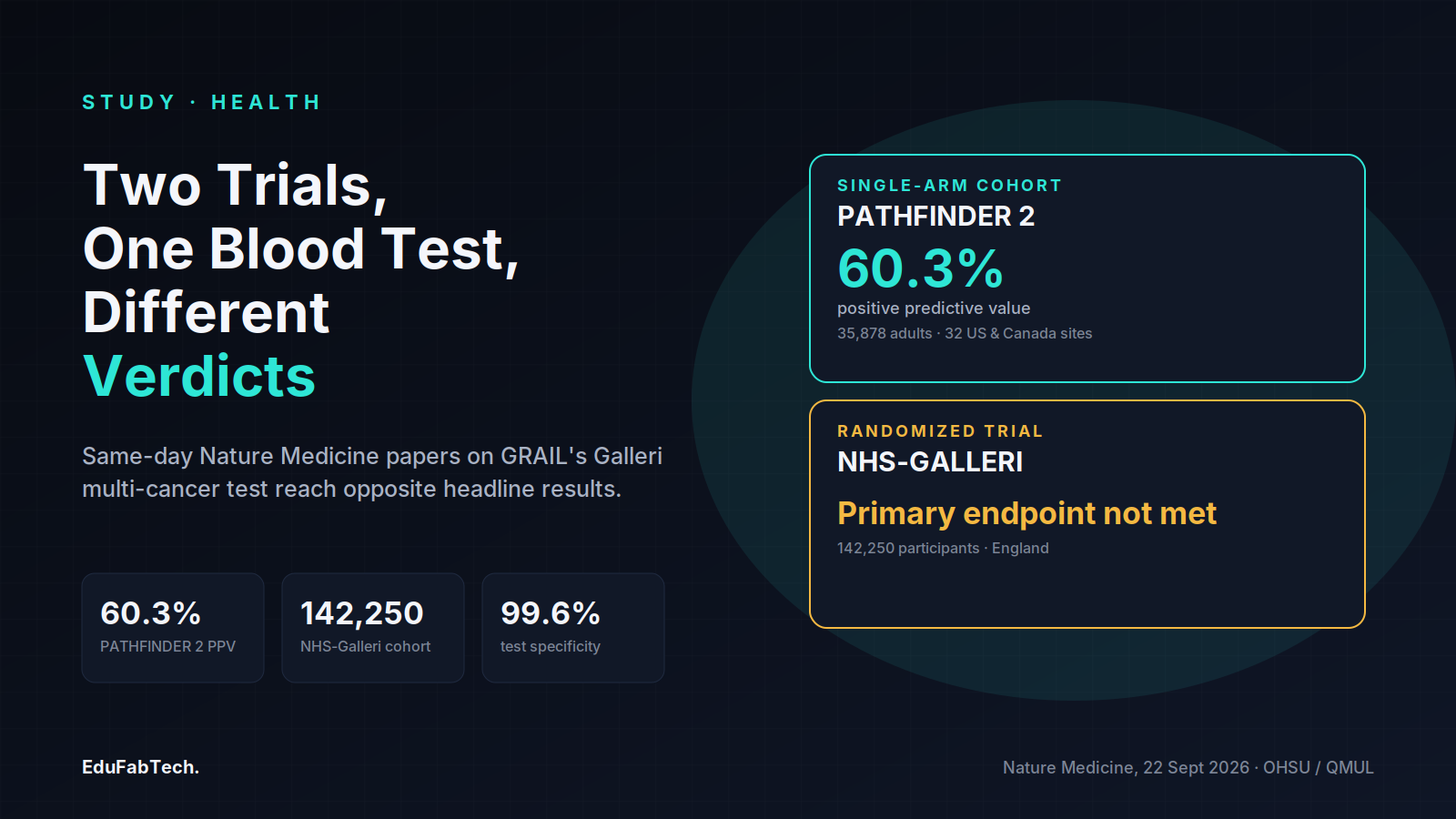
On 22 September 2026, Nature Medicine published two studies of the same blood test on the same day, run under very different designs, and they do not tell the same story. One is PATHFINDER 2, a single-arm cohort study of 35,878 adults aged 50 and older across 32 clinical sites in the United States and Canada, led by Nima Nabavizadeh at the Oregon Health & Science University Knight Cancer Institute. The other is the NHS-Galleri trial, a randomized controlled trial that assigned 142,250 people in England to receive the test or not. Both examined GRAIL's Galleri test, which screens a single blood draw for chemical patterns on cell-free DNA associated with more than 50 cancer types.
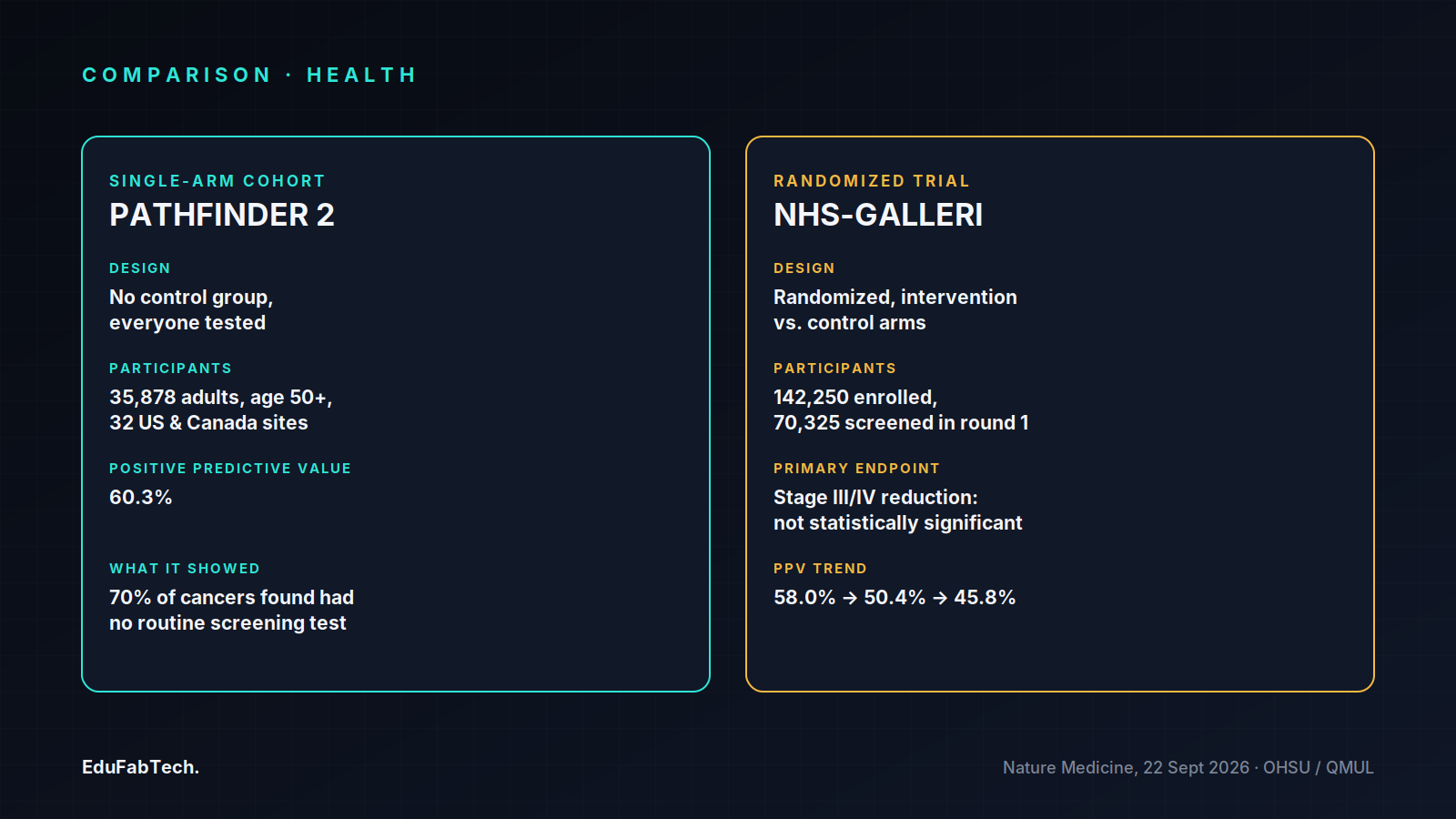
In PATHFINDER 2, 32,007 participants were evaluable for test performance. The test flagged a cancer signal in 287 people; 173 of those were confirmed to have cancer within 12 months, giving a positive predictive value of 60.3% and a specificity of 99.64%, meaning a false-positive rate of 0.36%. Sensitivity was 39.3% across all cancers detected in that window, rising to 69.8% for a prespecified group of 12 cancer types. When added to screening already recommended by the US Preventive Services Task Force for breast, colorectal, cervical and lung cancer, the test increased the number of cancers detected roughly 6.5-fold, and about 70% of the cancers it found had no routine screening test at all.
The NHS-Galleri trial, run by Queen Mary University of London with University College London and King's College London, reached a different conclusion on its primary question. Among 70,325 people in the first screening round of the intervention arm, the trial did not find a statistically significant reduction in stage III/IV cancer diagnoses compared with the control arm — the endpoint the trial was built to test. The authors state plainly that "the primary endpoint of a reduction in the incidence of stage III/IV cancer diagnoses in the intervention arm versus control arm was not met."
What each design could and couldn't show
The difference in outcome traces partly to the difference in design. PATHFINDER 2 has no control group: everyone in the performance analysis received the test, so the study can describe how often a positive result corresponded to a real cancer, but it cannot show whether the test changes how many people die of cancer, or whether earlier detection actually improves outcomes rather than just moving the diagnosis date earlier. The paper's own limitations section, cited in the OHSU announcement of the results, notes the single-arm design, the lack of a comparator, and a study population that reported better-than-average baseline health.
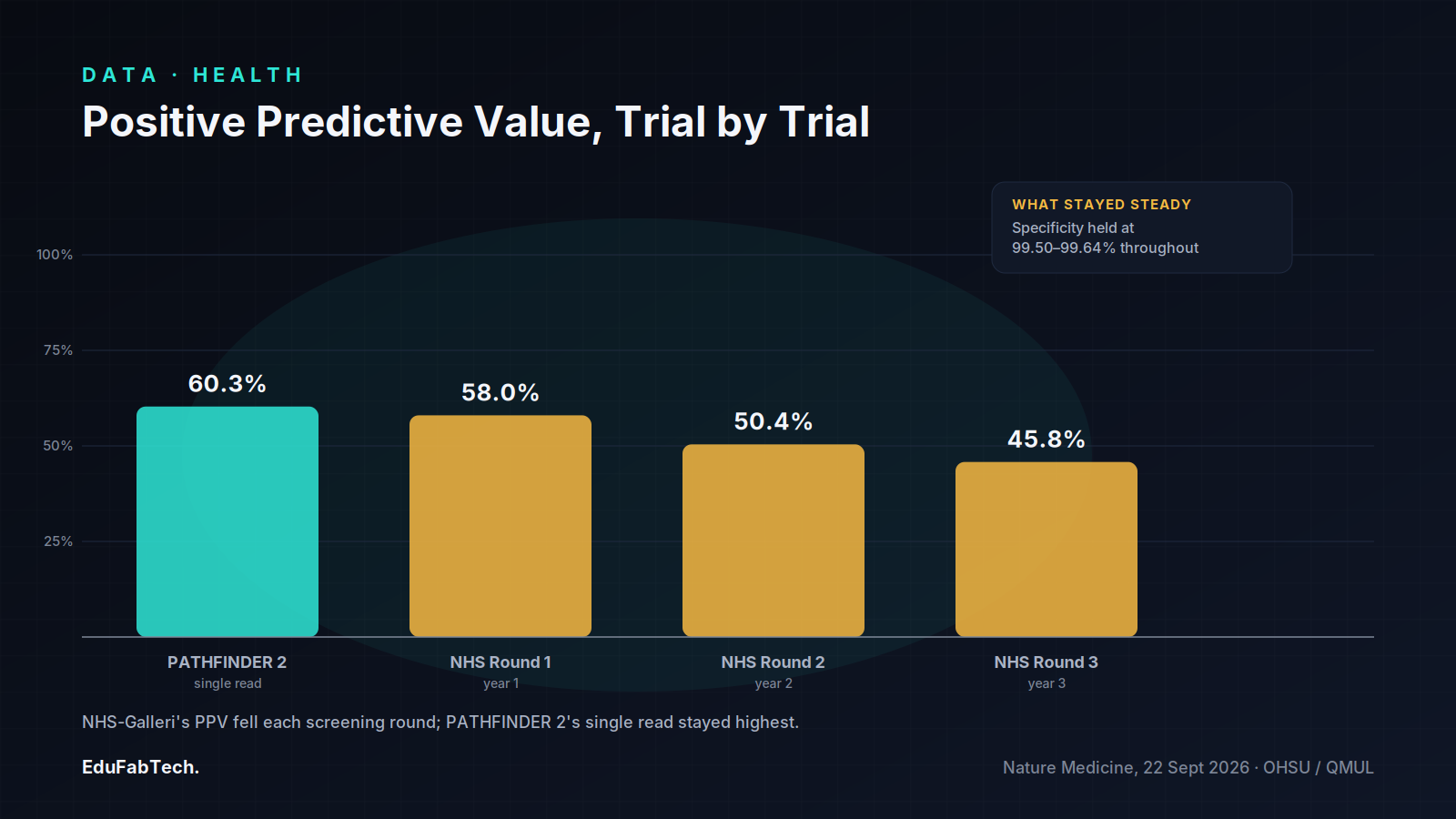
NHS-Galleri was built to answer the harder question directly, by randomizing people and comparing outcomes. Across three annual screening rounds, its positive predictive value fell from 58.0% in round one to 50.4% in round two and 45.8% in round three, with specificity holding between 99.50% and 99.60%. Sensitivity for all cancers ranged from 26.7% to 37.2%, and for the 12 prespecified cancer types from 47.6% to 63.4%. Of 937 cancers the test detected, 39.1% were stage I–II and 68.3% were stage I–III at diagnosis — a real stage shift, and stage IV diagnoses alone fell by more than 20% in the second and third screening rounds, though that shift did not translate into a statistically significant drop in the combined stage III/IV endpoint overall. The trial authors flag that the COVID-19 pandemic disrupted diagnostic access during part of the study, and that 12 months of follow-up is not enough to assess mortality.
Independent reviewers split on what the numbers mean
The same kind of performance numbers have read differently to different reviewers before. When an earlier, interim readout of the PATHFINDER 2 data was presented as a conference abstract in October 2025, the Science Media Centre gathered reaction from independent specialists whose concerns still bear on the final, peer-reviewed results. Nitzan Rosenfeld, director of the Barts Cancer Institute at Queen Mary University of London, called the specificity "very high" and noted that more than half the cancers the test found were early-stage, while adding that longer-term outcome data, including cancer mortality, would be needed to confirm the findings. Clare Turnbull of the Institute of Cancer Research, London, welcomed the improved positive predictive value but warned that a positive result for which no cancer can be found is "a big problem," and said that "data from randomised studies, with mortality as an endpoint, will therefore be absolutely essential" before the test's benefit can be established.
Anna Schuh, professor of molecular diagnostics at the University of Oxford, was more critical of that same interim data, calculating that a roughly 60% positive predictive value means about four in ten positive results are wrong, and estimating a cost of around $174,000 per additional cancer diagnosed in that dataset — above thresholds typically used to justify population screening in publicly funded health systems. Schuh disclosed holding minor GRAIL shares and involvement in an unrelated diagnostic algorithm. Both Nature Medicine papers were funded by GRAIL, which also participated in study design, data analysis and manuscript preparation, a detail disclosed in both publications.
What comes next
Neither paper describes its findings as a settled basis for population-wide adoption. PATHFINDER 2's authors describe the 12-month analysis as an interim look, with a 3-year follow-up already planned to assess outcomes in people who tested positive. The NHS-Galleri investigators say longer follow-up is needed before the trial can speak to its ultimate question — whether earlier detection through this kind of blood test reduces cancer deaths — since a missed primary endpoint after one round of screening does not rule out benefit that only appears with more time or more rounds. For now, the two studies published on the same day give a rare, direct comparison of what a single-arm cohort and a randomized trial say about the same screening technology, and they do not yet agree.
- Nabavizadeh, N. et al.. Performance and safety of a multi-cancer early detection test: the PATHFINDER 2 study. Nature Medicine, 2026. doi:10.1038/s41591-026-04618-w
- Neal, R.D., Dolly, S., Johnson, P. et al.. Performance of a multi-cancer early detection test in the randomized controlled NHS-Galleri trial. Nature Medicine, 2026. doi:10.1038/s41591-026-04652-8
- OHSU News. PATHFINDER 2 findings advance multi-cancer early detection blood testing. Oregon Health & Science University, 2026. link
- Science Media Centre. Expert reaction to conference abstract on the PATHFINDER II trial into the safety and performance of the Galleri test in people without cancer symptoms. Science Media Centre, 2025. link