REMODEL Trial: Semaglutide Misses Its Primary Kidney MRI Goals, but Biopsies Show a Fibrosis Signal
A 106-person, 52-week trial with paired kidney biopsies found semaglutide did not significantly change coprimary MRI measures, but secondary biopsy and imaging analyses pointed to reduced vascular resistance and fibrosis markers.
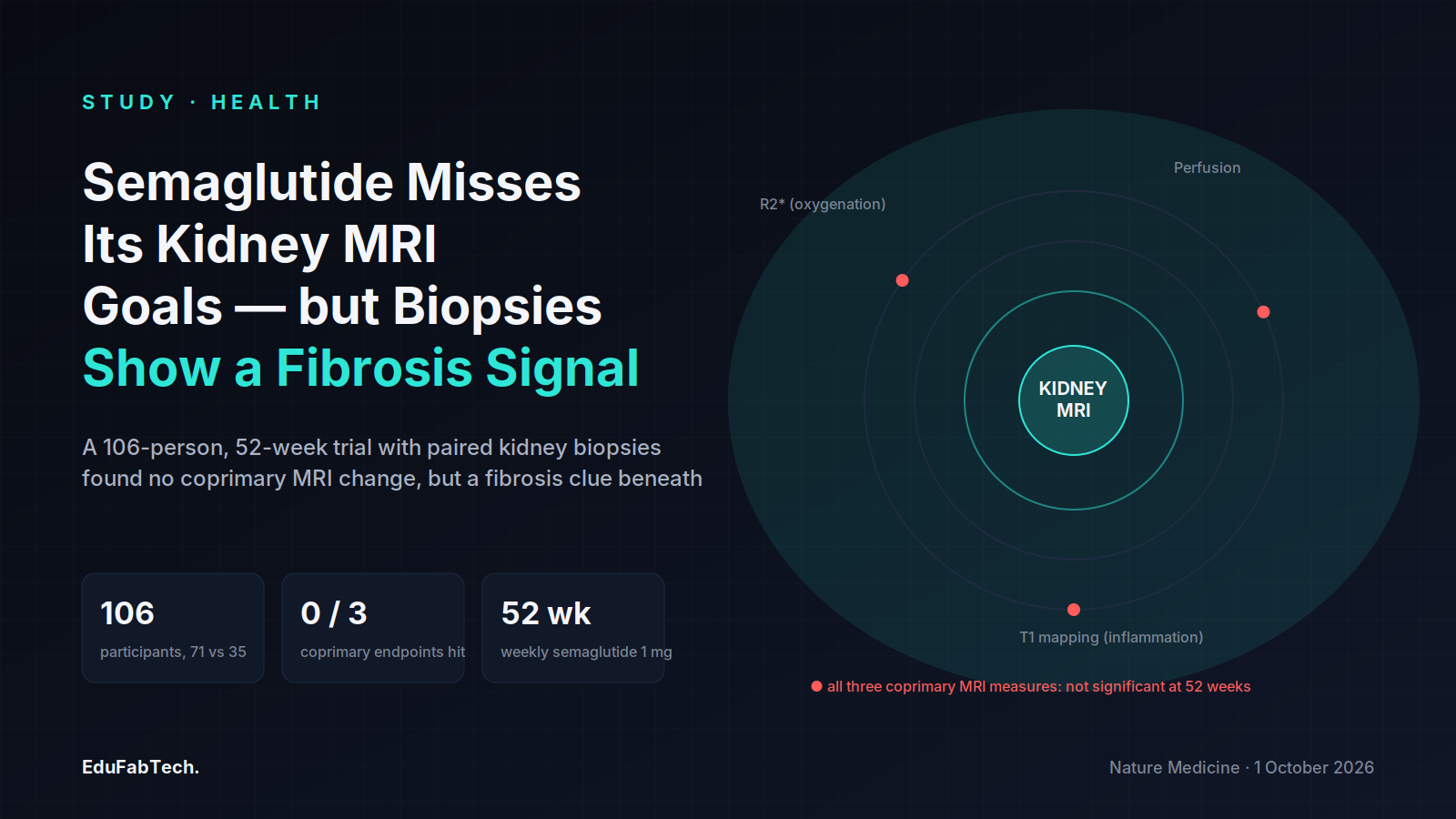
A randomized, placebo-controlled trial published in Nature Medicine on October 1, 2026 found that semaglutide did not significantly improve the three coprimary kidney MRI measures it was designed to test in people with type 2 diabetes and chronic kidney disease, but paired kidney biopsies and secondary imaging pointed to a plausible biological mechanism behind the drug's known kidney benefits. The trial, called REMODEL and registered as NCT04865770, enrolled 106 participants — 71 on semaglutide, 35 on placebo — at sites in Canada, Denmark, France, Italy, Poland, Spain, South Africa and the United States, and was sponsored by Novo Nordisk.
What the coprimary endpoints were designed to show
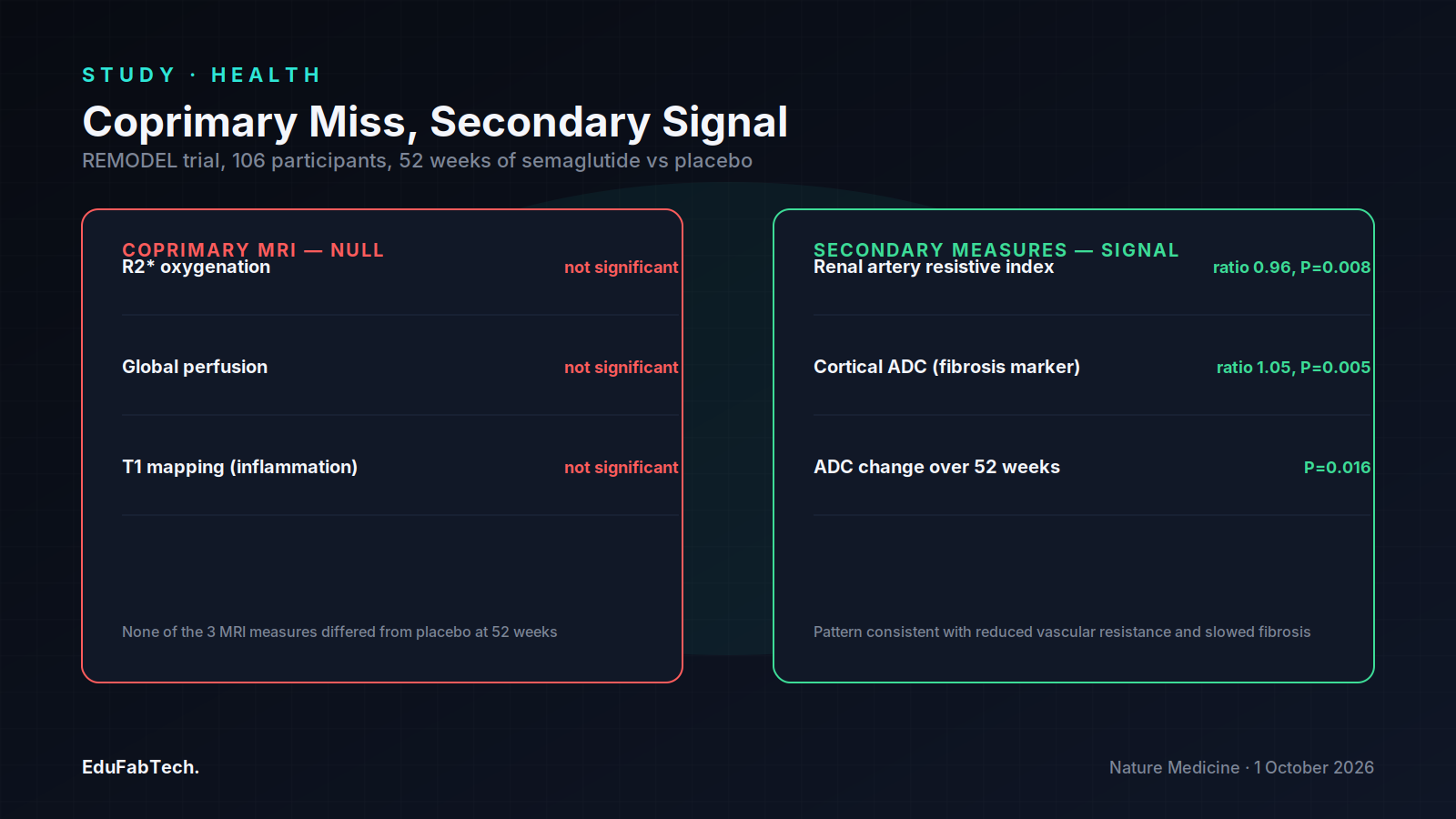
REMODEL's coprimary outcomes were three kidney MRI measures: oxygenation (R2*), global perfusion, and tissue inflammation estimated by T1 mapping, each tracked over 52 weeks of weekly subcutaneous semaglutide at 1 mg versus placebo. According to the trial's design paper in Nephrology Dialysis Transplantation, participants averaged 65.3 years old, had an average eGFR of 51.1 ml/min/1.73m², and the large majority were already on renin-angiotensin-system inhibitors (98.1%) or SGLT2 inhibitors (38.7%) — the current standard of kidney-protective care for type 2 diabetes. None of the three coprimary MRI measures differed significantly between the semaglutide and placebo groups after 52 weeks, the Nature Medicine paper reports.
What the secondary measures found
Where the trial found signal was in secondary outcomes. The renal artery resistive index — a Doppler ultrasound measure of vascular resistance in the kidney — fell significantly more with semaglutide than placebo (estimated treatment ratio 0.96, 95% CI 0.93–0.99, P = 0.008). Cortical apparent diffusion coefficient (ADC), an MRI measure that tends to fall as kidney fibrosis progresses, was higher with semaglutide than placebo (estimated treatment ratio 1.05, 95% CI 1.01–1.09, P = 0.005), and the change in ADC over the trial also favored semaglutide (estimated treatment difference 61.49, 95% CI 11.40–111.58, P = 0.016). The authors interpret this pattern as consistent with reduced vascular resistance and an attenuation of progressive fibrosis in the kidney, rather than as proof that fibrosis reversed.
What the biopsies showed
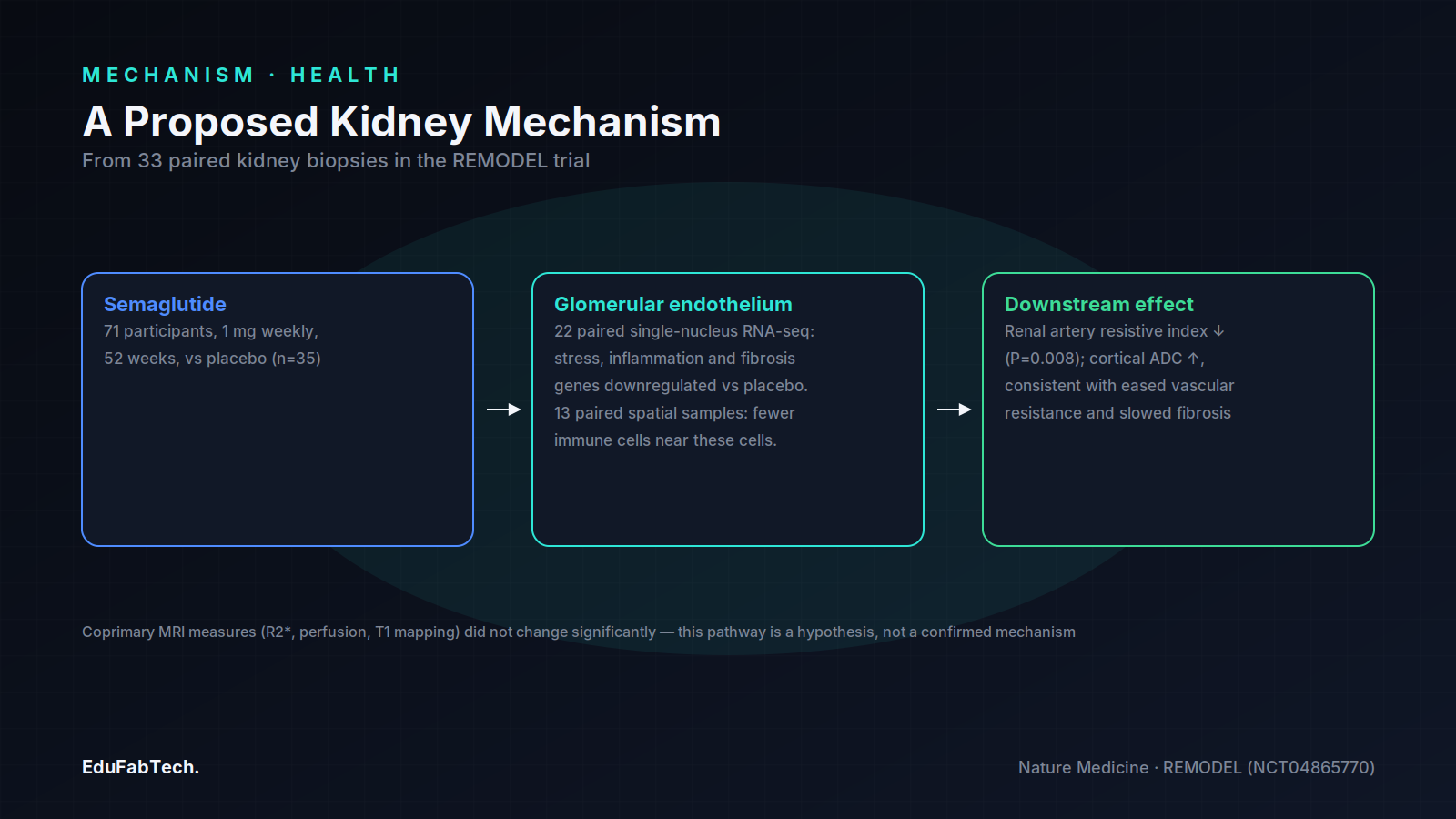
A subset of 33 participants — recruited at sites in Denmark, France, Poland, Spain and the United States — agreed to paired kidney biopsies before and after treatment, the design paper states. From that tissue, the team ran single-nucleus RNA sequencing on 22 paired samples and spatial transcriptomics on 13 paired samples. Glomerular endothelial cells were among the most transcriptionally responsive cell populations to semaglutide, with genes linked to metabolic stress, inflammation and fibrosis downregulated relative to placebo after treatment. The spatial data additionally showed fewer immune cells positioned near glomerular endothelial cells in the semaglutide group. Taken together with the imaging findings, the authors propose that semaglutide's kidney protection may work partly by acting on the glomerular endothelium — easing vascular resistance, slowing fibrosis, and reducing local immune cell presence — rather than through a single dominant pathway.
Why the coprimary miss matters for interpretation
The trial authors are explicit that REMODEL was a mechanism-of-action study, not a repeat of the kidney-outcomes question already answered by larger trials. Semaglutide's clinical benefit for kidney disease in type 2 diabetes was established separately in the FLOW trial, published in the New England Journal of Medicine, which found a 24% reduction in the risk of major kidney disease events among 3,533 participants (hazard ratio 0.76, 95% CI 0.66–0.88, P = 0.0003). REMODEL instead asked how the drug might produce that benefit, using imaging and tissue biology in a much smaller population. That difference in purpose is why a null result on the three coprimary MRI endpoints does not contradict semaglutide's established clinical effect — it means the specific MRI measures chosen did not detect the mechanism within 52 weeks and 106 participants, while other measures in the same trial did.
Limitations the authors flag
The Nature Medicine paper describes several constraints on how far these findings can be read. The exploratory design limited statistical power for some imaging analyses, no adjustment was made for testing multiple outcomes, and the study was not powered for the post hoc subgroup comparisons it reports. Women made up only 23.6% of participants, and the biopsy-based transcriptomic work came from a small subset of the overall trial — 33 participants for biopsy, narrowing further to 22 for single-nucleus sequencing and 13 for spatial analysis. The authors also note the trial relied on estimated rather than measured glomerular filtration rate using a reference method. None of this undermines the biological signal reported, but it means the mechanistic story — endothelial-cell-centered protection involving reduced vascular resistance, fibrosis and local immune activity — remains a hypothesis generated by this trial rather than one confirmed by it.
What it means for researchers and clinicians
For nephrology and diabetes researchers, REMODEL supplies something trials of clinical outcomes alone cannot: tissue- and cell-level data on what a GLP-1 receptor agonist does inside the human kidney over a year of treatment. For clinicians, the trial does not change prescribing — semaglutide's kidney benefit in type 2 diabetes is already supported by the larger FLOW trial — but it gives a biological account of why the drug might work, centered on the glomerular endothelium rather than on blood glucose or weight changes alone. The authors' own framing, calling the design "exploratory" and the subgroup findings unadjusted for multiplicity, is the appropriate way to carry this result forward: as a lead for further mechanistic study, not as a settled explanation.
A quick question for readers
When an article cites a study, do you open the source?
Every claim on this site links to a primary source. We want to know whether readers actually follow those links, or whether they …
Pick an answer, create a free account in a minute, and your vote counts. Already a member? Sign in
Source: Nature Medicine
Sources (3)
- Tuttle KR, Bjornstad P, Kretzler M, et al.. Effects of semaglutide on kidney disease in type 2 diabetes: a randomized placebo-controlled trial. Nature Medicine, 2026. nature.com ↗ · checked 4 Oct 2026
- Tuttle KR, et al.. Rationale, design and baseline characteristics of REMODEL, a mechanism-of-action trial with semaglutide in people with type 2 diabetes and chronic kidney disease. Nephrology Dialysis Transplantation, 2025. pmc.ncbi.nlm.nih.gov ↗ · checked 4 Oct 2026
- National Library of Medicine. A Research Study to Find Out How Semaglutide Works in the Kidneys Compared to Placebo, in People With Type 2 Diabetes and Chronic Kidney Disease (the REMODEL Trial). ClinicalTrials.gov, 2026. clinicaltrials.gov ↗ · checked 4 Oct 2026