Two Independent Trials Report Responses in KRAS G12D Cancers, but Nature Medicine Editorial Urges Caution
Phase 1 and phase 1b/2 trials of GFH375 and HRS-4642, published in the September 2026 issue of Nature Medicine, report tumor responses in a mutation long considered undruggable, though both are small, early-phase and unrandomized.
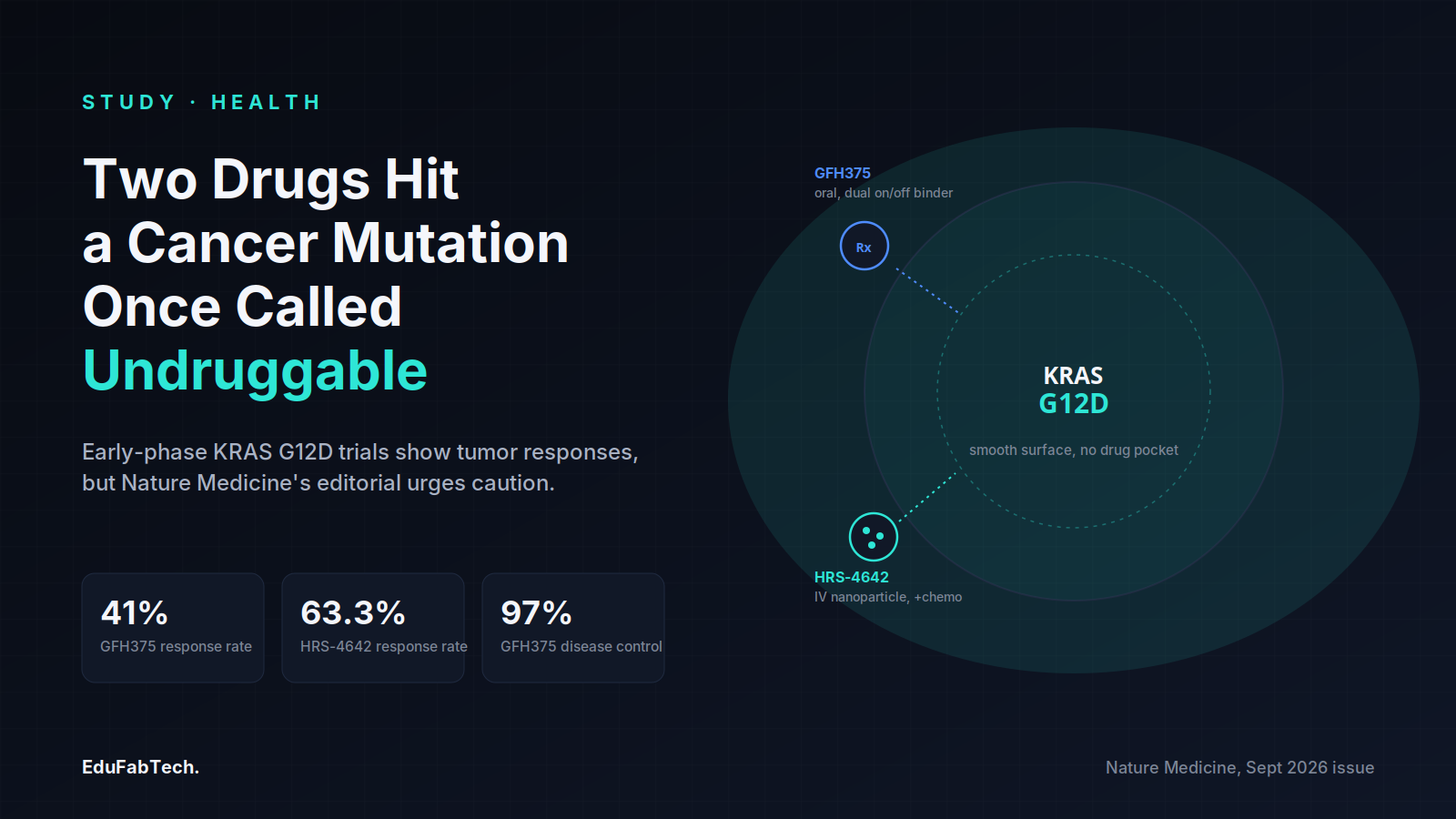
The KRAS gene has been called an undruggable target in cancer for four decades: its protein product sits so close to a perfectly smooth surface that most small molecules cannot get a grip on it. The G12D mutation, the single most common KRAS mutation in pancreatic cancer and among the most common in colorectal and non-small cell lung cancer, has been especially resistant to drug design because the pocket exploited by the first approved KRAS inhibitors, which target the rarer G12C mutation, does not exist on the G12D protein. Two clinical trials published in the September 2026 issue of Nature Medicine report that oral and intravenous KRAS G12D inhibitors can now produce measurable tumor responses in patients who had exhausted standard treatment, though both are small, single-arm, early-phase studies conducted at hospital sites in China.
The first trial, led by Xinghao Ai of Shanghai Chest Hospital and 25 co-authors, tested GFH375, an oral compound developed by GenFleet Therapeutics that binds KRAS G12D in both its active ("on") and inactive ("off") states. In a phase 1 dose-escalation study of 74 heavily pretreated patients with advanced KRASG12D-mutant solid tumors, including pancreatic ductal adenocarcinoma and non-small cell lung cancer, the confirmed objective response rate reached 41% and the disease control rate was 97%, according to the paper published in Nature Medicine on 15 September 2026. At a median follow-up of 141 days, progression-free survival at three months was 83%. Grade 3 or higher treatment-related adverse events occurred in 27 of 74 patients (36.5%), and the trial recorded one treatment-related death.
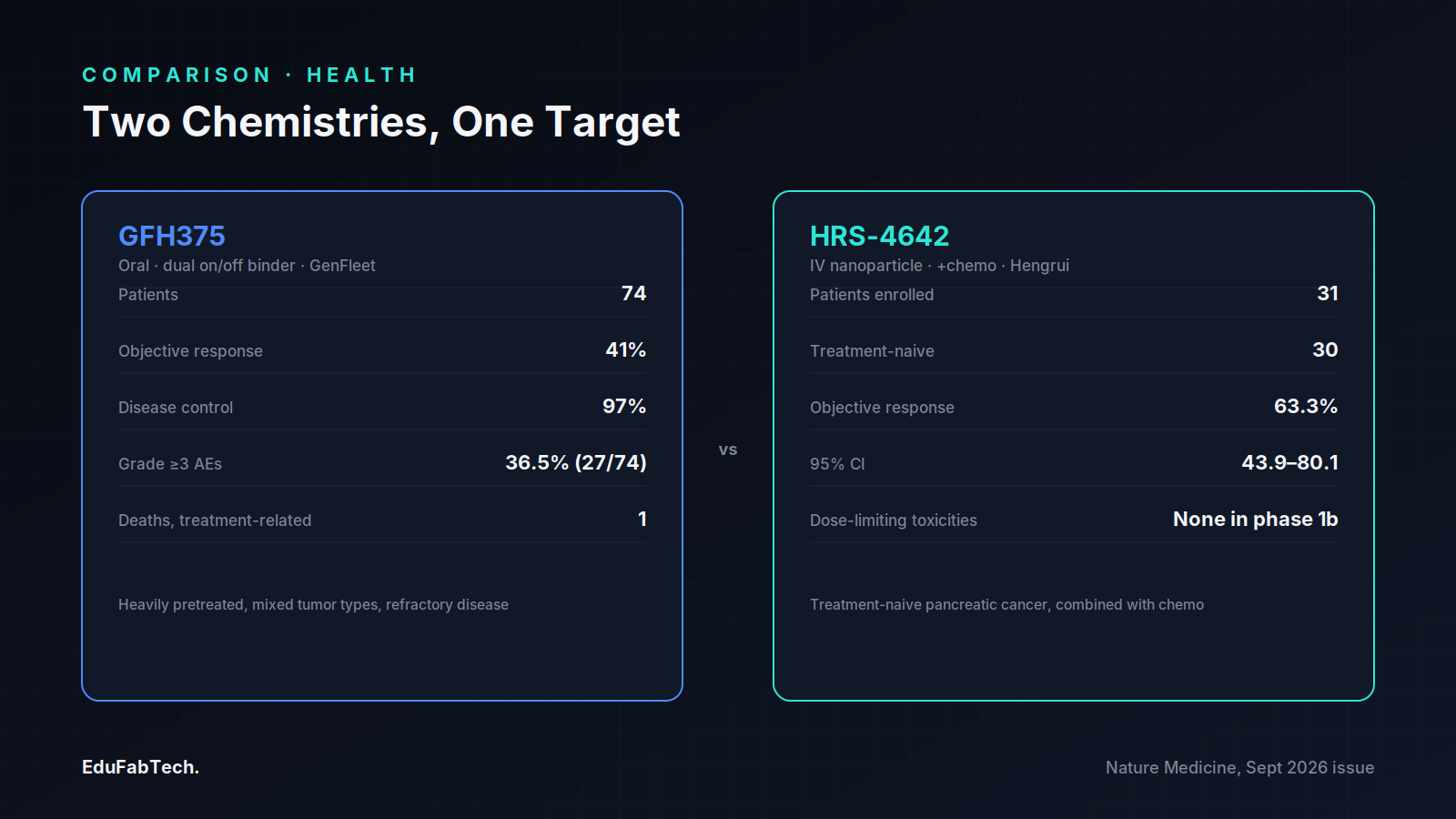
The second trial, led by Jiujie Cui of Shanghai Jiao Tong University School of Medicine and Kuirong Jiang of Jiangsu Province Hospital in Nanjing, tested HRS-4642, a noncovalent KRAS G12D inhibitor from Jiangsu Hengrui Pharmaceuticals formulated as a liposomal nanoparticle for intravenous delivery, designed to concentrate the drug in tumor tissue and prolong target inhibition. In this phase 1b/2 trial, published in Nature Medicine (volume 32, pages 3294–3301, 2026), 31 patients with advanced KRASG12D-mutant pancreatic cancer were enrolled, 30 of them treatment-naive, and treated with HRS-4642 combined with the chemotherapy drugs nab-paclitaxel and gemcitabine. The phase 1b portion found no dose-limiting toxicities, and the recommended phase 2 dose was set at 500 mg on day one and 1,200 mg on day eight of each three-week cycle. In the phase 2 portion, at a median follow-up of 12.3 months, the confirmed objective response rate among the 30 treatment-naive patients was 63.3% (95% confidence interval, 43.9–80.1), meeting the trial's primary endpoint.
Two different chemistries, one target
The two drugs take different routes to the same mutation. GFH375 is a small molecule taken by mouth that engages KRAS G12D across both of its conformational states, an approach intended to reduce the chance that tumors escape by shifting the balance between the "on" and "off" forms of the protein. HRS-4642 is delivered intravenously as a nanoparticle formulation and was tested only in combination with standard chemotherapy in previously untreated pancreatic cancer, rather than as a single agent in refractory disease. This is a meaningfully different clinical setting from the GFH375 trial, which enrolled patients who had already progressed on other treatments and included a mix of tumor types, so the two response rates are not directly comparable.
A related result, not part of the same Nature Medicine set but relevant context, was reported in the New England Journal of Medicine earlier in 2026: a first-in-human trial of setidegrasib, a KRAS G12D-targeted protein degrader rather than an inhibitor, reported a 36% response rate in 45 non-small cell lung cancer patients and 24% in 21 pancreatic cancer patients, with a median progression-free survival of 8.3 months in the lung cancer cohort. Three distinct drug classes reaching the clinic within the same year against a mutation considered undruggable a decade ago marks a genuine shift in medicinal chemistry against RAS proteins.
An editorial's note of caution
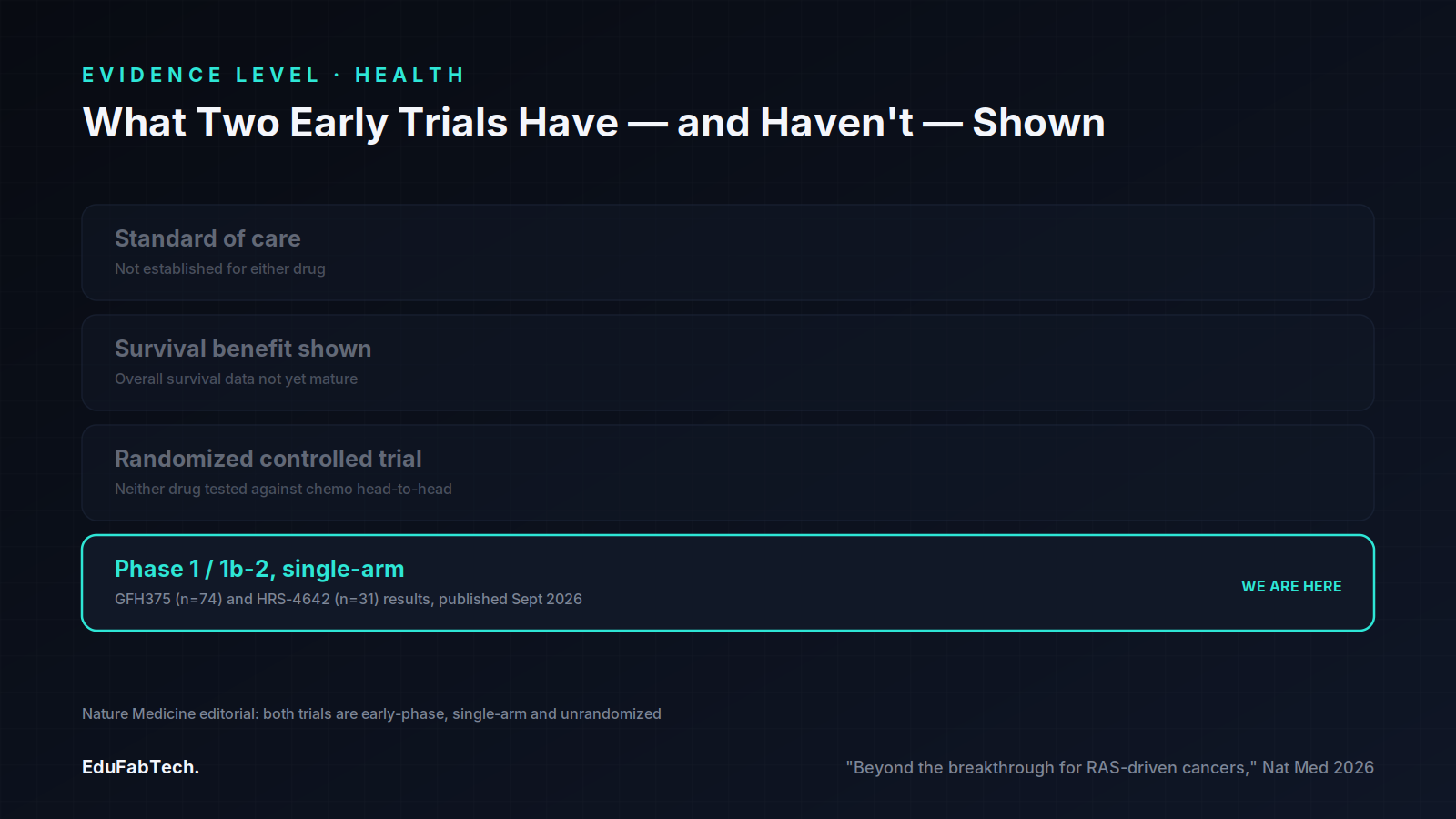
An accompanying editorial in the same issue of Nature Medicine, titled "Beyond the breakthrough for RAS-driven cancers" and written by Rich C. King, Erica S. Tsang and Jennifer J. Knox, frames the two trials as an important step rather than a settled advance. Both studies are early-phase, single-arm and unrandomized, meaning the response rates cannot yet be compared against standard-of-care outcomes in a controlled setting, and neither trial reports mature overall survival data. The GFH375 trial's one treatment-related death among 74 patients is also a reminder that toxicity in this drug class remains an open question as compounds move toward larger studies.
Two early clinical studies of selective KRASG12D inhibitors showed encouraging activity in advanced cancers with G12D mutations, signaling a potential shift in the treatment landscape for RAS-driven cancers — but the editorial stresses this is a beginning, not an endpoint, for the field.
What would need to happen next
Neither GFH375 nor HRS-4642 has yet been tested in a randomized controlled trial against standard chemotherapy, which is the step needed to establish whether either drug extends survival rather than simply shrinking tumors. Resistance mechanisms, which have already emerged for approved KRAS G12C inhibitors within months of clinical use, have not yet been characterized for either compound in these publications. Both trials were conducted entirely at hospital sites in China, and it remains to be seen how the drugs perform in more genetically and geographically diverse patient populations, as well as in the earlier-line and combination settings that multiple ongoing trials, registered on ClinicalTrials.gov, are now testing.
- GFH375 (oral, dual on/off binder): 74 patients, 41% objective response rate, 97% disease control rate, one treatment-related death
- HRS-4642 (intravenous nanoparticle, with chemotherapy): 30 treatment-naive pancreatic cancer patients, 63.3% confirmed objective response rate, no dose-limiting toxicities in phase 1b
For a mutation that pharmaceutical chemists spent thirty years failing to target, having two independent compounds produce measurable, publishable responses in the same year is itself notable. Whether either becomes a standard treatment depends on trials that have not yet been run.
- Xinghao Ai et al.. Oral KRAS G12D inhibitor GFH375 for previously treated advanced solid tumors with KRASG12D mutations: a phase 1 trial. Nature Medicine, 2026. doi:10.1038/s41591-026-04559-4
- Jiujie Cui et al.. KRAS-G12D inhibitor HRS-4642 plus chemotherapy in advanced KRASG12D-mutant pancreatic cancer: a phase 1b/2 trial. Nature Medicine, 2026. doi:10.1038/s41591-026-04538-9
- Rich C. King, Erica S. Tsang, Jennifer J. Knox. Beyond the breakthrough for RAS-driven cancers. Nature Medicine, 2026. doi:10.1038/s41591-026-04610-4
- Wungki Park et al.. First-in-human trial of the KRAS G12D degrader ASP3082 (setidegrasib) in advanced solid tumors. New England Journal of Medicine, 2026. link