Archival Hubble Data Point to a Candidate Second-Generation Planet at a Dead Star
A Warwick-led team reports in Nature Astronomy (5 October 2026) that unusual niobium levels in a white dwarf's atmosphere may trace to a candidate Jupiter-sized planet that formed after its star died.
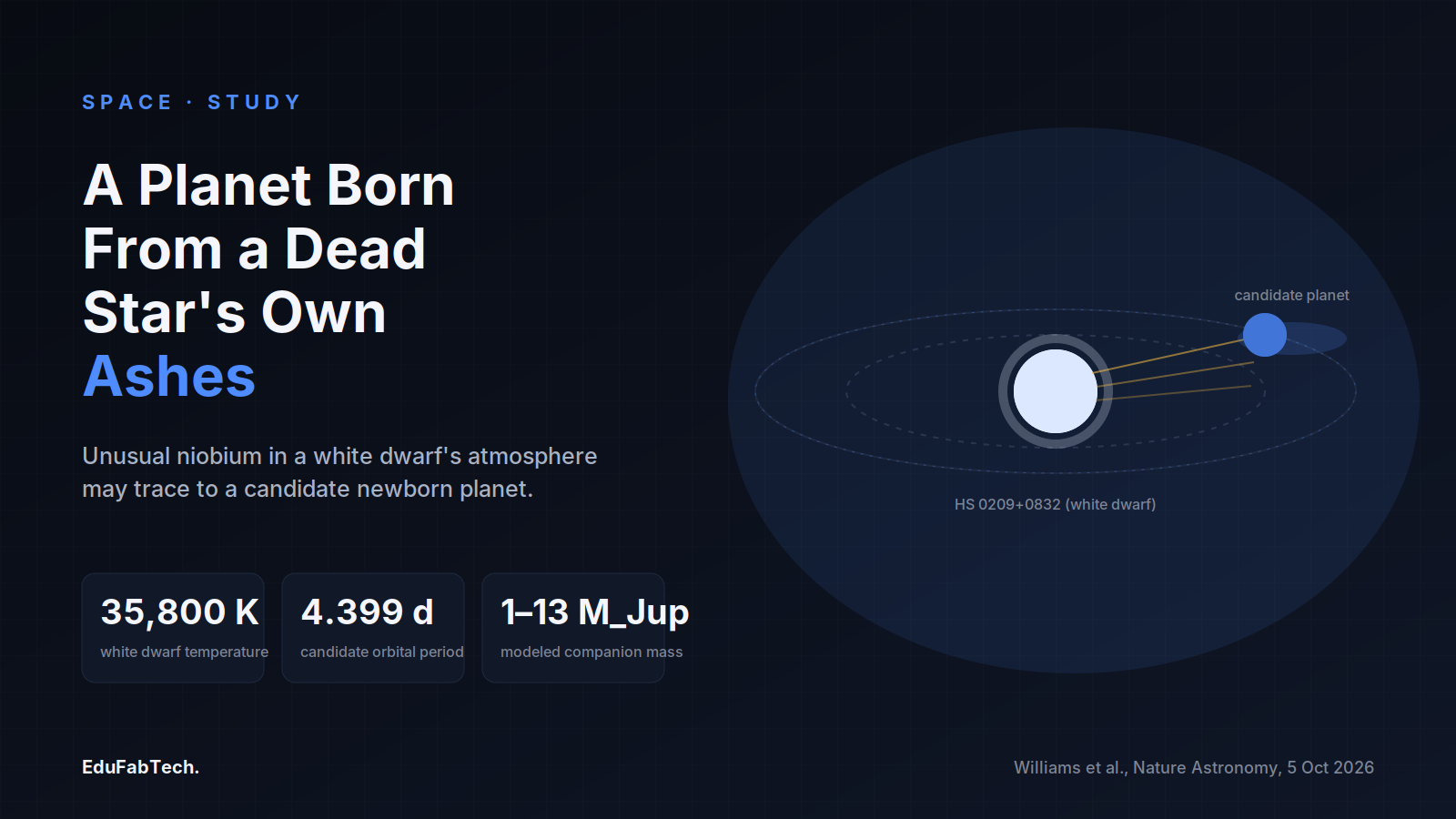
On 5 October 2026, Nature Astronomy published a study arguing that a 27-year-old, unexplained spectrum from the Hubble Space Telescope may be the first evidence of a planet that formed after its star had already died. The paper, led by Jamie Williams and Boris Gänsicke of the University of Warwick with Nicholas Stone of the University of Wisconsin–Madison, describes a candidate "second-generation" planet orbiting the white dwarf HS 0209+0832 and reports the star's effective temperature at 35,800 ± 500 kelvin with a cooling age of about 5 million years — young enough, the researchers say, that it is still hot (Williams et al., Nature Astronomy, 2026).
Hubble recorded the star's spectrum back in 1999, but roughly 100 of its absorption features went unidentified for more than two decades, according to the European Space Agency's Hubble release describing the discovery (ESA/Hubble, 5 October 2026). Williams, a doctoral candidate at Warwick, returned to the archival data with an updated atomic-line database and traced many of the unexplained features to niobium, an element the release says had not previously been reported in any white dwarf's atmosphere.
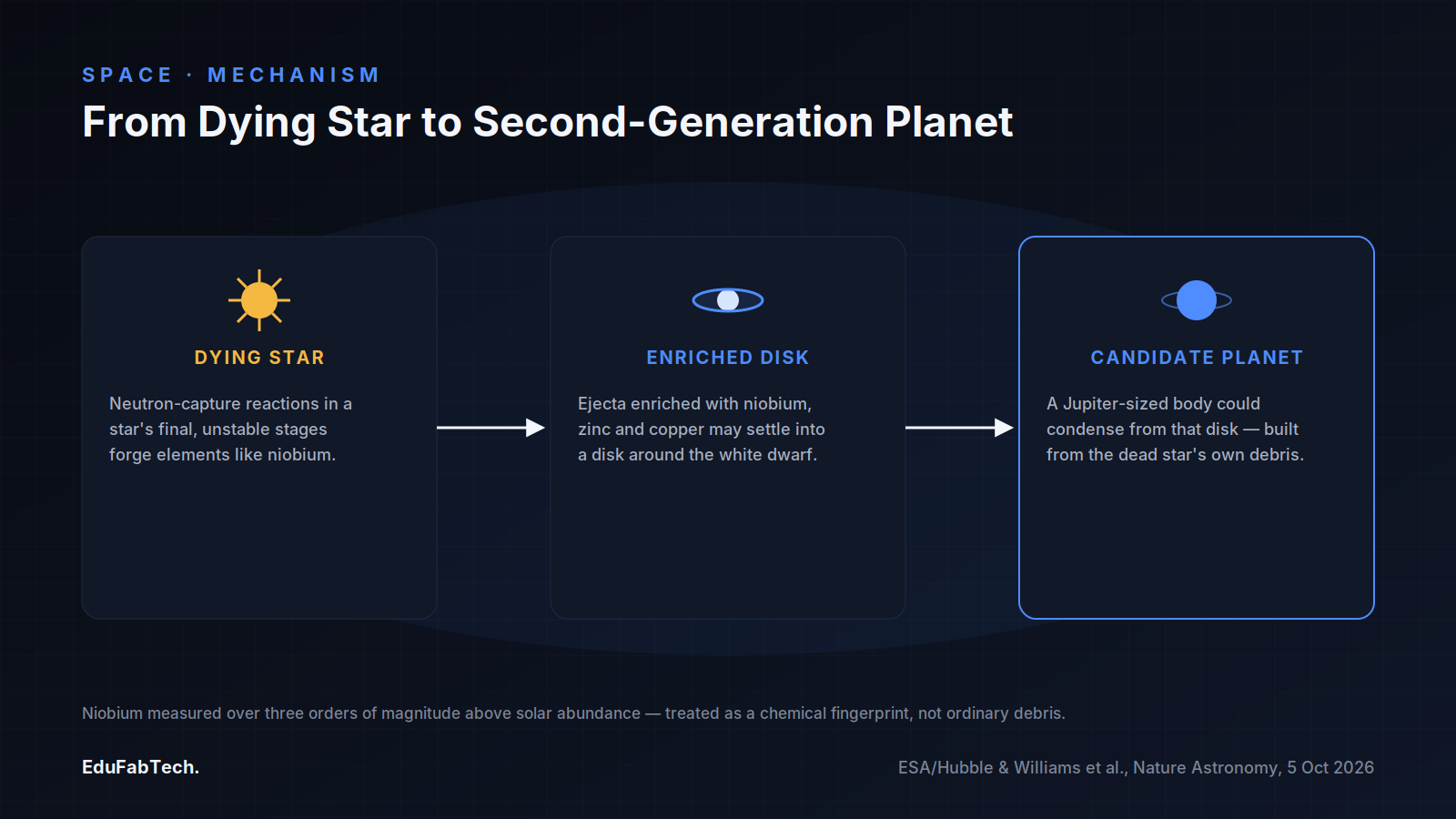
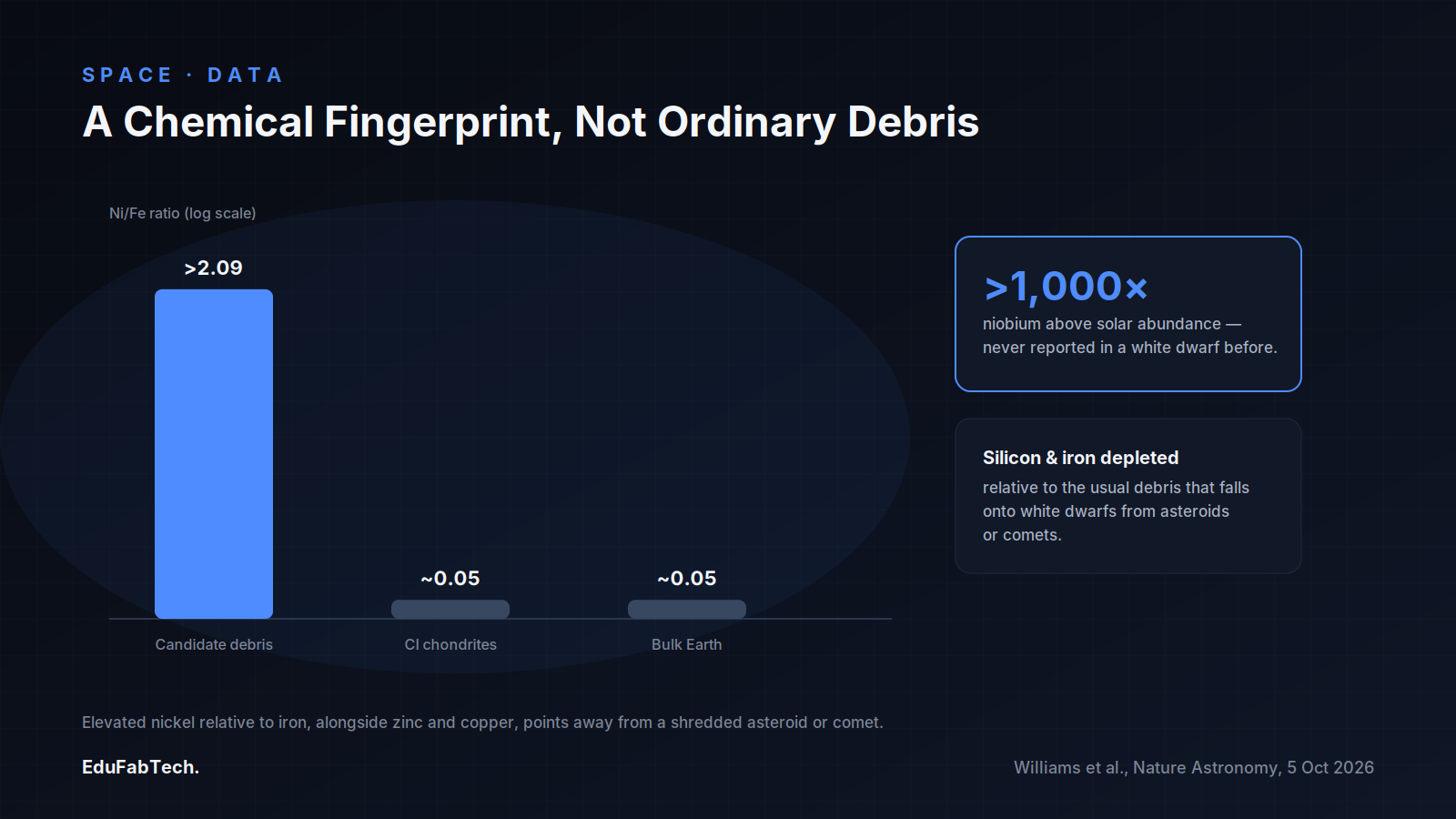
The amount of niobium is what makes the case. The Nature Astronomy paper reports the element at "over three orders of magnitude" above its solar abundance, alongside zinc and copper, while the lighter rock-forming elements silicon and iron are depleted relative to what falls onto most white dwarfs from shredded asteroids or comets (Williams et al., Nature Astronomy, 2026). The paper also gives a nickel-to-iron ratio above 2.09, compared with about 0.05 in CI chondrite meteorites and bulk Earth — a departure the authors treat as a chemical fingerprint rather than ordinary planetary debris.
A second line of evidence comes from brightness measurements. The team modelled photometric data showing a periodic dip with a period of 4.399 ± 0.026 days and an amplitude of 0.120% ± 0.018%, which they interpret as a companion orbiting at about 0.04 astronomical units — some 6 million kilometres, closer than Mercury is to the Sun (Williams et al., Nature Astronomy, 2026). The paper models the body's atmospheric escape across a companion mass range of 1 to 13 Jupiter masses — the span that keeps it within the planetary regime — and, using separate Spitzer infrared data, disfavours a brown-dwarf companion above roughly 20 Jupiter masses. The authors write that the white dwarf's radiation "will drive mass loss from this planet," a picture the ESA/Hubble release echoes in describing the star as "still very hot and likely blasting this planet with energy that is stripping its outer material" (ESA/Hubble, 5 October 2026).
The "second-generation" label refers to how the authors think such a planet would have to form. Stone told ESA/Hubble that elements like niobium "can only be synthesized in the exotic conditions that briefly emerge inside dying stars," pointing to the s-process, a slow neutron-capture reaction associated with the final, unstable stages of a star's life (ESA/Hubble, 5 October 2026). If a disk of that expelled, s-process-enriched material survived around HS 0209+0832 after it became a white dwarf, the paper argues a new planet could have condensed from it — built from the dead star's own ejected material rather than from the primordial disk that formed the system originally.
The authors are explicit that this is a candidate, not a confirmation. Gänsicke said he was surprised by the result, noting that niobium "had not been reported in any other white dwarf analyzed to date," according to ScienceDaily's account of the release (ScienceDaily, 2026). The Nature Astronomy paper itself lists alternative explanations it could not fully rule out, including a transiting cometary tail from an evaporating gas giant rather than an intact planet's day-night thermal cycle, and refers to its result throughout as a "second-generation planet candidate" rather than a confirmed detection.
For researchers working on planet formation and stellar end-states, the interest is less in one object than in the possibility it opens. A handful of planets and planetary debris have been found orbiting white dwarfs before, but the ESA/Hubble release states this is the first candidate carrying the specific chemical hallmarks of having formed from a star's death rather than survived it. Confirming or ruling out a genuine second-generation planet would give modellers of post-main-sequence systems a concrete test case for how much mass and heavy-element-enriched material a dying star can recycle into something resembling a planet.
The authors say the next step is detailed atmospheric modelling of second-generation planets to work out their likely composition, and note that further candidates could be found by searching other hot white dwarfs' ultraviolet spectra for the same carbon and s-process signatures. The current case rests on a 27-year-old archival spectrum reanalysed with an updated atomic-line database, plus two short TESS observing windows, in 2021 and 2023, that each cover only a handful of orbital cycles — evidence the authors describe as consistent with a second-generation planet, not proof of one.
A quick question for readers
When an article cites a study, do you open the source?
Every claim on this site links to a primary source. We want to know whether readers actually follow those links, or whether they …
Pick an answer, create a free account in a minute, and your vote counts. Already a member? Sign in
Comments 0
CommentNo comments yet. Members start the conversation.
Source: Nature Astronomy
Sources (3)
- Jamie T. Williams, Boris T. Gänsicke, Nicholas C. Stone, Detlev Koester, et al.. Discovery of a second-generation planet candidate accreting onto a white dwarf. Nature Astronomy, 2026. nature.com ↗ · checked 13 Oct 2026
- ESA/Hubble. Suspected second-generation planet solves Hubble cold case. ESA/Hubble, 2026. esahubble.org ↗ · checked 13 Oct 2026
- ScienceDaily. Hubble Space Telescope may have found a planet born after its star died. ScienceDaily, 2026. sciencedaily.com ↗ · checked 13 Oct 2026