Growth Mindset in the Classroom: What the Large Trials Show, What They Don't
A widely adopted teaching idea began with a handful of small studies; three decades on, the evidence is far more mixed than the classroom posters suggest.
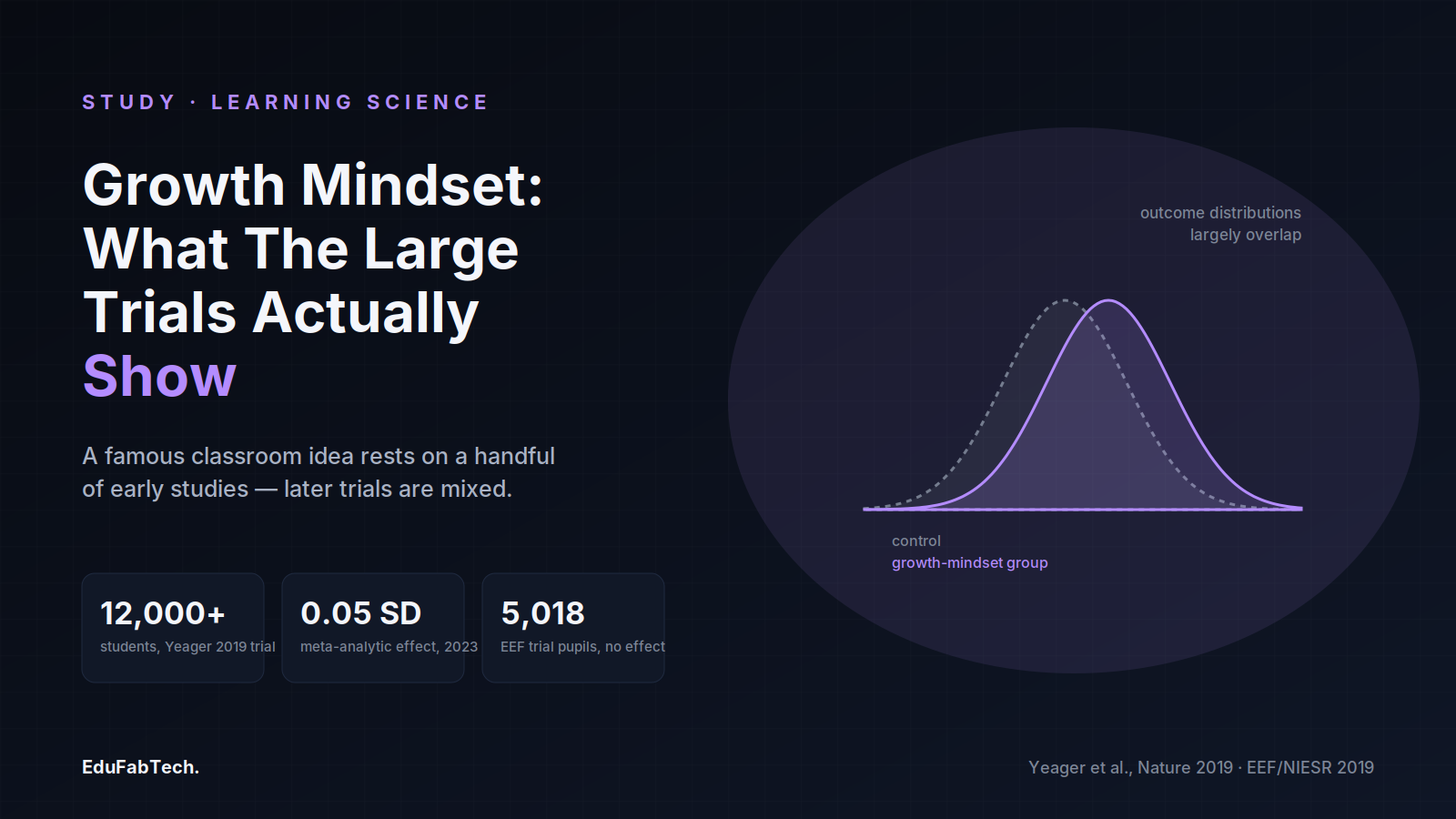
Tell a teacher that intelligence is not fixed, and something changes in how a class is run: praise shifts from "you're so smart" to "look how hard you worked," setbacks get reframed as data rather than verdicts, and a short talk about the malleability of the brain becomes part of the first week of term. This is growth mindset theory, and it is one of the most widely adopted ideas in contemporary education. It is also one of the better test cases for how a psychological finding travels from a small lab study to global classroom practice — and what happens to the evidence at each step of that journey.
The theory originates with the psychologist Carol Dweck's research on "implicit theories of intelligence": the idea that people hold either a fixed view (ability is a stable trait) or a growth view (ability develops through effort) and that this belief shapes how they respond to difficulty. The foundational classroom study was Blackwell, Trzesniewski and Dweck (2007) in Child Development. Its first component was a longitudinal survey of 373 seventh-graders showing that mindset predicted maths grade trajectories across the transition to junior high school. Its second component — the part that became the template for growth mindset teaching — was an eight-session intervention delivered to a group of 48 students and compared with a control group of 43 students who received study-skills instruction instead. That is the entire experimental basis on which the messaging half of growth mindset practice was built: a single study, one school, fewer than a hundred students in the treatment arm.
A second foundational strand concerns praise rather than mindset messaging directly. In Mueller and Dweck (1998), published in the Journal of Personality and Social Psychology, a series of six lab studies with fifth-graders found that praising a child's intelligence after success ("you must be smart at this") led to worse persistence, more avoidance of challenging tasks, and lower subsequent performance than praising effort ("you must have worked hard"). This is the empirical root of "praise the process, not the person," a phrase now standard in teacher training internationally. It is worth being precise about its evidentiary weight: it is a well-designed, frequently cited experimental research programme, but it was conducted in laboratory sessions with a specific age group, not as a classroom-scale trial measuring effects on term-long achievement.
Scaling beyond the lab
Small foundational studies are how psychology usually starts, and the honest next step is to ask whether the effect holds up at scale, in ordinary schools, with an intervention that could plausibly be delivered to millions of students. That step was taken by the National Study of Learning Mindsets, published as Yeager et al. (2019) in Nature. This was a large, pre-registered randomised trial: more than 12,000 ninth-grade students in a nationally representative sample of 65 public high schools in the United States were randomly assigned to a brief (under one hour) online growth mindset exercise or a control activity.
The results were real but modest and conditional. Among lower-achieving students, the intervention raised grade point average in core academic subjects by 0.10 points and reduced the proportion of students with a D or F average by more than five percentage points, according to the study. Both higher- and lower-achieving students were about three percentage points more likely to enrol in advanced mathematics the following year. Critically, the authors did not report a uniform effect: the grade gains concentrated in medium- and lower-achieving schools where peer norms supported taking on challenging coursework and where challenging courses were actually available to students who wanted them; schools lacking that combination — including some of the best-resourced ones, where students had less need of the message — showed little or no measurable effect.
That context-dependence is the study's most important finding and the one most often dropped when the result is summarised in a sentence. A one-hour online exercise moving GPA by a tenth of a point, in some schools, under some peer conditions, is a genuinely different claim from "growth mindset raises grades," and the distinction matters for anyone deciding whether to adopt the practice.
What the meta-analyses say
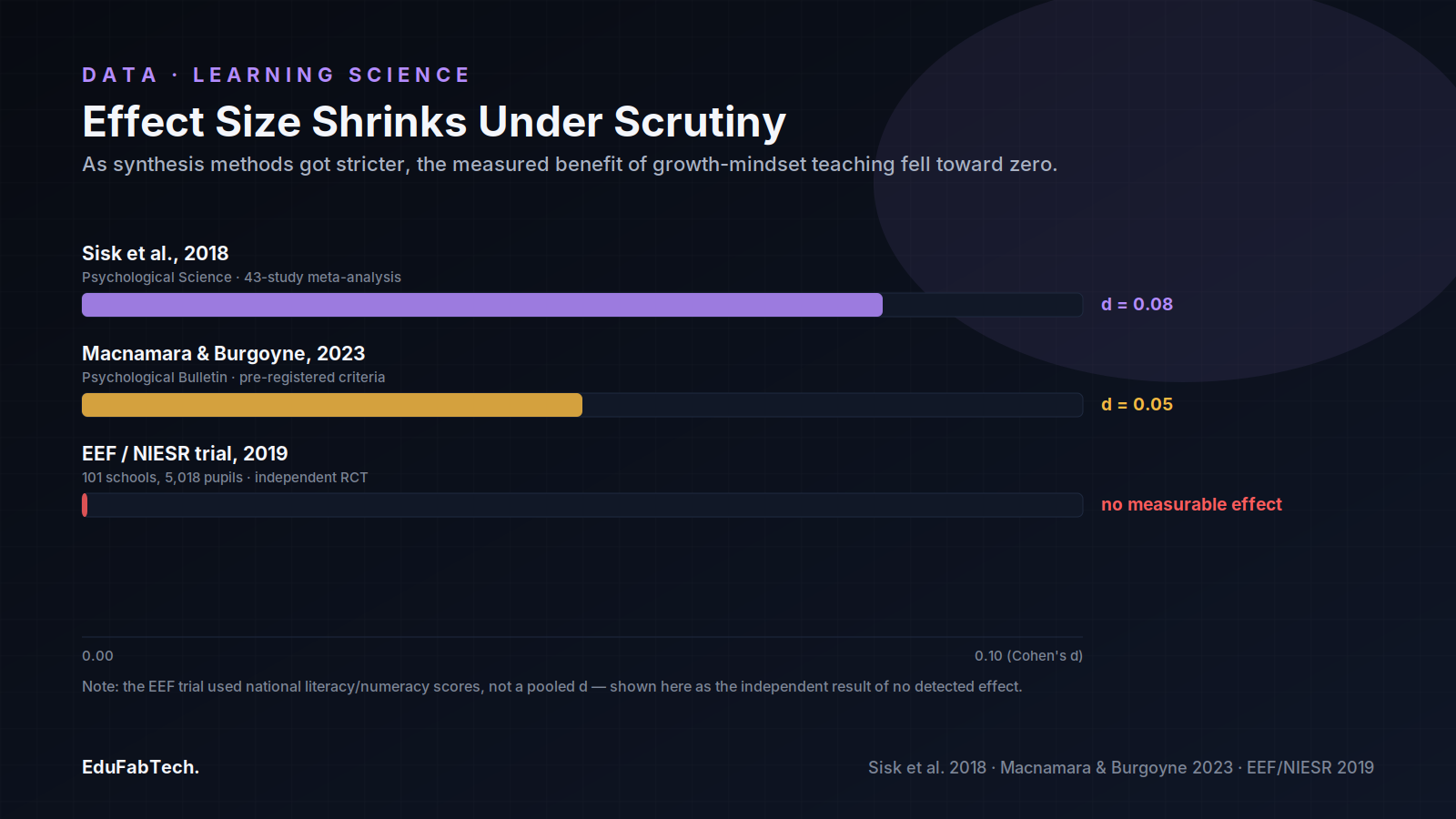
A single large trial, however well designed, is not the same as an established finding. Two meta-analyses in Sisk, Burgoyne, Sun, Butler and Macnamara (2018), published in Psychological Science, aggregated the wider literature. The first pooled 273 studies (365,915 participants) on the correlation between mindset and academic achievement and found it weak overall, somewhat stronger in children than in adults. The second pooled 43 studies (more than 57,000 participants) and found a small effect on achievement, a standardised mean difference of d = 0.08. The authors added an important qualifier: interventions that successfully shifted students' mindsets did not, on average, improve their achievement; the studies driving the small overall effect were disproportionately ones that had failed to change mindset at all — an odd pattern for a theory whose causal chain runs from changed belief to changed behaviour to changed achievement.
2023: two meta-analyses, one literature, different conclusions
The clearest sign that this evidence base is still contested, rather than settled, is that the field's two most recent, most comprehensive meta-analyses were published in the same issue of the same journal and reached different headline conclusions. Macnamara and Burgoyne (2023), in Psychological Bulletin, applied a set of pre-registered best-practice criteria to the intervention literature and reported an overall effect around 0.05 standard deviations — smaller again than the 2018 estimate. Their more pointed finding concerned research quality: by their coding, 94% of growth mindset intervention studies contained a design confound, and authors with a disclosed financial incentive in the outcome were about two and a half times as likely to report a positive effect. Their conclusion was that the apparent benefit of these interventions is substantially attributable to weak design and reporting practices rather than to a genuine effect on achievement.
Burnette, Billingsley, Banks, Knouse, Hoyt, Pollack and Simon (2023), published alongside it in the same volume of Psychological Bulletin, analysed 53 independent intervention samples and reached a more favourable reading, reporting meaningful effects in subgroups identified in advance as most likely to benefit — students who were academically at risk or otherwise plausible candidates for a belief-based intervention. A subsequent commentary in the same journal argued that both teams' conclusions were sensitive to how they modelled heterogeneity across studies, and that reanalysis with multilevel methods narrowed the gap between the two positions without erasing it. The disagreement is not a matter of one team reading the data carelessly; it reflects real, unresolved methodological choices about how to synthesise a heterogeneous, unevenly rigorous literature.
An independent trial outside the research groups that built the theory
Meta-analyses of a field's own literature are useful, but an independent classroom trial run by an organisation with no stake in the theory's success is a different kind of evidence. The Education Endowment Foundation's Changing Mindsets effectiveness trial (2019), evaluated by the National Institute of Economic and Social Research, randomised 101 schools and 5,018 Year 6 pupils in England to an eight-week growth mindset programme or a control condition. The evaluation found no evidence that pupils who received the programme made additional progress in literacy or numeracy on national end-of-primary assessments, including within subgroups who had entered the trial with a fixed mindset. The Education Endowment Foundation's own guidance following the trial was that schools should be cautious about adopting growth mindset teaching as a standalone route to raising attainment, given this result and the limited number of independent trials in ordinary classrooms.
Sorting the claims by evidentiary weight
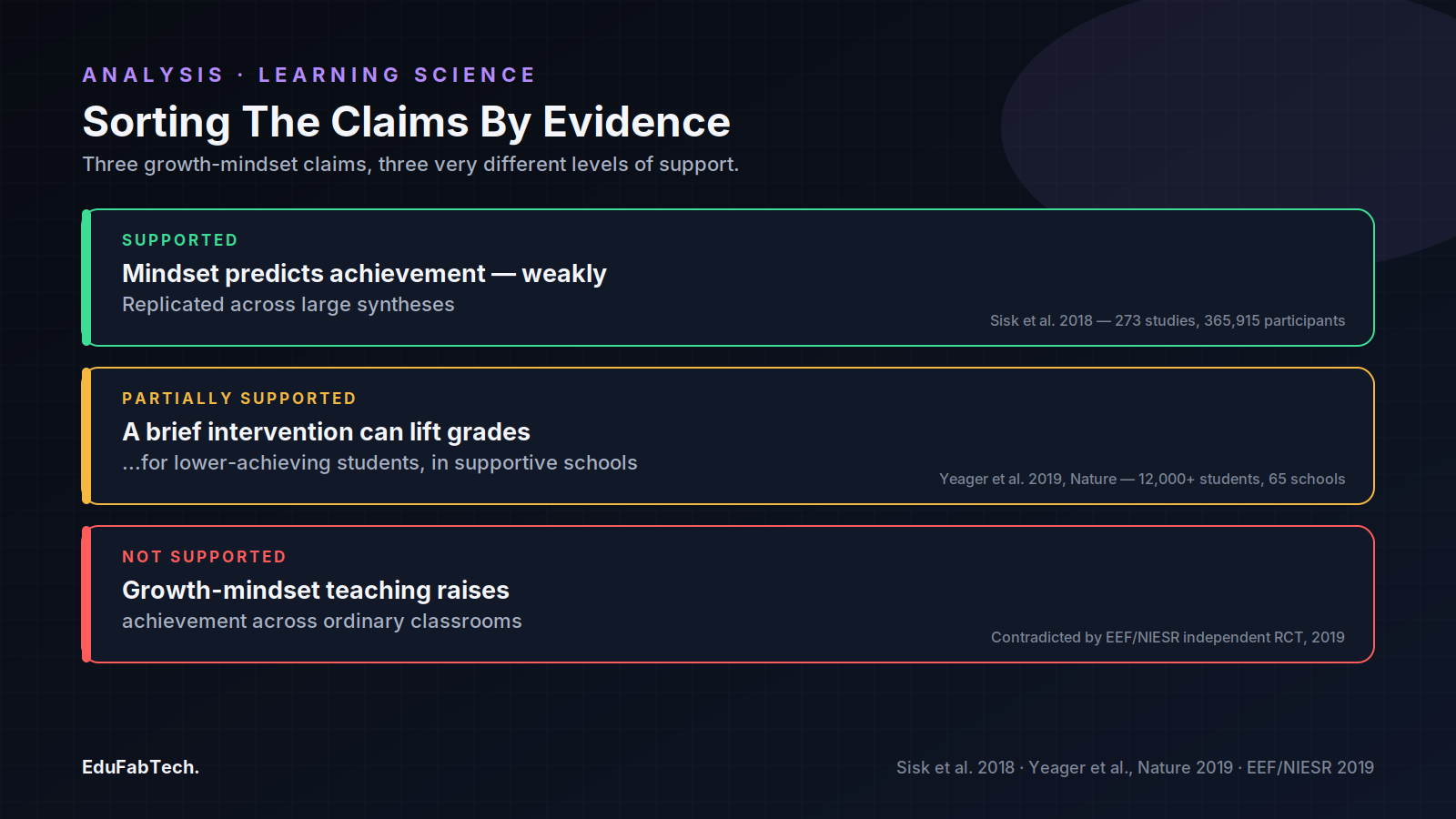
Laid end to end, the research trail supports three different levels of confidence, and conflating them is where popular accounts of growth mindset usually go wrong.
| Claim | Evidentiary status | Basis |
|---|---|---|
| The mindset–achievement correlation is real but weak | Replicated across large syntheses | Sisk et al. (2018), 273 studies |
| A brief, low-cost intervention can modestly raise grades for lower-achieving students in supportive school contexts | Supported by one large, well-designed national trial | Yeager et al. (2019), Nature |
| Growth mindset teaching reliably raises achievement across ordinary classrooms | Not supported | Contradicted by an independent RCT (EEF/NIESR, 2019) and disputed even within recent meta-analyses |
| Praising effort over ability changes short-term persistence and task choice in children | Supported by a well-designed lab research programme, not a classroom-scale trial | Mueller & Dweck (1998) |
The popular version of growth mindset theory — that changing what students believe about intelligence is, by itself, a lever for raising achievement across a school system — is the claim the evidence supports least well. Even the researchers most associated with the theory have narrowed their position over time: the 2019 Nature paper is explicit that the intervention worked only under specific peer-context and course-availability conditions, not universally, and the field's own 2023 meta-analyses disagree with each other about how much of the remaining effect is real versus an artefact of weak study design.
What this suggests for teaching and study practice
None of this means the underlying constructs are worthless, or that a teacher should discard everything associated with the theory. It means the claims should be weighted according to what actually backs them. A brief, well-designed mindset exercise is low-cost and, per the largest trial available, unlikely to cause harm; treating it as a substitute for curriculum quality, teacher support or resourcing is not supported by any of the evidence reviewed here — if anything, the Nature study suggests the intervention does the least where challenging coursework and supportive peer norms are already absent. Feedback that names a specific strategy rather than labelling a trait has a stronger experimental basis than mindset messaging itself, though that basis is a lab research programme and has not been tested at the same scale as the National Study of Learning Mindsets. And any single study — including the field's founding ones — should be read as a hypothesis-generating result rather than a settled fact until an independent team, ideally with no stake in the outcome, has tried to reproduce it under real classroom conditions.
That last point generalises well past mindset research. A theory can be intuitively appealing, well marketed in a bestselling book, and still rest on a handful of small studies until someone runs the 12,000-student version and several careful teams looking at the same data end up in a public disagreement about what it shows. That is not a failure of the science; it is what the science looks like while it is still being worked out.
- David S. Yeager, Paul Hanselman, Gregory M. Walton, et al.. A national experiment reveals where a growth mindset improves achievement. Nature, 2019. doi:10.1038/s41586-019-1466-y
- Lisa S. Blackwell, Kali H. Trzesniewski, Carol S. Dweck. Implicit Theories of Intelligence Predict Achievement Across an Adolescent Transition: A Longitudinal Study and an Intervention. Child Development, 2007. doi:10.1111/j.1467-8624.2007.00995.x
- Claudia M. Mueller, Carol S. Dweck. Praise for Intelligence Can Undermine Children's Motivation and Performance. Journal of Personality and Social Psychology, 1998. doi:10.1037/0022-3514.75.1.33
- Victoria F. Sisk, Alexander P. Burgoyne, Jingze Sun, Jennifer L. Butler, Brooke N. Macnamara. To What Extent and Under Which Circumstances Are Growth Mind-Sets Important to Academic Achievement? Two Meta-Analyses. Psychological Science, 2018. doi:10.1177/0956797617739704
- Brooke N. Macnamara, Alexander P. Burgoyne. Do Growth Mindset Interventions Impact Students' Academic Achievement? A Systematic Review and Meta-Analysis With Recommendations for Best Practices. Psychological Bulletin, 2023. doi:10.1037/bul0000352
- Jeni L. Burnette, Joseph Billingsley, George C. Banks, Laura E. Knouse, Crystal L. Hoyt, Jeffrey M. Pollack, Stefanie Simon. A Systematic Review and Meta-Analysis of Growth Mindset Interventions: For Whom, How, and Why Might Such Interventions Work?. Psychological Bulletin, 2023. doi:10.1037/bul0000368
- Francesca Foliano, Heather Rolfe, David Wilkinson. Changing Mindsets: Effectiveness Trial. Education Endowment Foundation (evaluated by the National Institute of Economic and Social Research), 2019. link