Growth Mindset: From a 91-Student Study to a National Trial to Near-Zero Meta-Analyses
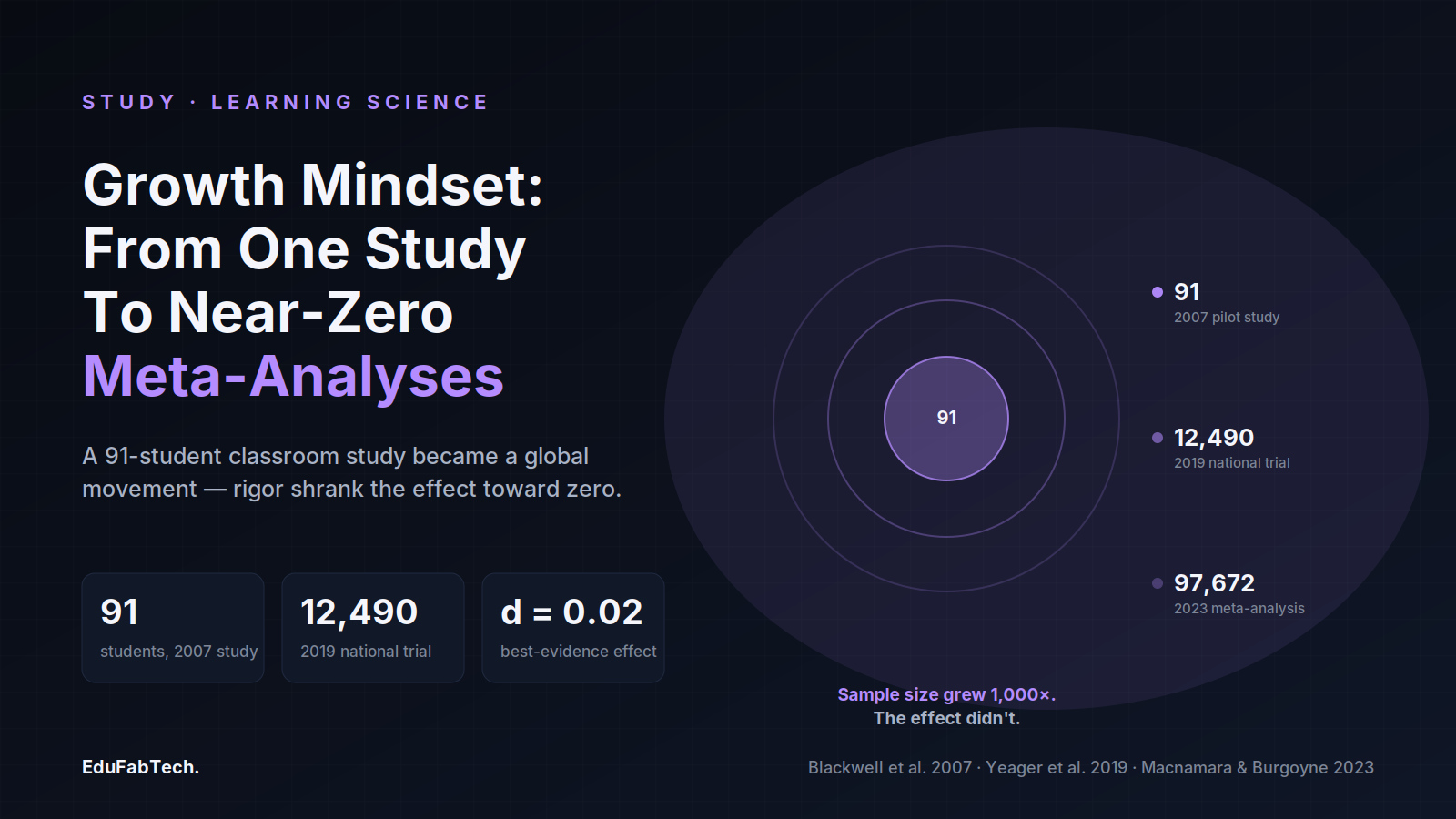
A single 2007 classroom study helped launch growth mindset into schools worldwide; a 12,490-student national trial found real but narrow gains, and the two most rigorous reviews since put the typical effect close to zero.
Growth mindset is the idea that students who believe intelligence can be developed through effort, strategy and help-seeking do better in school than students who believe ability is fixed. It is now built into teacher training programmes, school mission statements and classroom posters on several continents. The idea did not arrive with that scale of evidence behind it. It arrived as a single study.
That study, led by Lisa Blackwell with Kali Trzesniewski and Carol Dweck and published in Child Development in 2007, followed 373 seventh-graders' math grades and found that students who endorsed an "incremental" theory of intelligence showed an upward trajectory over two years of junior high, while those who held a "fixed" theory showed a flat one. A second part of the same paper tested whether teaching the incremental view could change outcomes directly: 48 students received an eight-session workshop teaching that effort builds new connections in the brain, compared with 43 students in a control workshop that covered general study skills and the structure of memory instead. The intervention group's math grades, which had been declining, reversed course; the control group's kept declining.
Ninety-one students, one school, one semester. That is the base on which a global movement in education was substantially built, until two very different kinds of follow-up arrived: a trial built for scale, and a series of meta-analyses built for scrutiny.
Taking it to scale: the National Study of Learning Mindsets
The largest single test of a growth-mindset intervention is the National Study of Learning Mindsets, led by David Yeager and colleagues and published in Nature in 2019. It was a randomized controlled trial run across 65 regular public high schools in the United States, chosen to be nationally representative, with 12,490 ninth-grade students assigned to receive either two 25-minute online sessions on growth mindset or a matched control activity.
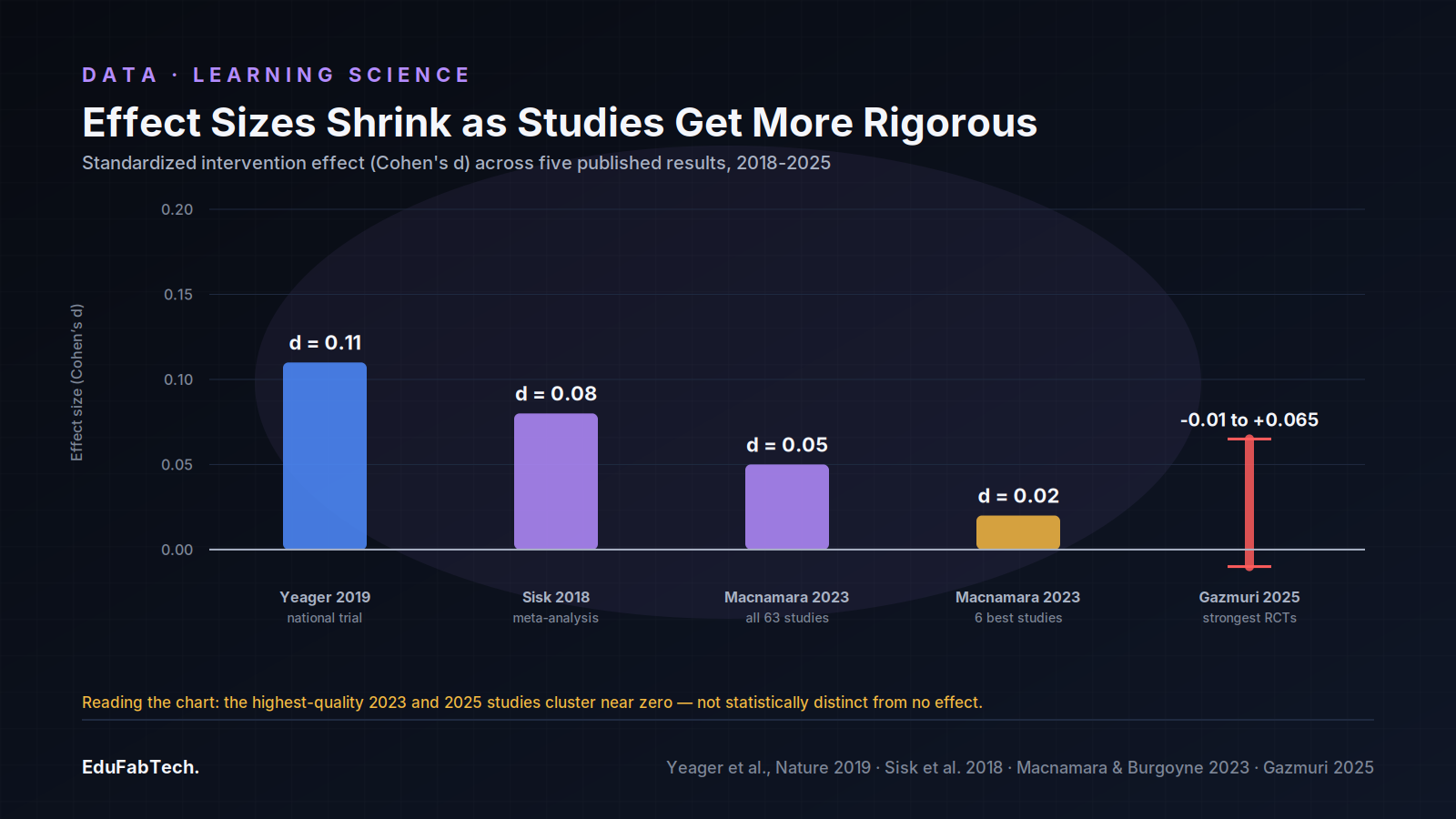
The effects were real, but narrow. Among lower-achieving students, the intervention raised grade point averages in core courses by 0.10 grade points on average, a standardized effect of roughly 0.11. In schools where peers were perceived to endorse the mindset message, that effect rose to as much as 0.18 grade points among lower- and medium-achieving students. Higher-achieving students showed no significant change in core-course GPA at all. The one effect that held across the full sample was behavioral rather than academic: students overall were 3 percentage points more likely to enrol in advanced mathematics the following year, raising the enrolment rate from 33% to 36%.
Yeager and colleagues were explicit that this was not a universal lift. The paper's own framing, visible in its title, is that mindset "improves achievement" only in specific places — among students already struggling, and more so where the surrounding school culture reinforces the message. That is a different claim from the one that reached many staff rooms, which was closer to "teach this and grades go up."
What the meta-analyses add
A trial of 12,490 students is large, but it is still one trial. The broader picture comes from pooling many studies. The first attempt at this, led by Victoria Sisk and colleagues and published in Psychological Science in 2018, ran two meta-analyses: one on the correlation between measured mindset and achievement, pooling 273 effect sizes from 365,915 participants, and one on intervention effects, pooling 43 effect sizes from 57,155 participants. The correlation was weak, r = 0.10. The average intervention effect was small, d = 0.08, and concentrated among academically at-risk students and those from lower-income households — a pattern that echoes, rather than overturns, what the 2019 national trial later found for its lower-achieving subgroup.
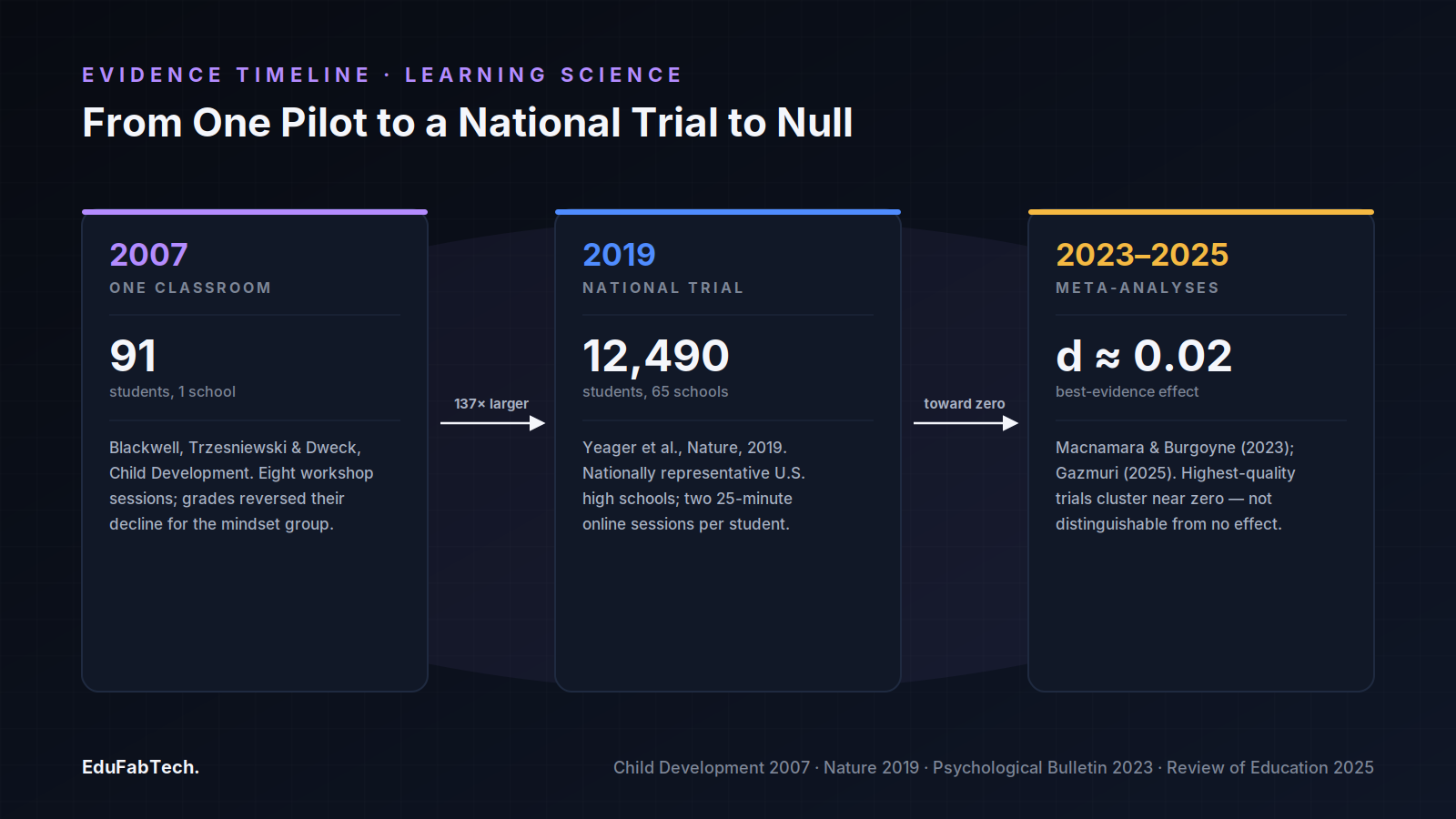
A more skeptical reckoning came from Brooke Macnamara and Alexander Burgoyne, whose systematic review and pre-registered meta-analysis appeared in Psychological Bulletin in 2023. Pooling 63 intervention studies across 79 independent samples and 97,672 students, they found an average effect of d = 0.05 that was no longer statistically significant once they corrected for publication bias; restricted to the six highest-quality studies, covering 13,571 students, the effect was d = 0.02, not statistically distinguishable from no effect at all. They also reported that 94% of the intervention studies they reviewed contained design confounds — features of the experiment, besides the mindset message itself, that could explain any difference between groups — and that researchers with a financial stake in mindset programmes were more likely to report positive results.
The most recent structured review, by Carolina Gazmuri of Durham University's Centre for Evidence in Education and published in Review of Education in August 2025, screened the literature down to 24 randomized controlled trials specifically measuring academic performance in school-age children. Among the four trials she rated highest on trustworthiness, two showed no detectable impact and two showed a very small one; across the strongest studies generally, effect sizes ranged from d = −0.01 to d = +0.065. Her own conclusion was direct: schools and governments should not expect meaningful gains, because "the anticipated outcomes are likely to be either null or very modest."
Sorting the claims
Three different kinds of claim have circulated under the name "growth mindset," and the evidence treats them very differently.
| Claim | Evidence status | What supports it |
|---|---|---|
| A belief that ability can grow correlates weakly with achievement | Replicated, small | Sisk et al. (2018): r = 0.10 across 273 effect sizes, 365,915 participants |
| A brief mindset intervention raises grades for lower-achieving or at-risk students | Replicated in targeted groups, effect is small and context-dependent | Yeager et al. (2019) national trial; Sisk et al. (2018) intervention arm, d = 0.08 |
| Teaching growth mindset meaningfully raises grades for students in general | Not supported at scale | Yeager et al. (2019) found no effect for higher achievers; Macnamara & Burgoyne (2023) found d = 0.02 in highest-quality studies; Gazmuri (2025) found d = −0.01 to +0.065 in the strongest trials |
What held up from 2007 to 2025 is narrower than what was popularized. The correlation between mindset and achievement is real but weak. The intervention effect, where it exists at all in rigorous trials, is concentrated among students who are already struggling and is sensitive to the surrounding school culture — not a general-purpose fix applied to a whole class. The claim that evaporated under scrutiny is the broad one: that a short lesson on neuroplasticity, delivered to any student, reliably moves grades.
What this means for teaching and studying
None of this means a teacher saying "you can get better at this with practice" is doing something harmful; it means that statement should not be mistaken for a structured intervention with guaranteed academic payoff. Responding to Gazmuri's review, as reported by EducationHQ in August 2025, Carl Hendrick, a professor of education at Academica University of Applied Sciences in Amsterdam, drew a related distinction: "Growth Mindset is a philosophy not an academic intervention." His recommendation was that teachers and school leaders should instead prioritise well-evidenced instructional practices such as explicit teaching and retrieval practice, and that "if mindset activities are implemented, they should be low-cost, time-efficient, and embedded within broader efforts to support motivation, resilience, or self-regulation, not bolted on as a standalone intervention."
For students deciding where to spend limited study time, the practical reading of this literature is modest: a belief that skills develop with effort is a reasonable thing to hold, and may matter somewhat more if you are already behind academically or facing a difficult transition, as the 2019 national trial and the 2018 meta-analysis both suggest. It is not, on the current evidence, a substitute for the structural changes — curriculum, instruction, assessment design — that the rest of this literature keeps coming back to when it looks for what actually moves grades.
A quick question for readers
Which study method makes things stick for you until the exam?
Research says some methods work far better than others. Vote first, then see whether students agree with the evidence.
Pick an answer, create a free account in a minute, and your vote counts. Already a member? Sign in
Comments 3
Comment-
The part that should get more attention is the 94% figure from Macnamara and Burgoyne: nearly every intervention study they reviewed had a d…
-
The number that should end the discussion is the 94% figure: Macnamara and Burgoyne found design confounds in nearly every intervention stud…
-
The number I'd put on a poster instead of the mindset slogan is 94%: that's the share of intervention studies Macnamara and Burgoyne found h…
Join free to read the full comments and reply Comments are between members; an account takes a minute.
Source: Nature
Sources (5)
- Lisa S. Blackwell, Kali H. Trzesniewski, Carol Sorich Dweck. Implicit Theories of Intelligence Predict Achievement Across an Adolescent Transition: A Longitudinal Study and an Intervention. Child Development, 2007. eric.ed.gov ↗ · checked 26 Oct 2026
- David S. Yeager, Paul Hanselman, Gregory M. Walton, et al.. A National Experiment Reveals Where a Growth Mindset Improves Achievement. Nature, 2019. pmc.ncbi.nlm.nih.gov ↗ · checked 26 Oct 2026
- Victoria F. Sisk, Alexander P. Burgoyne, Jin Sun, Jennifer L. Butler, Brooke N. Macnamara. To What Extent and Under Which Circumstances Are Growth Mind-Sets Important to Academic Achievement? Two Meta-Analyses. Psychological Science, 2018. journals.sagepub.com ↗ · checked 26 Oct 2026
- Brooke N. Macnamara, Alexander P. Burgoyne. Do Growth Mindset Interventions Impact Students' Academic Achievement? A Systematic Review and Meta-Analysis With Recommendations for Best Practices. Psychological Bulletin, 2023. psycnet.apa.org ↗ · checked 26 Oct 2026
- Carolina Gazmuri. Can Growth Mindset Interventions Improve Academic Achievement? A Structured Review of the Existing Evidence. Review of Education, 2025. eric.ed.gov ↗ · checked 26 Oct 2026