Handwriting Beats Typing for Notes — But the Famous 2014 Study Overstated It
A widely cited 2014 experiment launched laptop bans in lecture halls. A 2019 replication found almost nothing, and a 2024 meta-analysis of 24 studies found a real effect — just a much smaller one.
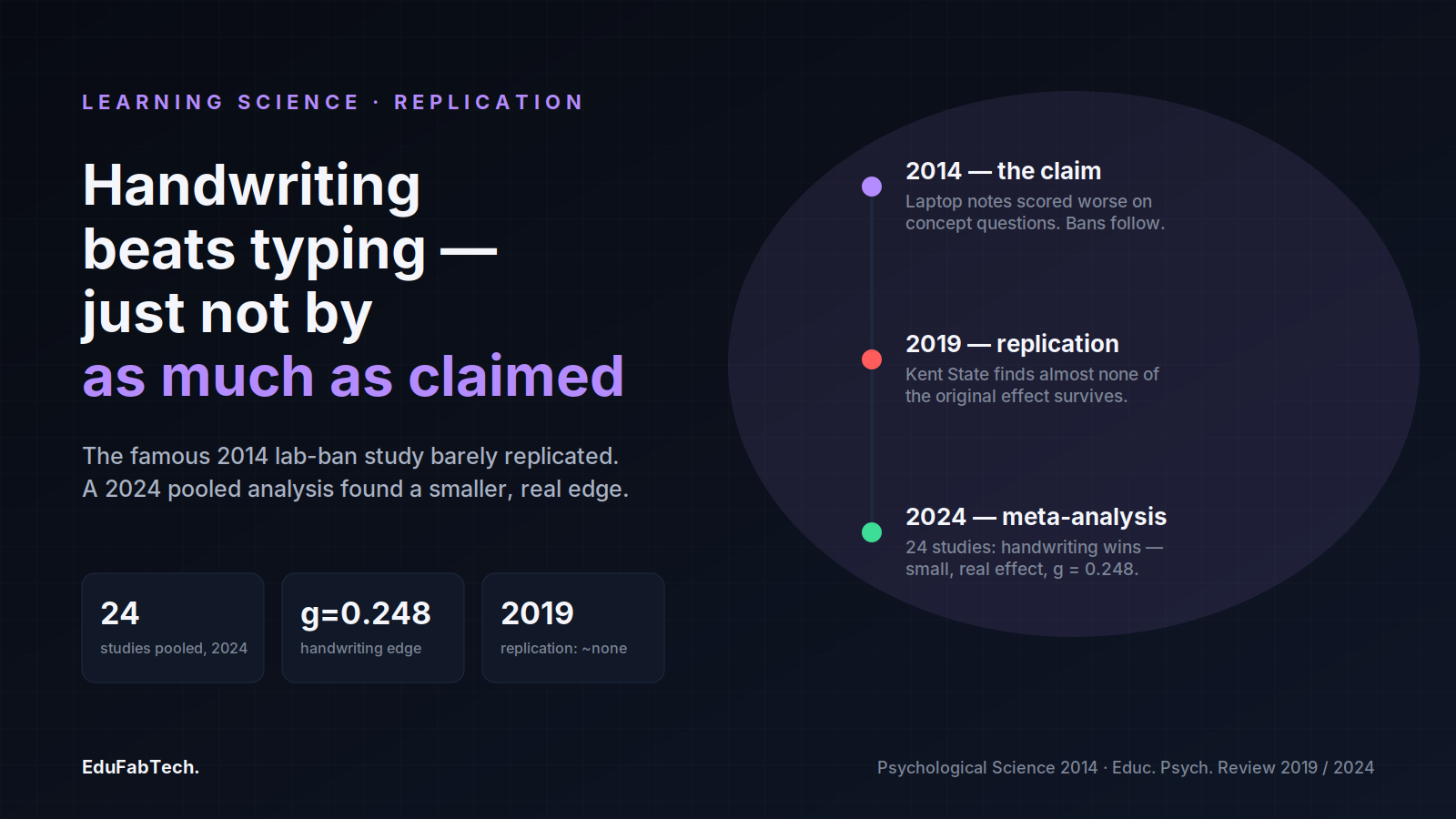
For more than a decade, one experiment has supplied the standard justification for banning laptops in lecture halls: a 2014 study claiming that students who type their notes learn less than students who write them by hand. The claim is only partly supported by what followed. A direct replication published five years later found almost none of the original effect, and a 2024 meta-analysis pooling 24 studies found a real advantage for handwriting — but a small one, present only under specific conditions the original study did not fully test.
The sequence is worth tracing in order, because it is a clean example of something that happens constantly in learning-science reporting: a single, vivid study becomes a policy, and the replication attempt that complicates it gets far less attention than the original.
The original claim
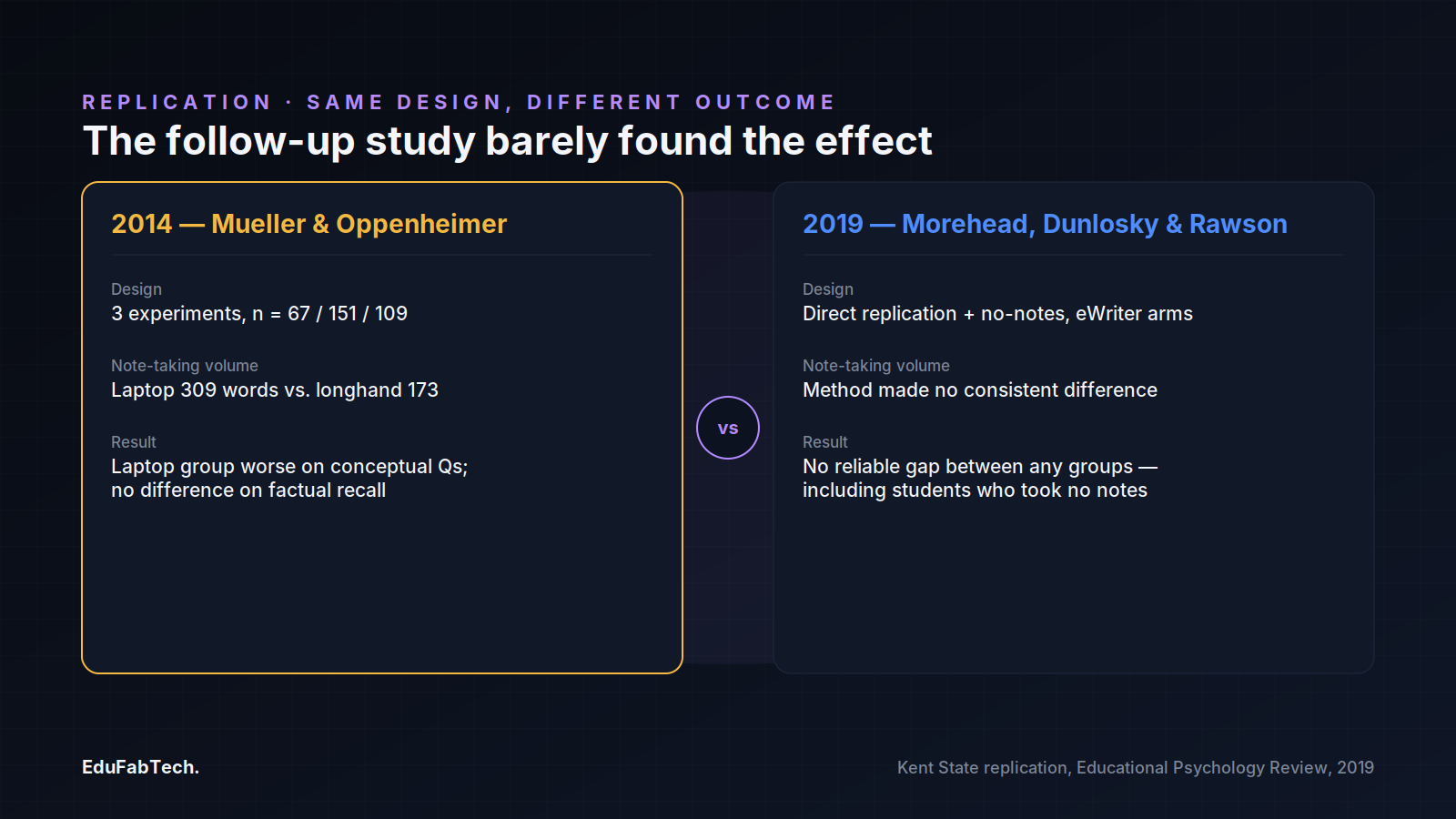
The 2014 paper, by Pam Mueller of Princeton University and Daniel Oppenheimer, then at the University of California, Los Angeles (he has since moved to Carnegie Mellon University), ran three experiments in which students watched recorded lectures and took notes either longhand or on a laptop, then answered factual and conceptual questions. Sample sizes were 67, 151 and 109 participants across the three experiments. Laptop users wrote far more — an average of 309 words versus 173 for longhand note-takers in the first experiment — but that volume did not translate into better scores. On factual recall there was no difference between groups, but on conceptual-application questions, the laptop group performed significantly worse. In the second experiment, students in the laptop condition who were explicitly instructed not to transcribe verbatim still produced notes with just as much verbatim overlap as laptop users given no such instruction — the instruction made no measurable difference — and typed notes remained far more verbatim than handwritten notes throughout. In a third experiment run a week later, students who reviewed longhand notes before a test did better on both factual and conceptual questions, while students who did not review notes before testing showed no difference by method. Mueller and Oppenheimer's own conclusion, titled "The Pen Is Mightier Than the Keyboard," was that laptop use "can negatively affect performance on educational assessments, even — or perhaps especially — when the computer is used for its intended function of easier note taking," the paper's closing assessment in Psychological Science.
That framing travelled further than most of the experimental nuance behind it. Universities cited the study to justify laptop bans, and "typing makes you dumber" became a durable claim in articles about studying — one that dropped the qualifiers about factual versus conceptual questions, and about review versus no review, that the original paper itself had carefully kept attached to its numbers.
The replication that mostly didn't hold
In 2019, Kayla Morehead, John Dunlosky and Katherine Rawson, all at Kent State University, ran a direct replication of the Mueller and Oppenheimer design, adding a condition for students who took no notes at all and one using eWriters. Their results, published as "How Much Mightier Is the Pen than the Keyboard?" in Educational Psychology Review (2019), did not reproduce the original pattern. Across their experiments, performance did not consistently differ between any of the note-taking groups — including the group that took no notes. On an immediate test in one experiment there was no significant difference between longhand and laptop note-taking, and on a delayed test given two days later in another experiment, note-taking method again had no measurable effect. When the researchers pooled the test-performance results from their direct replications in a meta-analysis, they found only a small, statistically nonsignificant effect favoring longhand. Their stated conclusion was blunt: "concluding which method is superior for improving the functions of note-taking seems premature." They pointed instead to the quality of notes and the overlap between note content and test content as the variables that actually predicted performance — a more mundane but better-supported finding than "banning laptops improves learning."
What a larger pooled analysis found in 2024
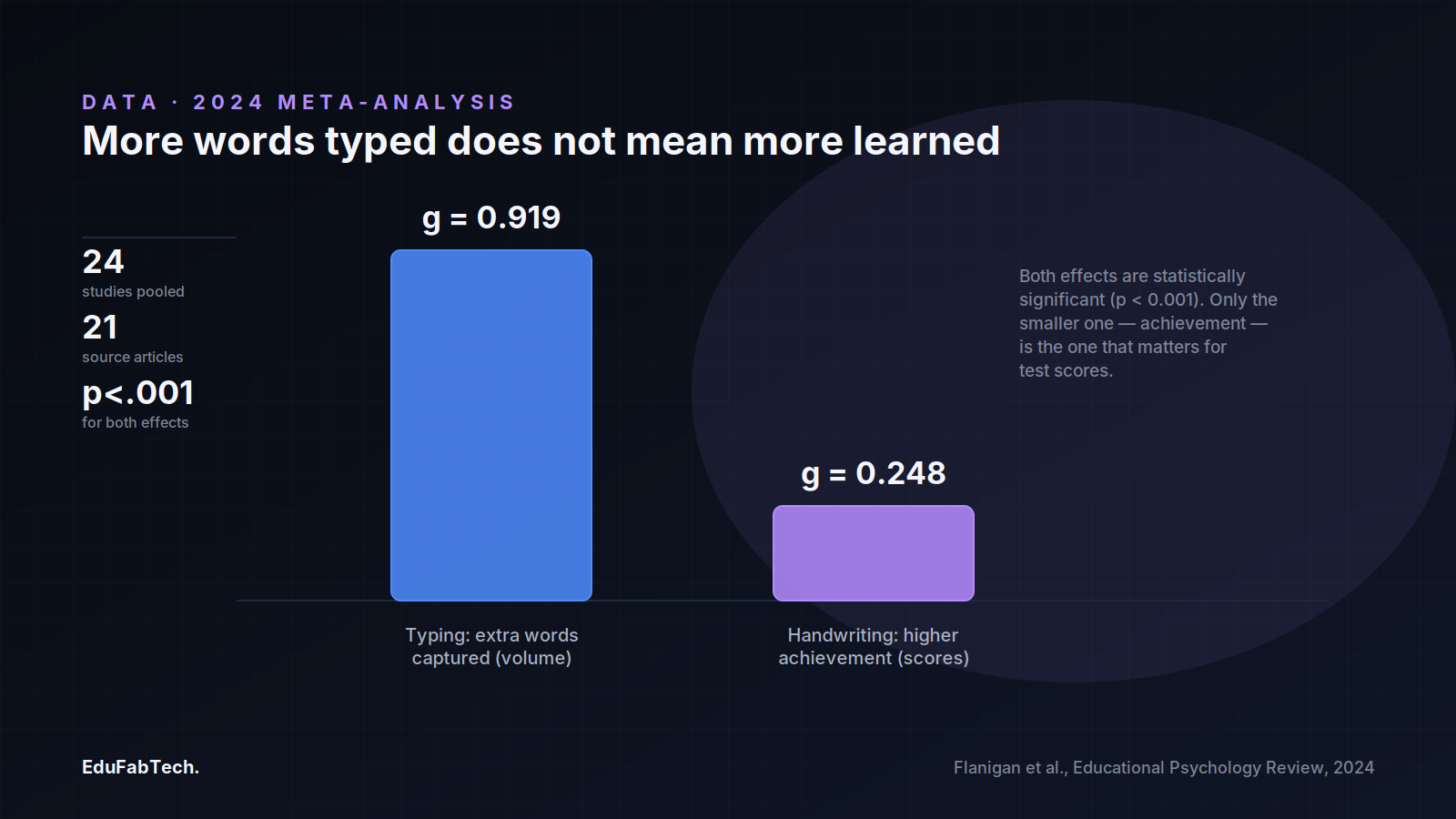
Five years after the Kent State replication, a team led by Abraham Flanigan of Georgia Southern University, with Jordan Wheeler, Tiphaine Colliot, Junrong Lu and Kenneth Kiewra, published a meta-analysis combining 24 separate studies across 21 articles on college lecture note-taking, in "Typed Versus Handwritten Lecture Notes and College Student Achievement," in Educational Psychology Review (2024). This is the strongest evidence currently available on the question, because it aggregates far more data than either the original study or the single replication attempt. The headline numbers are specific and worth keeping intact: students who took and reviewed handwritten notes had higher achievement on average, with an effect size of Hedges' g = 0.248 (p < 0.001) — described by the authors as a small effect. Typed notes, meanwhile, carried a much larger advantage in sheer volume, at Hedges' g = 0.919 (p < 0.001): students simply captured more words and more lecture content by typing. That extra volume did not convert into better scores.
Two moderator findings from the same meta-analysis matter for how the result should be applied. First, having the opportunity to review notes before an assessment further increased the handwriting advantage, echoing the review-dependent pattern that showed up in Mueller and Oppenheimer's own third experiment back in 2014. Second, neither the timing of the test (immediate versus delayed) nor the type of question asked (factual versus conceptual) changed the size of the handwriting advantage in a statistically meaningful way — a different pattern from the original 2014 study, where the laptop disadvantage was concentrated specifically in conceptual questions. The authors were explicit that none of the 24 included studies — or any other known meta-analysis on note-taking medium — accounted for the needs of students with disabilities, and they cautioned against applying the findings to course policies for those students.
A separate line of evidence that gets mixed in, but shouldn't be
A related but distinct strand of research looks at the neural signature of handwriting itself rather than at lecture learning. One frequently shared 2024 study using EEG, by researchers at the Norwegian University of Science and Technology, reported more complex brain connectivity patterns when university students wrote single familiar words by hand on a touchscreen than when they typed those same words with one finger. That is a real finding about motor and sensory processing during writing, but it is not a study of note-taking, lecture comprehension or test performance: the 40 participants, 36 of whom produced usable data, did not watch a lecture, take notes on new material, or complete any later memory test. Citing it as evidence that "handwriting improves learning" extends the study well past what it measured. It belongs in a different conversation from the lecture-note-taking literature above, and conflating the two is one of the more common ways this topic gets overstated in secondary coverage.
What follows for students and teachers
Three things can be said with different degrees of confidence, and separating them is the point of revisiting this topic at all.
- Replicated, modest effect: across a pooled set of 24 studies, students who handwrote and later reviewed their lecture notes outperformed students who typed theirs, by a small margin (Hedges' g = 0.248), per Flanigan et al. (2024).
- Single study, not replicated as originally framed: the specific 2014 finding that laptop note-takers were selectively worse on conceptual questions, and equivalent on factual ones, did not reappear in the 2019 Kent State replication, where no note-taking method reliably beat any other — including taking no notes.
- Popular claim the evidence does not support: that typing notes is simply bad for learning, full stop, or that EEG differences in handwriting motor activity during single-word copying tell us anything about lecture comprehension.
The more durable, boring-sounding variable across all three papers is not the writing instrument but what a note-taker does with the material: paraphrasing instead of transcribing verbatim, and reviewing notes before being tested on them. Mueller and Oppenheimer's own 2014 data showed the review step mattering as much as the method; Morehead, Dunlosky and Rawson's 2019 replication pointed to note quality and content overlap with the test; and Flanigan and colleagues' 2024 meta-analysis found the handwriting advantage grew specifically when review happened. A student who types notes, then paraphrases and reviews them, is working with a different note-taking process than a student who transcribes a lecture verbatim on a laptop and never looks at the notes again — and the research consistently distinguishes between those two typing behaviors even when popular summaries do not.
For instructors deciding whether to restrict laptops, the honest summary of the evidence is narrower than the original headline suggested: there is a real, replicated, small average advantage to handwritten and reviewed notes in college lecture settings, not a demonstrated cognitive harm from typing as such. Policies built on the stronger claim are relying on a reading of the 2014 study that the study's own later experiments, and the decade of follow-up research since, do not fully support.
A quick question for readers
Which study method makes things stick for you until the exam?
Research says some methods work far better than others. Vote first, then see whether students agree with the evidence.
Pick an answer, create a free account in a minute, and your vote counts. Already a member? Sign in
Comments 0
CommentNo comments yet. Members start the conversation.
Source: Educational Psychology Review
Sources (5)
- Pam A. Mueller, Daniel M. Oppenheimer. The Pen Is Mightier Than the Keyboard: Advantages of Longhand Over Laptop Note Taking. Psychological Science, 2014. journals.sagepub.com ↗ · checked 19 Oct 2026
- Kayla Morehead, John Dunlosky, Katherine A. Rawson. How Much Mightier Is the Pen than the Keyboard for Note-Taking? A Replication and Extension of Mueller and Oppenheimer (2014). Educational Psychology Review, 2019. link.springer.com ↗ · checked 19 Oct 2026
- Abraham E. Flanigan, Jordan Wheeler, Tiphaine Colliot, Junrong Lu, Kenneth A. Kiewra. Typed Versus Handwritten Lecture Notes and College Student Achievement: A Meta-Analysis. Educational Psychology Review, 2024. link.springer.com ↗ · checked 19 Oct 2026
- Journalist's Resource. The pen is mightier than the keyboard: Advantages of longhand over laptop note taking. Journalist's Resource, Shorenstein Center, 2016. journalistsresource.org ↗ · checked 19 Oct 2026
- The Learning Scientists. Handwritten versus Typed Note-Taking Effects on College Students' Performance. The Learning Scientists Blog, 2024. learningscientists.org ↗ · checked 19 Oct 2026