Handwriting vs. Typing Notes: A 2014 Finding Didn't Replicate; a 2024 Review Found a Small Edge
The famous "longhand beats laptops" result failed to reproduce in 2019, and a 2024 meta-analysis of 24 studies found a small, review-dependent advantage for handwriting, not a settled law of memory.
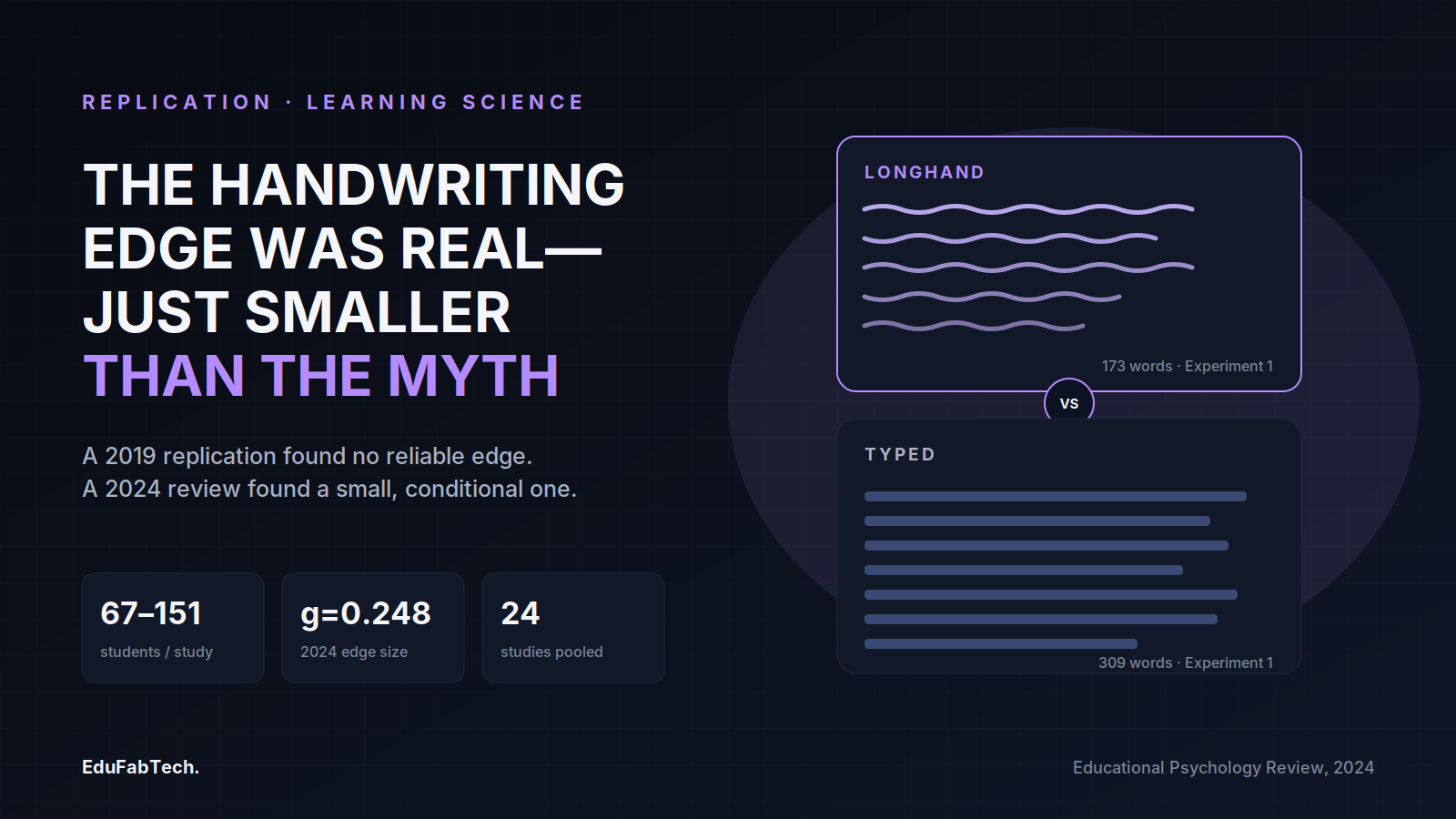
A single claim has shaped a decade of study advice: write your notes by hand, because typing them makes you learn less. The claim traces to one study, failed to reproduce in its strongest form five years later, and now sits closer to "small and conditional" than "settled law of memory" in the most recent synthesis of the evidence. That gap between the popular version of the finding and what the data actually support is itself the lesson.
The study that started it
In 2014, Pam Mueller of Princeton University and Daniel Oppenheimer, then at UCLA, published three experiments in Psychological Science comparing students who took notes on laptops with students who took notes longhand while watching the same recorded lectures. Sample sizes across the three experiments ranged from 67 to 151 students, according to a summary of the paper by Harvard Kennedy School's Journalist's Resource. Laptop users wrote far more: in the first experiment, an average of 309 words, against 173 words for longhand note-takers, the same summary reports.
On questions testing plain factual recall, the two groups did not differ. On questions that required applying or synthesising the lecture material, longhand note-takers did significantly better, per the Journalist's Resource breakdown of the original paper. Mueller and Oppenheimer's explanation was about process, not the pen itself: typing is fast enough to let students transcribe a lecture almost verbatim, while writing by hand is slow enough to force selection and paraphrasing — what the authors frame as generative processing rather than passive transcription. In a third experiment, giving students a chance to study their notes before the test changed the picture again: those reviewing longhand notes performed better on both factual and conceptual questions, the same source notes.
The replication that didn't hold
Direct replications are rare in education research, which makes what happened next unusually informative. In 2019, Kayla Morehead, John Dunlosky and Katherine Rawson published a replication and extension of the 2014 study in Educational Psychology Review. They kept the laptop and longhand conditions, added a group using eWriters (stylus-based digital tablets) and, in a second experiment, a group that took no notes at all.
The headline result did not survive. According to the study's own abstract, "some trends suggested longhand superiority; however, performance did not consistently differ between any groups," and the authors found only "small (nonsignificant) effects favoring longhand." Pooling their experiments, the advantage for conceptual recall that had anchored the original paper's conclusion was not statistically reliable. Morehead, Dunlosky and Rawson's stated conclusion is notably more cautious than the claim that later circulated in classrooms and advice columns: they write that "concluding which method is superior for improving the functions of note-taking seems premature."
What a 2024 meta-analysis adds
A single replication failure does not settle a question any more than a single original study does — which is why a meta-analysis matters more than either taken alone. In 2024, Abraham Flanigan, Jordan Wheeler, Tiphaine Colliot and colleagues published a meta-analysis of handwritten versus typed lecture notes in Educational Psychology Review, pooling 24 studies across 21 articles with college students, as summarised by The Learning Scientists, a research-communication blog run by cognitive scientists in the field.
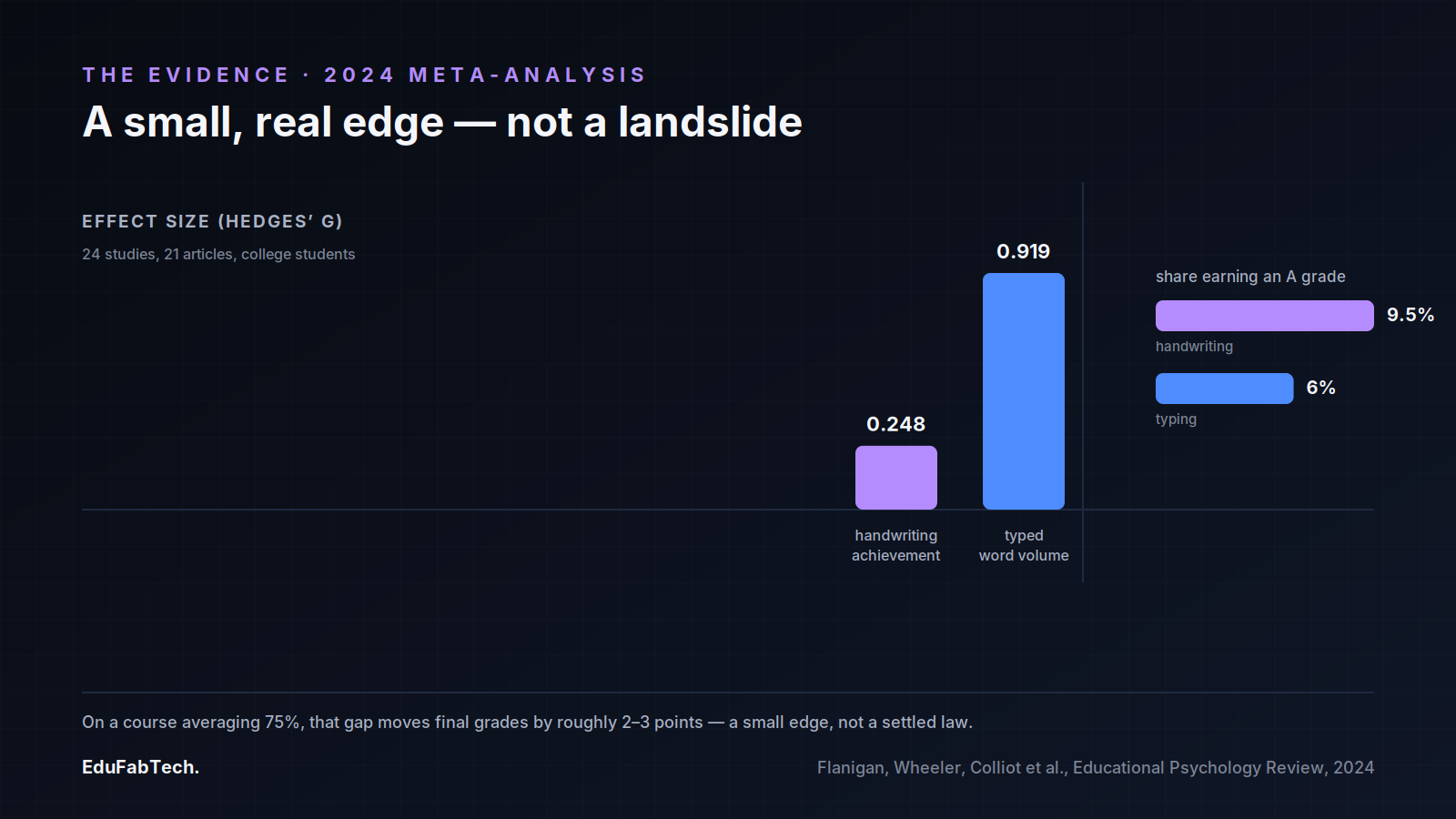
The meta-analysis found a real but modest achievement advantage for taking and reviewing handwritten notes, reported as a Hedges' g of 0.248, against a much larger advantage for typed notes in sheer volume of material recorded, at a Hedges' g of 0.919. Translated into a worked example by the authors, a course with an average grade of 75% and a standard deviation of 10% would see average grades shift by roughly 2 to 3 percentage points in favour of handwriting. The Learning Scientists' summary of the same paper puts this in pass-rate terms: roughly 9.5% of handwriting note-takers earned A grades against roughly 6% of typists, in the pooled sample.
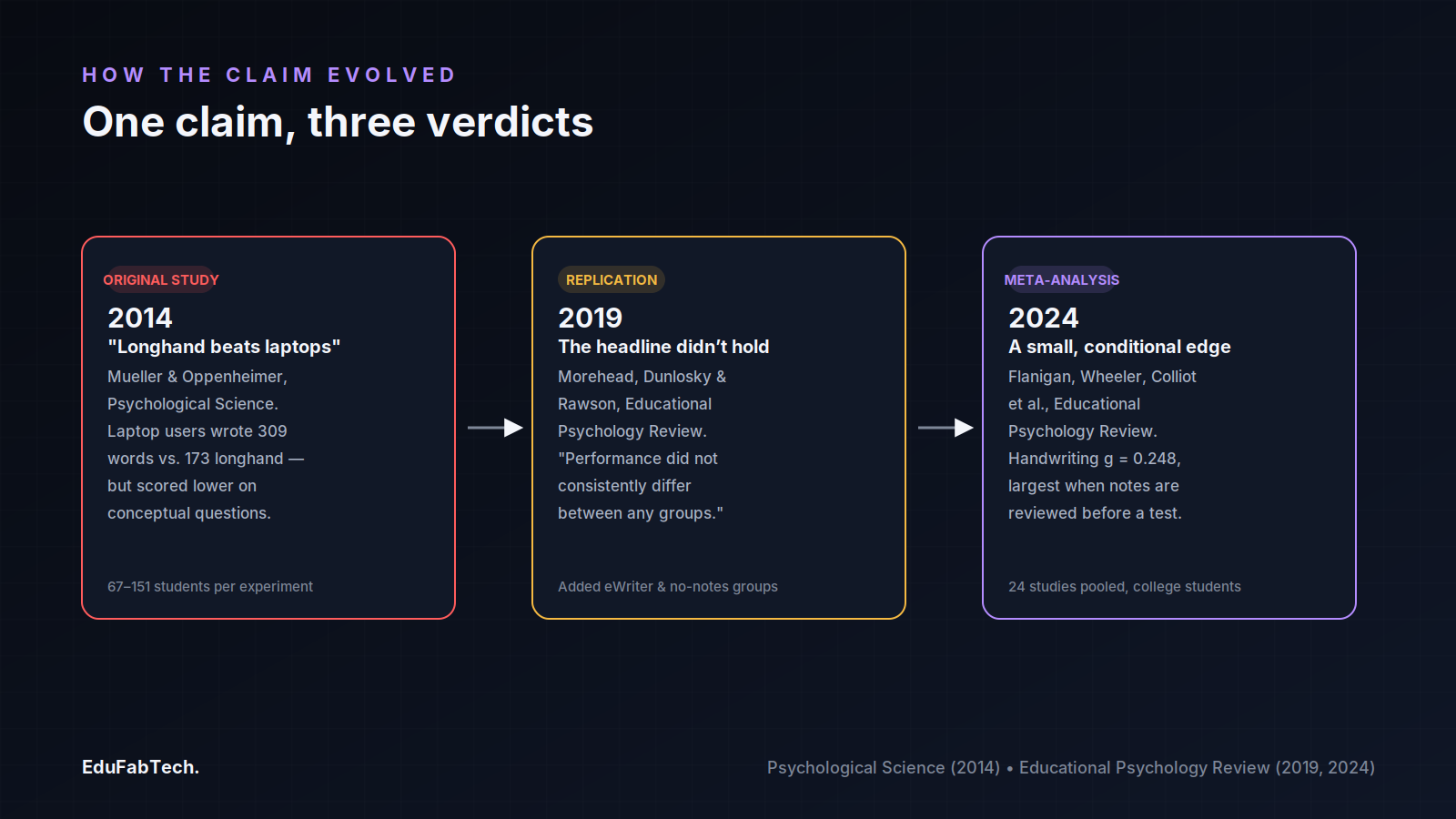
Two details inside that 2024 meta-analysis matter more than the headline number. First, per The Learning Scientists' account of the moderator analysis, the handwriting advantage grew when students had the opportunity to review their notes before being tested, and did not vary significantly by whether the test was immediate or delayed, or whether questions were factual or conceptual — a different pattern from the conceptual-only effect in the original 2014 study. Second, the authors themselves flag that their pooled studies cover college students only, not secondary or primary pupils, and that no study in their analysis, or any other known meta-analysis on note-taking medium, accounted for students with disabilities, which limits how far the 2.5-point grade shift can be generalised.
A popular claim the evidence does not support
Alongside the behavioural literature, a widely shared 2024 study is often cited as brain-level proof that handwriting is superior. Ruud Van der Weel and Audrey Van der Meer of the Norwegian University of Science and Technology published a high-density EEG study in Frontiers in Psychology finding that handwriting produced more widespread theta and alpha connectivity across brain regions than typing did. That finding is real, but it answers a narrower question than the headlines built on it suggest: the 36 university students in the task copied familiar words by hand or by typing, with no requirement to encode or later recall the material, so the study measured a pattern of brain connectivity during a motor-and-perceptual task, not a learning or memory outcome. Citing it as evidence that handwriting "helps you remember" extends the claim beyond what the experiment tested.
What follows for studying and teaching
Laid against each other, the three strands of evidence sit at different levels of confidence. The original 2014 conceptual-recall advantage is a single study whose central finding did not reproduce in the 2019 replication. The 2024 meta-analysis is the closest thing to a replicated, aggregated signal, and it says the handwriting advantage is small, driven partly by whether notes get reviewed afterward, and specific to the college students sampled. The EEG connectivity finding, however striking as neuroscience, has not been linked to any learning outcome and should not be read as settling the practical question.
For students, the more defensible takeaway is not "always write by hand," but "the note-taking method matters less than what happens to the notes afterward." A format that produces notes nobody reviews is weaker than either method used well. For teachers deciding whether to restrict laptops in lecture halls, the 2024 meta-analysis gives a legitimate, modest reason to prefer handwriting when the course rewards synthesis over sheer coverage — while the Morehead et al. replication is a reminder that the stronger, more dramatic version of that claim already failed to hold up once somebody tried to repeat it under tighter conditions.
The broader pattern is also a case study in how a nuanced finding becomes a slogan. Mueller and Oppenheimer's own framing was about transcription versus generative processing, a mechanism that could, in principle, be achieved by typing more slowly or more selectively. What travelled through classrooms and advice pages was a flatter claim about pens being better than keyboards — one that a later replication, and then a meta-analysis, both treat as weaker and more conditional than the version that made the story spread in the first place.
A quick question for readers
Which study method makes things stick for you until the exam?
Research says some methods work far better than others. Vote first, then see whether students agree with the evidence.
Pick an answer, create a free account in a minute, and your vote counts. Already a member? Sign in
Comments 2
Comment-
The part worth sitting on is the EEG study getting cited as brain proof when it never tested memory at all - 36 students copying familiar wo…
-
The EEG study is the one that annoys me most here, not because the finding is wrong but because of what it's being asked to do. Thirty-six s…
Join free to read the full comments and reply Comments are between members; an account takes a minute.
Source: Educational Psychology Review
Sources (4)
- Pam A. Mueller, Daniel M. Oppenheimer. The Pen Is Mightier Than the Keyboard: Advantages of Longhand Over Laptop Note Taking. Psychological Science, 2014. journals.sagepub.com ↗ · checked 23 Nov 2026
- Kayla Morehead, John Dunlosky, Katherine A. Rawson. How Much Mightier Is the Pen than the Keyboard for Note-Taking? A Replication and Extension of Mueller and Oppenheimer (2014). Educational Psychology Review, 2019. eric.ed.gov ↗ · checked 23 Nov 2026
- Abraham E. Flanigan, Jordan Wheeler, Tiphaine Colliot, et al.. Typed Versus Handwritten Lecture Notes and College Student Achievement: A Meta-Analysis. Educational Psychology Review, 2024. link.springer.com ↗ · checked 23 Nov 2026
- F. R. (Ruud) Van der Weel, Audrey L. H. Van der Meer. Handwriting but not Typewriting Leads to Widespread Brain Connectivity: A High-Density EEG Study With Implications for the Classroom. Frontiers in Psychology, 2024. frontiersin.org ↗ · checked 23 Nov 2026