Retrieval, Spacing and Interleaving: What Learning-Science Evidence Actually Supports
Meta-analyses back testing and spaced practice; interleaving and single classroom trials show promise with caveats; learning styles remain unsupported by controlled evidence.

Ask a group of students how they study, and most will describe rereading notes, highlighting a textbook, or cramming the night before an exam. Ask a cognitive psychologist which techniques actually produce durable learning, and the answer looks different. Over the past two decades, a body of controlled experiments and meta-analyses has built up around a small number of techniques that reliably improve long-term retention, a somewhat larger set of techniques that help under specific conditions, and at least one widely believed claim about learning that controlled research has not supported. Sorting these three categories out matters, because they are often discussed as if they carry the same weight.
The clearest guide to this sorting is a 2013 monograph in Psychological Science in the Public Interest by John Dunlosky, Katherine Rawson, Elizabeth Marsh, Mitchell Nathan and Daniel Willingham, who reviewed ten commonly used study techniques against the available experimental evidence and rated each for utility. Two techniques — practice testing and distributed (spaced) practice — received the authors' highest utility rating, meaning the effects generalize across learners, materials and settings and are supported by many independent studies. Five others, including elaborative interrogation and self-explanation, were rated moderate. Three — summarization, highlighting and rereading — were rated low, not because they never help, but because the controlled studies the authors examined mostly failed to show benefits beyond less effortful or longer baseline reading.
What replicates: testing and spacing
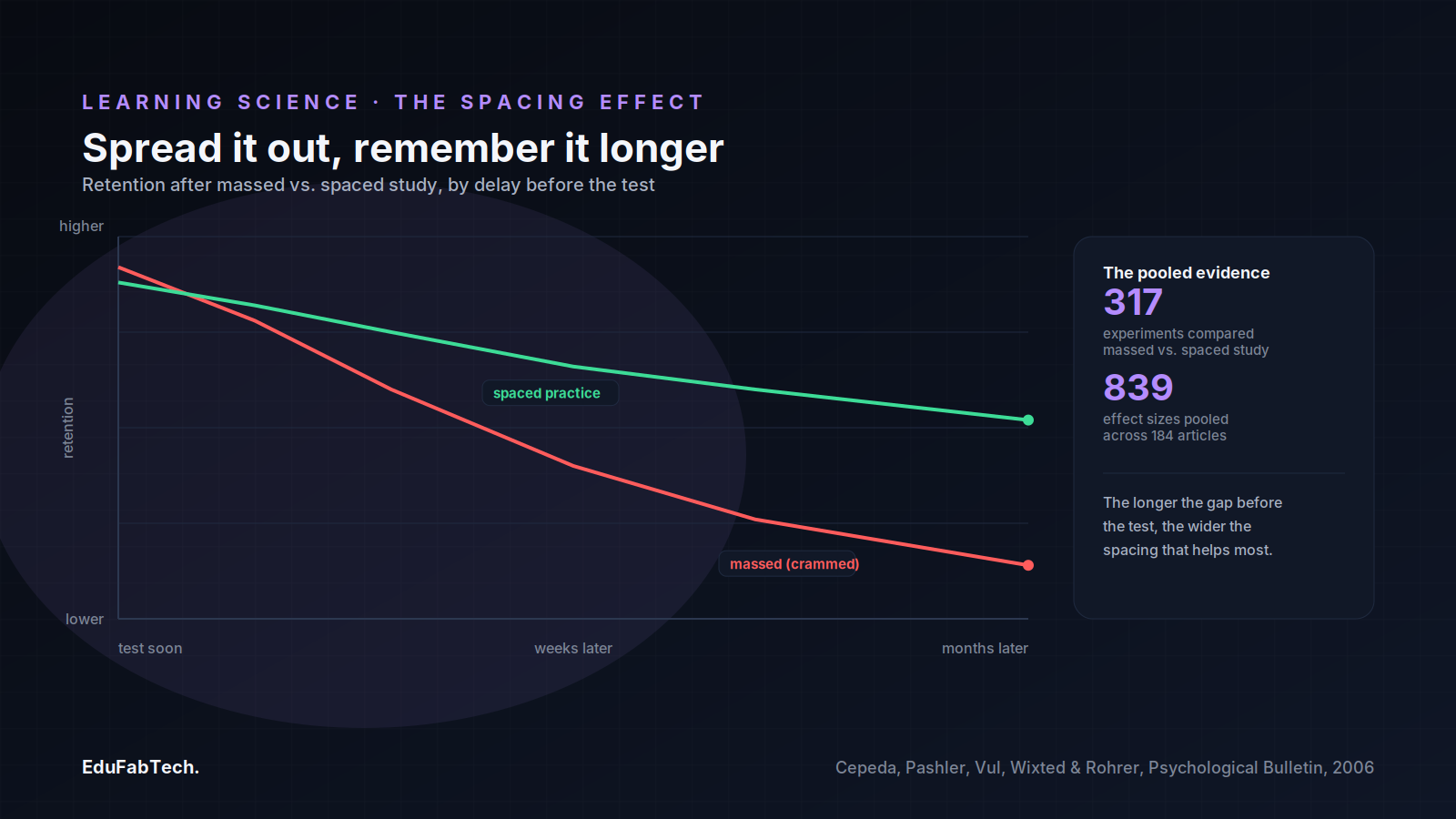
Spacing is the best-replicated finding in this literature. A 2006 meta-analysis in Psychological Bulletin by Nicholas Cepeda, Harold Pashler, Edward Vul, John Wixted and Doug Rohrer pooled 839 effect-size estimates from 317 experiments reported in 184 articles, comparing massed study (reviewing material in one sitting) against the same material studied across separated sessions. The spacing advantage held across verbal memory tasks of many kinds, and the analysis showed something more specific: the gap between study sessions that produces the best long-term retention grows larger as the delay before the final test grows longer. In practice, this means cramming the night before a test can still produce decent short-term recall, but the same hours spread across days or weeks produce better retention weeks or months later — and the optimal gap depends on how long the material needs to be remembered, not on a fixed rule like "study every three days."
Retrieval practice — testing yourself on material rather than re-reading it — has a similarly strong base, though the single most cited demonstration is one study rather than a meta-analysis. Jeffrey Karpicke and Janell Blunt, writing in Science in 2011, had college students study short science texts either by building concept maps while the text remained visible, or by reading the text once and then writing down everything they could recall from memory, repeated without seeing the text again. A week later, the group who had practiced free recall outperformed the concept-mapping group on a test of both factual retention and the ability to draw inferences, a result the authors attributed to retrieval itself altering memory, not merely to additional exposure to the material. That single study does not stand alone — Dunlosky and colleagues' 2013 review cites dozens of practice-testing experiments reaching broadly similar conclusions — but it is worth naming as the study most commonly invoked for the finding, and recognizing it as one experiment among many rather than a standalone proof.
Together, spacing and retrieval practice make up the part of this literature where a researcher can say "this replicates" without much hedging: multiple independent labs, different materials (word lists, science texts, foreign-language vocabulary, medical knowledge), and different measures of retention converge on the same conclusion. That convergence is exactly what is missing from several other popular claims about learning.
Interleaving: real effects, narrower evidence base
Interleaving — mixing problem types during practice rather than working through one type at a time (blocking) — has a more interesting evidentiary status. It is intuitively appealing and has a plausible mechanism: interleaving forces learners to identify which method or formula applies to a given problem, a discrimination skill that blocked practice does not require. But the empirical base is thinner and more domain-specific than the base for spacing or testing. The most direct classroom evidence comes from Doug Rohrer, Robert Dedrick and Sandra Stershic's 2015 study in the Journal of Educational Psychology, which followed 126 seventh-grade students across a three-month unit, giving half of them practice sets with problem types blocked and half with the same problems interleaved. On tests given one day and then one month after the unit ended, the interleaved group scored substantially higher. That is a genuine, well-designed classroom trial — but it is one trial, in one subject (graphing and slope-related mathematics), at one grade level, in one school district. It supports interleaving as promising in mathematics instruction specifically; it does not establish that interleaving works the same way in history, language learning or motor skills, where the evidence is sparser and sometimes mixed. Readers should treat interleaving as a technique with a solid demonstration behind it rather than one with the multi-domain replication record that spacing and testing have.
Why rereading and highlighting feel productive anyway
If testing and spacing work this well, why do so many students reread and highlight instead? Robert Bjork, John Dunlosky and Nate Kornell addressed this directly in a 2013 Annual Review of Psychology article on self-regulated learning, arguing that learners judge how well they are learning by how fluent the material feels in the moment, not by how well they will recall it later. Rereading a passage makes it feel more familiar each time, and that rising fluency is easy to mistake for growing knowledge. Retrieval practice feels harder — because it is harder, in a way that is doing cognitive work — and that difficulty is routinely misread as a sign that it is not working. Bjork and colleagues call this a case where the subjective sense of learning and the objective fact of learning point in opposite directions, and it is a large part of why effective techniques are underused: they do not feel as good while you are doing them.

This is also why the low ratings for highlighting and rereading in Dunlosky and colleagues' 2013 review are worth taking at face value rather than as a dismissal of all low-effort techniques. The authors did not find that highlighting never helps; they found that, across the controlled comparisons available to them, highlighting rarely outperformed simply reading the same material again, and sometimes underperformed it, particularly when learners highlighted too much text for it to be a useful cue for later review. The technique is not harmful so much as a relatively weak use of study time compared with the alternatives sitting right next to it in the same review.
The claim the evidence does not support: learning styles
Among popular beliefs about learning, the "learning styles" hypothesis — the idea that each student has a preferred mode (visual, auditory, kinesthetic, and so on) and learns best when instruction is matched to it — occupies a different category from spacing or interleaving. It is not a technique with thin evidence; it is a specific, testable claim that has been tested and has not held up. Harold Pashler, Mark McDaniel, Doug Rohrer and Robert Bjork reviewed the literature in a 2008 Psychological Science in the Public Interest article and set out exactly what evidence would be needed to support the hypothesis: a study would need to classify learners by style, randomly assign them to be taught in a matched or mismatched way, and show that matched instruction produced better outcomes than mismatched instruction for each style category — a crossover pattern, not just an overall preference. Searching for studies meeting that design, the authors found almost none that used an adequate method, and the few that did found no such crossover effect. Their conclusion was not that people lack preferences about how they like to study — many clearly do — but that matching instruction to a stated preference does not improve learning outcomes in the controlled studies available. This claim remains in wide circulation in teacher training and corporate learning-and-development material nearly two decades later, which makes it a useful case study in how a plausible, appealing idea can outlast the evidence against it.
Reading this evidence by its kind, not just its conclusion
The sections above are not equally certain, and treating them as equally certain is itself a common error. Spaced practice rests on a meta-analysis covering hundreds of experiments; retrieval practice rests on a comparably large and consistent body of work, anchored by widely cited single studies such as Karpicke and Blunt's; interleaving rests on a smaller number of well-designed studies concentrated in mathematics; and the rejection of learning-styles matching rests on an absence of supporting evidence after a systematic search for it, which is a different kind of finding from a positive effect. A student or teacher deciding how to allocate study or class time is on firmest ground adopting spaced review and frequent low-stakes retrieval practice, reasonably solid ground experimenting with interleaved problem sets in quantitative subjects, and on no ground at all trying to diagnose a "learning style" and teach or study to it.
None of this amounts to a claim that cognitive psychology has solved learning. Dunlosky and colleagues were explicit in 2013 that several techniques — interleaving among them, at that point — needed more research before utility ratings could be assigned with confidence, and the subsequent decade of work, including the Rohrer classroom trial, has filled in some but not all of that gap. What the accumulated record supports is a working distinction: some techniques have been tested enough times, in enough settings, by enough independent groups, that betting on them is reasonable; others have one or two good demonstrations that justify trying them without yet justifying a universal recommendation; and at least one widely taught idea has been looked for directly and not found. Knowing which category a given claim about learning falls into is itself worth practicing — ideally with retrieval, spaced out over time, rather than read once and set aside.
A quick question for readers
Which study method makes things stick for you until the exam?
Research says some methods work far better than others. Vote first, then see whether students agree with the evidence.
Pick an answer, create a free account in a minute, and your vote counts. Already a member? Sign in
Source: Psychological Science in the Public Interest (Dunlosky et al.)
Sources (5)
- Dunlosky, J., Rawson, K.A., Marsh, E.J., Nathan, M.J., Willingham, D.T.. Improving Students' Learning With Effective Learning Techniques. Psychological Science in the Public Interest, 2013. journals.sagepub.com ↗ · checked 5 Oct 2026
- Cepeda, N.J., Pashler, H., Vul, E., Wixted, J.T., Rohrer, D.. Distributed Practice in Verbal Recall Tasks: A Review and Quantitative Synthesis. Psychological Bulletin, 2006. doi.org ↗ · checked 5 Oct 2026
- Karpicke, J.D., Blunt, J.R.. Retrieval Practice Produces More Learning than Elaborative Studying with Concept Mapping. Science, 2011. science.org ↗ · checked 5 Oct 2026
- Rohrer, D., Dedrick, R.F., Stershic, S.. Interleaved Practice Improves Mathematics Learning. Journal of Educational Psychology, 2015. doi.org ↗ · checked 5 Oct 2026
- Pashler, H., McDaniel, M., Rohrer, D., Bjork, R.. Learning Styles: Concepts and Evidence. Psychological Science in the Public Interest, 2008. doi.org ↗ · checked 5 Oct 2026