Learning Styles: 2025 Review of 17 Meta-Analyses Puts the Matching Effect Near Zero
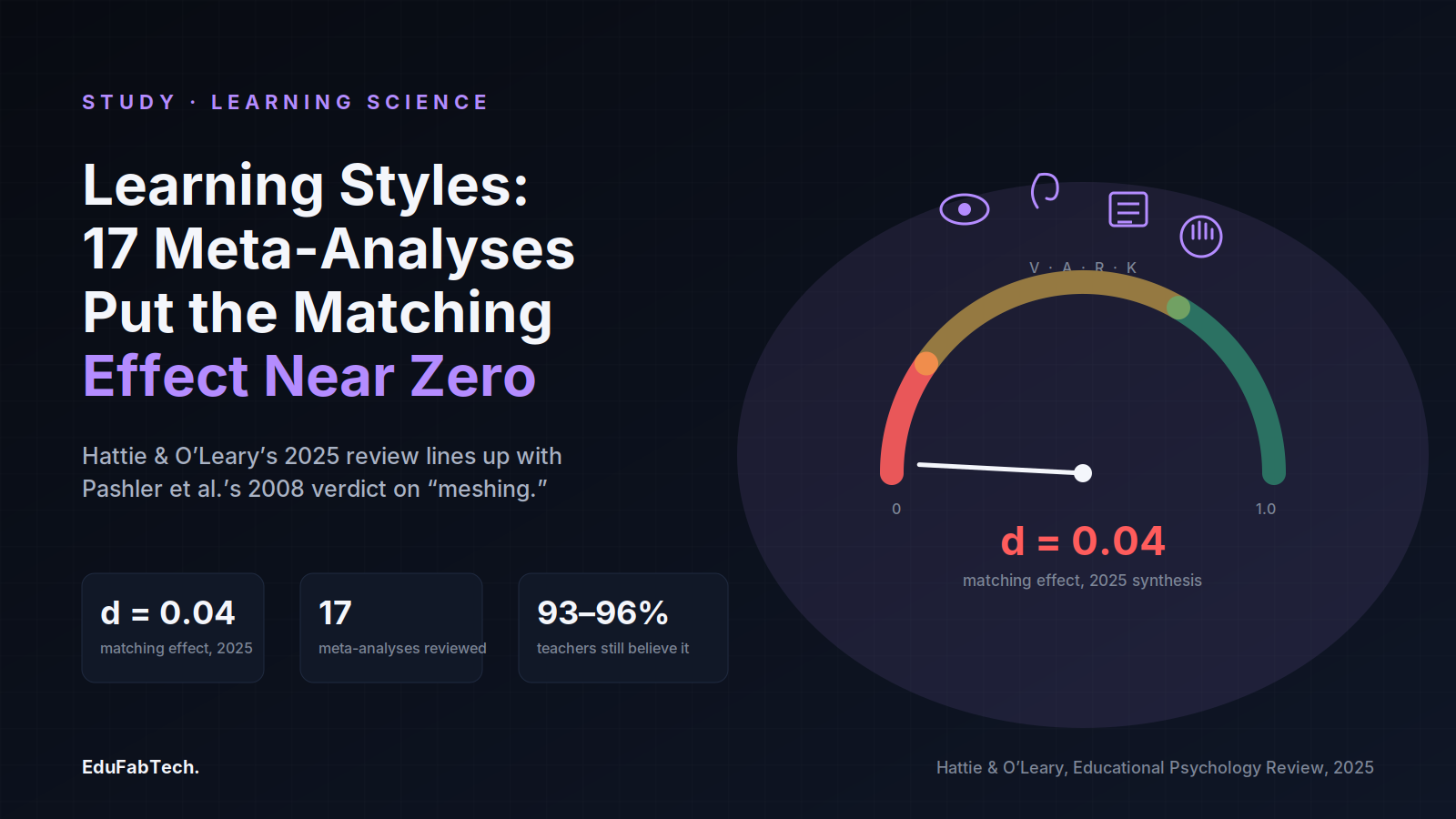
Hattie and O'Leary's 2025 synthesis lands close to Pashler et al.'s 2008 verdict on "meshing," even as a 2024 meta-analysis found a small, heavily caveated benefit and most surveyed teachers still believe the opposite.
A model almost every teacher has heard of
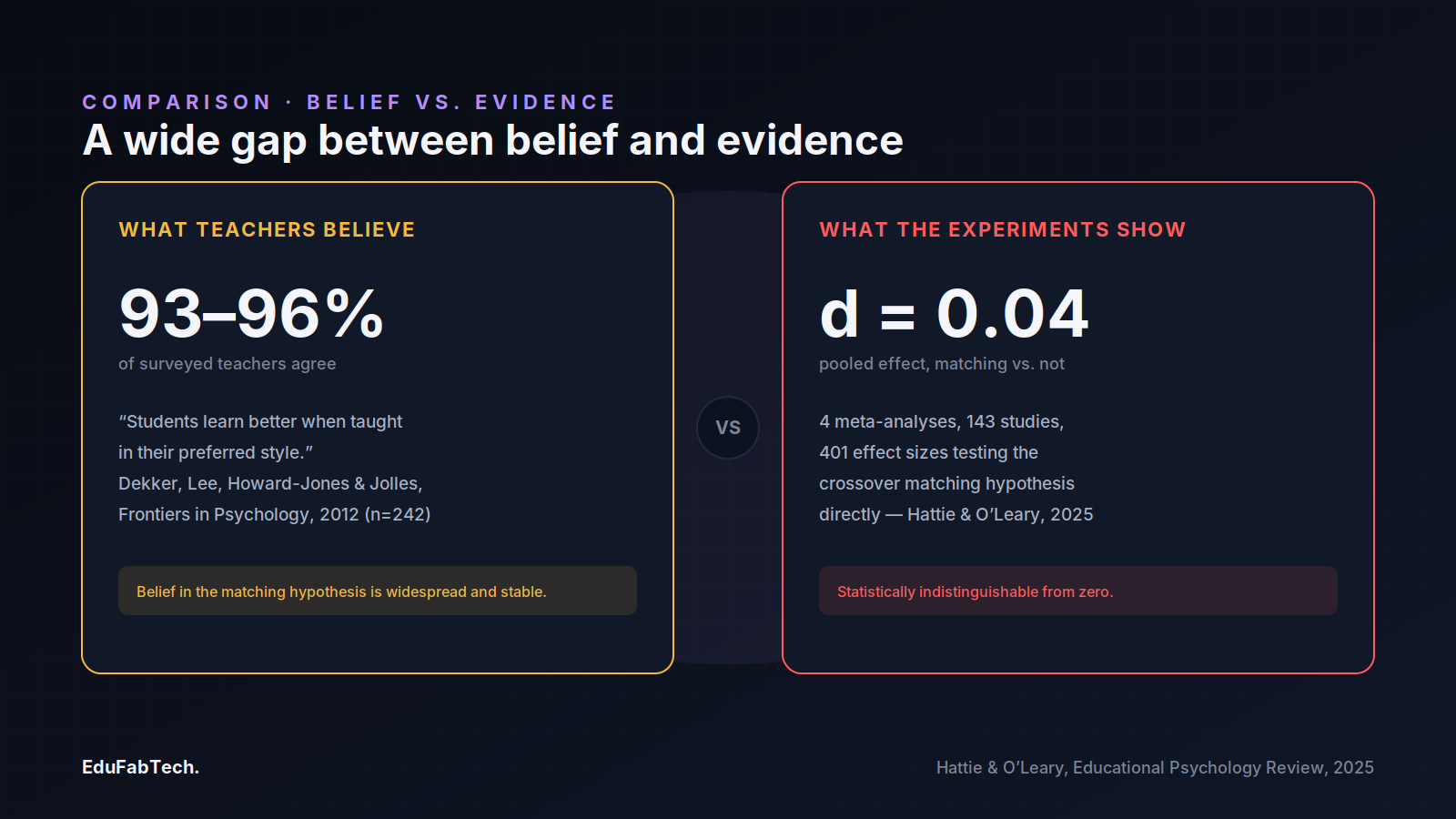
Ask a room of teachers whether some students learn best from pictures, others from listening and others from moving and doing, and most will say yes. In a survey of 242 teachers in the United Kingdom and the Netherlands, 93% of UK respondents and 96% of Dutch respondents agreed with the statement "individuals learn better when they receive information in their preferred learning style (e.g., visual, auditory, kinesthetic)," according to Dekker, Lee, Howard-Jones and Jolles, writing in Frontiers in Psychology (2012).
The claim behind that belief has a name: the "meshing" or "matching" hypothesis. It holds that students have a stable, identifiable style — commonly reduced to visual, auditory, read/write and kinesthetic (VARK), after a scheme proposed by Neil Fleming — and that instruction tailored to that style produces better learning than instruction that ignores it. That is a stronger and more specific claim than simply noting that people have preferences, or that some content suits a diagram better than a paragraph. It says matching the format of teaching to the format a student prefers changes how much they learn.
That specific claim has now been tested, reviewed and re-reviewed across almost two decades. The most recent synthesis, published in 2025, lands close to where the first major review landed in 2008 — even though a widely cited meta-analysis in between found something that looked, briefly, like support.
The bar the evidence has to clear
The 2008 review, by Harold Pashler, Mark McDaniel, Doug Rohrer and Robert Bjork in Psychological Science in the Public Interest, set out exactly what evidence would have to look like to support the matching hypothesis. It required what the authors called a crossover interaction: students of one style must learn best under one instructional method, while students of a different style must learn best under a different method — not just that everyone benefits somewhat from one format. Reviewing the available experiments against that standard, the authors concluded that "at present, there is no adequate evidence base to justify incorporating learning-styles assessments into general educational practice."
Doug Rohrer and Hal Pashler returned to the question in a shorter piece in Medical Education (2012), aimed at health-professions educators who were adopting style inventories in curricula. Their point was not that visual-spatial or verbal ability doesn't vary between students — it clearly does — but that this variation does not imply a student with weaker visual-spatial skill will learn anatomy better from a textbook with fewer diagrams. Ability differences and style-matching benefits are not the same claim, and only the second one had been tested and found wanting.
Why the belief persists anyway
The Dekker et al. (2012) survey that opened this piece wasn't only about learning styles. Teachers were shown 32 statements about the brain and learning, 15 of which were myths, and asked to mark each correct or incorrect. On average, teachers in the sample agreed with 49% of the mythical statements. Learning styles and hemispheric "left-brain, right-brain" dominance were among the myths with the highest acceptance, each drawn with over 80% agreement. The authors also noted that teachers with more general background knowledge about the brain were not reliably better at rejecting the myths — belief in neuromyths correlated positively, not negatively, with general brain knowledge in their sample, which they linked to the appeal of commercialized educational programs built around style-matching.
A 2024 meta-analysis complicates, but doesn't overturn, the verdict
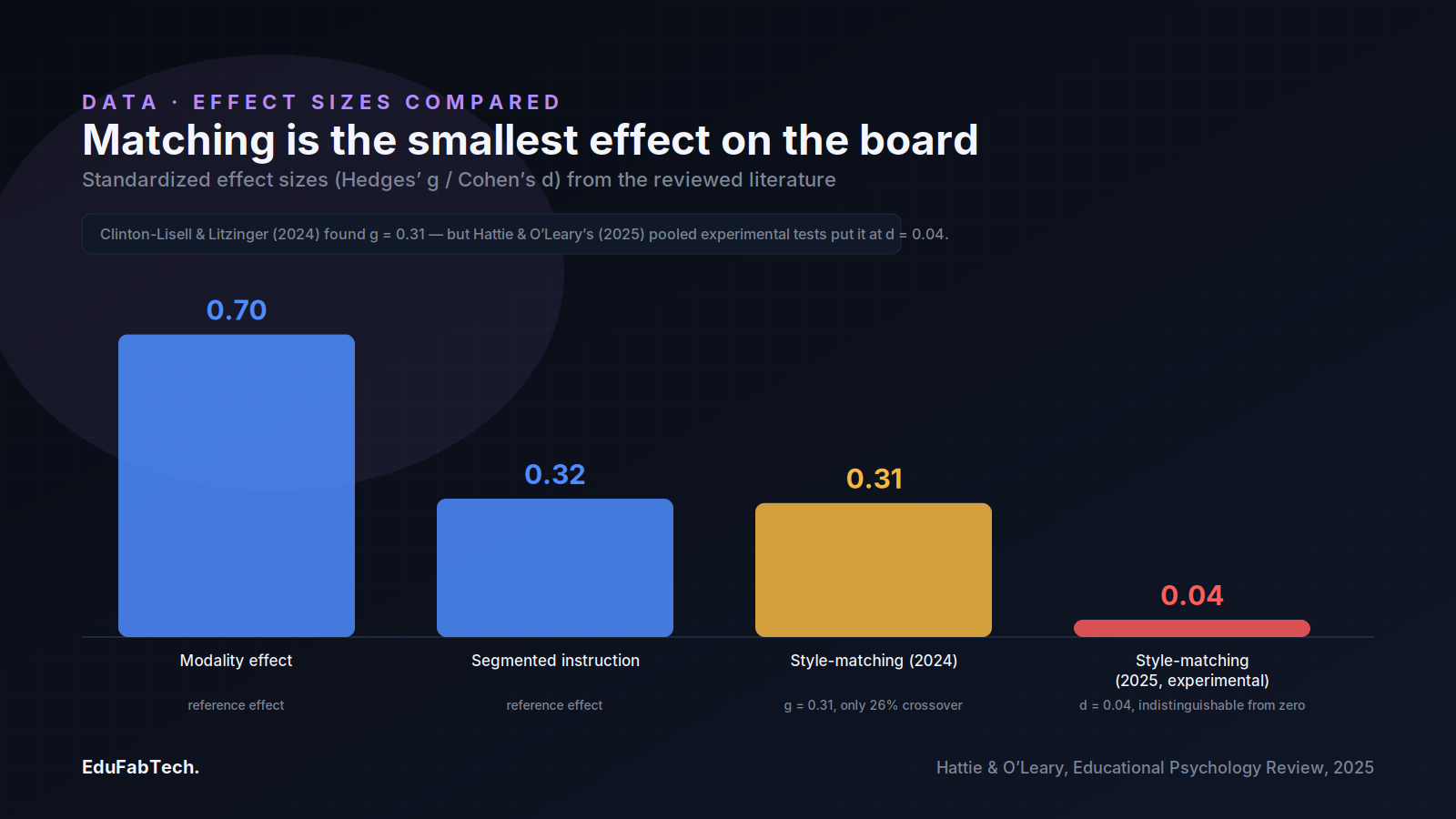
The clearest challenge to the 2008 consensus came from Virginia Clinton-Lisell and Christine Litzinger, writing in Frontiers in Psychology (2024). Pooling 21 studies with 101 effect sizes and 1,712 participants, they found a small but statistically significant overall benefit from matching instruction to a measured style: Hedges' g = 0.31.
Read past the headline number and the caveats pile up quickly. Only 26% of the outcome measures in the pooled studies actually showed the crossover pattern that Pashler and colleagues said was required to validate the hypothesis — most of the positive effect came from designs where everyone, regardless of style, did somewhat better under one format, which is a different and much weaker claim. Clinton-Lisell and Litzinger also report that 85% of the studies in their pool excluded some participants from the final analysis because those participants' learning-style scores couldn't be confidently categorized as matched or unmatched to instruction. And set against other instructional effects measured in education research, g = 0.31 is modest: the authors note it falls below, for instance, the modality effect (0.70) and segmented instruction (0.32). Their own conclusion is carefully worded: style-matching benefits are "too small and too infrequent to warrant widespread adoption," and they recommend multimodal instruction — presenting material through multiple formats to all students, rather than sorting students by label — as achieving comparable gains without the sorting.
Seventeen meta-analyses later: the 2025 synthesis
The most recent word on the topic comes from John Hattie and Tim O'Leary, writing in Educational Psychology Review (2025), who drew on 17 meta-analyses to separate two kinds of evidence that the literature had been blending together. Four of those meta-analyses, covering 143 studies and 401 effect sizes, directly tested the matching hypothesis using experimental designs; pooled, they produced an effect size of d = 0.04 — statistically indistinguishable from zero, and in line with the 2008 verdict. A separate body of correlational studies, which simply asked whether a measured style preference correlated with achievement without manipulating instruction, averaged r = 0.24. Hattie and O'Leary argue that this second, larger number is what keeps the myth alive in reviews and textbooks, because correlational studies routinely conflate a fixed "style" with a learned, adaptable "strategy" — and strategies, unlike styles, really do predict achievement.
Their proposed fix is conceptual rather than just statistical: stop asking whether a student is a "visual learner" and start asking whether a student has the strategies to match a given task's demands — switching between visual, verbal or hands-on approaches as the material requires, rather than sticking to one preferred mode. That reframing treats learning approach as something taught and adjusted, not diagnosed and fixed.
Three bodies of evidence, three different weights
Lined up together, the learning-styles literature is a useful illustration of how to read competing claims in education research. The teacher-survey numbers from Dekker et al. (2012) describe a popular belief, not a tested effect — widespread agreement is evidence of a belief's reach, not its accuracy. The Clinton-Lisell and Litzinger (2024) meta-analysis is a single, carefully caveated synthesis that found a real but small and methodologically fragile effect, the kind of result that calls for replication before it changes practice. The Pashler et al. (2008) and Hattie and O'Leary (2025) reviews, taken together, are closer to a replicated finding: two independent reviews, seventeen years apart, using different and sometimes larger sets of meta-analyses, converging on an effect close to zero for the specific claim that matching instructional format to a measured style improves learning.
| Source | Year | What was measured | Result |
|---|---|---|---|
| Pashler, McDaniel, Rohrer & Bjork | 2008 | Crossover-interaction studies testing matching | No adequate evidence base for matching |
| Dekker, Lee, Howard-Jones & Jolles | 2012 | Teacher belief (242 teachers, UK & Netherlands) | 93–96% agreement with the matching claim |
| Clinton-Lisell & Litzinger | 2024 | 21 studies, 101 effect sizes, 1,712 participants | Hedges' g = 0.31, but only 26% showed crossover |
| Hattie & O'Leary | 2025 | 4 meta-analyses, 143 studies, 401 effects (matching only) | d = 0.04, indistinguishable from zero |
What follows for studying and teaching
None of this means format doesn't matter, or that diagrams, narration and hands-on demonstration are interchangeable. It means the specific claim worth retiring is narrower than it sounds: that sorting a student into a visual, auditory or kinesthetic category and then matching instruction to that label changes how much they learn. The evidence reviewed by Pashler et al. (2008) and Hattie and O'Leary (2025) does not support administering a style inventory and planning lessons around its result.
- Clinton-Lisell and Litzinger's (2024) own recommendation is multimodal instruction for everyone — presenting the same material through more than one format — rather than style-based grouping, since it produces comparable benefit without the sorting.
- Hattie and O'Leary's (2025) recommendation is to teach flexible strategies matched to what a task demands — switching to a diagram for spatial content, to worked examples for procedural content — rather than treating a student's preferred mode as fixed.
- Where content genuinely has a visual or spatial structure, present it visually for everyone; where it is sequential or verbal, present it that way for everyone. The decision follows the material, not a label attached to the learner.
For students allocating study time, the practical upshot is that choosing a study method because it matches a self-identified "style" has no demonstrated advantage over choosing a method suited to the material and the task — a weaker, more mundane-sounding rule, but one actually backed by the studies that have tested it directly.
A quick question for readers
Are group projects good for learning?
Loved by some, dreaded by many. What is your real experience?
Pick an answer, create a free account in a minute, and your vote counts. Already a member? Sign in
Comments 3
Comment-
The part that would make me push back is the quiet shift inside Clinton-Lisell and Litzinger's own g = 0.31. Only 26% of their outcome measu…
-
The number that actually does work here is the split between d = 0.04 and r = 0.24, not the headline zero. Hattie and O'Leary are basically…
-
The number I'd put on the fridge is d = 0.04 from Hattie and O'Leary versus r = 0.24 from the correlational pile, because that gap is basica…
Join free to read the full comments and reply Comments are between members; an account takes a minute.
Source: Educational Psychology Review
Sources (5)
- Harold Pashler, Mark McDaniel, Doug Rohrer, Robert Bjork. Learning Styles: Concepts and Evidence. Psychological Science in the Public Interest, 2008. journals.sagepub.com ↗ · checked 16 Nov 2026
- Doug Rohrer, Hal Pashler. Learning styles: Where's the evidence?. Medical Education, 2012. digitalcommons.usf.edu ↗ · checked 16 Nov 2026
- Sanne Dekker, Nikki C. Lee, Paul Howard-Jones, Jelle Jolles. Neuromyths in Education: Prevalence and Predictors of Misconceptions Among Teachers. Frontiers in Psychology, 2012. frontiersin.org ↗ · checked 16 Nov 2026
- Virginia Clinton-Lisell, Christine Litzinger. Is it really a neuromyth? A meta-analysis of the learning styles matching hypothesis. Frontiers in Psychology, 2024. frontiersin.org ↗ · checked 16 Nov 2026
- John Hattie, Tim O'Leary. Learning Styles, Preferences, or Strategies? An Explanation for the Resurgence of Styles Across Many Meta-analyses. Educational Psychology Review, 2025. link.springer.com ↗ · checked 16 Nov 2026