Marry Early, Settle Down, Succeed? What Couples Research, Divorce Data and the WHO Say to University Students
Commitment helps, the certificate does not, and timing matters more than people think: what 1,621 students, 43 couples studies, 20 years of divorce data and the WHO's 2025 figures say about love at university, the traps, and how to choose.
Every campus has a version of the same argument. One side says: find the right person early, marry, and life falls into order; the degree gets finished, the job gets found, the drinking stops, and a formal commitment protects you from the worst of what relationships can do. The other side says: wait, nothing is more expensive than the wrong marriage at 22. Both sides are partly right, and the research is specific about which parts. This article sets out what the evidence says about commitment and student wellbeing, about the age at which marriage holds, about how to recognise a relationship that will last, and about whether formalising a relationship protects anyone from violence. The short version: commitment helps, the certificate does not, the calendar matters more than people think, and the safest relationship is the one you decided on rather than slid into.
What a committed relationship does for a student
The clearest evidence on students comes from a 2010 study of 1,621 undergraduates by Scott Braithwaite, Raquel Delevi and Frank Fincham, published in the journal Personal Relationships. Students in committed romantic relationships reported fewer mental health problems than single students, were less likely to be overweight, and engaged in less problematic substance use, including less binge drinking and less driving while intoxicated. The effect on mental health was small; the effect on risky behaviour was larger, and the authors found that risky behaviour explained much of the health difference. In plain terms, a committed relationship brought order to the week before it brought order to the mind. Note what the study did not measure: marriage. Married students were removed from the sample. The benefit belonged to commitment, not to the paperwork.
Evidence that relationships raise grades is thinner. The studies that exist are small, mostly single-campus, and point in both directions depending on the quality of the relationship and how much time it takes. The honest summary is that a good relationship removes some of the things that wreck a semester, and a bad one adds to them.
Timing: the twenties are not all the same
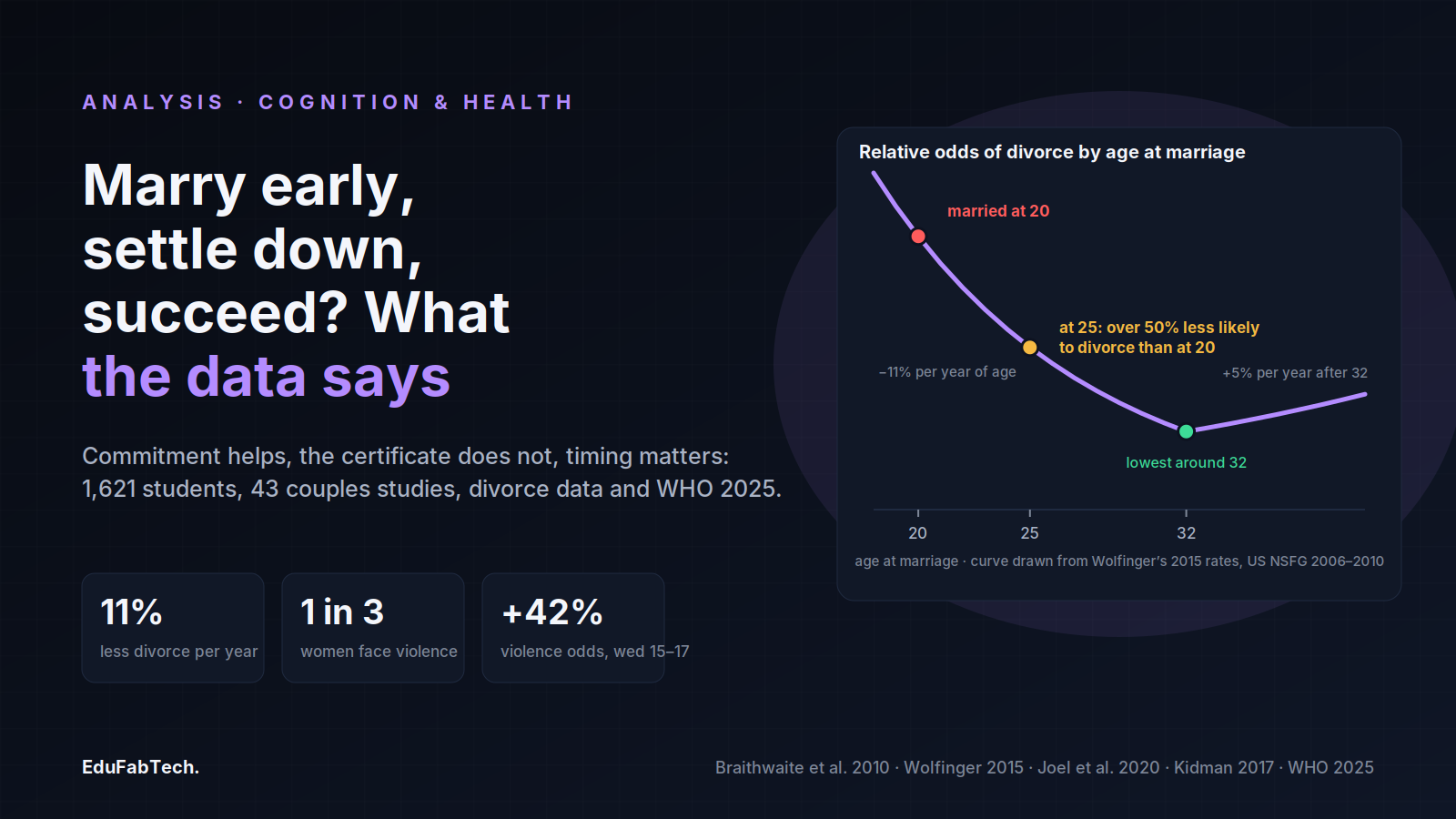
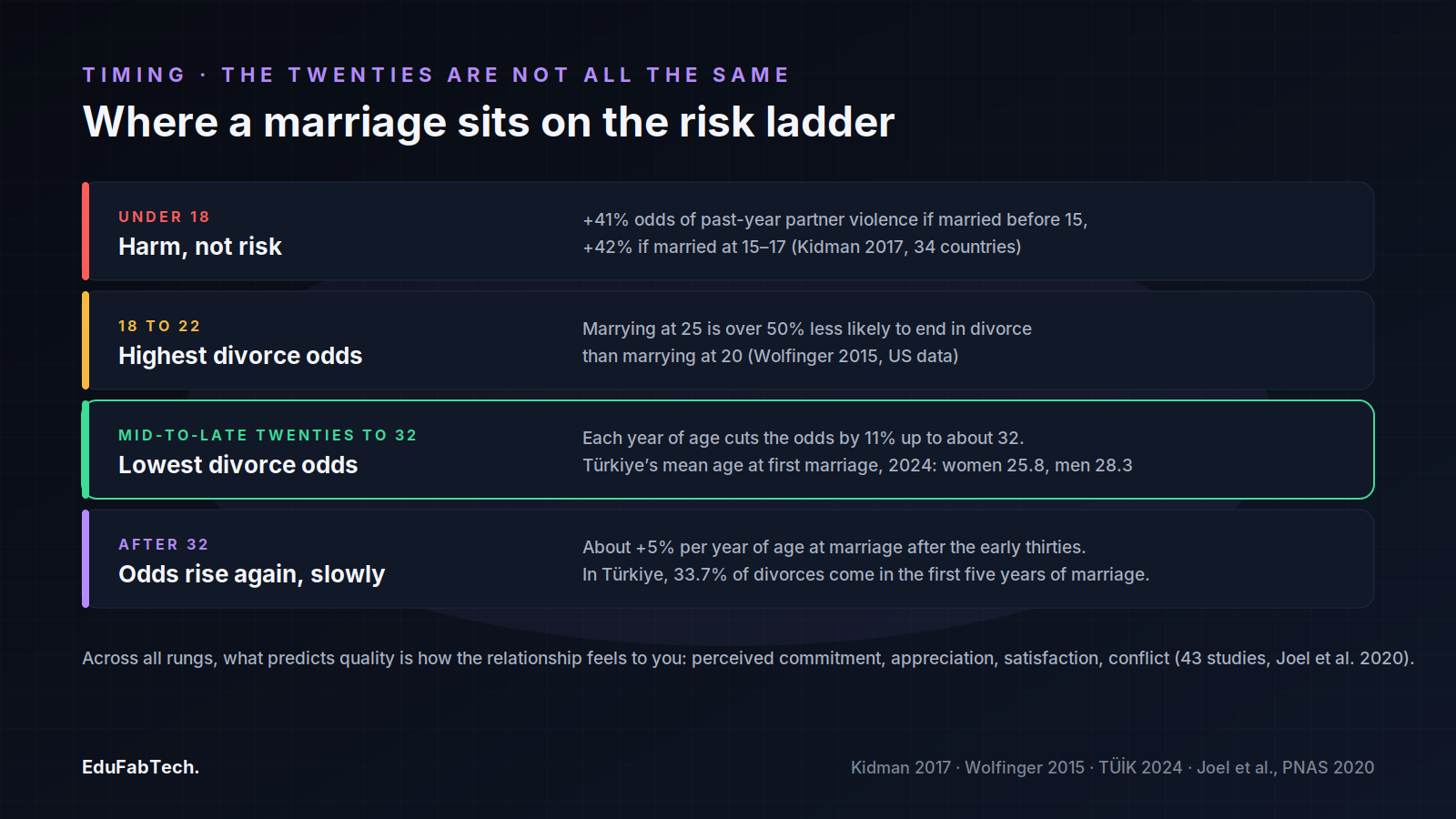
The strongest data on timing is American, and it is worth reading closely because the pattern is not what either side of the campus argument expects. In 2015 the sociologist Nicholas Wolfinger analysed the United States National Survey of Family Growth for 2006 to 2010 and found that each additional year of age at marriage cut the odds of divorce by 11 per cent, up to about age 32; after the early thirties the odds rose again by about 5 per cent per year. The practical comparison in his analysis: someone who marries at 25 is more than 50 per cent less likely to divorce than someone who marries at 20. The pattern held after controlling for sex, race, family background, education, religion and sexual history before marriage.
So "early" is the wrong word. Marrying at 20 and marrying at 27 are both early by the standards of most rich countries, and they carry very different risks. In Türkiye, to take one national example, the Turkish Statistical Institute reported that the mean age at first marriage in 2024 was 28.3 for men and 25.8 for women, with 187,343 divorces against 568,395 marriages, and 33.7 per cent of divorces happening within the first five years. A student who marries at 21 is marrying four to seven years before the national average, into the window where, on the American data, the divorce odds are at their highest.
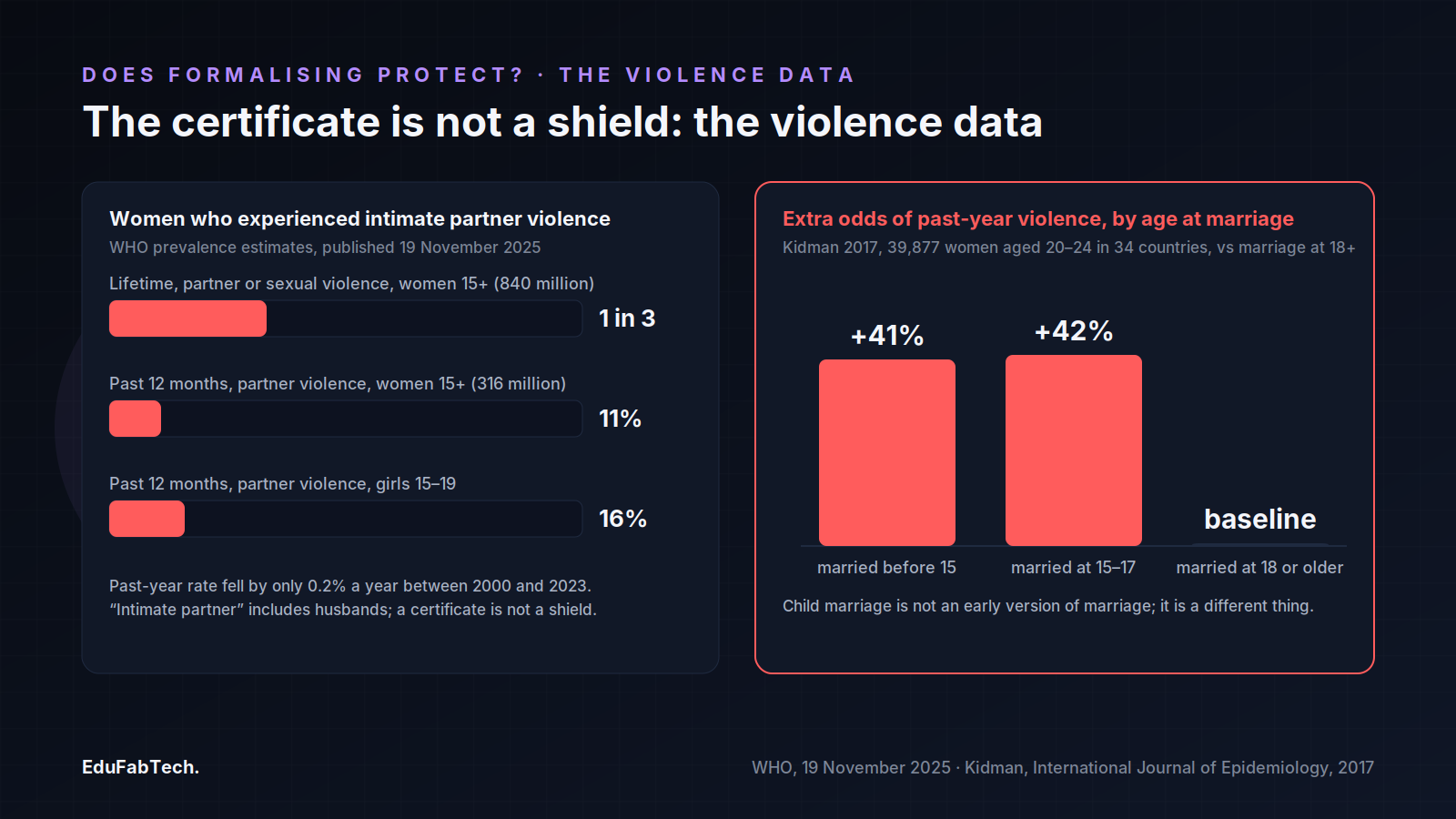
Below 18 the question changes from risk to harm. Rachel Kidman's 2017 study in the International Journal of Epidemiology, covering 39,877 married or cohabiting women aged 20 to 24 in 34 countries, found that women who married before 15 had 41 per cent higher odds of physical or sexual violence from their partner in the past year, and women who married at 15 to 17 had 42 per cent higher odds, compared with women who married as adults. Child marriage is not an early version of marriage. It is a different thing, and the law in most countries treats it that way.
Choosing: what predicts a relationship that lasts
The largest study of this question pooled 43 longitudinal couples studies from 29 laboratories and used machine learning to find which self-reported variables predicted relationship quality over time. Published in PNAS in 2020 by Samantha Joel and colleagues, it found that the strongest predictors were relationship-specific and belonged to the person answering: perceived partner commitment, appreciation, sexual satisfaction, perceived partner satisfaction and conflict. Relationship-specific variables explained 45 per cent of the variance in relationship quality at the start of the studies; individual traits explained 21 per cent; and a partner's own reports about themselves added nothing beyond what the person already perceived. The practical reading is the most useful sentence in this field: how you experience the relationship predicts its future better than who your partner is on paper.
That reverses the usual checklist. Income, family, looks, degree and city are the inputs people compare; the data says the outputs to watch are whether you believe your partner is committed, whether you feel appreciated, and how the two of you handle conflict. Those three can be observed in a year of dating. They cannot be observed in a résumé.
There is a second finding about choosing that matters for students specifically. In a 2006 paper in Family Relations, Scott Stanley, Galena Rhoades and Howard Markman proposed that the long-documented link between living together before marriage and later divorce is partly a matter of "sliding versus deciding": couples who drift into shared leases, shared finances and then marriage because leaving has become costly, rather than because they chose each other, carry that inertia into the marriage. Student life is built for sliding. A shared room is cheaper than two; a partner's city becomes your city; the wedding is the next step because every other step was.
The violence question: does formalising protect?
The argument that marriage protects against violence does not survive the data. The World Health Organization's prevalence estimates published on 19 November 2025 put the number of women who have experienced intimate partner or sexual violence in their lifetime at 840 million, nearly one in three women aged 15 and over; 316 million, 11 per cent, experienced physical or sexual violence from a partner in the past year alone, and among girls aged 15 to 19 the past-year figure was 16 per cent. The violence in those figures happens inside relationships, married ones included; "intimate partner" is the category. WHO also notes that the past-year rate fell by only 0.2 per cent a year between 2000 and 2023.
Formalising a relationship changes two things, and neither is the risk of violence. It raises the cost of leaving, which is exactly the inertia Stanley and colleagues describe, and in the worst case it turns a bad relationship into one that is legally and financially hard to exit. And for the youngest brides it raises the odds of violence outright, as Kidman's 34-country data shows. The factors that do protect are the opposite of inertia: an education that is finished rather than abandoned, an income of one's own, friends who were not dropped, and a relationship entered by decision. The warning signs are specific, and they are not the same as passion. WHO counts controlling behaviours among the forms of partner violence: a partner who monitors your phone, decides who you may see, controls your money, or makes jealousy the proof of love.
The traps, in the order students fall into them
- Marrying to leave. A dormitory, a family home or a shortage of money are reasons to move, not reasons to marry. A marriage chosen as an exit inherits the problem it was meant to escape and adds a second one.
- Sliding. Shared lease, shared bank account, shared pet, then a wedding "because it was time". Each step made the next one cheaper than its alternative. Ask at each step whether you would choose this person again from zero.
- Isolation. Friends who fade in the first year of a relationship are the people who would have noticed the warning signs in the second.
- Money before income. Debt taken on jointly at 21 outlives most relationships formed at 21.
- Unfinished degrees. When one partner's studies pause "for now", the pause has a way of becoming the biography; in the child-marriage data it is the girl's schooling that ends first.
- Jealousy read as devotion. It is the most common early form of control, and the most often forgiven.
A decision checklist built from the evidence
- Do I believe this person is committed to me? Not "do they say so", but do I believe it when I am alone.
- Do I feel appreciated most weeks, or mostly tolerated?
- When we disagree, do we end up closer, the same, or further apart? Conflict was a top-five predictor in 43 studies.
- Did we decide, or did we slide? List the last three steps the relationship took and who chose each one.
- Could each of us leave tomorrow without losing a home, an income, a degree or a passport? If not, that dependency is a risk, not a bond.
- Is either of us under 18? Then the answer is no; the minimum age in most countries is 18, and the 34-country data above is the reason.
- Where are we on the timing curve? Finishing the degree first and marrying in the mid-to-late twenties is, on the best data available, the lowest-risk path.
- Has anyone who loves me said they are worried? They are usually seeing something you have stopped seeing.
Order, the thing the campus argument is really about, turns out to come from commitment and from deciding, not from the ceremony and not from the calendar alone. A relationship that gives you fewer wrecked weeks, that you chose rather than drifted into, and that you could leave if you had to, is the one that helps a degree get finished. Tell us in the forum what the argument sounds like on your campus, and answer this week's question in the polls: would you marry before you graduate?
A quick question for readers
How much do you sleep on a typical night during exam weeks?
Sleep is when memory consolidates. How much are students actually getting when it matters most?
Pick an answer, create a free account in a minute, and your vote counts. Already a member? Sign in
Sources (5)
- Braithwaite, S. R.; Delevi, R.; Fincham, F. D.. Romantic relationships and the physical and mental health of college students. Personal Relationships, 2010. doi.org ↗ · checked 5 Oct 2026
- Wolfinger, N. H.. Want to Avoid Divorce? Wait to Get Married, But Not Too Long. Institute for Family Studies, 2015. ifstudies.org ↗ · checked 5 Oct 2026
- Kidman, R.. Child marriage and intimate partner violence: a comparative study of 34 countries. International Journal of Epidemiology, 2017. academic.oup.com ↗ · checked 5 Oct 2026
- Joel, S.; Eastwick, P. W.; et al.. Machine learning uncovers the most robust self-report predictors of relationship quality across 43 longitudinal couples studies. Proceedings of the National Academy of Sciences, 2020. escholarship.org ↗ · checked 5 Oct 2026
- World Health Organization. Lifetime toll: 840 million women faced partner or sexual violence. WHO, 2025. who.int ↗ · checked 5 Oct 2026