Studying in Meads, Kentucky: universities, housing and student life
A practical, sourced guide to living in Meads — a Boyd County community on the US-60 corridor between Marshall University in Huntington and Kentucky Christian University in Grayson.
A Boyd County community where three states nearly meet
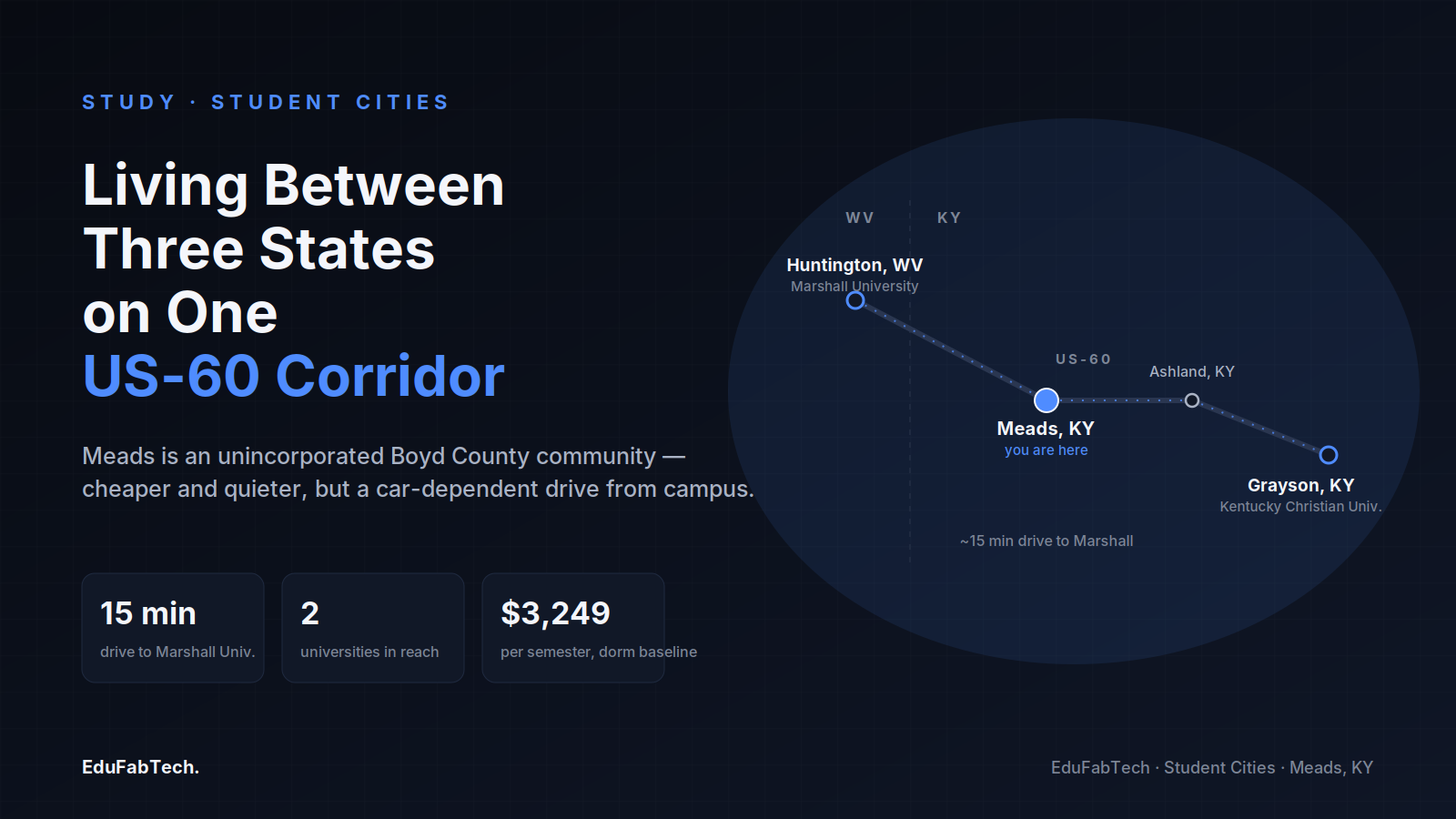
Meads is not a college town in its own right, and saying so plainly is the most useful thing a guide can do. It is an unincorporated community in Boyd County, Kentucky, strung along the U.S. Route 60 corridor just south of the city of Ashland, where the Rockdale subdivision on the hills and the Mead Station Plaza strip make up most of what you can point at. The name comes from a long-gone rail stop, Mead's station on the Chesapeake & Ohio line, now CSX freight track that still runs through. For a student, Meads matters because of where it sits rather than what it contains: it is inside the Huntington–Ashland metropolitan area, in the "Tri-State" corner where Kentucky, West Virginia and Ohio come together at the Ohio and Big Sandy rivers.
That position is the whole point. From a room in Meads you are roughly fifteen minutes by car from Marshall University in Huntington, West Virginia, across the state line to the north-west; you are a short drive into Ashland itself for shops, a hospital and the public library; and you are on the same US-60 that runs west to Grayson, home of Kentucky Christian University. People live in Meads precisely because it is cheaper and quieter than downtown Huntington while still being commutable to it.
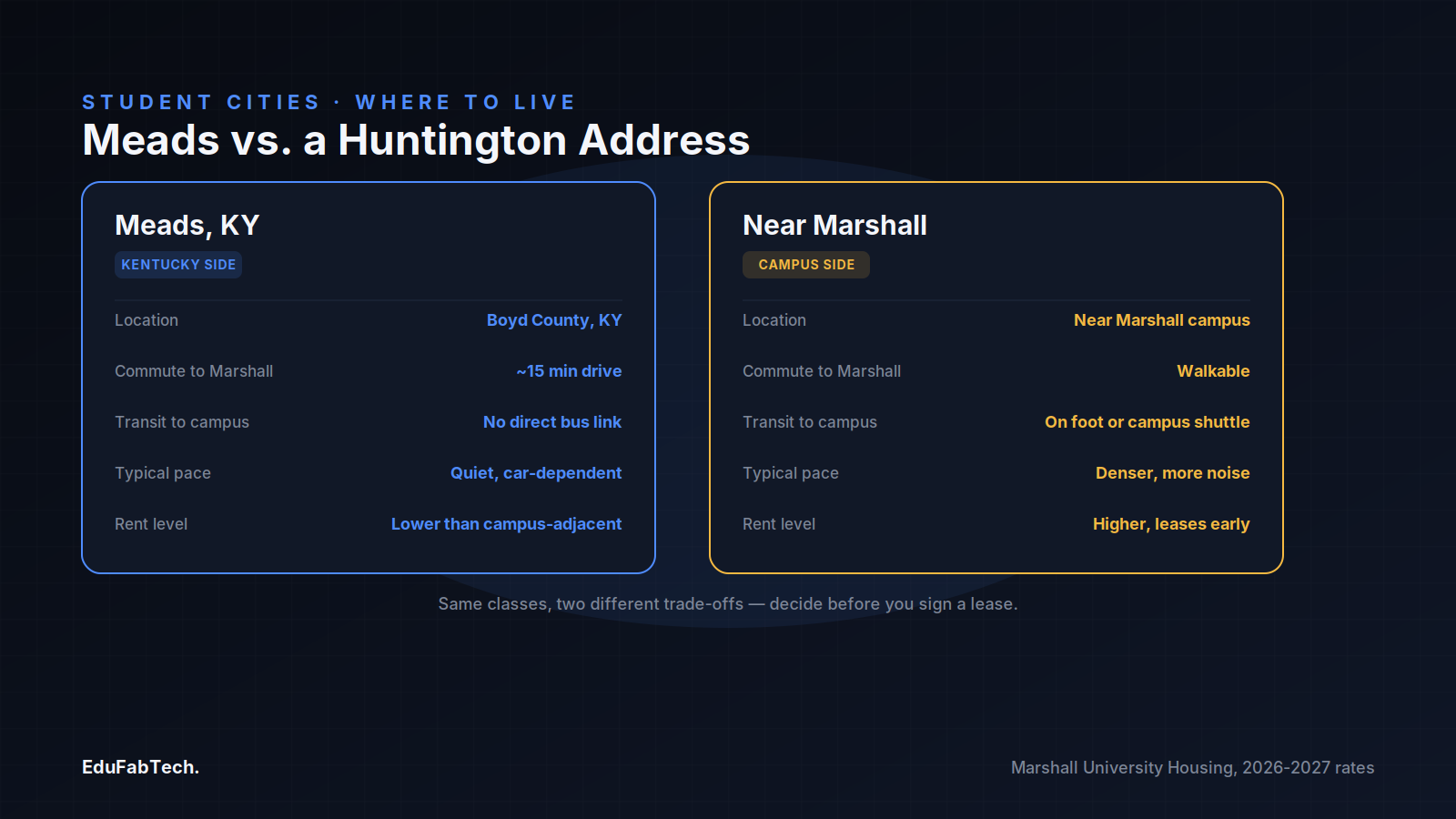
The trade-off is equally plain. There is no campus bus stop in Meads, the two local bus systems do not knit the state line together, and almost everything here assumes you have a car. Read the transport section below before you decide where to sign a lease, because for a student without a vehicle the geography that makes Meads affordable can also make it isolating.
The universities within reach
The anchor institution for the area is Marshall University, whose main campus is in downtown Huntington, West Virginia. Marshall was founded as Marshall Academy in 1837 and named for Chief Justice John Marshall (Marshall University, Our History). It is a public university best known regionally for its Joan C. Edwards School of Medicine, an AACSB-accredited business school, and the "Thundering Herd" athletics identity bound up with the memory of the 1970 air disaster that killed much of the football team. For most students based in Meads, Marshall is the realistic degree-granting destination, reached by crossing from Kentucky into West Virginia.
Within Marshall sits the Elizabeth McDowell Lewis College of Business, the university's business school. It was renamed in 1996 after Elizabeth McDowell Lewis, a 1931 graduate of the school; the college says it is believed to be the first school in the nation named for a woman (Marshall University, About Elizabeth McDowell Lewis). Since 2024 it has been housed in the Brad D. Smith Center for Business and Innovation at 1425 4th Avenue in Huntington (Lewis College of Business, history). It is not a separate institution you apply to on its own; its degrees are Marshall degrees, so treat it as the business wing of the same campus.
West along US-60, in Grayson, is Kentucky Christian University. It was founded on 1 December 1919 as the Christian Normal Institute, became Kentucky Christian College in 1944, and took its current name in 2004 (Kentucky Christian University, History & Heritage). It is a small, private Christian university in the Appalachian foothills, with programmes that lean toward business, nursing, education and ministry; it is a very different environment from Marshall, and Grayson is far enough that students generally live there rather than commute from Meads.
For sub-degree and technical study, two Huntington options are worth knowing. Mountwest Community and Technical College, a public two-year college on One Mountwest Way, began life in 1975 as Marshall Community College before becoming independent in 2010. Huntington Junior College, a private two-year college in Huntington accredited by the Higher Learning Commission, offers associate programmes in fields such as accounting, medical assisting and court reporting. Both are commutable from Meads on the same roads you would use for Marshall.
Where a room is, and when to start looking
Housing around Meads comes in a few recognisable shapes: rooms and whole houses in the Rockdale subdivision and similar US-60 neighbourhoods, small apartment buildings closer to Ashland, and — for anyone willing to cross into Huntington — the denser rental market around Marshall's campus. If your classes are at Marshall, decide early whether you want the Kentucky-side quiet of Meads with a daily drive, or a walkable Huntington address with higher rent and more noise.
First-year Marshall students should look at university housing before anything else. Marshall operates traditional residence halls and the apartment-style Landing, and living on campus removes both the commute and the lease risk in your first year while you learn the area. Off-campus, the leasing calendar near a university runs ahead of the academic year: the best rooms within walking distance of Marshall are often committed in late winter and spring for an August start, so begin searching months before you arrive and do not expect good late-summer options close to campus.
Whatever you are considering, line up listings first — EduFabTech's Meads city page and its rooms listings are a starting point, and if your timetable is on the West Virginia side it is worth checking what sits near Marshall University as well.
What a room costs, and how to avoid the scam
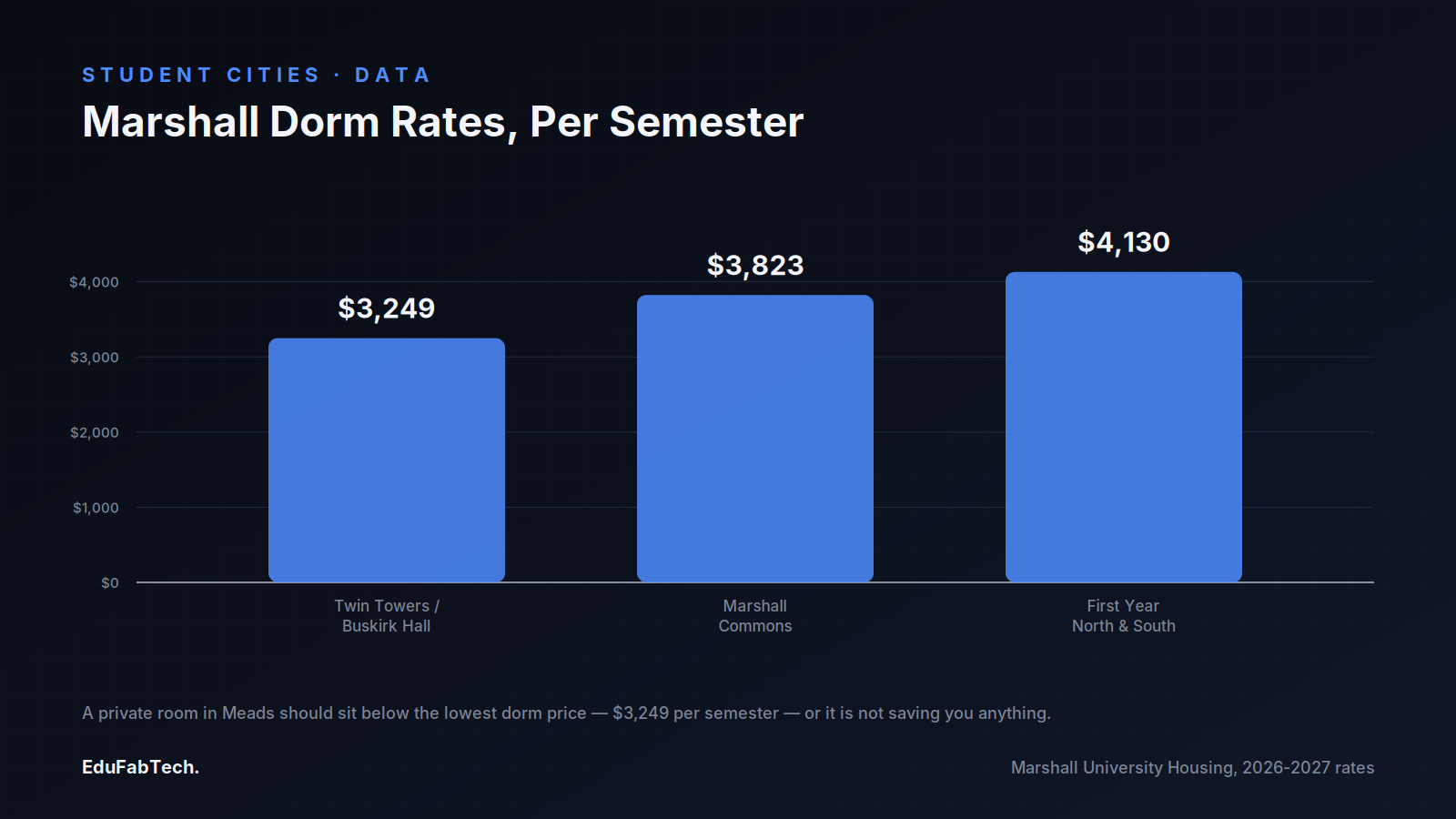
The one housing figure you can anchor to is the university's own. Marshall University's housing office lists 2026–2027 residence-hall rates of $3,249 per semester for a double room in Twin Towers and Buskirk Hall, $3,823 for a double in the Marshall Commons halls, and $4,130 for the First Year North and South halls (Marshall University Housing, 2026–2027 rates). Those are per-semester dormitory prices, not what a private room in Meads costs; use them as a benchmark, since a modest off-campus share should sit below the single-room dorm figure or it is not saving you anything.
On the private market, the scams here follow a predictable script. Because Meads is spread out and many listings are for houses or rooms rather than managed buildings, fraud tends to appear as a "landlord" who is conveniently out of state, cannot let you in to view the place, and asks for a deposit or first month to "hold" it before you have seen anything. The defence is the same every time: view the actual unit in person (or have someone you trust do it), meet the person who controls the keys, and get a written lease before money moves. Deposits in this area are normally paid by cheque or a traceable transfer to a named person or company once you have signed — never by bank wire, gift card or cryptocurrency to secure a room sight unseen. If a price near campus looks far below everything else, treat that as a warning, not a find.
Furnishing a room for very little
A commuter community surrounded by a small metro is good terrain for second-hand furnishing, because stock turns over with every academic year and the US-60 corridor is lined with resale and donation stores. The Hillbilly Flea Market on Russell Road in Ashland is the nearest genuine flea market, an indoor hall of rotating booths a few minutes from Meads; the enclosed Ashland Town Center and the surrounding retail handle the new-goods end when you need a mattress or kitchen basics you would rather buy fresh.
For the cheapest route, work the student calendar: move-out weeks in May and August flood the area with desks, chairs, mini-fridges and whole room sets, much of it given away rather than sold. EduFabTech's second-hand, furniture and free-stuff listings for Meads are built around exactly this churn. Measure your room and your car before you collect anything large, and if you are leaving at the end of the year, plan to pass the same items on rather than pay to dump them.
Working while you study
Rules depend heavily on your status, and this is information, not legal advice. For international students, the authority to read is U.S. Immigration and Customs Enforcement's Student and Exchange Visitor Program (SEVP): it states that an F-1 student may work on campus up to 20 hours per week while school is in session, and full-time during periods when school is not in session, with off-campus training such as CPT and OPT authorised separately (ICE SEVP, Employment). Before you accept any job, confirm the specifics with your school's Designated School Official — on-campus work is tied to your enrolment and your DSO's approval, and the hour limit counts across all jobs at once.
Domestic students face no such cap, but the practical constraint in Meads is transport: an on-campus job at Marshall is easy to reach if you already commute there, while retail and service work is scattered along the US-60 and US-23 corridors and generally assumes you can drive to it. Start with your own campus — libraries, dining, departments and the student-employment office — before looking further out. EduFabTech's Meads jobs listings collect part-time openings students post locally.
Libraries and places to study
If you study at Marshall, the main study building is the John Deaver Drinko Library on the Huntington campus. For the Fall 2026 term the libraries' published schedule has Drinko open 24 hours Monday through Thursday, with shorter hours on Friday and the weekend (Marshall University Libraries, hours). Group study rooms are bookable online rather than claimed on arrival.
On the Kentucky side, the nearest public option to Meads is the Boyd County Public Library. Its Midland branch sits at 6686 U.S. Route 60 close to the community, and the main library is on Central Avenue in Ashland (Boyd County Public Library, Midland branch). The Midland branch has study rooms you can use without a campus login, which helps on days you are working from home rather than driving across the river. EduFabTech also lists bookable study spaces in Meads for when you want a desk off campus.
Getting around: two bus systems and a state line
Public transport here is real but fragmented, because the metro straddles a state border and each side runs its own system. In Huntington, the Tri-State Transit Authority (TTA) operates the city routes; its 2026 fare schedule lists a basic one-way fare of $1.00 plus a $0.25 zone charge, a $4 day pass and a $35 31-day pass, and it states that Marshall University students ride free (Tri-State Transit Authority, Bus Fares). That free-ride arrangement is a genuine benefit if your life is centred on the Huntington campus.
On the Kentucky side, the City of Ashland runs the Ashland Bus System. Its published fares are $0.75 for a full one-way ride and $30 for a monthly pass, with a reduced fare of $0.35 and a $15 monthly pass, and "students to and from school" are listed among those who qualify for the reduced rate with proof (Ashland Bus System, Fares and Passes). The catch for someone living in Meads is that neither system is designed to carry you from a Boyd County subdivision across the river to Marshall's campus on a daily timetable. For that commute, plan around a car, a car-share with classmates, or an address closer to the campus you actually attend.
The honest trade-offs
What is good about Meads for a student is straightforward: lower rents than the blocks around Marshall, quiet residential streets, easy driving access to two cities' worth of jobs, shops and libraries, and a genuinely affordable cost of living by the standards of larger university towns. The second-hand economy is strong, and you are never far from a hospital, a mall or a grocery run.
What is hard is mostly about distance and dependence on a car. Meads has no campus, no walkable student district and no single bus that takes you to class across the state line; winters in the Appalachian foothills bring cold and the occasional snow that complicates a river-crossing commute; and the social life of being a student happens in Huntington or on campus, not in the subdivisions. If you have a car and want calm and low rent, Meads works well. If you do not drive, think hard before choosing it over a room nearer campus.
A short checklist for your first weeks
- View any room in person and meet the keyholder before paying; never wire a deposit to hold a place unseen.
- Confirm which campus you attend and how you will reach it daily — car, car-share, or a bus system that actually serves that side.
- If you are on an F-1 visa, see your Designated School Official before taking any job, and read the ICE SEVP employment rules first.
- Get a Boyd County Public Library card for off-campus study and its study rooms.
- If you study at Marshall, set up your free TTA bus access and learn the Drinko Library hours and room-booking system.
- Furnish from the May and August move-out churn and from local resale stores rather than buying everything new.
- Browse current rooms and second-hand listings for Meads before you commit to anything.
A quick question for readers
Do you work part-time while you study?
Many students work to pay the bills. See how common it is — and how many hours people really do.
Pick an answer, create a free account in a minute, and your vote counts. Already a member? Sign in
Comments 0
CommentNo comments yet. Members start the conversation.
Source: Marshall University Housing
Sources (4)
- Marshall University Housing. 2026–2027 Residence Hall Room Rates. Marshall University, 2026. marshall.edu ↗ · checked 15 Oct 2026
- Ashland Bus System. Fares and Passes. City of Ashland, Kentucky, 2026. ashlandky.gov ↗ · checked 15 Oct 2026
- U.S. Immigration and Customs Enforcement. Employment (Student and Exchange Visitor Program). ICE SEVP, 2026. ice.gov ↗ · checked 15 Oct 2026
- Kentucky Christian University. History & Heritage. Kentucky Christian University, 2026. kcu.edu ↗ · checked 15 Oct 2026