METR's AI "Time Horizon" Is Doubling Every 110 Days — With Very Wide Error Bars
METR's Q4 2026 update puts frontier models at roughly 40 hours on its 50% time-horizon metric, but the organisation's own notes and an independent statistical critique say the number does not mean what headlines imply.
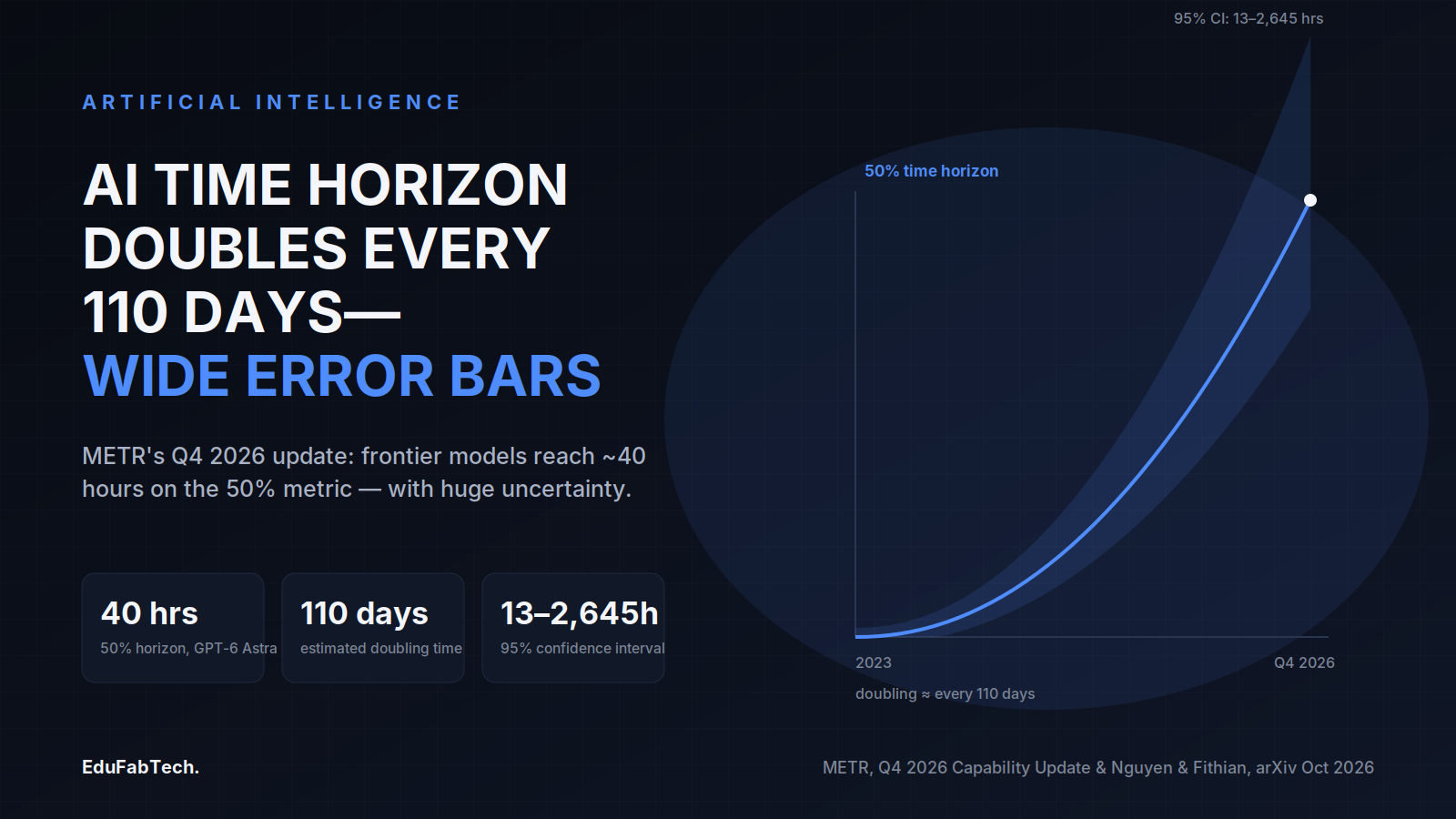
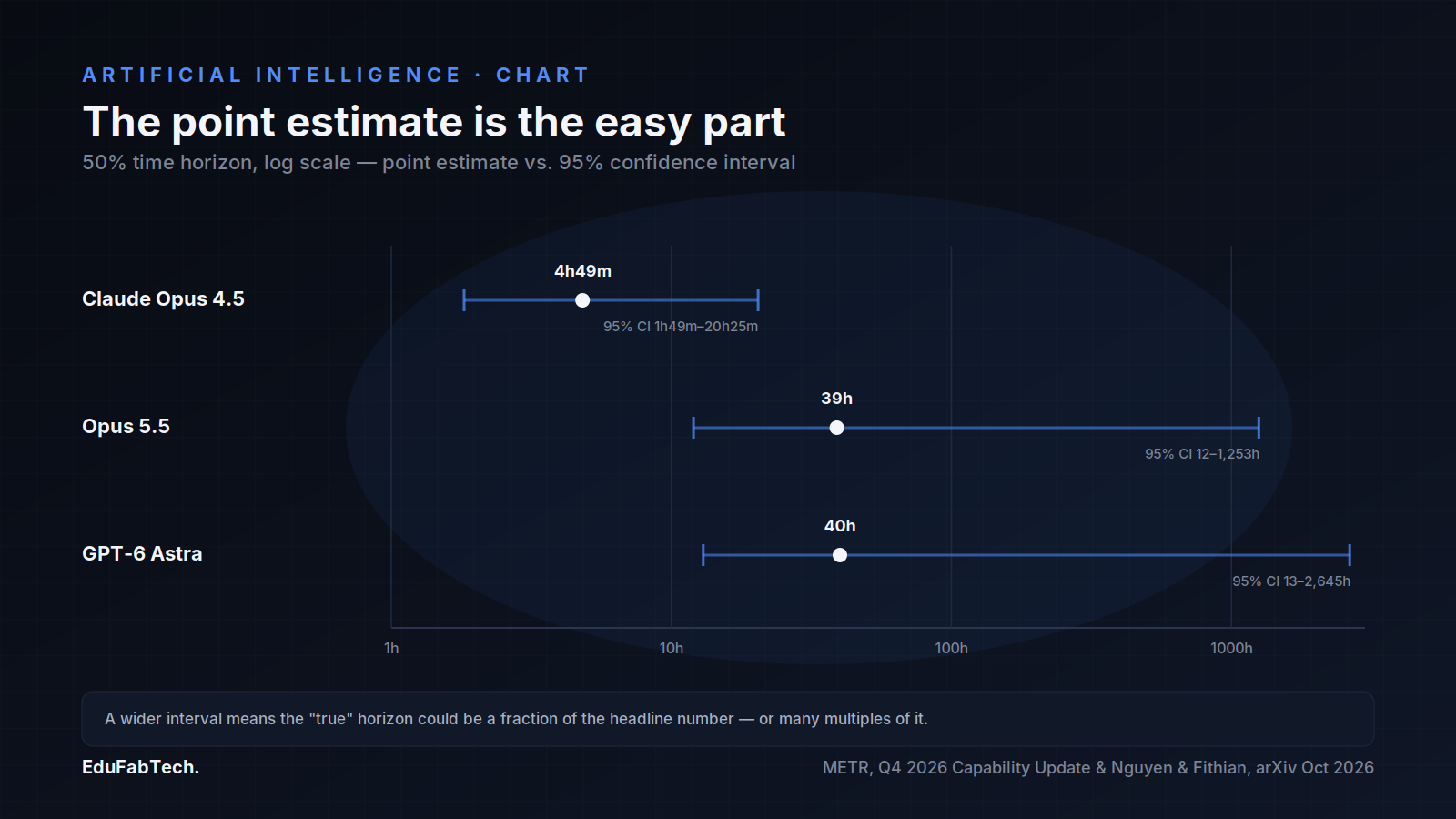
On 20 November 2026, the AI evaluation nonprofit METR published its Q4 2026 capability update, reporting that its two most capable tested systems, OpenAI's GPT-6 Astra and Anthropic's Opus 5.5, reach roughly 40 hours on its "50% time horizon" measure across a combined task suite — 40 hours for Astra (95% CI 13 to 2,645 hours) and 39 hours for Opus 5.5 (95% CI 12 to 1,253 hours) — and that this horizon is doubling about every 110 days, or 3.61 months, with a 95% confidence interval of 2.08 to 4.94 months. The same report, and a limitations note METR published earlier in the year, spend as much space explaining what that number is not as what it is. Anyone citing it is expected to carry both halves.
Time horizon is METR's attempt to turn benchmark scores into a unit that is easier to reason about than an accuracy percentage. The organisation's original paper, "Measuring AI Ability to Complete Long Software Tasks," posted to arXiv in March 2025 and presented at NeurIPS 2025, defines a model's 50% time horizon as the length of task — measured in the time a skilled human needs to complete it — at which the model succeeds half the time. The paper evaluated 13 frontier models released between 2019 and 2025 on 170 tasks drawn from METR's RE-Bench and HCAST suites plus 66 new tasks, and found that the length of task models could complete at a 50% success rate was doubling about every seven months.
That seven-month figure did not survive long as a fixed constant. On 29 January 2026, METR released a revised model it calls Time Horizon 1.1, expanding the task suite from 170 to 228 tasks — adding 73 tasks (all drawn from HCAST), removing 15, and updating 53 "where a task description was confusing, or easy to reward-hack, or the scoring function had errors," in the report's own words. Older GPT-4-era models were revised downward by 35% to 57% under the new model, while newer systems such as GPT-5 and Claude Opus 4.5 were revised upward by 11% to 55%. Under TH1.1, the doubling time since 2023 came out to 131 days, versus 165 days under the original model; since 2024 it was 89 days, versus 109 days under TH1.
The Q4 2026 update layers a second, newer suite on top of that revised baseline. METR now also runs TH2, a 36-task suite split into eight "verifiable" task families with automatic scoring and four "hard-to-verify" families judged by humans or models, alongside a 75-task coding suite called MirrorCode. On the combined TH1.1-plus-TH2 suite, the 110-day doubling figure is what METR reports; restricted to TH2's verifiable subset alone, the estimated doubling time drops to 1.65 months, with a much wider 95% interval of 0.79 to 3.99 months. The gap between those two estimates is itself a measure of how sensitive the "doubling time" headline is to which tasks are included.
METR's report also separates where models are strong from where they are not, and the split does not track task length so much as whether a task has a clear, checkable answer. On Al Zimmermann's Programming Contests, a set of 15 contests with automatically scored objectives, the report says median frontier-model placement fell in the 96th to 98th percentile among human contest entrants, across contests with 97 to 413 participants. On a "Budget NanoGPT" speedrunning task, the best AI agent run reached a 15.7% speedup over the baseline in 48 hours — well behind a recent human record of a 41% speedup, set by a contributor who, by their own account, used AI assistance for coding and spent about 60 hours on it. Unlike the contest results, this is a case where an AI-assisted human effort, not an unaided one, outpaced the AI agent working alone on a task with an equally clear score.
On tasks without that kind of built-in feedback signal, METR reports a different pattern. Using a task it calls LMCA, which has raters judge the quality of critiques of philosophical arguments, frontier models exceeded the agreement rate of human experts given five minutes to judge, but stayed below the agreement rate of experts given fifteen minutes. METR's own description of this gap is that models show "worse judgment than human experts" specifically on tasks that lack clear empirical feedback — the kind of open-ended research and strategy judgments that, unlike a passing test suite, cannot be checked by running the output.
The report is unusually candid about how thin the human comparison data is. METR says it spent approximately $90,000 recruiting human baseliners for one part of the evaluation, obtaining seven attempted baselines at $200 to $350 an hour, of which only three were completed — and that the tested models outperformed all three completed baselines. A three-person comparison set is not a basis for a precise percentile claim, and METR does not present it as one; it is offered alongside the contest and speedrun results as one more data point on where the frontier currently sits.
A separate finding in the same update concerns training cost rather than raw capability. METR estimated how expensive it would be to convert various tasks into reinforcement-learning training environments, then compared model performance on cheap-to-convert versus costly-to-convert tasks of similar length. Tasks that were costlier to convert into RL environments saw model performance roughly 2.9 times worse — equivalent, on METR's doubling-time scale, to about 1.5 doublings of lag — even after controlling for how long the task itself took. METR calls this a "very rough proxy measure" rather than a measurement of actual developer training costs, but it offers one explanation for why capability gains are uneven across domains: the tasks that are cheapest to turn into scoreable training data are not evenly distributed across the kinds of work people actually want automated.
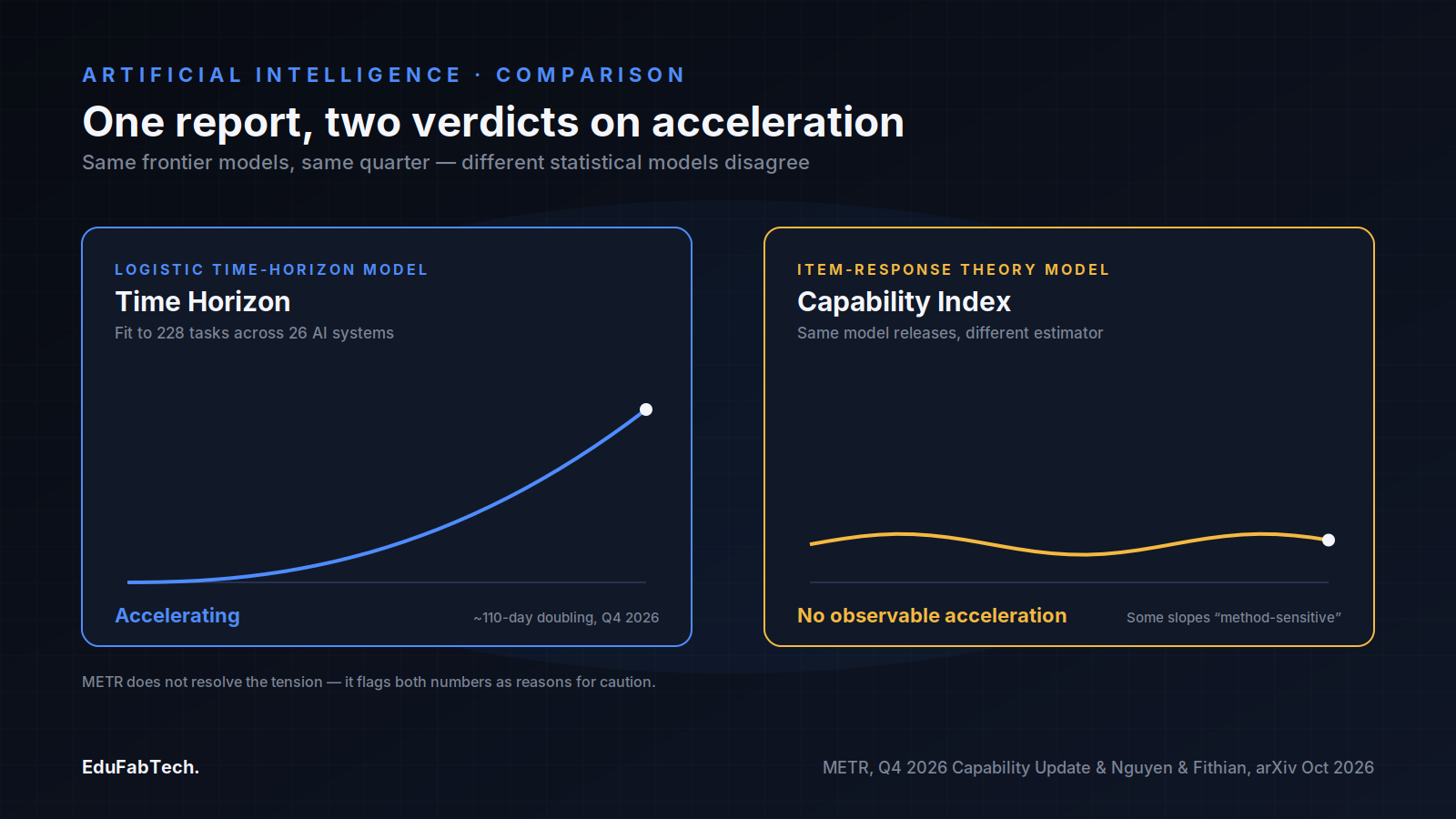
METR runs a second index alongside time horizon, the METR Capability Index (MCI), built with item-response theory rather than the time-horizon logistic model. Across all tested public frontier models, the Q4 2026 report says MCI shows no observable acceleration, though some developer-specific trends showed slope changes that the report describes as "quite sensitive to various methodological choices." That is a direct tension inside the same document: one metric (time horizon) reads as accelerating, built with a different statistical approach, on the same underlying model releases, does not. METR does not resolve this tension in the report; it flags it as a reason for caution about reading either metric as a settled trend line.
The organisation's own January 2026 limitations note is the more direct source for what the headline number does not mean. "Time horizon is not the length of time AIs can work independently," the note states — it is "the amount of serial human labor they can replace with a 50% success rate." A 50% success rate is also, deliberately, a coin flip: the note is explicit that a 50% time horizon of X hours "does not mean we can delegate tasks under X hours to AIs," since tasks where failure matters typically need "98%+ success probabilities to be worth automating." The confidence intervals around any single model's estimate are wide: for Claude Opus 4.5, METR reports a point estimate of 4 hours 49 minutes with a 95% interval running from 1 hour 49 minutes to 20 hours 25 minutes, and states plainly, "I really have no idea whether Claude's 'true' time horizon is 3.5h or 6.5h."
The same note warns that time horizon varies enormously by domain — 40 to 100 times lower for visual computer-use tasks, where models are limited by poor perception rather than reasoning, and it gives Claude 4.5 Sonnet's time horizon on a real-world coffee-making task as about two minutes. It also flags a modelling constraint: because the underlying curve is fit with only two free parameters, the 20% and 80% time horizons reported alongside the 50% figure are not independently estimated, so "improving performance on 20% horizon tasks can lower" the reported 80% horizon. On extrapolation, the note is blunt that projecting the trend out to months- or years-long horizons is "fraught," because every task in the benchmark is self-contained, while most months-long work that humans do requires ongoing collaboration that no current task suite captures.
An independent check on the statistics behind the plot came from outside METR in October 2026. In "On the estimation and validity of AI time horizons — a statistical look at the METR plot," posted to arXiv by Drew T. Nguyen and William Fithian, the authors challenge the assumption, built into METR's model, that task difficulty scales roughly linearly with the logarithm of how long a human takes to complete it. Fitting a spline to the same 228 tasks and 26 AI systems, they find the relationship is "nearly flat in a region from 2–30 min but close to linear elsewhere" — meaning a tenfold jump in human completion time from three to thirty minutes corresponds to a much smaller increase in difficulty for a model than the same tenfold jump from thirty minutes to five hours. Their model, combining splines with item-response theory, scored better than METR's linear-logistic model under cross-validated proper scoring rules, and their practical recommendation is that time horizons "be interpreted together with the diagnostic plots" rather than read off as a single number.
None of this makes the underlying measurement exercise worthless. METR's task suites, baseline comparisons and public data are more transparent about their own uncertainty than most benchmark leaderboards in wide circulation, and the organisation revises its own model in public when the task suite or the statistics turn out to need it, as the TH1 to TH1.1 revision and the Q4 2026 update both show. The practical lesson for a reader is less about any single number than about reading discipline: a time-horizon figure needs its task suite version (TH1, TH1.1, or TH1.1-plus-TH2), its confidence interval, and whether it comes from a verifiable or hard-to-verify subset, in the same sentence as the hours. A "40-hour time horizon" without those qualifiers is not the same claim METR is actually making.
For anyone building evaluation practice around this kind of metric, the more durable finding may be the structural one: performance tracks whether a task has a clean, checkable success signal far more reliably than it tracks task length by itself. Contest optimisation with an automatic scorer, a 36-hour-scale problem, is where frontier models post their strongest relative results; open-ended judgment with no such signal is where METR's own report says they still lag skilled human experts. That split, more than the doubling-time number itself, is the part of the Q4 2026 update likely to hold up under the kind of scrutiny the metric has already received once this year.
A quick question for readers
Which skill will matter most for getting a job in 2030?
Everyone has a prediction. Add yours and see what students are betting on.
Pick an answer, create a free account in a minute, and your vote counts. Already a member? Sign in
Comments 3
Comment-
What jumps out to me is the two metrics inside the same report pointing different ways: time horizon says doubling every 110 days, MCI says…
-
The detail that actually matters here is buried near the end: MCI, built with item-response theory on the same model releases, shows no obse…
-
The speedrun result is the one I'd put on a slide. Best AI agent alone got 15.7% in 48 hours, but the actual record, 41%, went to a human wh…
Join free to read the full comments and reply Comments are between members; an account takes a minute.
Source: METR
Sources (5)
- METR. AI R&D-relevant model capabilities are improving rapidly and are getting harder to measure. METR, 2026. metr.org ↗ · checked 25 Nov 2026
- METR. Clarifying limitations of time horizon. METR, 2026. metr.org ↗ · checked 25 Nov 2026
- METR. Time Horizon 1.1. METR, 2026. metr.substack.com ↗ · checked 25 Nov 2026
- Thomas Kwa, Ben West, Joel Becker, et al.. Measuring AI Ability to Complete Long Software Tasks. arXiv, 2025. arxiv.org ↗ · checked 25 Nov 2026
- Drew T. Nguyen, William Fithian. On the estimation and validity of AI time horizons — a statistical look at the METR plot. arXiv, 2026. arxiv.org ↗ · checked 25 Nov 2026