A 2025 Review of 266 Musculoskeletal Trials Finds Median Statistical Power of Just 42%
A meta-review in Sports Medicine – Open examined 266 randomised trials behind 41 meta-analyses and found most were sized to detect effects larger than later pooled analyses actually found.
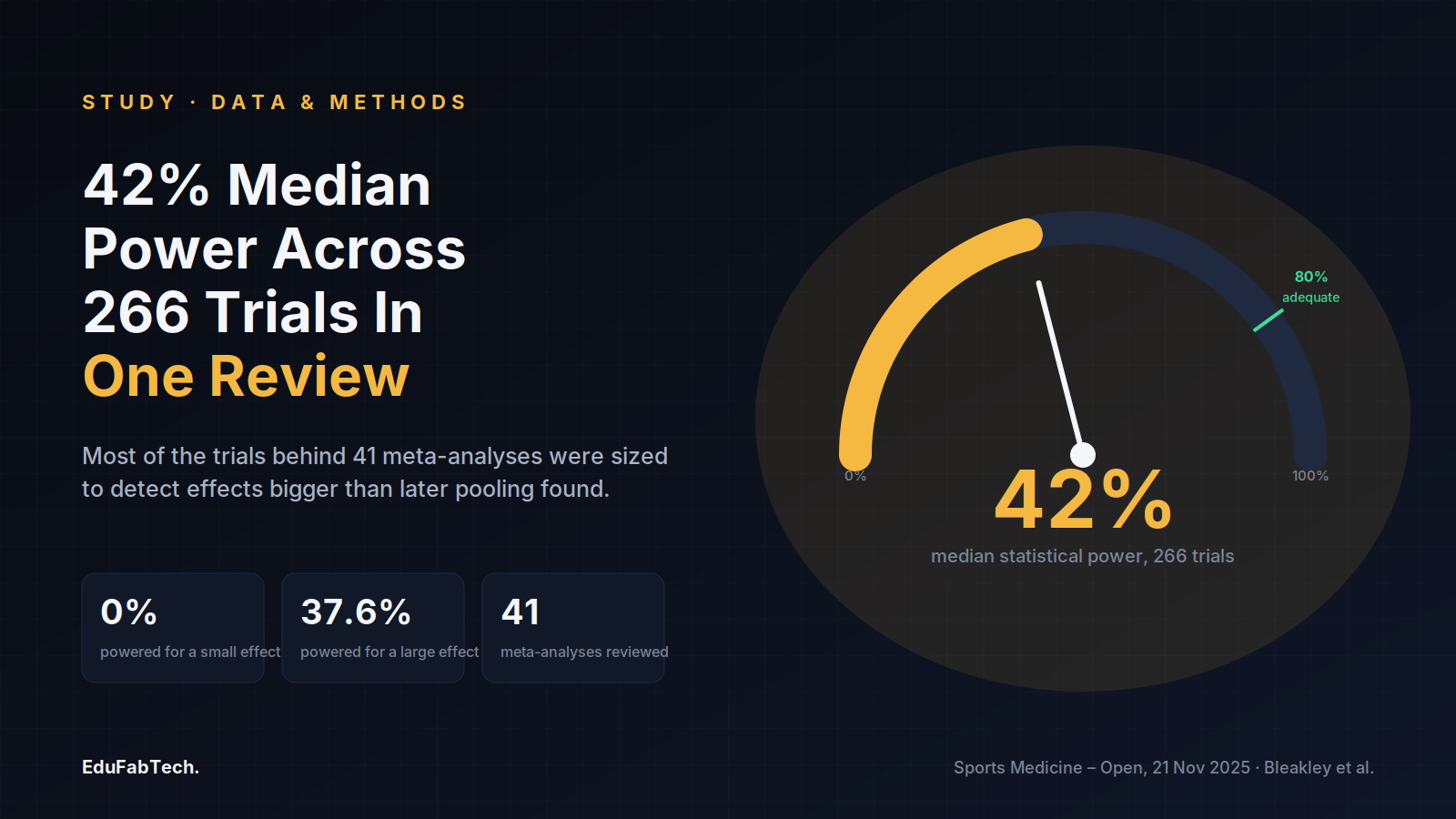
A meta-review published in Sports Medicine – Open on 21 November 2025 did something unusual: instead of asking whether a set of trials found an effect, it asked whether those trials were ever big enough to find one reliably. Chris Bleakley, Natalie Klempel, Jente Wagemans, Fredh Netterström-Wedin and James Smoliga pulled together 266 randomised controlled trials feeding into 41 meta-analyses of conservative treatments for musculoskeletal injuries — ankle sprains, tendinopathy, Achilles tendon rupture and general musculoskeletal pain — and calculated how much statistical power each trial actually had. The median came out at 42%.
Statistical power is the probability that a study will detect a real effect, given the effect's true size and the study's sample size. A trial with 80% power, the conventional benchmark written into most funding and ethics applications, will correctly detect a genuine effect in 80 out of 100 repeated experiments. A trial with 42% power will miss a real effect more often than it finds it. The number matters for a reader because it runs in the opposite direction from what most people assume a published, peer-reviewed trial implies: low power does not just risk false negatives, it also inflates the size of the effects that do clear the bar for statistical significance, since only the inflated subset reaches a low p-value in a small sample.
The review's search covered MEDLINE and PEDro through March 2024, restricted to meta-analyses of at least five parallel two-arm trials testing non-surgical treatments, and excluded designs using partial eta squared as an effect-size metric. From 4,737 candidate articles, 41 meta-analyses qualified, contributing the 266 individual RCTs that form the dataset. The authors calculated power two ways: the trial's power to detect the summary effect later produced by its own meta-analysis, and, separately, its power against Cohen's conventional thresholds for a small, medium or large effect (d = 0.2, 0.5 and 0.8).
The headline numbers
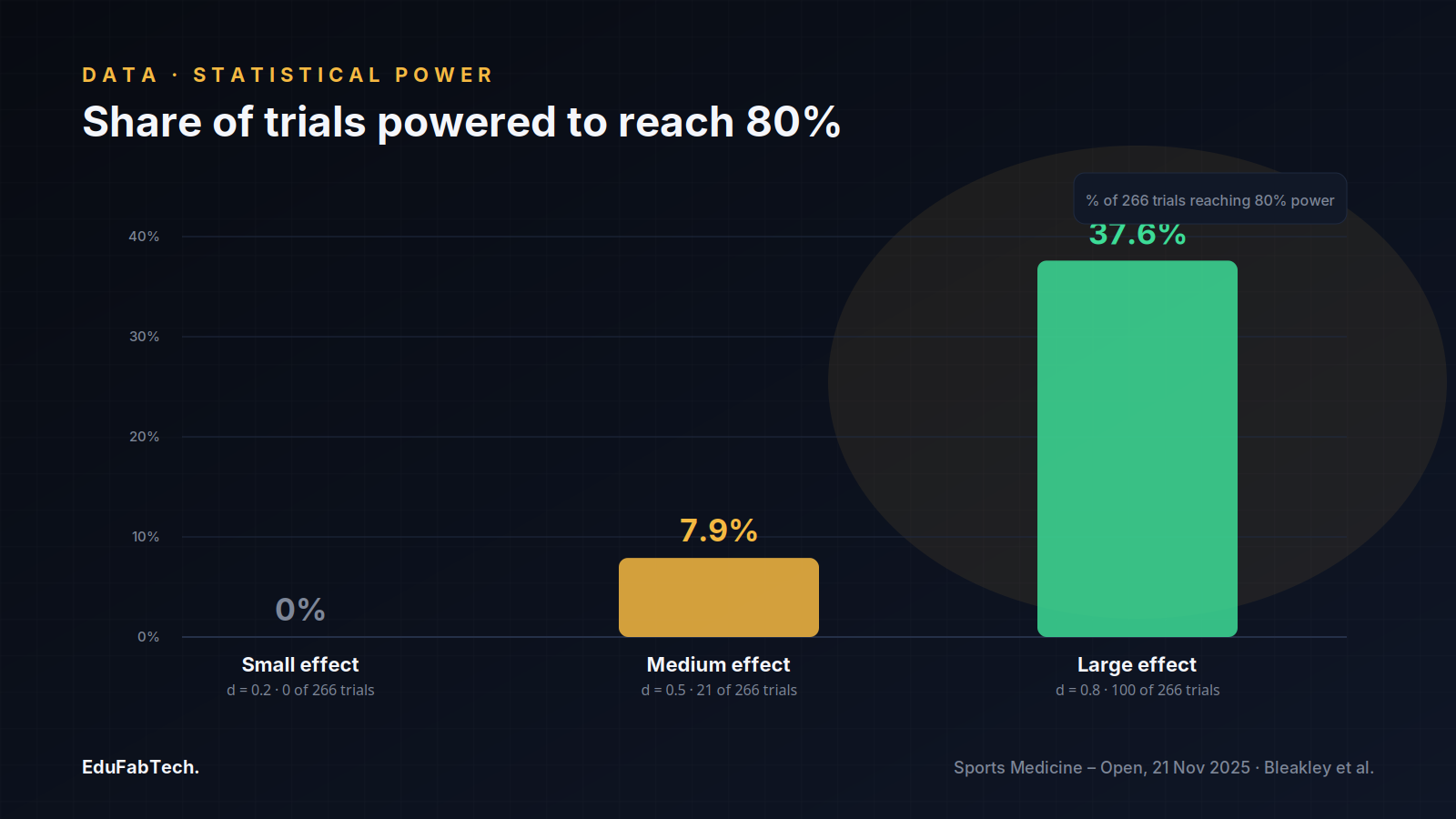
Against the meta-analytic summary effect, median power across all 266 trials was 42% (interquartile range 14–73%), rising to a median of 54% when restricted to the 223 trials that belonged to a statistically significant meta-analysis. Even within that more favourable subset, only 29.6% of trials (66 of 223) reached the 80% threshold. Measured the conventional way, against Cohen's fixed benchmarks, the picture was starker still, as the table below shows.
| Assumed effect size (Cohen's d) | Trials with power of at least 80% |
|---|---|
| Small (d = 0.2) | 0% (0 of 266) |
| Medium (d = 0.5) | 7.9% (21 of 266) |
| Large (d = 0.8) | 37.6% (100 of 266) |
Not one of the 266 trials had the sample size needed to reliably detect a small effect. That is a practical concern in a field where many treatments for sprains and tendon injuries plausibly produce small-to-moderate improvements rather than large ones, meaning a sizeable share of these trials were essentially incapable of confirming or ruling out the effect they were testing for, whatever the true effect turned out to be.
Delta inflation and the winner's curse
The review also checked what happened when trial teams stated, in advance, the effect size they expected. Among the 76 trials that reported an a priori target effect, the median expected effect was 0.73 — close to Cohen's "large" threshold — against a median observed effect of only 0.36 once the trial ran. Sixty-three of those 76 trials, or 82.8%, overestimated the effect they ultimately found. The authors describe this as "delta inflation", and link it to a companion phenomenon they call the winner's curse: in a small, underpowered sample, only an unusually large observed effect will cross the threshold for statistical significance, so the significant results that get published and pooled into meta-analyses are systematically larger than the true effect.
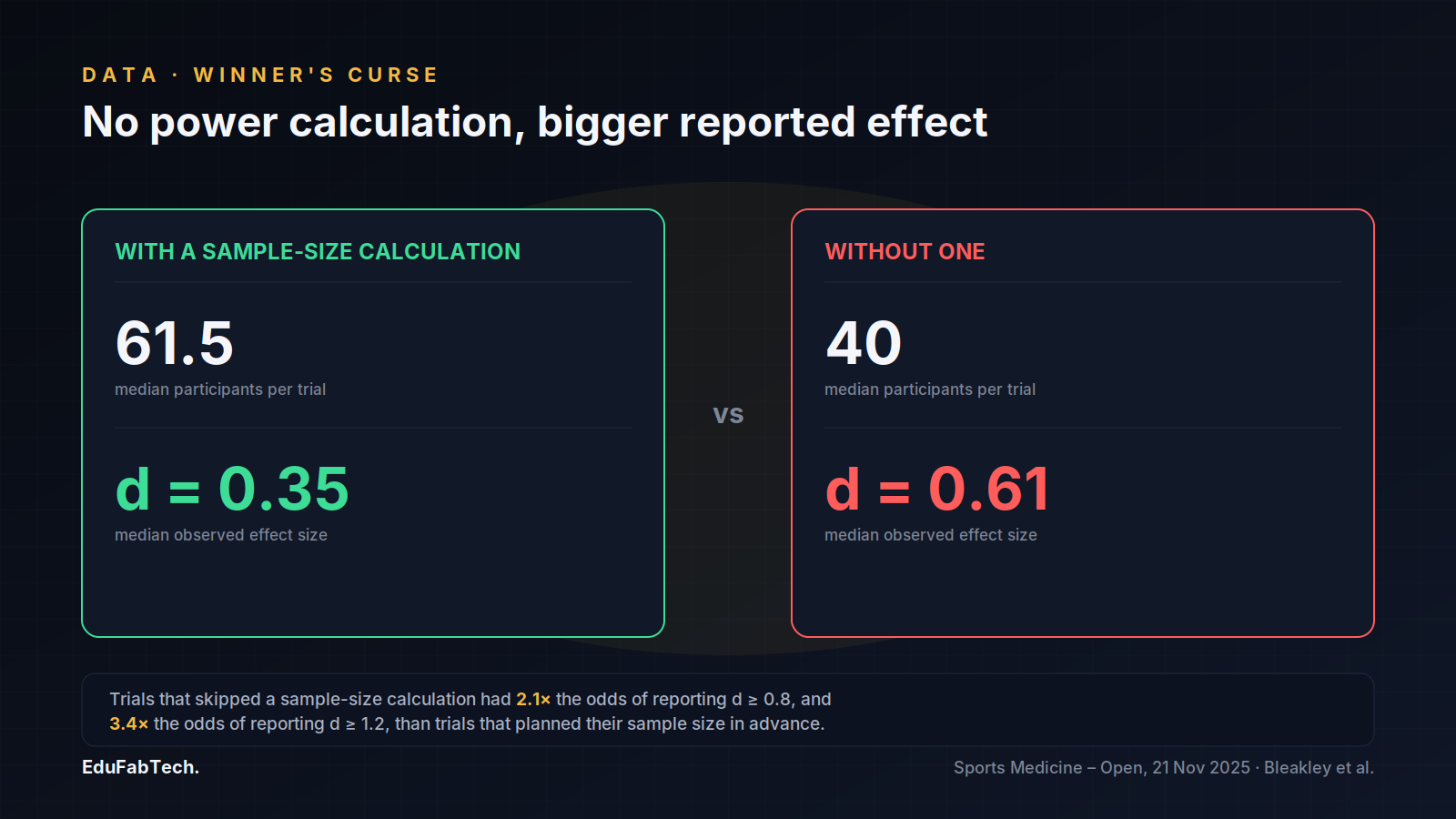
The clearest evidence for that mechanism sits in a direct comparison the review ran between trials that reported a formal sample-size calculation and those that did not. Trials with a stated calculation had a larger median sample (61.5 participants) and a smaller median observed effect (0.35). Trials without one were smaller (median 40 participants) and reported a larger median effect (0.61) — and had 2.1 times the odds of reporting an effect of d ≥ 0.8, and 3.4 times the odds of reporting one of d ≥ 1.2, than trials that had planned their sample size in advance.
How the field compares
Bleakley and colleagues note in their discussion that a median power of 42% in musculoskeletal trials is, if anything, better than what earlier audits found elsewhere. A widely cited 2013 analysis in Nature Reviews Neuroscience by Katherine Button, John Ioannidis and colleagues examined every neuroscience meta-analysis published in 2011 — 49 meta-analyses covering more than 730 individual studies — and put median statistical power in that field at 21%. The musculoskeletal figure also came in above a psychology benchmark of 36% that the review cites for comparison. None of the three fields clears 80%, which is the number that funders, ethics boards and most textbooks treat as adequate.
What to check before trusting a trial's result
None of this means a given trial is wrong. It means a reader cannot take "statistically significant" as a stand-in for "the effect is probably this large," or even "the effect probably exists," without first checking how the study was sized. A few things are worth looking for in the methods section of any randomised trial report:
- Whether the paper reports a sample-size or power calculation at all, and whether it states the assumed effect size, the alpha threshold (almost always 5% in this review's sample, at 98.3%) and the target power (80% in 79.7% of cases that specified one, per the review).
- Whether the assumed effect size is justified against prior evidence — a pilot study, a related meta-analysis, a minimal clinically important difference — rather than simply chosen to make a feasible sample size look adequate.
- Whether the achieved sample is small relative to the effect being claimed; a large effect from a small trial is the signature the review associates with underpowered, delta-inflated results.
- Whether the paper's own confidence interval around its effect estimate is wide enough that a much smaller true effect, or none, remains plausible.
The DELTA2 guidance, published in The BMJ in 2018 by Jonathan Cook, Steven Julious, Will Sones and co-authors, sets out the recommended process for choosing that target difference and reporting it — drawing on systematic reviews of existing methods, a Delphi study and a two-day consensus meeting among trialists, funders and patient representatives. Bleakley and colleagues point to that guidance directly, recommending that trial teams consult "a range of evidence sources (both existing data and expert opinion)" when settling on a target effect, rather than picking whatever number a feasible sample size happens to support.
What the authors recommend instead
The review's own prescription is not simply "run bigger trials," though it does note that larger samples are "time consuming, expensive" and face real recruitment constraints in a clinical field. Its suggested fixes are more structural: multi-centre collaboration and pooling of individual-level data across sites, routine data sharing so that future power calculations can draw on real prior effect sizes rather than optimistic guesses, and more consistent use of outcome measures that are precise enough to detect a true effect without needing an inflated sample. As the authors put it, "low statistical power permeates musculoskeletal injury research, limiting the clinical utility of many RCTs," and the causes are "multifactorial and extend beyond sample size calculation alone."
For a reader outside the field, the transferable point is less about musculoskeletal medicine specifically than about how to read any trial. A result that clears the conventional significance threshold has passed one test. Whether the underlying study had enough statistical power to make that result trustworthy — rather than one of the larger, luckier effects that small samples tend to surface — is a separate question, and one the review shows most trials in this literature were not built to answer well.
A quick question for readers
How long can you study before checking your phone?
No judgement — just honest numbers. You might be surprised how you compare.
Pick an answer, create a free account in a minute, and your vote counts. Already a member? Sign in
Comments 3
Comment-
The number that should worry people more than the 42% median is the 0% — zero of 266 trials had enough power to reliably detect a small effe…
-
The number I'd put next to the headline isn't 42%, it's the zero: 0 of 266 trials could reliably detect a small effect. That's not a sample-…
-
The bit I'd actually use is the sample-size-calculation comparison: trials that bothered to plan their sample (median 61.5 participants) rep…
Join free to read the full comments and reply Comments are between members; an account takes a minute.
Source: Sports Medicine - Open
Sources (3)
- Chris M. Bleakley, Natalie Klempel, Jente Wagemans, Fredh Netterström-Wedin, James Smoliga. Statistical Power in Musculoskeletal Research: A Meta-Review of 266 Randomised Controlled Trials. Sports Medicine - Open, 2025. sportsmedicine-open.springeropen.com ↗ · checked 27 Nov 2026
- Katherine S. Button, John P. A. Ioannidis, Claire Mokrysz, Brian A. Nosek, Jonathan Flint, Emma S. J. Robinson, Marcus R. Munafò. Power failure: why small sample size undermines the reliability of neuroscience. Nature Reviews Neuroscience, 2013. nature.com ↗ · checked 27 Nov 2026
- Jonathan A. Cook, Steven A. Julious, Will Sones, et al.. DELTA2 guidance on choosing the target difference and undertaking and reporting the sample size calculation for a randomised controlled trial. The BMJ, 2018. doi.org ↗ · checked 27 Nov 2026