Studying in Bloomington, Illinois: universities, housing and student life
A practical, sourced guide to studying in Bloomington–Normal — Illinois State, Illinois Wesleyan, nearby Eureka, where students live, what it costs, and how to get around.
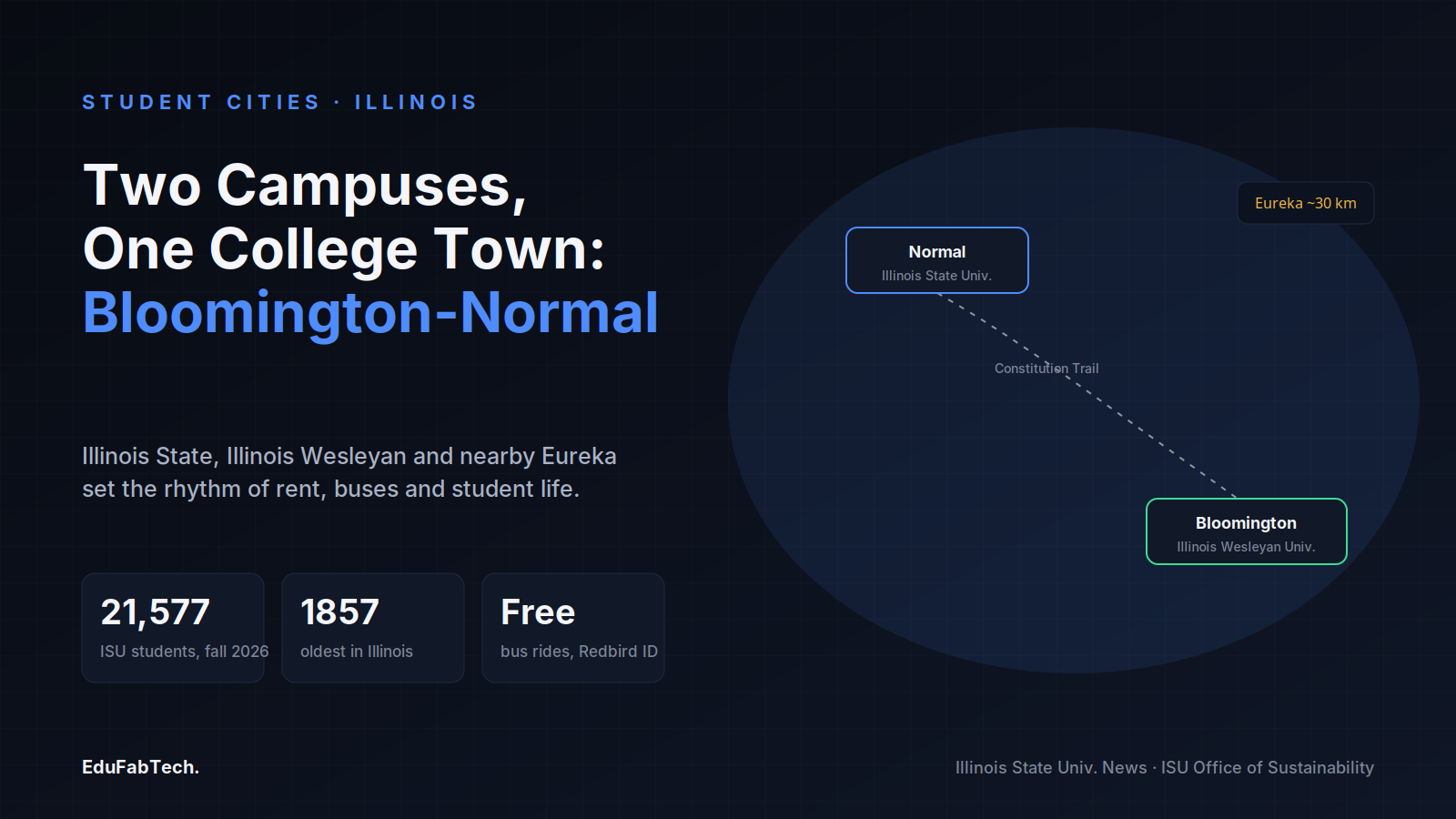
Bloomington and Normal are two separate municipalities in central Illinois that function, for a student, as one place: the locals call it Bloomington–Normal, or just B–N. The city limits meet near the Illinois State University campus, and you can walk from a lecture in Normal to a diner in Bloomington without noticing where one town ends. What holds it together is not a single downtown but two campuses, a ring of quiet residential streets, and the headquarters of a very large insurance company that shapes the job market and the rents. If you study here, you study in a mid-sized Midwestern town on flat prairie, roughly two to three hours by road from both Chicago and St. Louis, with real winters and an economy that does not rise and fall only with the academic calendar.
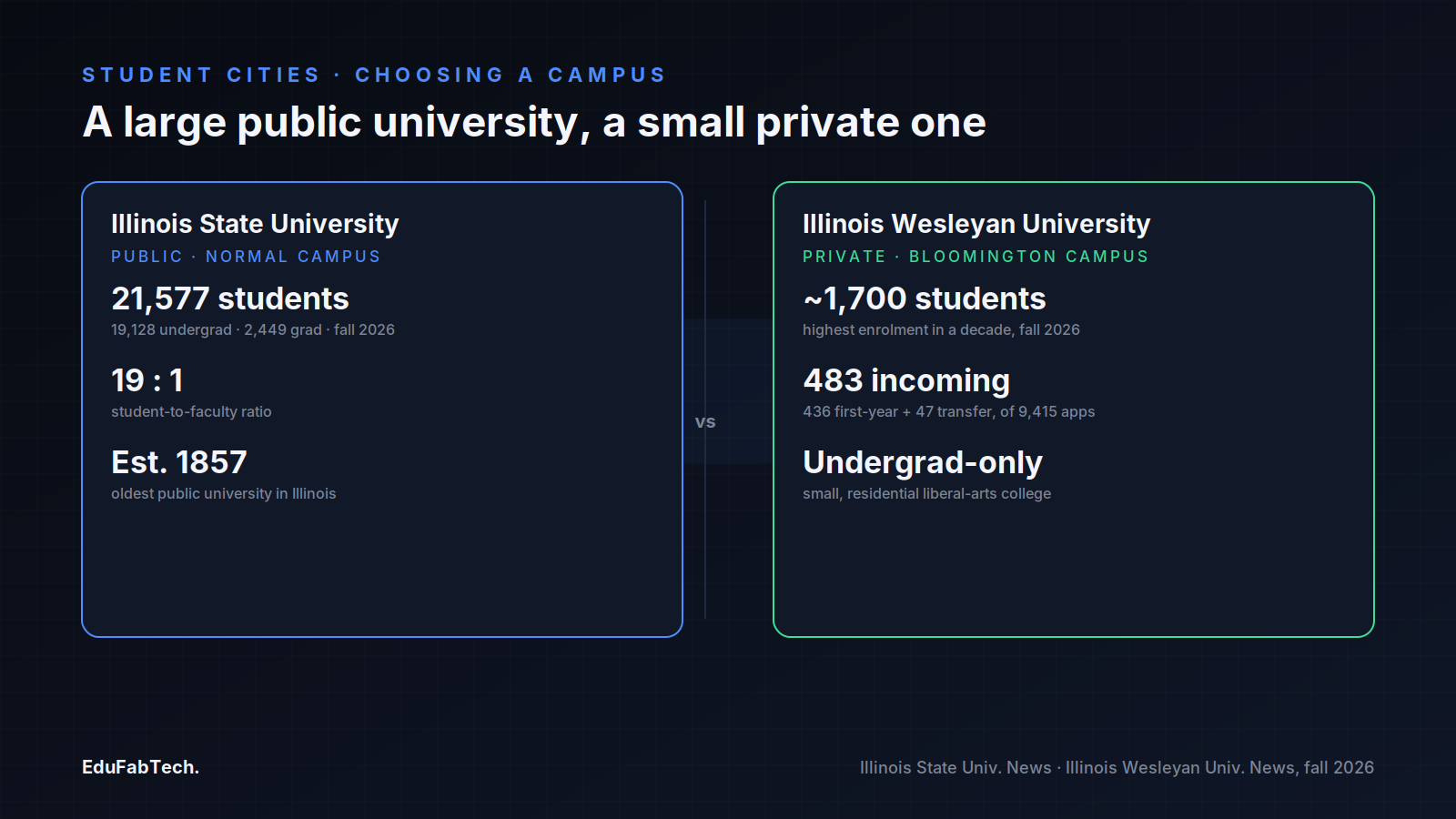
The anchor is Illinois State University, whose campus sits in Normal. According to the university's own About page, Illinois State was established in 1857 and is the oldest public university in Illinois; the town of Normal takes its name from the institution, which began as a "normal" school for training teachers. Teacher education remains a signature strength, and the university also runs colleges spanning business, nursing, fine arts and the sciences; the About page lists a 19-to-1 student-to-faculty ratio. For scale: Illinois State University News reported that the university enrolled 21,577 students for fall 2026 — 19,128 undergraduates, 2,449 graduate students and 432 international students — which the university described as a modest decline from the previous year's record enrolment.
A kilometre or so to the south, in a leafy residential part of Bloomington, is Illinois Wesleyan University, a very different kind of school: a small, private, almost entirely undergraduate liberal-arts university. Its About page describes a residential campus of roughly 1,600 students at an exclusively undergraduate, independent university. Illinois Wesleyan University News reported that fall 2026 enrolment reached nearly 1,700 — the highest in a decade — with an incoming class of about 483 (436 first-year students and 47 transfers) drawn from 9,415 applications. The two schools give the city an unusual mix: a large public university and a selective small college a short bus ride apart.
If neither fits, there is a third option within commuting range. Eureka College, a small liberal-arts college about 30 kilometres east in the town of Eureka, was — per the Illinois Office of Tourism's enjoyillinois.com listing — founded in 1855 by abolitionists and is best known as Ronald Reagan's college, with a Reagan Peace Garden and Museum on campus. It is a genuine degree-granting college, but it is a drive away, not part of the twin-city fabric; most students who choose it live in Eureka itself.
Where students settle in Bloomington–Normal
Housing here sorts itself by campus. Illinois State requires most first- and second-year students to live in university housing, so the first two years usually mean a residence hall on the Normal side — the Tri-Towers and Watterson complexes are the big ones — and then a move outward. The streets immediately west and south of the Illinois State quad, around the uptown Normal core, are the classic student rental belt: older houses split into flats, mid-rise apartment blocks built for students, and purpose-built complexes along Main Street and toward College Avenue. Illinois Wesleyan students, by contrast, cluster in the quieter residential grid north and east of their own campus, closer to downtown Bloomington.
Beyond the immediate campus rings, students who want cheaper rent or more space look to east Bloomington and the apartment corridors near Veterans Parkway, trading a walkable commute for a bus ride or a car. The city is flat and compact enough that a bicycle works much of the year, and the Constitution Trail — a converted rail path that runs through both towns — connects a lot of student neighbourhoods without touching traffic. You can see rooms close to campus through EduFabTech's listings near Illinois State University, or start with the Bloomington rooms page.
Renting a room without losing your deposit
The off-campus rental market in Normal runs on an early cycle that catches newcomers out: leases for the following August are often signed the previous autumn or winter, so students sometimes commit nearly a year ahead. That urgency is exactly what scammers exploit. The usual pattern here is a listing near campus priced slightly below the going rate, a "landlord" who is conveniently out of town, and pressure to send a deposit to hold the place before you can see it.
Protect yourself with a few fixed rules. See the actual unit in person, or send someone you trust, before you pay anything — a real local landlord or leasing office near campus can let you walk through. Never send a deposit or "holding fee" by bank wire transfer, gift card or cryptocurrency; those are the methods thieves ask for precisely because the money cannot be recovered. A normal arrangement in Bloomington–Normal is a signed written lease and a security deposit paid by cheque or card once you have keys and a walkthrough, not cash handed over to reserve a unit sight unseen. If a deal can only happen today and only by wire, walk away.
Furnishing a room cheaply: markets and second-hand
Bloomington has one genuinely well-known resale institution: the 3rd Sunday Market. According to the market's own site, it has run since 1988 at the Interstate Center on Interstate Drive in Bloomington, drawing around 450 vendors on a handful of Sundays from May through November, selling antiques, vintage goods, crafts, plants and garden items. It is seasonal and more antiques-oriented than a weekly flea market, so plan around its dates rather than expecting it any Sunday.
For day-to-day kitting-out — a desk, a lamp, a microwave — the thrift stores, the end-of-semester move-out giveaways near the Illinois State halls, and student-to-student resale are where the cheap wins are. The weeks around May graduation are the best time of year to pick up furniture that departing students cannot take with them. On EduFabTech you can look through second-hand furniture and things people are giving away free before you buy anything new.
Working while you study
Both universities employ large numbers of students on campus — in dining halls, libraries, labs and offices — and for domestic students that is usually the simplest way to earn alongside classes. For international students the rules are stricter and worth getting right from the start. The U.S. Department of Homeland Security's Study in the States guidance states that an F-1 student "may not work more than 20 hours per week when school is in session," and that on-campus employment is authorised through the student's Designated School Official (DSO) rather than by filing a separate work-permit application.
This is general information, not legal advice, and the details — Curricular Practical Training, Optional Practical Training, off-campus authorisation — depend on your programme and timing. Confirm everything with the office that handles your status: at Illinois State that is International Student and Scholar Services, and Illinois Wesleyan has its own international office. For listings of student-friendly roles around town, see EduFabTech's Bloomington jobs page.
Libraries and places to study
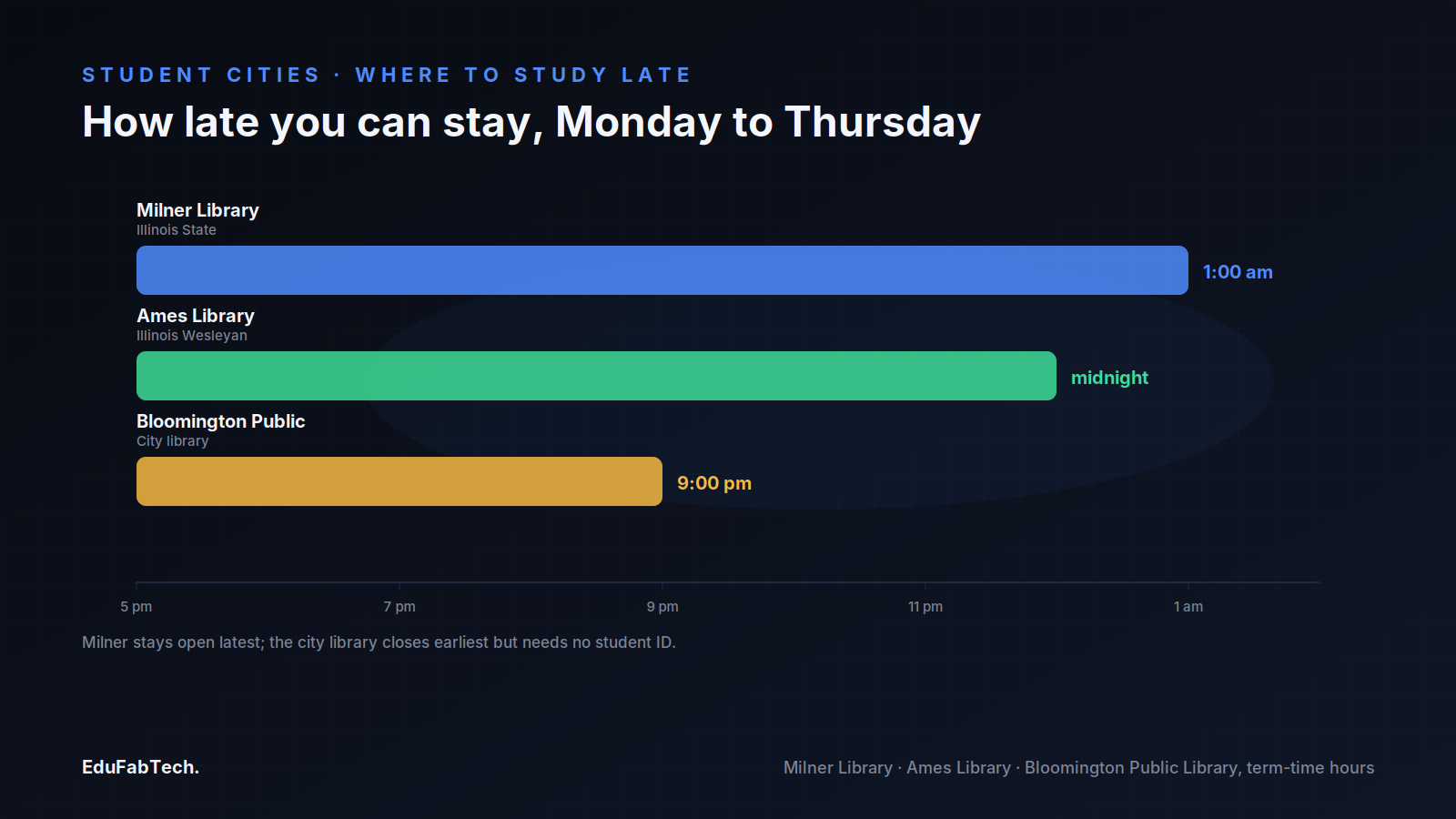
Illinois State's main library is Milner Library, a large multi-floor building on the Normal campus. Per Milner's hours page, the main floor stays open until 1 a.m. Monday through Thursday and on Sunday during the term — useful when the halls are noisy and you need a late desk. Illinois Wesleyan's Ames Library, according to the library's hours page, stays open until midnight Monday through Thursday during term and has bookable group study and project rooms, with evening access by IWU card swipe after 6 p.m.
Off campus, the Bloomington Public Library at 205 E. Olive Street is a quiet, free alternative open until 9 p.m. Monday through Thursday — handy for students who live on the Bloomington side or want a desk away from campus crowds during exams. EduFabTech also keeps a running list of study spaces around Bloomington.
Getting around
The local bus operator for both towns is Connect Transit, and for Illinois State students the headline fact is simple: you ride free. The university's Office of Sustainability states that you can "use your Redbird ID to ride Connect Transit, Bloomington–Normal's bus system." That covers the fixed routes across both towns, so a student living off-campus can get to lectures without a car and without a separate fare. Normal's uptown transit centre is the hub where routes meet.
Illinois Wesleyan and Eureka students, and anyone without a free-ride agreement, pay Connect Transit's standard fares; check the operator's current fare page before relying on a specific price. Because the twin cities are flat and the Constitution Trail links so many neighbourhoods, a lot of students get by on a bike plus the bus and keep a car only for trips out of town. Chicago and St. Louis are both reachable by road, and Amtrak serves Normal's Uptown Station for longer journeys.
What it costs
The clearest on-campus figure comes from Illinois State itself. Its 2026–2027 residence hall rates list a standard double room at $3,373 per semester ($6,746 for the year) and a single at $4,489 per semester ($8,978 for the year), with suite-style and super-single rooms running higher — up to $5,769 per semester ($11,538 a year) for a super single in a suite. Those are room charges only; a meal plan is billed separately on top of the room charge.
For off-campus renting, the most authoritative local benchmark is the U.S. Census Bureau. Its QuickFacts for Bloomington city, Illinois put the median gross rent at $1,050 a month over the 2020–2024 period, with median household income at $77,384 (in 2024 dollars). That median covers all rentals, not just student units, and shared student flats near campus can come in below it per person — but it is a reliable, dated anchor for what housing costs in this city, and a reminder that Bloomington–Normal is cheaper than Chicago while not being a bargain town.
The good and the hard
What is good: the twin cities are genuinely affordable by U.S. standards, compact enough to live without a car, and stabilised by a large non-university employer, so the place does not empty out or collapse when students leave for the summer. Free bus travel for Illinois State students, a flat city with a dedicated trail network, and two very different institutions within a short ride of each other are real advantages.
What is hard: this is central-Illinois prairie, which means cold, long winters and hot, humid summers, and the flatness that makes cycling easy also makes the wind bite in January. The town is quiet — students who want a big-city nightlife or culture scene will feel the limits and end up taking trips to Chicago. The early lease cycle pressures newcomers into committing fast, and the student rental stock near campus is uneven in quality. And for a car-free international student, the absence of a dense transit network beyond the main bus routes can make life outside the campus corridor inconvenient.
A checklist for your first weeks
- Sort your status first. If you are international, meet your DSO at Illinois State's ISSS or Illinois Wesleyan's international office before you take any job, and confirm the 20-hour rule for your situation via Study in the States.
- Get your campus ID working for the bus. Illinois State students: activate the Redbird ID that lets you ride Connect Transit free, and learn the routes to your neighbourhood.
- Never wire a deposit to hold a room. See the unit in person, use a written lease, and pay only by cheque or card after a walkthrough.
- Furnish second-hand. Time purchases to the May move-out and the seasonal 3rd Sunday Market; check free listings first.
- Find your study spot. Scope Milner or Ames library hours and the Bloomington Public Library before the first exam crunch.
- Budget realistically. Compare an on-campus room ($6,746 a year for a double at Illinois State in 2026–2027) against a shared flat near the city's $1,050 median rent before you sign.
A quick question for readers
Do you work part-time while you study?
Many students work to pay the bills. See how common it is — and how many hours people really do.
Pick an answer, create a free account in a minute, and your vote counts. Already a member? Sign in
Comments 0
CommentNo comments yet. Members start the conversation.
Source: Illinois State University
Sources (5)
- Illinois State University. Illinois State enrolls 21,577 students for fall 2026. Illinois State University News, 2026. news.illinoisstate.edu ↗ · checked 16 Oct 2026
- Illinois State University. 2026–2027 Residence Hall Rates (Housing Costs). Illinois State University University Housing Services, 2026. housing.illinoisstate.edu ↗ · checked 16 Oct 2026
- U.S. Census Bureau. QuickFacts: Bloomington city, Illinois. U.S. Census Bureau, 2024. census.gov ↗ · checked 16 Oct 2026
- U.S. Department of Homeland Security. Working in the United States (F-1 students). Study in the States, DHS, 2026. studyinthestates.dhs.gov ↗ · checked 16 Oct 2026
- Illinois Wesleyan University. Total Enrollment Sets 10-year High at Illinois Wesleyan. Illinois Wesleyan University News, 2026. iwu.edu ↗ · checked 16 Oct 2026