Studying in Boise: universities, housing and student life
A practical, sourced guide to the universities in and around Idaho's capital, where students live, what rooms and dorms actually cost, and how to get around.
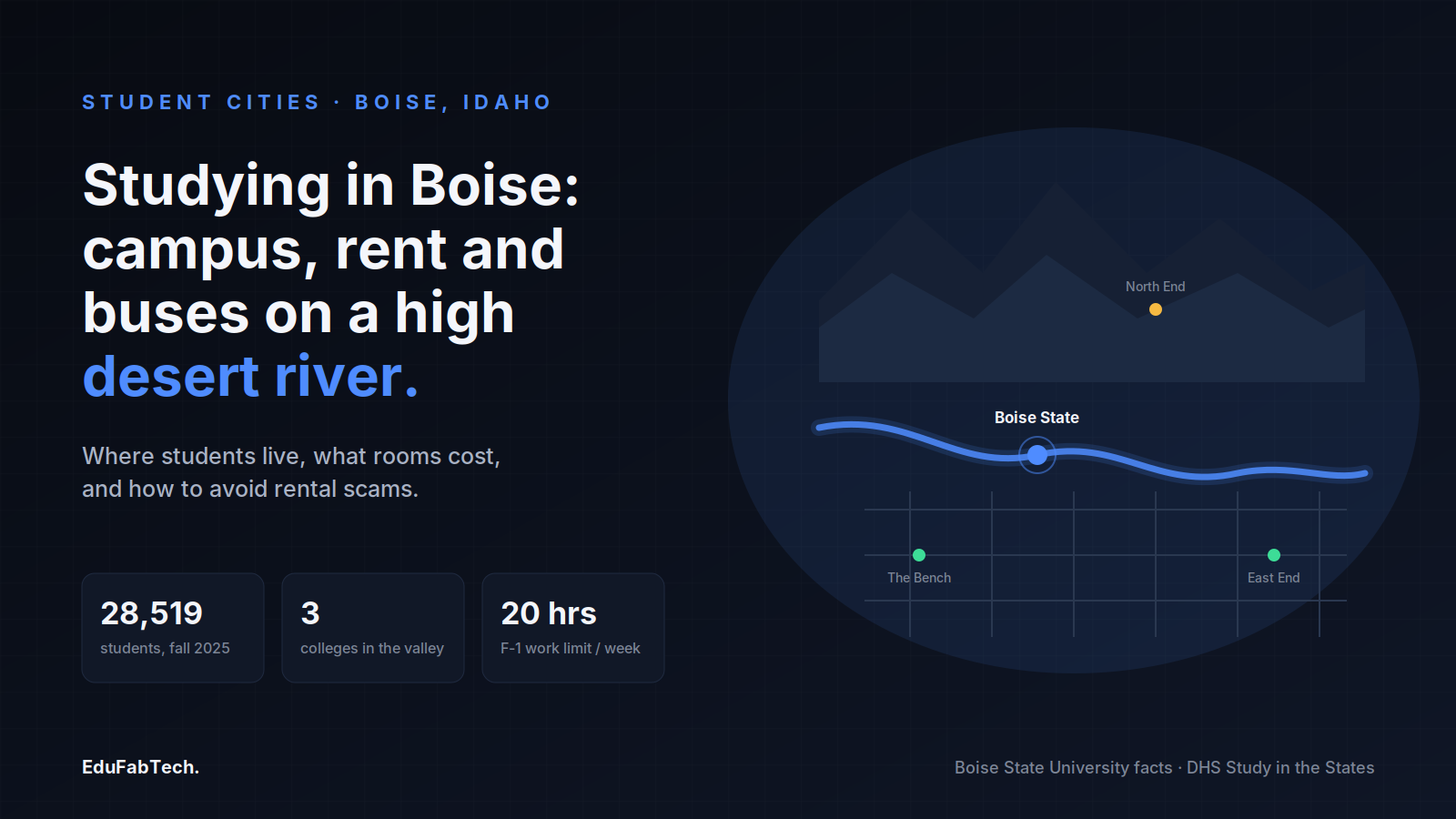
Boise sits where the high desert of southern Idaho meets the foothills, on a river that runs straight through the middle of the city. It is Idaho's capital and its largest city, the hub of a cluster of valley towns — Nampa, Meridian, Caldwell, Eagle, Garden City — that locals call the Treasure Valley. For a student that geography matters in a very ordinary way: the main university campus is downtown, the mountains are twenty minutes behind it, and most of where you will live, shop and work is spread along a flat grid of avenues between the two.
The campus at the heart of it all is Boise State University, on the south bank of the Boise River at 1910 University Drive, directly across the water from Julia Davis Park and the city's downtown core, according to the university's own facts and figures page. If you have seen Boise on television at all, it was probably the bright blue playing surface of Albertsons Stadium, which sits on the same campus. But the day-to-day experience of studying here is less about football and more about a walkable riverfront campus a few minutes from the shops, museums and bus routes of a mid-sized state capital.
This guide covers the universities by name, where students actually find rooms and how to do it without being cheated, furnishing a place cheaply, the rules around part-time work, libraries and study spots, getting around, and the honest pros and cons of the city. Figures are given with their source and year so you can check them yourself; housing costs in particular move every year, so always confirm against the original page before you budget.
The universities in and around Boise
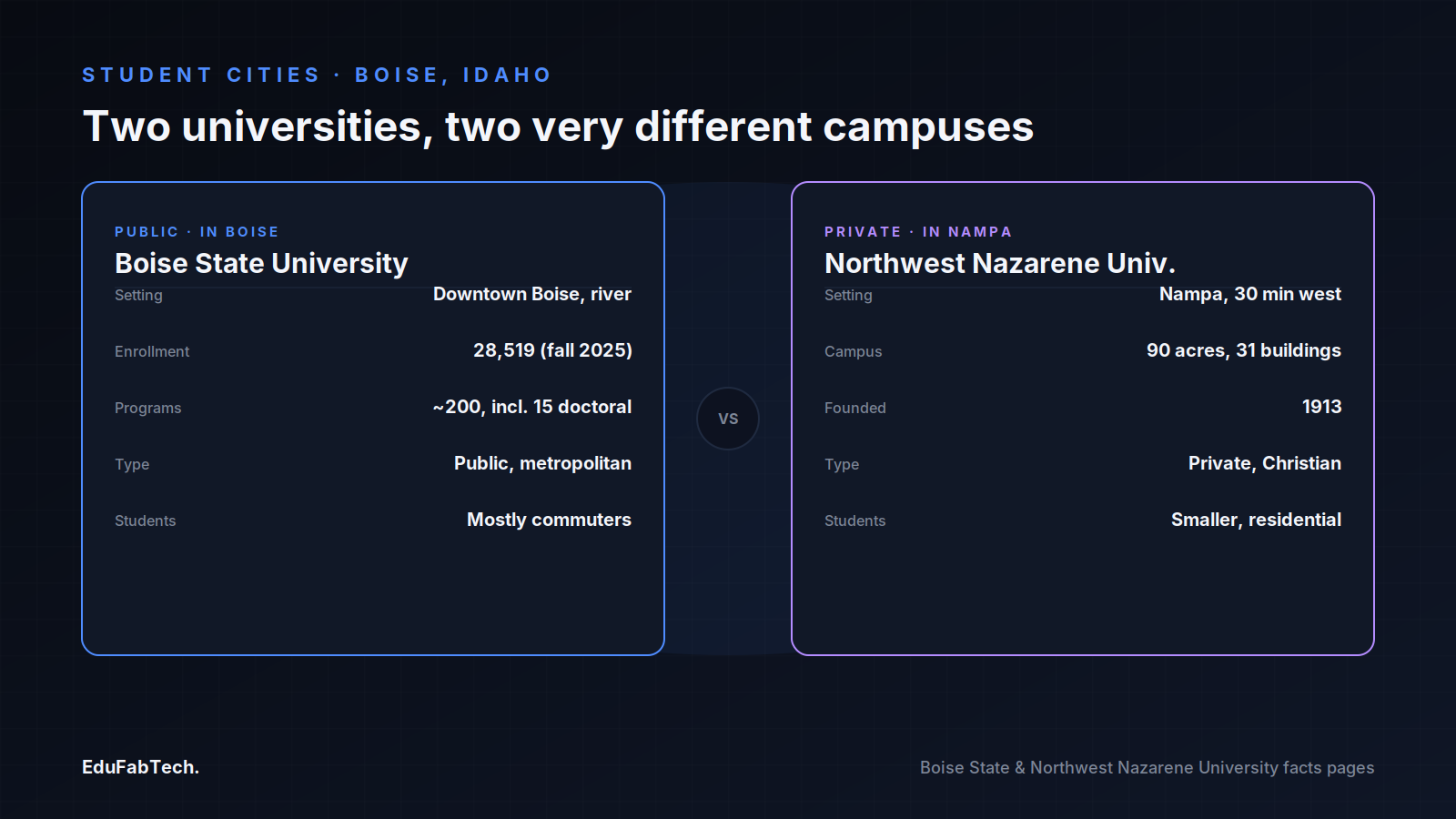
Boise State University is the big one — a public metropolitan research university that enrolled 28,519 students in fall 2025, according to the university's facts page. The same page lists about 200 programs of study, including 15 doctoral programs, from engineering and health sciences to business and public service, and a few genuinely unusual ones — Boise State says it runs the nation's only master's degree in Raptor Biology, which fits a region where birds of prey nest in the nearby Snake River canyon. It is a commuter-heavy campus: a majority of undergraduates are Idaho residents, and many students drive or bus in from elsewhere in the valley rather than living on the quad.
Northwest Nazarene University (NNU) is the other degree-granting university most students in this series will consider. It is not in Boise proper but in Nampa, about half an hour west down Interstate 84, and the university describes its home as a 90-acre campus of 31 buildings within the Boise metropolitan area, at an altitude of around 2,500 feet, on its campus page. NNU is a private Christian university affiliated with the Church of the Nazarene, founded in 1913, and much smaller than Boise State, as set out in its institutional overview. If you are choosing between them, the practical differences are size, setting (urban state capital versus a quieter small city) and the faith-based character of NNU.
One smaller option rounds out the picture. Boise Bible College, in the Garden City enclave just northwest of downtown, is a private Bible college accredited by the Association for Biblical Higher Education that grants associate and bachelor's degrees in biblical and ministry fields, as its at-a-glance page describes. It is a very different, much smaller community than either university, and worth a look only if its programmes match what you want to study. You can see student listings clustered around each on EduFabTech's pages for Boise State University, Northwest Nazarene University and Boise Bible College.
Where students live, from campus to the Bench
Boise State guarantees and houses a large share of its first-year students on campus, and for a newcomer — especially an international student arriving without a car — a residence hall for the first year is the simplest way to land softly. The halls run from older, cheaper buildings to newer suite- and apartment-style complexes, and the university publishes the full price list each year (see the costs section below).
After first year, most students move off campus, and Boise's neighbourhoods have distinct characters. The North End, with its tree-lined streets and bungalows, is the most sought-after and priciest; the Boise Bench, the elevated terrace just south and west of downtown, and the East End near the university tend to be more affordable and are well served by buses. Further out, Garden City, Meridian and Nampa are cheaper again but mean a longer commute. NNU students will mostly look within Nampa itself, where rents are generally lower than central Boise.
Start looking earlier than feels comfortable. Boise has grown quickly and its rental market is tight, so the best-value rooms near campus go first — aim to be searching two to three months before the semester, and expect competition in July and August when everyone arrives at once. When you do find a place, check the basics before any money changes hands: that the person showing it actually controls it, that a written lease names the parties and the monthly rent, what the deposit is and the conditions for getting it back, and who pays for heat, water and electricity, which in Boise's cold winters and hot summers is not a trivial line. EduFabTech's rooms listings for Boise and the wider city page are a place to begin, but the rules below matter wherever you search.
Renting without being scammed
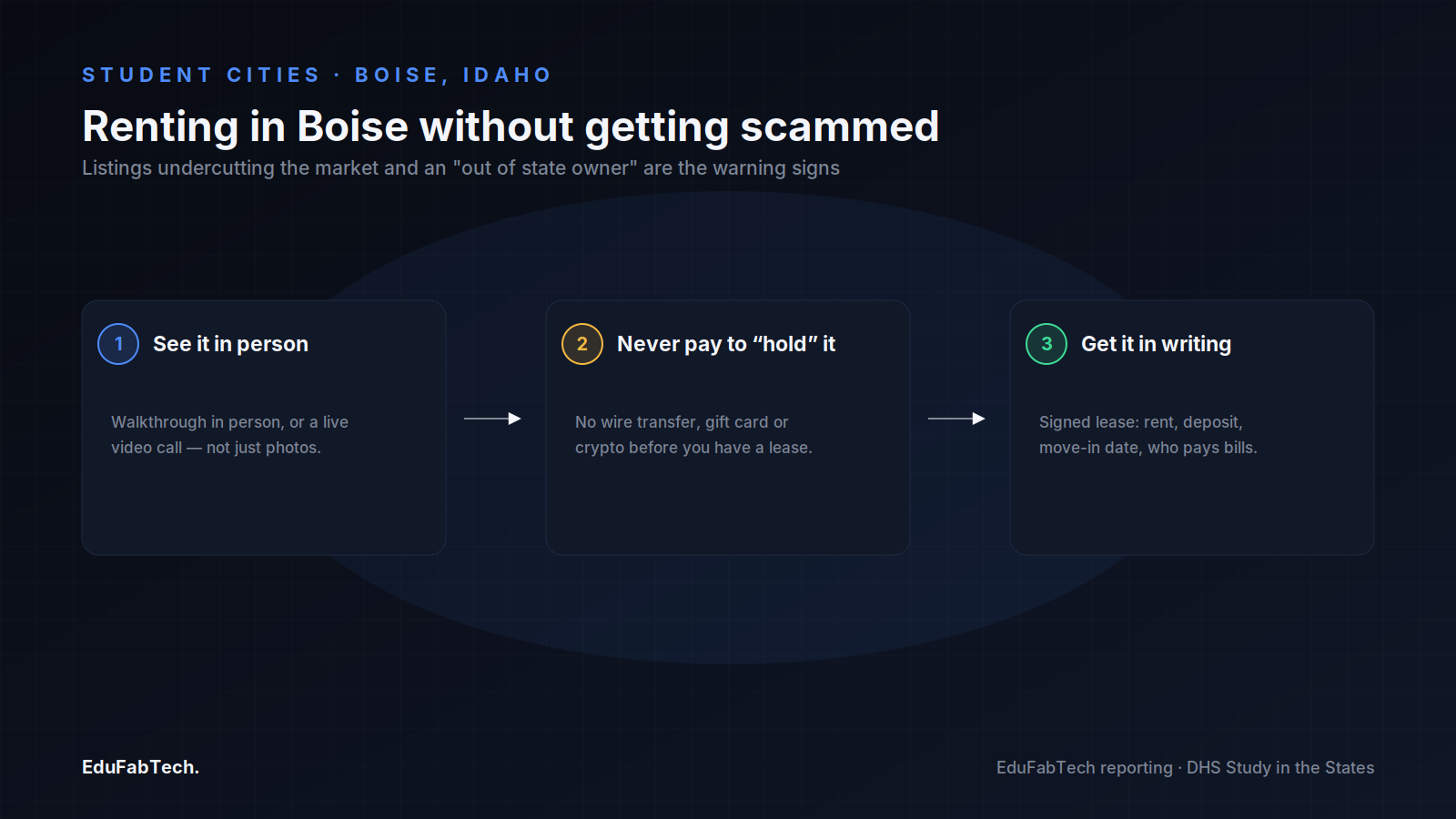
The scams that hit students in Boise follow a pattern. A listing appears at a price that undercuts everything else, often for a house in the North End or near campus; the "owner" is conveniently out of state and cannot show it in person; and you are asked to send a deposit or first month's rent to "hold" it before you have seen inside. Treat that sequence as a warning in itself.
A few rules keep you safe. See the actual unit in person, or have someone you trust see it, before you pay anything — a video call walkthrough is better than nothing but is easy to fake with photos that are not of that unit. Never send money by bank wire transfer, gift card, cryptocurrency or a payment app to someone you have not met to reserve a room; legitimate Boise landlords take a deposit and first month's rent once you sign a lease, not before you have keys. Be wary if a price is far below the going rate, if the person refuses to meet, or if they pressure you to decide today. Get everything — rent, deposit, move-in date, what is included — in a signed written lease, and keep copies. If you are coming from abroad and arranging a room before you land, lean on your university's housing or international student office rather than paying a stranger sight unseen.
Furnishing a room on a student budget
Boise is a good city for second-hand. The clearest starting point is Idaho Youth Ranch, a long-running Idaho non-profit whose thrift-store sales fund its youth programmes and which runs several stores across the city, including a large one on South Broadway Avenue near the Boise State side of the river (store details here). For the thriftiest option of all, the Idaho Youth Ranch Outlet Bins on West Irving Street sells donated goods by weight rather than by item — bring patience and dig. These are the kinds of places to kit out a room with crockery, a desk lamp, bedding and a chair for very little.
For food and the weekend rhythm of the city, the Capital City Public Market is a fixture: founded in 1994, it runs every Saturday in downtown Boise from April into December with more than 150 rotating vendors selling produce, local food, and handmade crafts, according to the market's own description. It is as much a place to meet people as to shop. For the practical business of furnishing and re-using, EduFabTech also lists second-hand things, used furniture and items given away free around Boise — the last of which fills up at the end of each semester when students clear out.
Working while you study
If you are an international student on an F-1 visa, the rules are set by U.S. federal law, not the university, and you should read them at the source. The U.S. Department of Homeland Security's Study in the States site states that F-1 students may work on campus but may not work more than 20 hours per week when school is in session, and that you must talk to your Designated School Official (DSO) before you begin, since on-campus work needs your DSO's approval while your SEVIS record is active, as explained on its working in the United States page. On-campus jobs — the library, dining halls, departmental roles — are the standard first option because they do not need separate work authorisation. Anything off campus has stricter conditions; do not take an off-campus job, or work more than the permitted hours, without checking with your DSO first. This is a pointer to the official rules, not legal advice, and your own circumstances may differ.
Domestic students face no such cap and commonly work in Boise's hospitality, retail and campus jobs. Either way, EduFabTech's Boise jobs listings are one place to look for part-time work near campus.
Libraries and places to study
On campus, Albertsons Library is the main study building, at 1865 Cesar Chavez Lane. During term it keeps long hours — Monday to Thursday from 7 a.m. to 10 p.m., shorter on Friday and Saturday, and open again on Sunday — with online resources available around the clock, per the library's hours and location page; note that parts of the building have at times been closed for renovation, so check before you plan a late night there. It also houses a MakerLab for students who need tools beyond a desk.
Off campus, the Boise Public Library's main branch sits downtown at 715 S. Capitol Boulevard, a short walk or bus ride from the university across the river. The downtown library has been undergoing construction and the city has said all three floors are due to reopen to the public in mid-December 2026, according to a City of Boise announcement — worth checking its current hours before you go. A public-library card is free for residents and gives you a quiet, no-cost alternative to campus during busy exam weeks. For desks, group rooms and other spots students actually use, EduFabTech keeps a running list of study spaces in Boise.
Getting around: the free campus bus and the Greenbelt
Buses in the Treasure Valley are run by Valley Regional Transit under the ValleyRide brand. A single local ride is $1.50 and an all-day pass is $2.50, according to VRT's fares and passes page. The crucial detail for Boise State students is that you do not normally pay at all: the university states that students, faculty and staff ride free on all Valley Regional Transit buses, using a free bus sticker added to your Bronco Card ID at the Student Union Building, as set out on Boise State's alternative transportation page. Get that sticker in your first week — it turns a flat, grid-planned city into something you can cross without a car.
That said, Boise is a car-oriented city and bus frequencies are modest compared with a large metro, so a bicycle is a genuinely useful second option. The Boise River Greenbelt, a riverside path of roughly 25 miles, runs right past the Boise State campus and connects downtown, the parks and much of the East End, making cycling or walking to class pleasant for much of the year. Pay the ValleyRide fare only when you are off campus and off the free programme — otherwise your Bronco Card is the fare.
What it costs
The clearest sourced figures come from Boise State's own housing office. For 2026-27 the university published proposed residence-hall room rates — still to be finalised by the Idaho State Board of Education at the time of writing — ranging from the older halls at the lower end (Chaffee Hall at roughly $5,200 to $7,000 for the academic year, Towers Hall at about $7,000 for a suite double) up to the newest apartment-style building, The Osprey, at $12,400 to $15,300, all on the housing rates page. First-year students in traditional halls must also buy a meal plan, listed at $5,970 for the year on the same page. For those staying in university apartments rather than halls, Boise State's apartment rates page lists University Heights at $936 a month for a one-bedroom and $1,030 for a two-bedroom for 2026-27. These are the strongest dated housing numbers available; private off-campus rents vary widely by neighbourhood and should be checked unit by unit rather than assumed.
Beyond rent, budget for the Idaho winter and summer in your utility costs, for a meal plan or groceries, and for the small things a thrift run can cover cheaply. The free bus removes one recurring cost that bites students in many cities.
The honest trade-offs
What is good about Boise for a student is real. It is a safe-feeling, walkable state capital with a compact downtown, a river and a 25-mile greenbelt threaded through it, mountains and desert within easy reach, and a flagship university whose buses you ride for free. The campus is close to the city's cultural and civic core, not stranded on a ring road.
What is hard is mostly a consequence of the city's popularity. Boise has grown fast, and housing supply has not kept pace, so rooms near campus are competitive and off-campus rents have climbed well above what Idaho's smaller towns charge. It is a car-centred valley: without a bike or a bus habit, getting beyond campus to Meridian or Nampa takes planning. The climate swings hard — cold, sometimes snowy winters and genuinely hot, dry summers — and summer wildfire smoke can settle over the valley for days. And it is a mid-sized city, not a metropolis; the nightlife and the number of big employers are smaller than a coastal hub, which some students love and others find quiet.
A short checklist for your first weeks
- Get your Bronco Card and add the free Valley Regional Transit bus sticker at the Student Union Building before you start commuting.
- If you are on an F-1 visa, meet your DSO early and confirm the on-campus work rules before accepting any job.
- Never pay a deposit before you (or someone you trust) have seen the unit in person; never wire money, buy gift cards or send crypto to hold a room.
- Get a Boise Public Library card and scout both the public library and Albertsons Library for the study spot that suits you.
- Kit out your room from Idaho Youth Ranch and the end-of-semester free-stuff listings before buying anything new.
- Learn one or two bus routes between home, campus and downtown, and walk or cycle the Greenbelt once to see how the city fits together.
- Check the Boise events listings to meet people in your first month.
A quick question for readers
Do you work part-time while you study?
Many students work to pay the bills. See how common it is — and how many hours people really do.
Pick an answer, create a free account in a minute, and your vote counts. Already a member? Sign in
Comments 0
CommentNo comments yet. Members start the conversation.
Source: Boise State University
Sources (5)
- Boise State University. 2026-2027 Housing Rates. Boise State University, 2026. boisestate.edu ↗ · checked 17 Oct 2026
- Boise State University. Facts and Figures. Boise State University, 2025. boisestate.edu ↗ · checked 17 Oct 2026
- Valley Regional Transit. Fares and Passes. Valley Regional Transit, 2026. valleyregionaltransit.org ↗ · checked 17 Oct 2026
- U.S. Department of Homeland Security. Working in the United States. Study in the States, 2026. studyinthestates.dhs.gov ↗ · checked 17 Oct 2026
- Capital City Public Market. About. Capital City Public Market, 2026. capitalcitypublicmarket.com ↗ · checked 17 Oct 2026