Studying in Bowling Green, United States: universities, housing and student life
A practical, honest guide to studying in Bowling Green, Ohio — the university, where students live, what a room costs, second-hand shops, part-time work rules, study spaces and getting around.
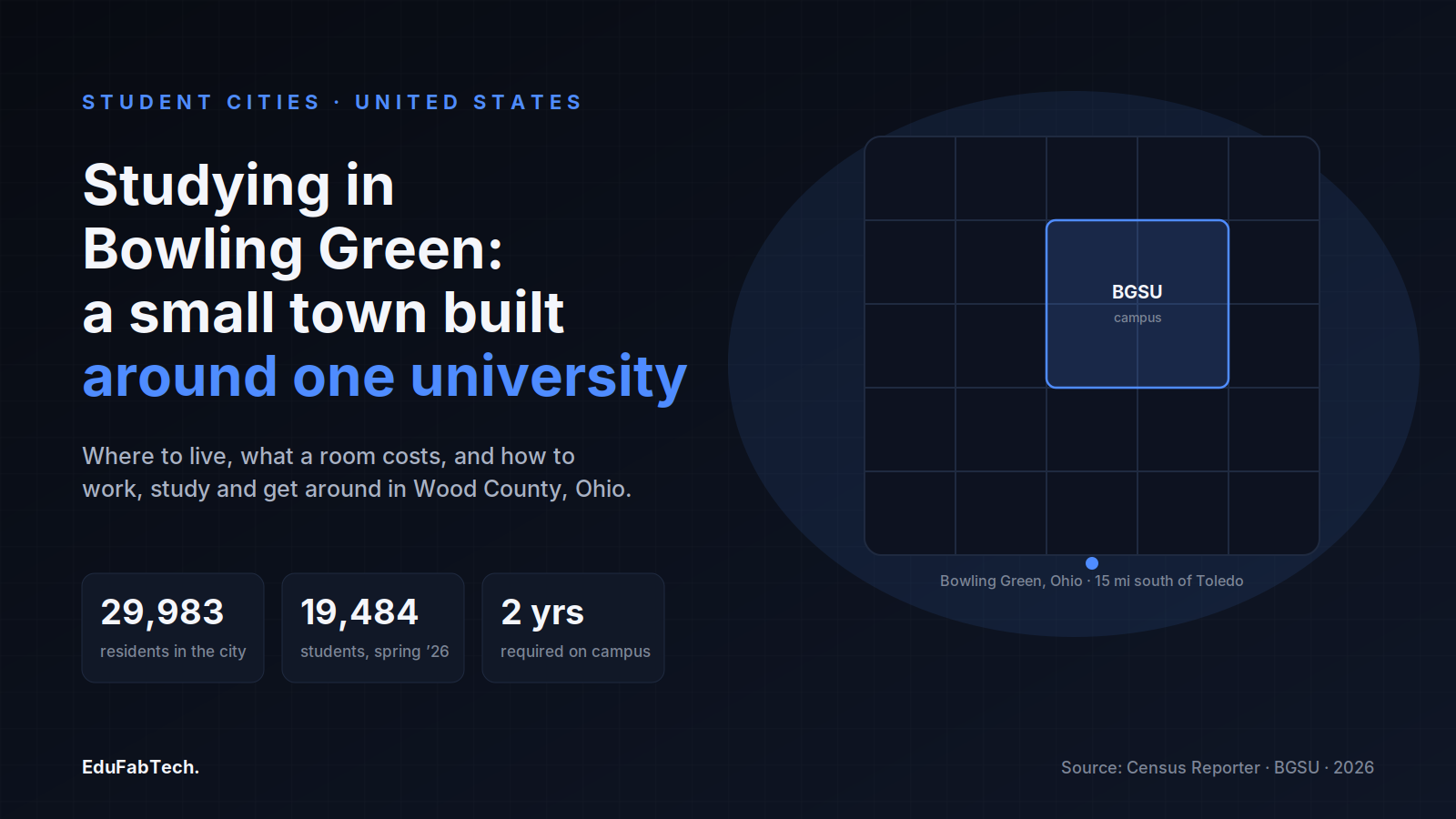
Bowling Green sits on flat, open farmland in Wood County, about fifteen miles south of Toledo in northwest Ohio, and it is one of the clearest examples in the state of a town built around its university. According to the U.S. Census Bureau's 2024 five-year American Community Survey estimates, as compiled by Census Reporter, the city has about 29,983 residents and a median household income of $45,154 — a figure held down by the thousands of students who live here, rather than a measure of local wages. When the semester ends, Main Street and the residential streets near campus noticeably empty out.
The university at the centre of all this is Bowling Green State University, a public institution founded in 1910. On its own about page, BGSU describes offering more than 200 undergraduate majors and programs to more than 19,600 students, says it is ranked a tier-one public university by U.S. News & World Report, and promotes a campus-wide "Life Design" advising approach. It reported its largest spring enrolment in nearly two decades in January 2026, with 19,484 students, a 3.7% rise over the previous spring. The campus is known for programs in education, business and the creative arts, and its teams compete as the Falcons.
Within the university, the Bowling Green State University College of Business Administration — now named the Allen W. and Carol M. Schmidthorst College of Business — runs undergraduate and graduate business degrees, including an AACSB-accredited MBA. If you are coming to study business, that is the college you will deal with, and its building sits on the main Bowling Green campus rather than at a separate site.
Living on campus, and what a room actually costs
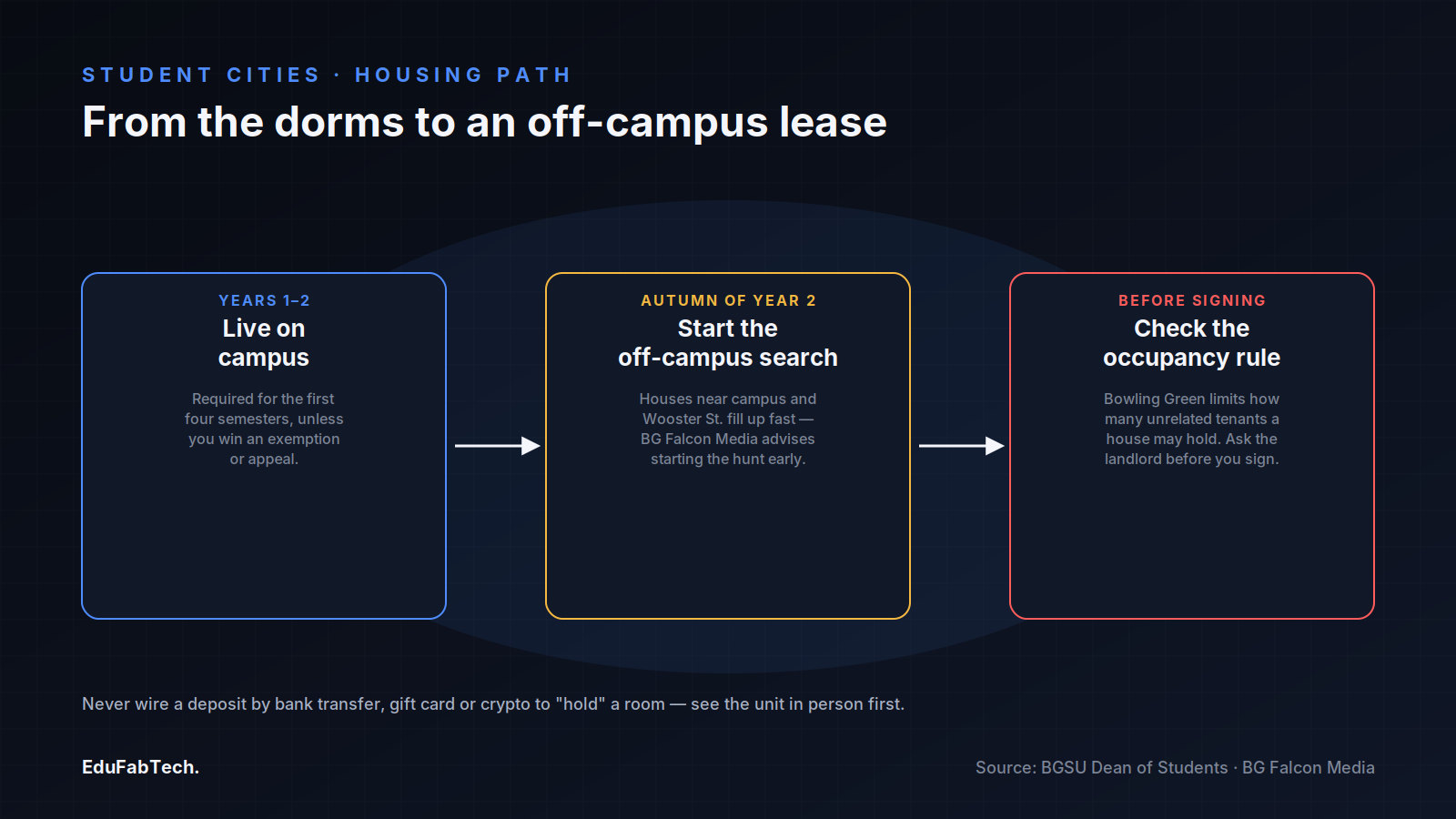
You should assume you will live on campus at first. BGSU's Office of the Dean of Students states that undergraduates must live on campus for their first two years — four semesters — unless they meet exemption criteria or win an appeal. That rule shapes the whole housing picture: first- and second-year students are in the residence halls, and the off-campus market is mostly third- and fourth-years, graduate students and international students who qualify for an exemption.
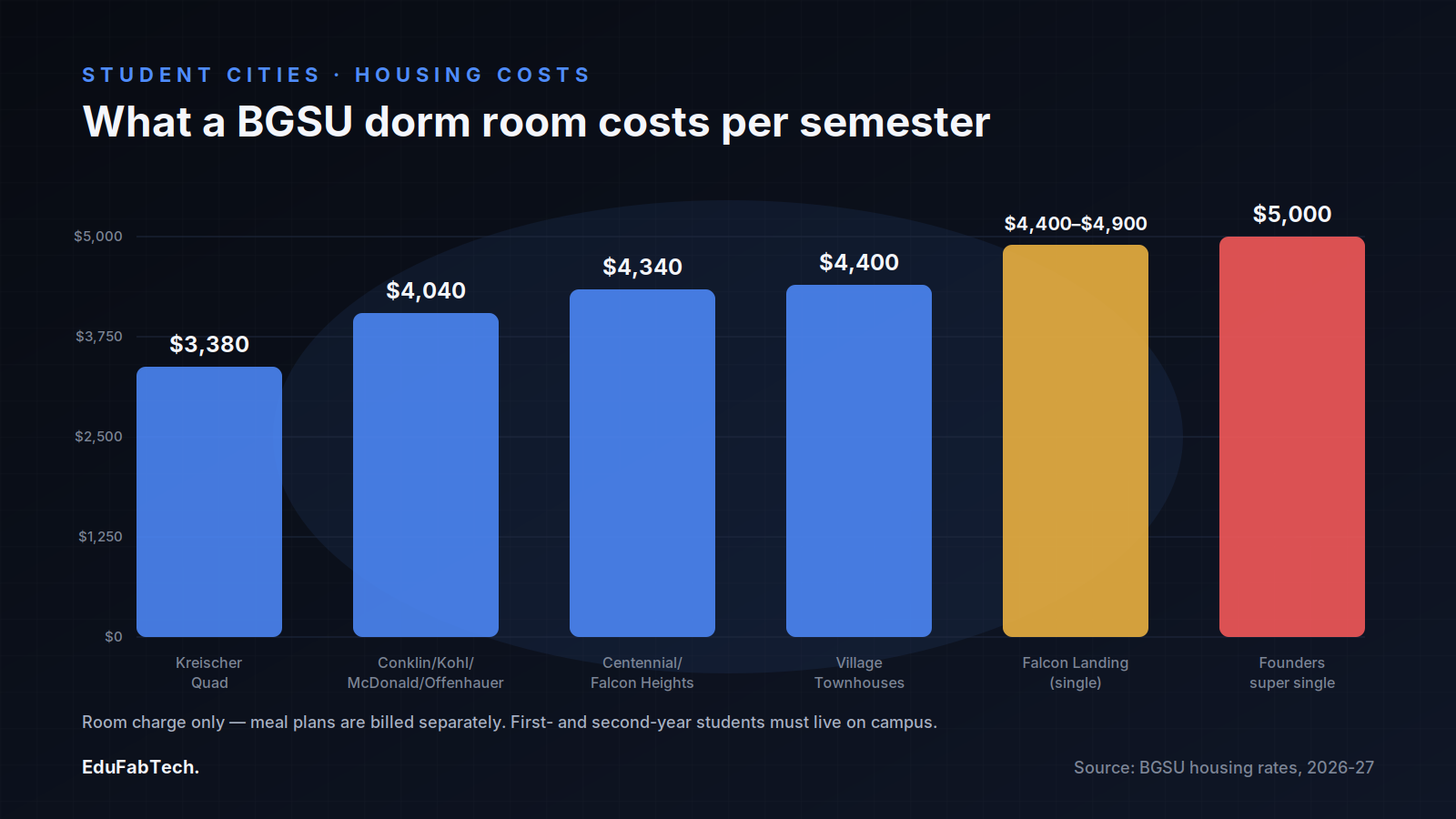
The halls themselves are priced per semester, for the room only, with meal plans billed separately. On BGSU's 2026-27 housing rates page, a double or quad room in Kreischer Quadrangle is listed at $3,380 per semester, the cheapest standard option; doubles in Conklin, Kohl, McDonald and Offenhauer Towers are $4,040; Centennial Hall and Falcon Heights doubles are $4,340; and The Village Townhouses are $4,400. Single rooms run from $4,400 up to $4,900 in Falcon Landing, and a "super single" in Founders Hall reaches $5,000 per semester. These are housing charges before any meal plan, so budget the dining cost on top.
Moving off campus: when to look, and the rule people forget
The off-campus search here starts earlier than newcomers expect. BGSU's student newspaper, BG Falcon Media, has reported that students are advised to start the off-campus search in the autumn, because the best houses close to campus fill up quickly. Most off-campus student housing clusters north and east of campus, within walking or cycling distance of Wooster Street, and in the low-rise apartment complexes around the edges of town.
One local rule catches people out. The Dean of Students office warns that Bowling Green has an occupancy ordinance limiting how many unrelated people may share a dwelling, and advises you to ask a property manager about that ordinance before signing — a four-person house may legally sleep fewer than four unrelated tenants. On scams: the danger here is the same as in any college town where demand peaks in spring. Fake listings appear on social-media marketplace posts and sublet groups, often for a room near campus at a suspiciously low rent. See the unit in person — or send someone you trust — before paying anything, confirm the person showing it actually controls the lease, and never send a deposit by bank transfer, gift card or cryptocurrency to "hold" a room. A legitimate Bowling Green landlord will give you a written lease and a normal security deposit; nobody credible needs crypto to reserve a flat. You can start comparing rooms in Bowling Green or browse all student listings in the city before you commit.
Furnishing a room without overspending
Because the student population turns over every year, Bowling Green has a steady supply of cheap second-hand furniture — and a cluster of thrift shops to match. The Bowling Green convention and visitors bureau lists Goodwill at 1058 N. Main St., the Habitat for Humanity ReStore at 829 W. Newton Rd. (useful for furniture, housewares and building odds and ends), The Fringe Thrift Store at 1234 North St., and Buffs at 140 E. Wooster St. The ReStore and Goodwill are the two to try first for a desk, a lamp or a set of plates. The other reliable source is the end of the academic year: when leases end in the spring, usable furniture gets left at the kerb and given away, so timing a pick-up to late April or early May can furnish a room for almost nothing.
For fresh food, a farmers' market runs downtown through the warm months, and three full supermarkets — Meijer, Kroger and ALDI — sit within the town, so you are not dependent on campus dining once you move out. On EduFabTech you can also scan second-hand things and things given away free around the city.
Working while you study
On-campus jobs — in dining, the library, recreation and departmental roles — are the simplest first job, and for international students they come with the fewest conditions. The U.S. Department of Homeland Security's Study in the States service, run by the Student and Exchange Visitor Program, states plainly that an F-1 student "may not work more than 20 hours per week when school is in session." The same page explains that on-campus employment generally does not require a separate work-authorisation application, while off-campus employment requires a recommendation from your Designated School Official (DSO) and, in most cases, authorisation from U.S. Citizenship and Immigration Services (USCIS) before you can begin; training options such as Curricular Practical Training (CPT) and Optional Practical Training (OPT) are also arranged through your DSO. This is general information, not legal advice: confirm your own situation with BGSU's international student office and the official DHS pages before you accept any job. Current openings students post locally sit on the EduFabTech jobs board for Bowling Green.
Libraries and places to study
The anchor is the eight-floor Jerome Library at the heart of campus. BGSU's study-spaces guide describes a first-floor Learning Commons with more than 60 tables and 200 chairs, ten private cubicles and a presentation space, four bookable group study rooms for three to eight people on the first floor with more on the seventh, and an eighth floor kept for quiet study with a view over campus. During the last two weeks of each semester the library runs "24/5" hours — open around the clock, five days a week — as part of BGSU's Final Push. For a change of scene, the independent cafés and the public library downtown give you somewhere to work off campus. EduFabTech also tracks study spaces and desks around town for when the library is packed at exam time.
Getting around a flat, walkable town
Bowling Green is small and level, which makes walking and cycling genuinely practical — many students never need a car day to day, and the campus itself is compact. Public transport works differently from a big city, though. The City of Bowling Green runs BG Transit as a demand-response, origin-to-destination service rather than fixed bus routes: you book a ride, ideally at least an hour ahead by phone, and it collects you. The city lists a fare of $4 for riders aged 4 to 64 within Bowling Green and $4.50 for trips that start or end outside the city limits, with a reduced fare of $2 (or $2.25 outside the limits) for seniors, people with disabilities and children aged 4 to 13 who hold a Transit ID card; the page states no separate university-student discount. BGSU also operates its own campus shuttle service for students during the school week. Toledo, fifteen miles north, is the nearest city for an airport, bigger shops and intercity connections.
The honest trade-offs for students
What is good: Bowling Green is an affordable, compact and safe-feeling college town where you can live without a car, the university is large enough to offer real academic range, and Toledo is close when you want a city. What is hard: it is a genuinely small town, so nightlife, restaurants and shopping beyond campus are limited, and the place quietens dramatically over the summer. Winters in northwest Ohio are cold, grey and windy across open country. The demand-response transit is helpful but is not a turn-up-and-go bus network, so a bicycle is the more reliable everyday option. The two-year on-campus requirement adds cost you cannot avoid in your early years, and the off-campus market rewards people who start looking months ahead. Read the headline poverty and income figures for the town with care, too: they reflect a population dominated by students, not a settled workforce.
A checklist for your first weeks
- Confirm which residence hall you are assigned to and what the per-semester rate and meal plan actually cost you, so there are no billing surprises.
- If you are a third-year or international student seeking an exemption, contact the Dean of Students office early and ask about the occupancy ordinance before signing any lease.
- Never pay a deposit before seeing the place in person, and never pay by transfer, gift card or crypto.
- International students: register with the BGSU international office and read the DHS rules on working before taking any job.
- Get a bicycle and a lock; learn how to book BG Transit for the days you cannot cycle.
- Furnish from Goodwill and the Habitat ReStore, and watch the kerbside giveaways at the May move-out; check what is going free and second-hand nearby.
- Find your spots in Jerome Library before exams, when the extended finals-week hours and every table fill up.
A quick question for readers
Do you work part-time while you study?
Many students work to pay the bills. See how common it is — and how many hours people really do.
Pick an answer, create a free account in a minute, and your vote counts. Already a member? Sign in
Comments 0
CommentNo comments yet. Members start the conversation.
Source: Bowling Green State University
Sources (5)
- Bowling Green State University. 2026-27 Housing Rates Per Semester. BGSU Office of Residence Life, 2026. bgsu.edu ↗ · checked 16 Oct 2026
- Bowling Green State University. Off-Campus Student Services. BGSU Office of the Dean of Students, 2026. bgsu.edu ↗ · checked 16 Oct 2026
- City of Bowling Green. BG Transit – Public Transportation. City of Bowling Green, Ohio, 2026. bgohio.gov ↗ · checked 16 Oct 2026
- U.S. Department of Homeland Security. Working in the United States. Study in the States (SEVP), 2026. studyinthestates.dhs.gov ↗ · checked 16 Oct 2026
- U.S. Census Bureau. Bowling Green, OH — ACS 2024 5-year estimates. Census Reporter, 2024. censusreporter.org ↗ · checked 16 Oct 2026