Studying in Charlotte: universities, housing and student life
A practical guide to UNC Charlotte, Queens and life in the Queen City — where students live along the Blue Line, what a dorm room costs in 2026-27, how to get around, and the honest trade-offs.
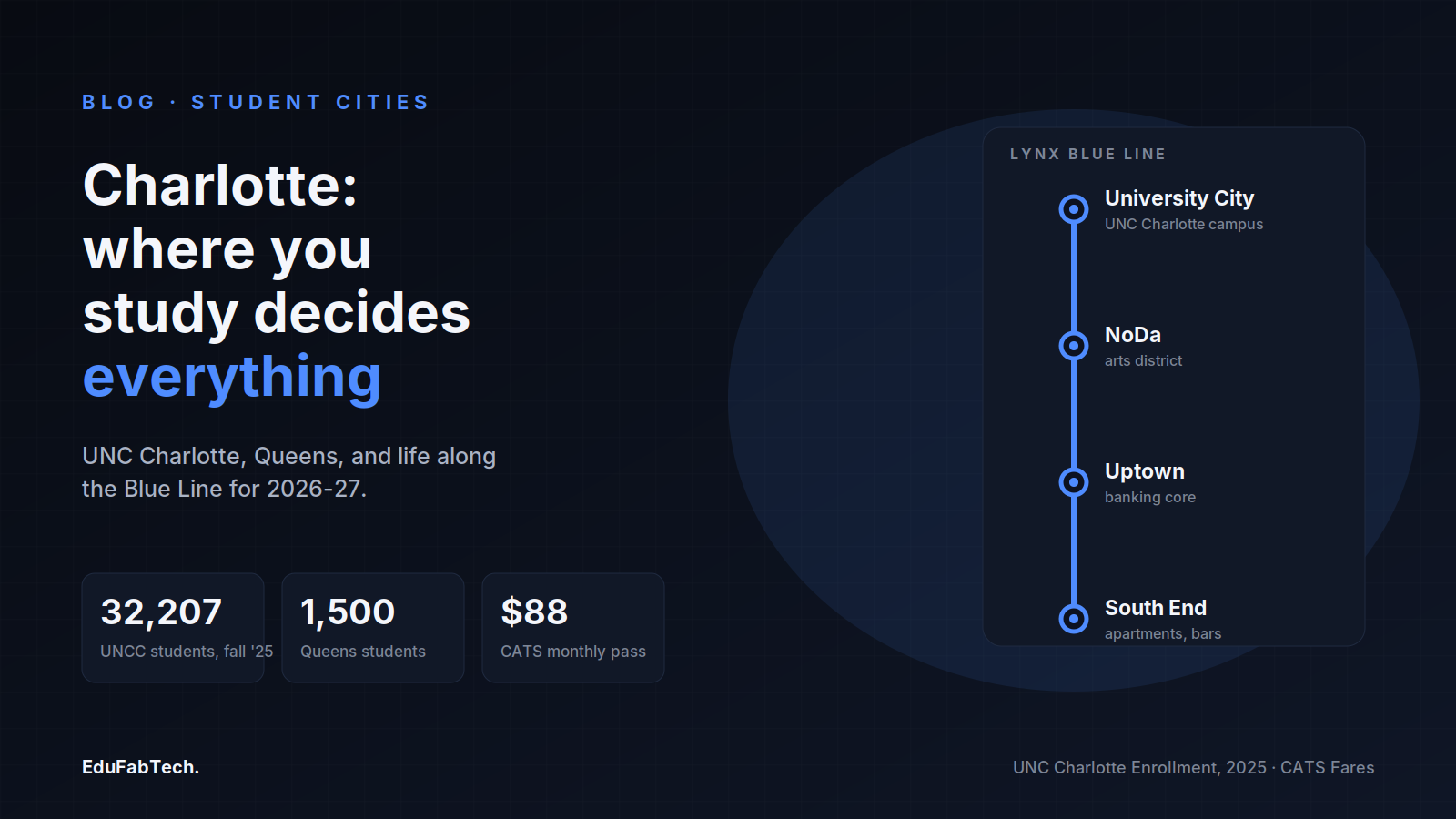
Charlotte sits in the Piedmont of North Carolina, a banking town that grew faster than almost anywhere in the American Southeast and is still catching up with itself. For students that means two things at once: a city with real jobs, a light-rail spine and a dense Uptown of glass towers, and a city where the student world is split between two very different corners. In the northeast is University City, built around a sprawling public research campus. South of the centre, in a canopy of old oaks, is a small private university that still feels like a residential college. Where you study decides almost everything else about how you live here.
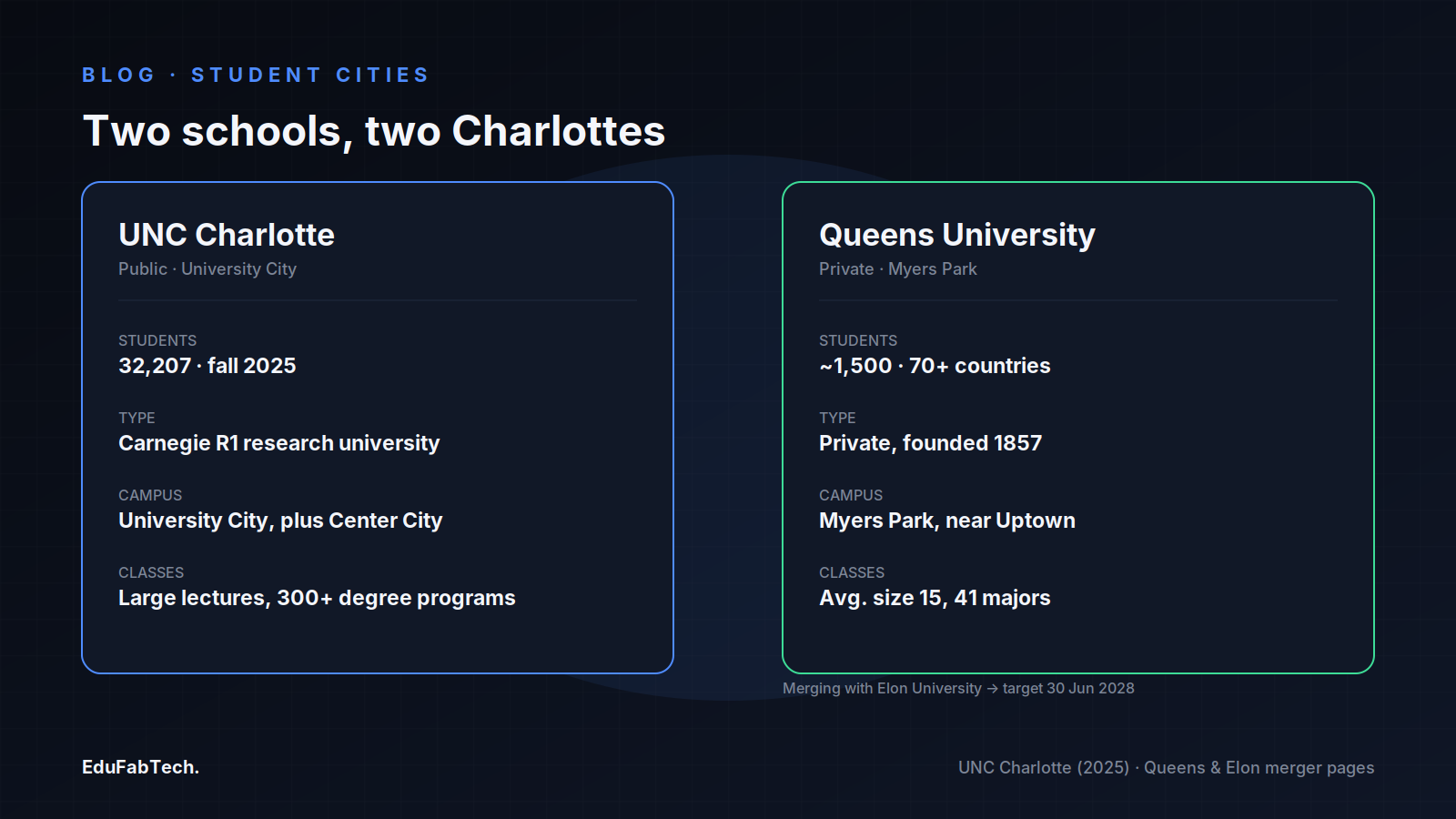
The bigger of the two is the University of North Carolina at Charlotte, whose main campus occupies wooded land in University City, several miles northeast of Uptown, with a smaller Center City campus in the downtown core. It is a Carnegie R1 research university, and it is growing hard. According to UNC Charlotte's own announcement (2025), the university enrolled 32,207 students in fall 2025 — 26,213 undergraduate and 5,994 graduate — surpassing its previous record of 31,091 set in fall 2024. The same page describes Charlotte as a "top-tier R1 institution" with more than 300 degree programs. The practical upshot for a new student is scale: large lecture courses, a campus you walk or ride a shuttle across, and a student body larger than many a small American town.
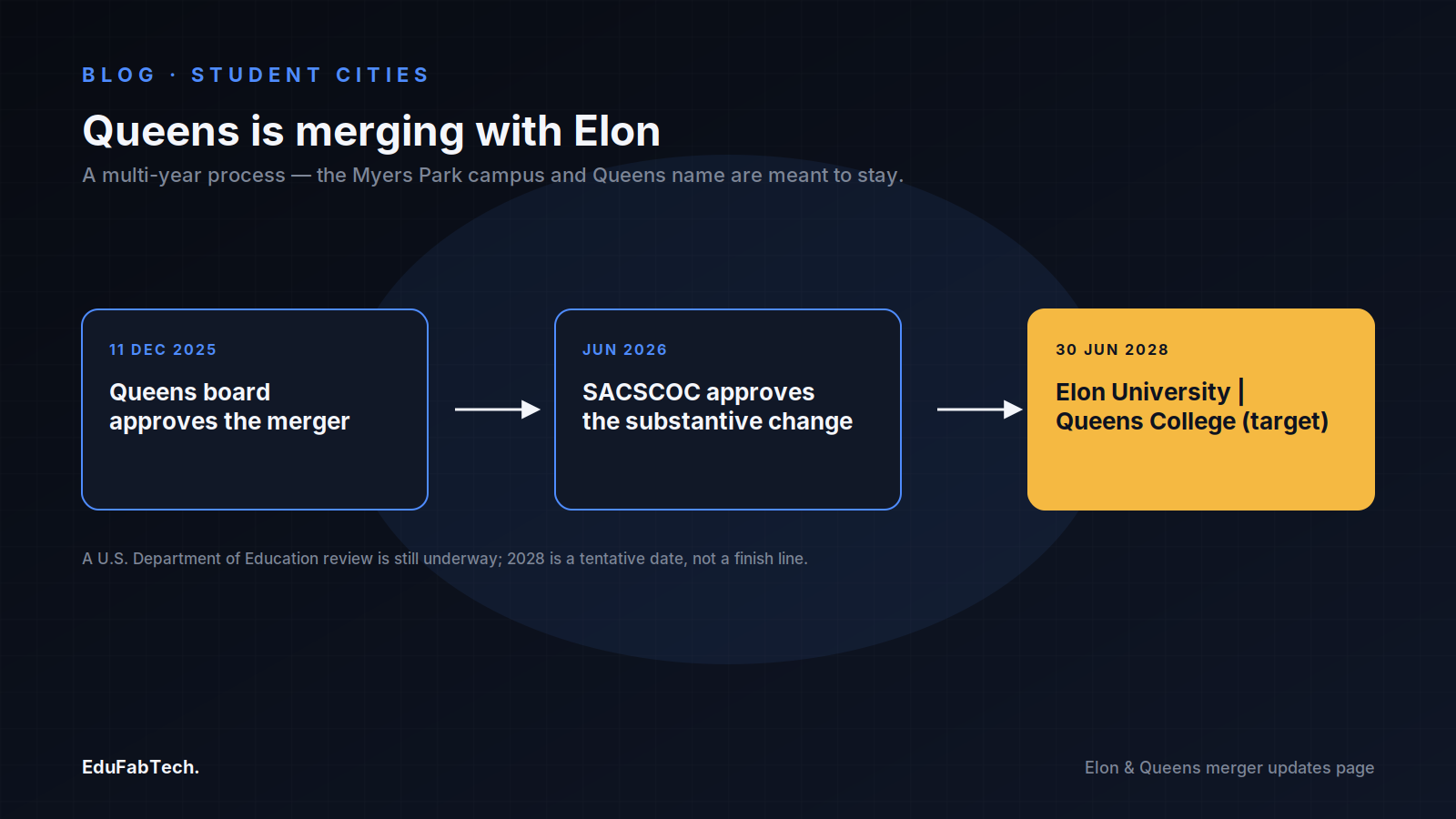
The smaller institution is Queens University of Charlotte, in the historic Myers Park neighbourhood a short way south of Uptown. Its own "Get to Know Queens" page describes a university of roughly 1,500 students from 40-plus states and 70-plus countries, founded in 1857, with 41 majors and an average class size of 15. It is a place where you are likely to know your professors by name. One thing to understand before you apply: Queens is merging with Elon University. The institutions' Elon & Queens merger page records that the Queens Board of Trustees unanimously approved the merger on 11 December 2025, and that in June 2026 the Southern Association of Colleges and Schools Commission on Colleges approved the substantive change — the most significant accreditation milestone so far. A U.S. Department of Education review is still underway, and the page lists a tentative completion date of 30 June 2028. The combined undergraduate unit in Charlotte is planned to be called Elon University | Queens College, with the plans designed to preserve the Queens name and the residential undergraduate experience on the Myers Park campus. Because this is still moving, read the official updates for the current status rather than second-hand summaries.
Those are not the only places to study in the area. In Concord, northeast of the city, Cabarrus College of Health Sciences sits on the campus of Atrium Health Cabarrus; its own site lists associate, bachelor's and master's programmes in nursing and allied health, which makes it a genuine option if health care is your field. You can see listings around the main campus on EduFabTech at near UNC Charlotte, or browse everything for the city at Charlotte on EduFabTech.
University City, South End and the Blue Line: where students settle
Housing choices in Charlotte follow the LYNX Blue Line, the light-rail route that runs from the UNC Charlotte main campus down through NoDa and Uptown to the apartment-heavy South End and on to the southern suburbs. Most UNC Charlotte undergraduates start on campus, and for the newest ones that is not optional: the university's housing office states that "the First-Year Live-On Requirement for first-time in college (FTIC) students began with those who were admitted for fall 2025," with exemptions for specific circumstances. The general housing application, that page notes, opens "in early Spring semester," so the time to apply is the spring before you arrive, not the summer.
Beyond the first year, students spread out. Around the main campus, University City is full of purpose-built apartment blocks within walking or shuttle distance of class — convenient, but the demand is real and the best-located buildings fill early. Along the Blue Line, NoDa and South End draw students who want bars, music and a car-free commute into Uptown, at a price that reflects how fashionable those districts have become. Queens students mostly stay close to Myers Park and the neighbouring Dilworth and Plaza Midwood areas, which are leafy and central but not cheap. A sensible rhythm for off-campus searching is to start in January and sign by March for an August move-in; waiting until July means thin pickings near campus.
Charlotte's rental scams look like scams everywhere, but they cluster where students are most rushed: University City listings that are priced suspiciously low, "landlords" who are travelling and cannot show the unit, and demands to send a deposit to "hold" a room before you have seen it. The rule that protects you is simple. See the actual unit in person, or have someone you trust see it, before any money moves. A normal deposit here is paid to a named management office by a traceable method after you have signed a lease — never by bank wire, gift card or cryptocurrency to an individual. If a request cannot survive a face-to-face viewing and a written lease, walk away. You can compare genuine options on EduFabTech's Charlotte rooms listings.
Furnishing a room without overspending
An empty room is an opportunity to shop second-hand, and Charlotte has the outlets for it. The Habitat for Humanity of the Charlotte Region runs several ReStores selling donated furniture, appliances and home goods, with the proceeds funding local home-building — a reliable place for a desk, a mattress frame or a lamp at a fraction of retail. For food and the weekend ritual of a market, the Charlotte Regional Farmers Market at 1801 Yorkmont Road is operated by the N.C. Department of Agriculture and runs year-round with produce, baked goods and crafts across its buildings. In Uptown, the 7th Street Public Market is a food hall rather than a flea market, but it is an easy stop off the Blue Line when you want to know the city rather than just your campus. For the practical business of kitting out a room, EduFabTech's second-hand furniture page for Charlotte is worth checking, especially in late August and in May when leases turn over and students give things away.
Working while you study
If you are an international student, treat employment as something with rules attached, not a casual sideline. UNC Charlotte's International Student and Scholar Office sets out the basics on its student employment page: F-1 students may "work part time, up to 20 hours per week, on-campus during the academic year" and "full-time, 40 hours per week, during summer vacation," and for any off-campus work "authorization and approval from the ISSO is always required prior to a student undertaking any off-campus work." Off-campus options such as Curricular Practical Training and Optional Practical Training depend on your programme and timing. This is not legal advice; check your own status with the ISSO (or the equivalent office at your university) and with the federal authorities before you accept any job. Domestic students face no such immigration limits, and a growing city with hospitals, banks and a large university campus has steady part-time demand; EduFabTech's Charlotte jobs listings are one place to look.
Libraries and places to study
At the centre of UNC Charlotte's study life is the J. Murrey Atkins Library, in the heart of the main campus. The library's own site lists reservable study rooms, both single and group study spaces, dedicated quiet and silent study areas, and nap pods on the third floor for the long nights before deadlines. Check its hours page for current opening times, which vary by term. Queens students have the Everett Library on the Myers Park campus. Beyond the campuses, the Charlotte Mecklenburg Library system runs branches across the city if you want a change of desk; EduFabTech also collects local options on its Charlotte study-spaces page.
Getting around: the Blue Line and the bus
Charlotte is a driving city with one strong exception — the LYNX Blue Line — and students are among the people best placed to use it, because the northern end of the line reaches the UNC Charlotte main campus. The Charlotte Area Transit System (CATS) is run by the City of Charlotte, and its fares page lists a local bus and rail one-way adult fare of $2.20 and a local monthly pass at $88.00, with a reduced $1.10 one-way fare for eligible youth and riders with disabilities. UNC Charlotte students do better than that. The university's Parking and Transportation Services explains on its CATS All-Access Pass page that currently enrolled students who have paid the Miscellaneous Transportation Service Charge receive, automatically, "unlimited rides on all Charlotte Area Transit System (CATS) buses, streetcars, the airport sprinter and the LYNX Blue Line"; students who have not paid the charge can buy a discounted semester pass for $25. For a student living near a Blue Line station, that pass can replace a car entirely. Away from the rail corridor, though, buses are less frequent and a car still shapes daily life.
What it costs
The clearest, dated housing figures come from UNC Charlotte's own dormitories. For the 2026-27 academic year, the university's rates page lists traditional double rooms in Holshouser Hall at $3,765 and singles at $5,075, suite-style rooms such as a four-person, two-bedroom unit in Cedar Hall at $4,645, and apartment-style options up to a one-bedroom in Belk Hall at $6,020. Those rates, the page states, include "rent, utilities (including internet, cable and laundry) and membership in the Resident Students Association (RSA)." One thing to budget for: the page notes that first-year students and those in suite or traditional housing must select a meal plan on top of the room rate, which pushes the real figure higher. Off campus, rents in University City and along the Blue Line vary widely by building and roommate count, so get a written figure for a specific unit before you commit rather than trusting a headline average.
| UNC Charlotte housing, 2026-27 academic year | Rate |
|---|---|
| Holshouser Hall, traditional double | $3,765 |
| Holshouser Hall, traditional single | $5,075 |
| Cedar Hall, 4-person / 2-bedroom suite | $4,645 |
| Belk Hall, 1-person / 1-bedroom apartment | $6,020 |
Figures from UNC Charlotte Housing & Residence Life (2026-27); rates exclude the required meal plan.
The honest trade-offs
Charlotte's strengths for a student are concrete. It is a large, growing economy with employers in finance, health care and technology, which means internships and graduate jobs are nearby rather than three states away. The Blue Line gives UNC Charlotte students something rare in the American South: a genuine car-free option between campus, Uptown and the apartment districts. The climate is mild for much of the year, and the city is green, with Myers Park and the greenways offering room to breathe.
The hard parts are just as real. Housing is the chief one — rents in the fashionable Blue Line districts have risen with the city's popularity, and the best-placed student apartments near the main campus go early, so a late search leaves you with a long commute or a high price. Away from the rail line, Charlotte is built for cars, and bus frequencies can make a carless life slow. The campus is big, which some students love and others find impersonal, especially in large first-year courses. And the city's rapid growth cuts both ways: more jobs and more construction, but also more traffic and more competition for rooms. None of this should put you off; it should shape when you start looking and where you choose to live.
A checklist for your first weeks
- If you are a first-year at UNC Charlotte, confirm your on-campus assignment early — the live-on requirement and the spring application window mean this is settled months before you arrive.
- If you are searching off campus, view the unit in person before paying anything, and pay a deposit only to a named office by a traceable method — never by wire, gift card or crypto to hold a room.
- Activate your CATS All-Access Pass through the university if you qualify, and work out your nearest Blue Line station before deciding you need a car.
- Furnish from the Habitat ReStores and end-of-lease giveaways in late August rather than buying everything new.
- International students: meet the ISSO (or your university's equivalent) about work authorisation before accepting any job, on or off campus.
- Find your study base early — a reservable room at Atkins Library or a quiet branch of the Charlotte Mecklenburg Library — so you are not hunting for a desk during exams.
- Get off your own campus early — ride the Blue Line out to NoDa or 7th Street Public Market — so the city feels like home before exams start.
A quick question for readers
Do you work part-time while you study?
Many students work to pay the bills. See how common it is — and how many hours people really do.
Pick an answer, create a free account in a minute, and your vote counts. Already a member? Sign in
Comments 0
CommentNo comments yet. Members start the conversation.
Source: UNC Charlotte
Sources (5)
- UNC Charlotte Housing & Residence Life. Rates & Payments (2026-27 academic year). University of North Carolina at Charlotte, 2026. housing.charlotte.edu ↗ · checked 21 Oct 2026
- UNC Charlotte. UNC Charlotte's enrollment surge sets another record. Inside UNC Charlotte, 2025. inside.charlotte.edu ↗ · checked 21 Oct 2026
- Charlotte Area Transit System. Fares & Passes. City of Charlotte, 2026. charlottenc.gov ↗ · checked 21 Oct 2026
- Elon University. Elon & Queens. Elon University, 2026. charlotte.elon.edu ↗ · checked 21 Oct 2026
- UNC Charlotte International Student and Scholar Office. Student Employment Overview. University of North Carolina at Charlotte, 2026. isso.charlotte.edu ↗ · checked 21 Oct 2026