Studying in Chittenango: universities, housing and student life
A small Madison County village 15 miles east of Syracuse, Chittenango is a quieter, car-dependent base for students bound for Syracuse University or Colgate — here is how living here actually works.
A Baum village between two very different campuses
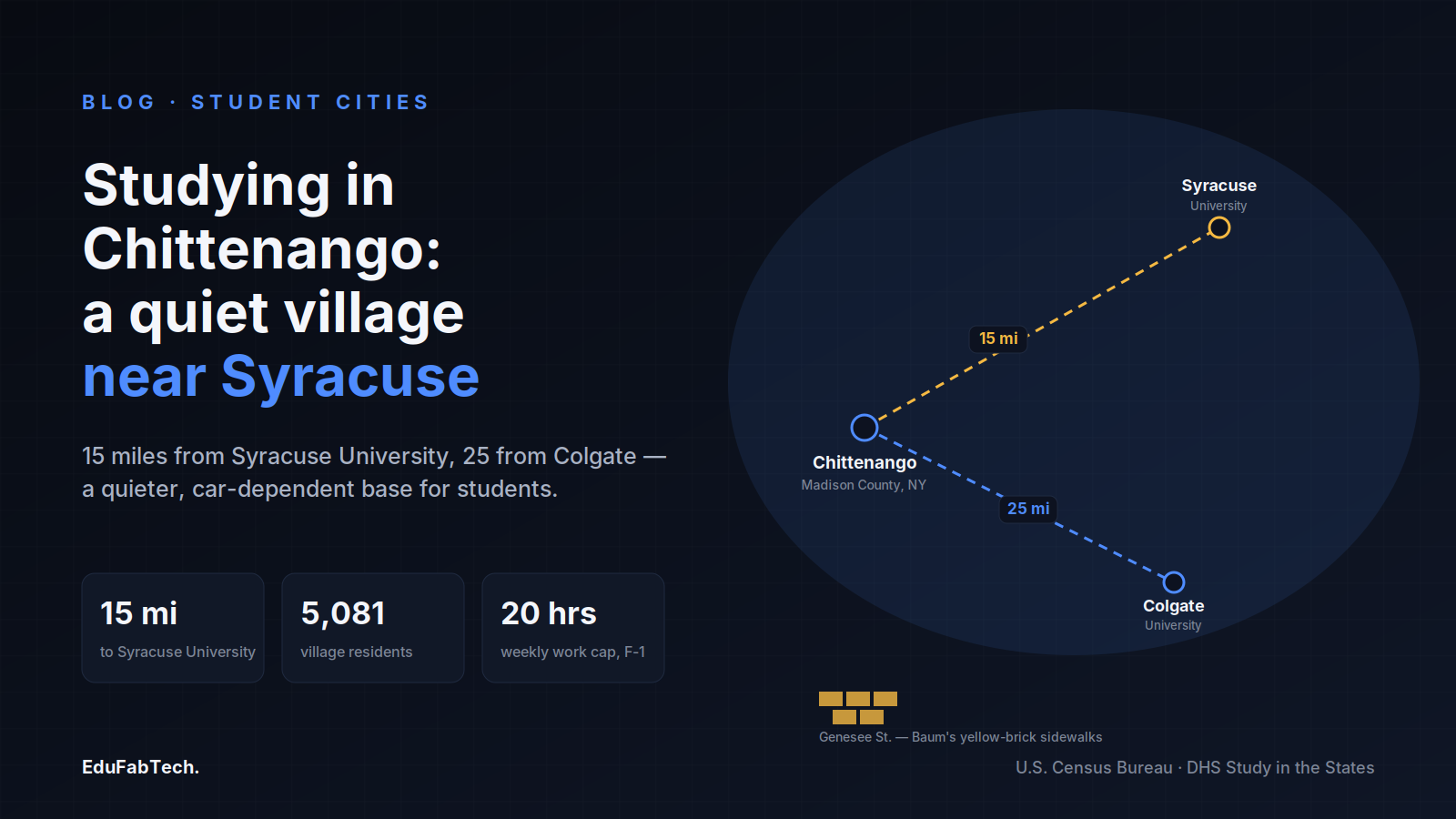
Chittenango is best known for something that has nothing to do with higher education: it is the birthplace of L. Frank Baum, author of The Wonderful Wizard of Oz, a fact the village wears openly. The All Things Oz foundation runs a small museum here dedicated to Baum's life and work, and the sidewalks along Genesee Street — the main commercial strip, which doubles as State Route 5 — are laid in yellow brick. It is a real place with a tourist's calling card, and for a student that sets the tone: this is a quiet upstate New York village, not a campus town.
The village sits in the town of Sullivan, Madison County, roughly 15 miles (24 km) east of Syracuse, with Interstate 90 (the New York State Thruway) running a few miles to the north. The Central New York Regional Planning and Development Board, drawing on U.S. Census Bureau counts, records the village at 5,081 residents in the 2010 census — a community small enough that the supermarket, the pharmacy and the library are a short drive or walk apart, and large enough to have the ordinary services a student needs week to week.
The honest starting point is that no university is located in Chittenango itself. Students who choose to live here do so as a trade: lower rents and a calmer setting in exchange for a daily commute. That makes it a workable base mainly for people who already have a car, or who are prepared to organise their week around travel. Before you sign anything, it helps to see what is actually on offer locally — EduFabTech keeps the village's student listings in one place.
Syracuse University and Colgate: the degrees within reach
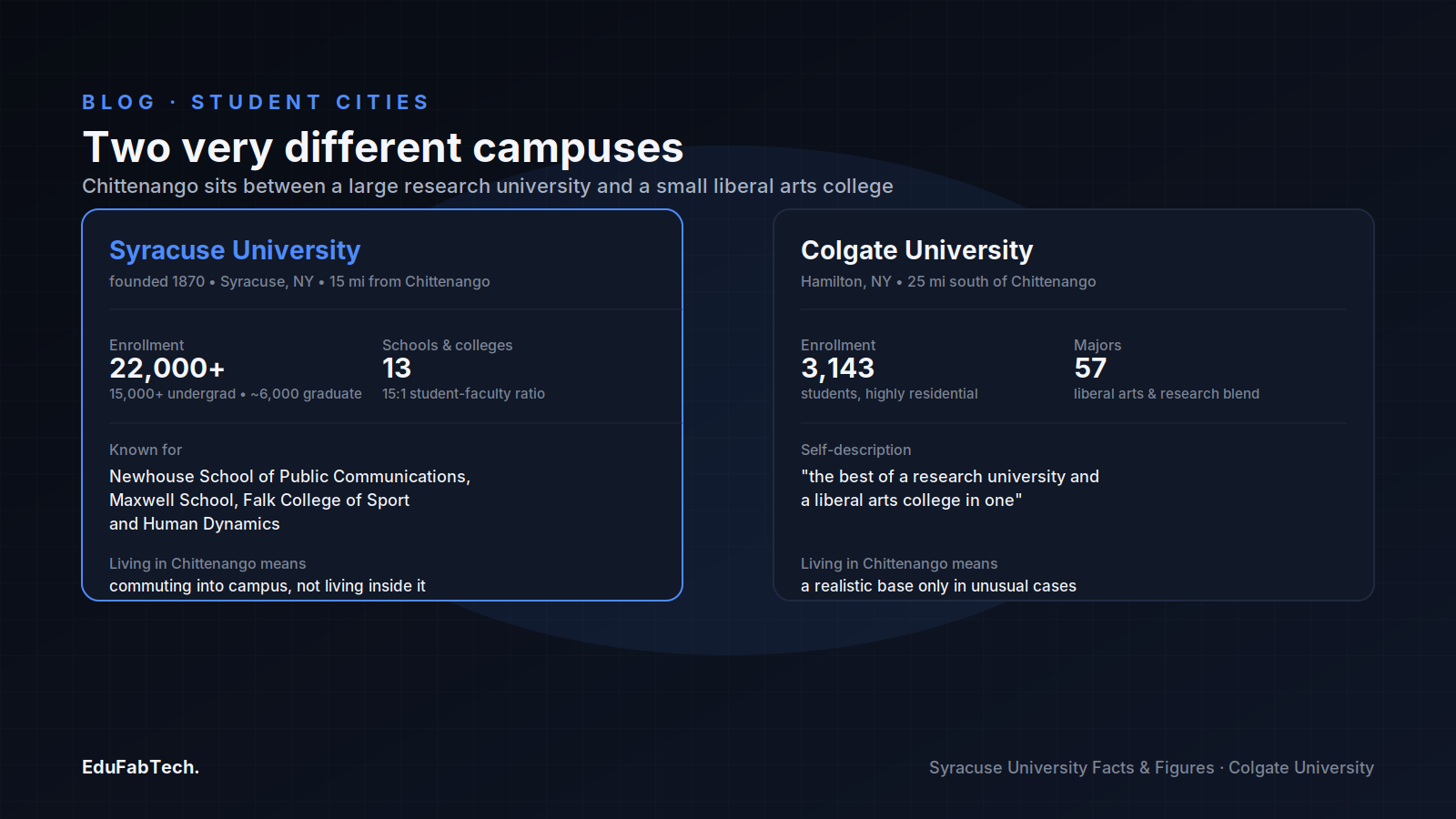
The nearest major institution is Syracuse University, founded in 1870 and set on a hill overlooking the city. Its Facts and Figures page lists more than 22,000 students — over 15,000 undergraduates and around 6,000 graduate students — spread across 13 schools and colleges, with a 15:1 student-to-faculty ratio. Syracuse is particularly associated with its S.I. Newhouse School of Public Communications and its Maxwell School of Citizenship and Public Affairs, and its colleges include the David B. Falk College of Sport and Human Dynamics, a draw for students in sport management, nutrition, social work and public health. The main campus and its south campus housing are in Syracuse, about a half-hour drive west of Chittenango.
Studying at Syracuse from a Chittenango base means you are commuting into a full-sized research university with graduate programmes and a large international community, rather than living inside it. That is manageable for upper-year students, graduate students or those with family nearby, but it is worth being clear-eyed: much of undergraduate social life at Syracuse happens on University Hill and in the adjacent neighbourhoods, and a 15-mile gap puts you at the edge of it.
The other institution on record is Colgate University, about 25 miles south in the village of Hamilton. Colgate's own figures put enrolment at 3,143 students across 57 majors, and it describes itself as offering "the best of a research university and a liberal arts college in one." It is a small, highly residential college where nearly everyone lives on or beside campus, so Chittenango is a realistic base for Colgate only in unusual circumstances — a longer southward drive, and a very different scale from Syracuse. For most readers, the practical relationship is Chittenango-to-Syracuse; EduFabTech lists rooms near Syracuse University for exactly that commute.
Living in the village when the campus is a drive away
Housing in Chittenango is mostly what you would expect of a small upstate village: single-family houses, some of them divided into apartments, a scattering of purpose-built flats, and rooms let within larger homes. There is no student-dormitory market here the way there is beside a campus, so your choices are essentially the ordinary local rental stock. That has an upside — you are renting in a settled residential community, not a transient student quarter — and a downside, which is that supply is thin and the best-value places go quickly to long-term local tenants. Browse what is currently available through the village's rooms listings before you fix your expectations.
Because the stock is ordinary housing rather than managed student lets, the safety advice is specific. Most genuine rooms in Chittenango are advertised by local owners, and the normal pattern is to view the property in person, meet the person letting it, and sign a written lease before any money changes hands. A deposit here typically means a security deposit plus the first month's rent, paid once you have seen the place and have a lease in hand — not a fee to "hold" a listing you have only seen in photographs. The classic scam, in a village where remote demand comes from students who cannot easily visit, is a too-cheap house listed by someone who claims to be out of town and asks you to wire a deposit to secure it. Never send money by bank transfer, gift card or cryptocurrency to reserve a room you have not entered; if a landlord will not let you or a trusted proxy walk through the property first, treat that as the end of the conversation. Start looking early — several weeks before term, not days — because the thin supply means waiting until the last minute leaves you choosing from whatever is left.
What a room costs here, and the campus yardstick
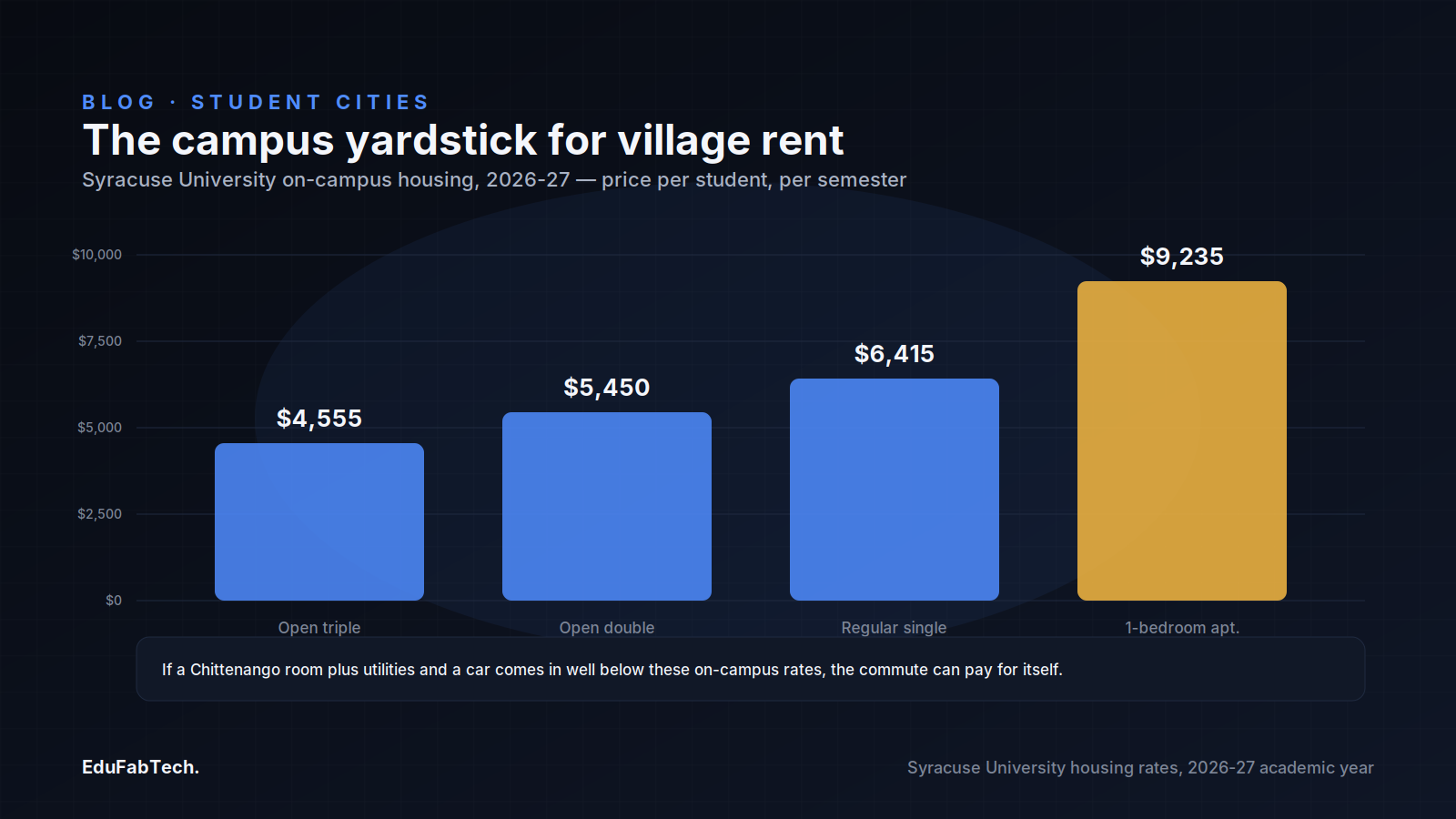
There is no official, Chittenango-specific student rent figure published by the village, so the honest answer is that local rents sit within the wider Syracuse-area market and vary with the house. The most reliable dated benchmark available is the university's own: Syracuse University's 2026-27 housing rates list an open triple at $4,555 and an open double at $5,450 per student per semester, rising to $6,415 for a regular single and $9,235 for a modern one-bedroom apartment. Those are on-campus prices for a full academic term, not Chittenango rents — but they are a useful yardstick. If a village room plus its share of utilities and the cost of running a car comes out well below the campus single, the commute may pay for itself; if it does not, the convenience of living on the Hill is worth weighing. On-campus residents also pay for a meal plan alongside the room, a cost a village tenant avoids but replaces with their own groceries.
Furnishing a place on a student budget
Village and small-town upstate New York is good territory for second-hand furnishing, largely through the turnover of local households: garage and estate sales in warmer months, charity and thrift shops in the surrounding towns, and the steady flow of items people give away when they move. A room let unfurnished can be kitted out cheaply if you are patient and have a way to move a desk or a mattress — which, again, assumes access to a car or a friend with one. Rather than naming shops that open and close, the most current picture is local and seasonal; EduFabTech aggregates what people in the area are selling and giving away through its second-hand listings, which is usually a faster route than driving between stores on spec. Buy the mattress new or verified-clean; almost everything else — desk, chair, shelving, kitchenware — is routinely available used.
Earning while you study: the rules that bind
If you are an international student, where and how much you can work is governed by federal rules, not by local custom, and you should treat the official guidance as the authority. The U.S. Department of Homeland Security's Study in the States guidance states that in on-campus employment an F-1 student "may not work more than 20 hours per week when school is in session," and warns that if a Designated School Official (DSO) knows you are working without permission, they must report it through SEVIS and your SEVIS record will be terminated. Off-campus work and practical training (CPT and OPT) have their own conditions and approvals. This is not legal advice: confirm your own situation with your university's international student office and the official page before you accept any work. For what is actually being advertised around the village, the local jobs listings are a starting point, but the legal ceiling always comes first.
Where to read, and how to reach campus
In the village itself, the Sullivan Free Library at 101 Falls Boulevard is the obvious public study space; it is part of the Mid-York Library System and opens Monday to Thursday 10am–7pm, Friday 10am–6pm and Saturday 10am–2pm. It is a community library rather than an academic one, so for deep research and long opening hours most students will still rely on Syracuse University's own libraries once they are on campus. EduFabTech's study-spaces listings flag desks and quiet rooms as they come up locally.
Getting to campus is the defining daily question. The regional bus operator is Centro, run by the Central New York Regional Transportation Authority, and it concentrates its frequent higher-education routes on and around the Syracuse University campus — not on villages 15 miles out. For fares, Centro's 2026 FAQ prices a Day Pass at $4.00 ($2.00 reduced) and a seven-day MAX Pass at $12.00 ($6.00 reduced), with a 10-ride pass at $10.00. In practice, a Chittenango-based student should assume they need a car: Route 5 runs straight into Syracuse and Interstate 90 is a few minutes north, and both make the drive quick, but there is no convenient campus bus from the village itself. Factor fuel, parking and winter driving into the budget before deciding the village is cheaper than living nearer campus.
The honest ledger for a Chittenango student
What is good about Chittenango is real: it is quiet, it is settled, rents are generally lower than in the neighbourhoods pressed up against University Hill, and you get an actual town — library, shops, a bit of Oz-themed charm — rather than a student strip. For a graduate student, a mature student, or someone who values calm and a car over proximity, it can be a genuinely sensible choice.
What is hard is equally real, and mostly comes down to distance and climate. You are committing to a 15-mile commute in Central New York, where winters are long and snowy and a car becomes close to non-negotiable; the campus social and academic life you are paying tuition for happens 15 miles away; and the local rental supply is small, so good rooms are scarce and must be chased early. If you do not drive, or you want to be in the middle of campus life, a village this far out will fight you. The decision is less about Chittenango being good or bad than about whether its specific trade — space and quiet for distance and dependence on a car — fits how you actually study.
Your first two weeks: a checklist
- Confirm your enrolment and, if you are an international student, meet your university's international student office and your DSO before doing anything work-related.
- See any room in person (or send a trusted proxy) before paying; sign a written lease; pay the security deposit and first month's rent only once you hold that lease.
- Never wire a deposit or pay by gift card or cryptocurrency to "hold" a place you have not entered.
- Sort out transport first: if you have a car, check your route via Route 5 and I-90 and the parking situation on campus; if you do not, map how you will realistically get to Syracuse each day.
- Get a Sullivan Free Library card and scout campus study spaces so you have somewhere to work in both the village and on the Hill.
- Furnish from local second-hand and give-away listings, but buy a clean or new mattress.
- Register with the university's emergency and weather-alert systems before the first snow — this is Central New York, and the commute changes in winter.
A quick question for readers
Do you work part-time while you study?
Many students work to pay the bills. See how common it is — and how many hours people really do.
Pick an answer, create a free account in a minute, and your vote counts. Already a member? Sign in
Comments 0
CommentNo comments yet. Members start the conversation.
Source: Syracuse University
Sources (5)
- Syracuse University. Facts and Figures. Syracuse University, 2026. syracuse.edu ↗ · checked 18 Oct 2026
- Syracuse University. 2026-27 Housing Rates. Syracuse University, 2026. housingmealplans.syr.edu ↗ · checked 18 Oct 2026
- Central New York Regional Transportation Authority (Centro). FAQs: Fares and Passes. Centro, 2026. centro.org ↗ · checked 18 Oct 2026
- U.S. Department of Homeland Security. Working in the United States. Study in the States (DHS), 2025. studyinthestates.dhs.gov ↗ · checked 18 Oct 2026
- Colgate University. Colgate at a Glance. Colgate University, 2026. colgate.edu ↗ · checked 18 Oct 2026