Studying in Dayton: universities, housing and student life
A practical, sourced guide to studying in Dayton, Ohio — its universities across the Miami Valley, where students live, what rooms and transit cost, and the honest trade-offs.
Dayton sits in southwest Ohio where the Stillwater, the Mad and Wolf Creek pour into the Great Miami River, which is why the local park system is called Five Rivers MetroParks and why the downtown core floods onto a grid of low bridges. It is a mid-sized post-industrial city that invented powered flight — the Wright brothers ran a bicycle shop here — and that aviation lineage still shapes the place, from Wright-Patterson Air Force Base on the eastern edge to the research institutes that cluster around it. For a student, the practical headline is that Dayton is cheap by American standards, flat, drivable, and spread out: the campuses are not stacked in one college town but scattered across a metro of suburbs and small towns.
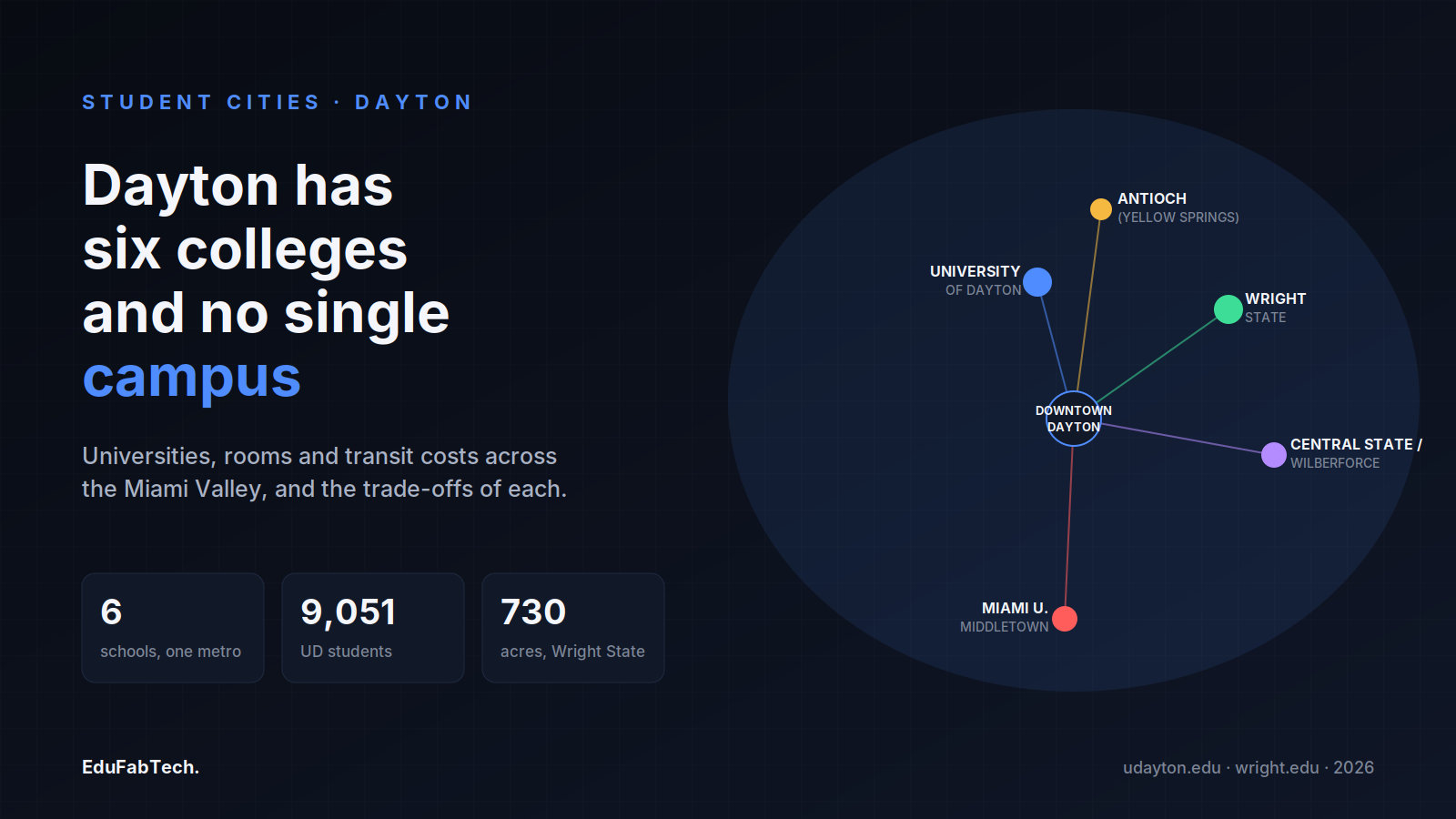
That geography matters more here than in most student cities. There is no single "university district" that holds everything. The University of Dayton sits just south of downtown; Wright State is ten miles northeast in Fairborn; the two historically Black institutions are out past Xenia; Antioch's university arm is in a village to the east; and Miami University's Middletown campus is a half-hour south. Where you study decides almost everything else — which bus you can catch, which neighbourhood you can afford, whether you will need a car.
This guide walks through the institutions, where students actually find rooms and how to do it without being cheated, how to furnish a place cheaply, the work rules that apply to international students, the libraries worth knowing, getting around, and an honest account of what the Miami Valley gives students and what it withholds.
Six institutions across one metro
The University of Dayton is the anchor. Its own site describes it as a Catholic, Marianist university "situated on the banks of the Great Miami River in southwest Ohio, less than two miles from downtown Dayton," teaching 9,051 undergraduate, graduate and law students, and it calls itself the "No. 1 Catholic university for engineering research and development, according to the National Science Foundation" (udayton.edu, 2026). In practice UD is known for engineering, the University of Dayton Research Institute, and an unusually dense student neighbourhood of university-owned houses immediately south of the academic campus. It is a residential, traditional-age campus with a strong Catholic identity — comfortable for many, a specific fit worth knowing about before you commit.
Wright State University is the big public option, physically in Fairborn next to Wright-Patterson Air Force Base though it carries a Dayton mailing address and describes itself as "a national public university in Dayton, Ohio" with "32 academic buildings on 730 acres across two campuses" and more than 11,000 students across "six colleges, a medical school, and a branch campus in Celina" (wright.edu, 2026). It is named for Orville and Wilbur Wright, houses the Boonshoft School of Medicine, and is locally famous for a tunnel system linking most core buildings — genuinely useful in an Ohio February.
Central State University, in Wilberforce just east of Xenia, bills itself on its own site as "Ohio's only public Historically Black College or University (HBCU) and 1890 Land-Grant Institution" with more than 135 years of history (centralstate.edu, 2026). A short walk away, Wilberforce University is, by its own account, the nation's oldest private historically Black university, founded in 1856 and affiliated with the African Methodist Episcopal Church (wilberforce.edu, 2026). The two share a hilltop but are entirely separate institutions with separate histories.
Antioch University keeps its headquarters at 900 Dayton Street in Yellow Springs, the small arts-leaning village northeast of Dayton, and now delivers its bachelor's, master's and doctoral programmes largely through low-residency and online formats rather than a traditional resident campus (antioch.edu). It is distinct from the independent Antioch College in the same village, with which it has had no affiliation since 2009. Finally, Miami University Middletown, about half an hour south, is a regional commuter campus of Miami University offering associate degrees and selected bachelor's programmes such as nursing and engineering technology; it opened in 1966 as Ohio's first regional campus. Among the smaller specialist options, Kettering College in Kettering is a private Seventh-day Adventist institution focused on health sciences, sited next to the Kettering hospital — worth knowing if nursing, sonography or respiratory therapy is your field.
How Dayton splits into student neighbourhoods
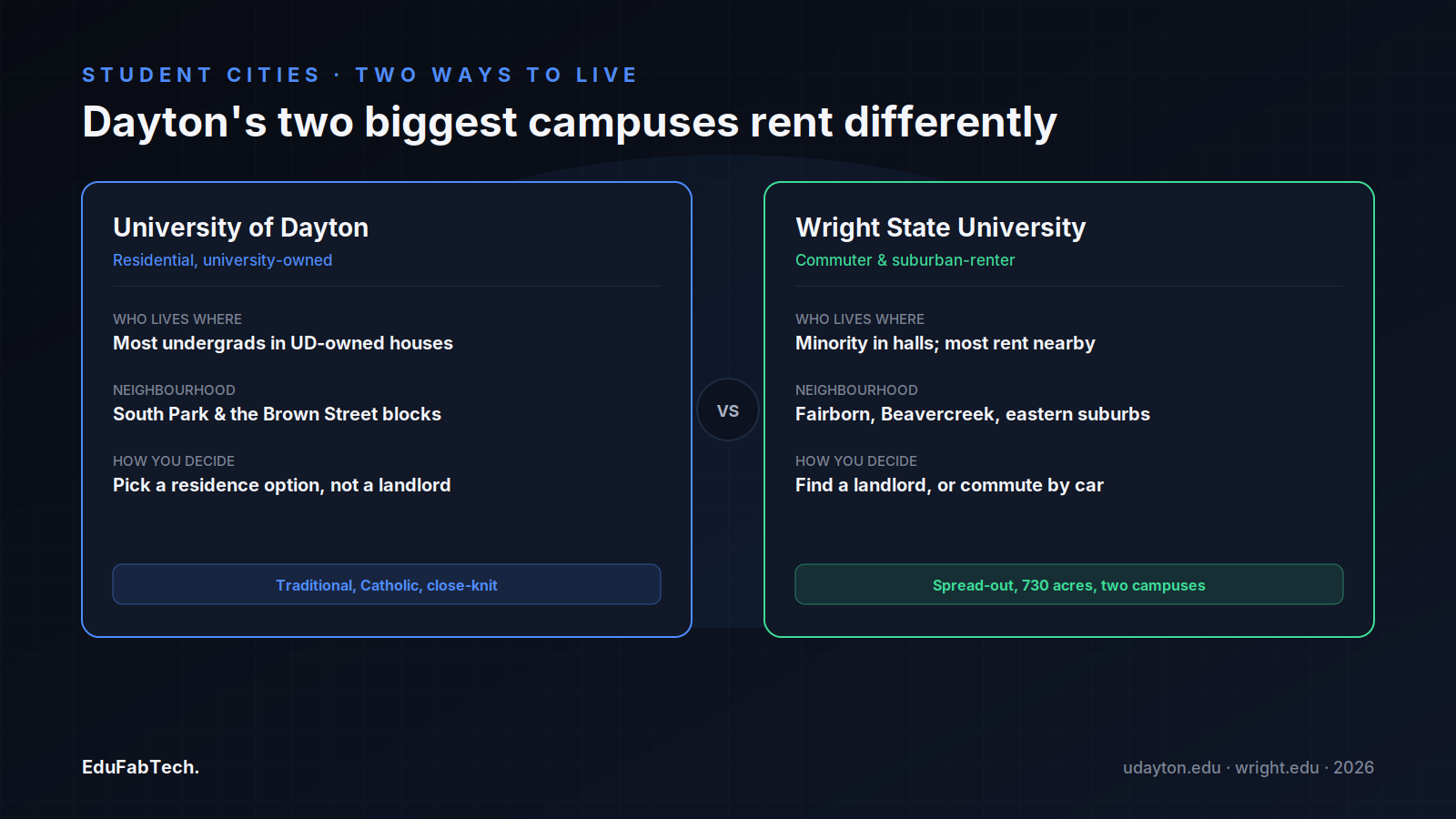
At UD, most undergraduates live in university-owned housing, and that includes the distinctive "student neighbourhood" of porch-fronted houses the university itself owns and assigns — so for the first years the decision is less "find a landlord" than "pick a residence option." Wright State is more of a commuter and suburban-renter campus: a minority live in the residence halls, and the rest rent in Fairborn, Beavercreek and the eastern suburbs, or commute from across the metro. Central State and Wilberforce are residential campuses out in Greene County, where off-campus rentals are thinner and a car is close to essential.
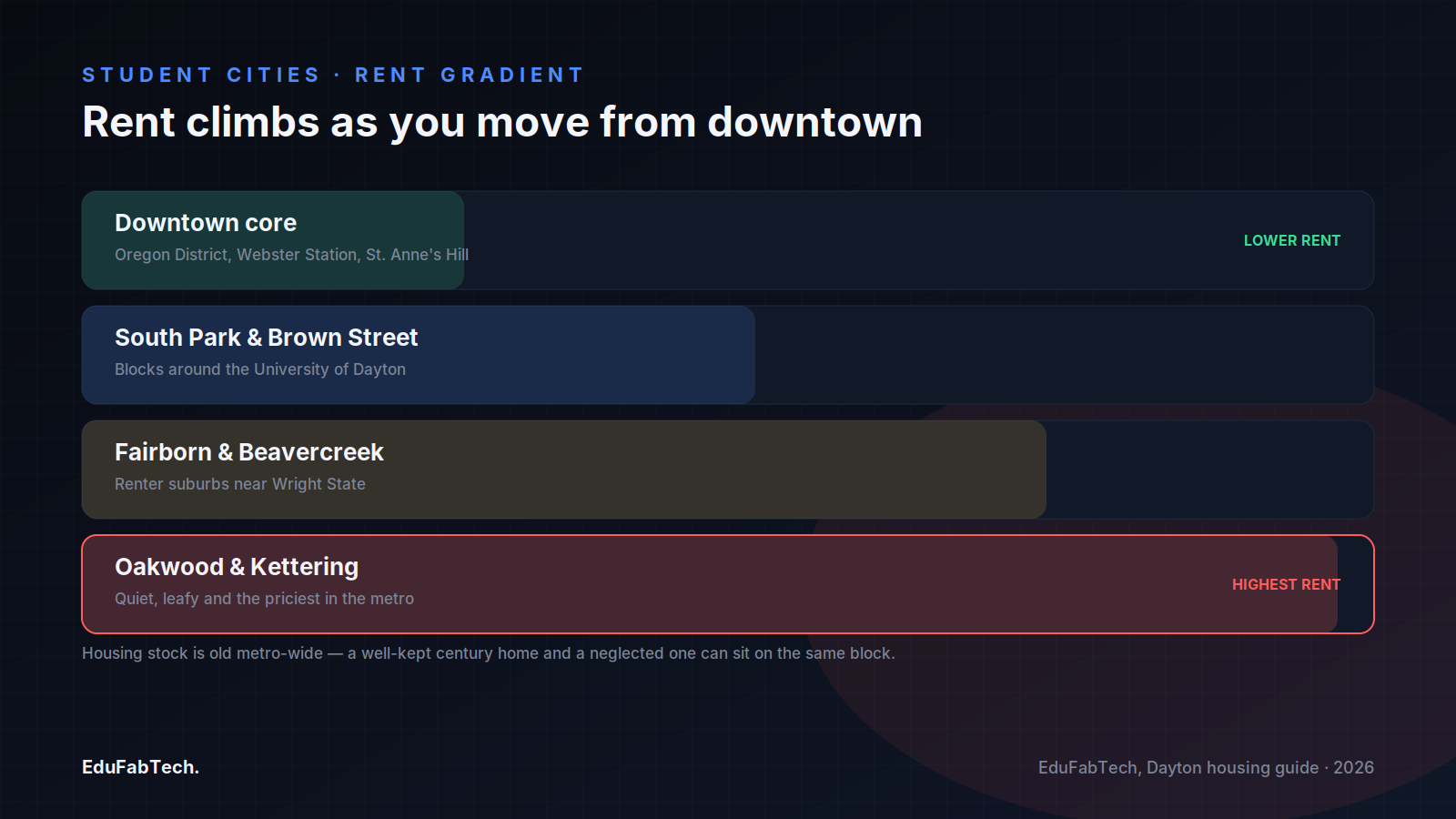
If you are renting on the private market, the neighbourhoods students gravitate to around UD are South Park and the blocks near Brown Street; around Wright State it is Fairborn and Beavercreek; and downtown itself — the Oregon District, Webster Station, St. Anne's Hill — draws graduate students and anyone who wants to walk to bars and the market. Rents rise as you move toward Oakwood and Kettering (quiet, leafy, pricier) and fall in the older neighbourhoods closer to the city core. Dayton is cheap enough that an entire apartment is realistic on a modest budget, but the housing stock is old, and the gap between a well-kept century home and a neglected one is wide.
Start looking earlier than feels necessary for the on-campus options — UD's housing selection runs months ahead of the academic year — but the private market in Dayton moves on a shorter clock, with many leases turning over in summer for an autumn start. You can browse rooms and sublets on EduFabTech's Dayton rooms listings and filter by what is near the University of Dayton.
Signing a lease without losing your deposit
The rental scams that show up in Dayton follow the city's own pattern: listings for cheap single-family houses in sought-after neighbourhoods like the Oregon District or near the UD campus, posted by someone who claims to be an out-of-town owner and asks you to send a deposit to "hold" the place before you can view it. The rule that protects you is simple and absolute — never send money by bank wire, gift card, payment app or cryptocurrency to secure a room you have not seen, and never to someone you have not met. A real Dayton landlord will let you walk the actual unit, will give you a written lease, and will take a deposit by normal, traceable means.
Before you pay anything, confirm the person showing the place has the right to rent it, read the whole lease including who pays for heat (relevant in a cold-winter city with old houses and high gas bills), and get every promise in writing. A security deposit of roughly one month's rent is ordinary here; a demand for several months up front, or pressure to decide within the hour, is a warning sign. If you are abroad and cannot view in person, ask a current student or a university housing office to look on your behalf rather than trusting photos.
Furnishing a room: the 2nd Street Market and the thrift circuit
The landmark worth building a Saturday around is the 2nd Street Market, the public market run by Five Rivers MetroParks in a block-long former 1911 railroad building at 600 E. Second Street; it opens Fridays 11 a.m.–3 p.m., Saturdays 9 a.m.–3 p.m. and Sundays 11 a.m.–3 p.m., with local food and craft vendors and an outdoor market area in the warmer months (metroparks.org). It is the place for produce, bread and a cheap international lunch rather than for a sofa, but it is also the easiest way to understand the city's food culture early.
For the actual furnishing — a desk, a mattress frame, a lamp — Dayton's older neighbourhoods generate a steady supply of second-hand goods, and the region's thrift stores and estate-sale scene are active and genuinely cheap. Rather than naming shops that open and close, the practical move is to track what students in the city are passing on directly: EduFabTech lists second-hand things and used furniture in Dayton, and a free-stuff feed that fills up fastest at the end of each semester when leases end and people move out. Collecting a kerbside couch from the UD student neighbourhood in May is a local rite.
Working while enrolled
If you are an international student, read the work rules from the source before you take any job. Under the USCIS Policy Manual, "F-1 status permits students with Designated School Official (DSO) approval to work at an on-campus job for up to 20 hours per week when school is in session," and such students "are not required to apply for employment authorization with USCIS" for that on-campus work (USCIS, 2026). The 20-hour cap is a weekly limit during term and covers all jobs combined; off-campus work, including practical training, has separate rules and approvals. This is general information, not legal advice — your university's international student office is the authority on your specific case, and you should clear any job with them first. Domestic students face no such cap, and on-campus and suburban service jobs are the usual starting point. Current openings students post are collected on EduFabTech's Dayton jobs listings.
Libraries and places to read
On campus, the University of Dayton's Roesch Library runs long daily hours in term and moves to 24-hour access the week before and during final exams, with floors graded from conversational to silent (libcal.udayton.edu). Wright State's Paul Laurence Dunbar Library at 3640 Colonel Glenn Highway extends its hours into the early morning during finals week (calendar.libraries.wright.edu). Off campus and free to everyone, the Dayton Metro Library's Main Library at 215 East Third Street downtown offers free Wi-Fi, laptop lending and group study rooms you can reserve, and it runs designated weekday "Quiet Space" hours from 2 to 6 p.m. (daytonmetrolibrary.org). For many students the public library is the quiet alternative when the campus is a bus ride away. EduFabTech also lists bookable study spaces in the city.
Moving around the Miami Valley
Public transport is run by the Greater Dayton Regional Transit Authority (RTA), which operates both diesel buses and distinctive electric trolleybuses through downtown. A single boarding for riders age 13 and over is $2.40, the daily maximum is $5.50, and a 31-day rolling monthly pass is $70.00, with reduced fares for older adults and people with disabilities (Greater Dayton RTA, 2026). The RTA's Tapp Pay system caps what you spend automatically, so you "never pay more than the daily or monthly (31-day rolling) max fare rate" (Greater Dayton RTA, 2026) — which means you can pay per ride and let the fare cap do the work of a pass. Routes converge on the downtown Wright Stop Plaza hub, and service reaches Wright State and the eastern suburbs, but it thins out in the evenings and on weekends, and the outlying campuses at Wilberforce and Middletown are poorly served. Confirm any student discount directly with your university or the RTA, since arrangements vary by school. The honest summary: downtown, UD and Wright State are workable without a car; much of the rest of the metro is not.
What it costs, and what is hard
Dayton's low cost of living is its single biggest advantage for students. For the city of Dayton itself, the U.S. Census Bureau reports a median gross rent of $918 a month for the 2020–2024 period and a population of 136,688 as of July 2025 (U.S. Census Bureau QuickFacts, 2025) — low enough that a full apartment, not just a shared room, is within reach for many. On-campus prices are higher and vary sharply by institution. For 2026–27, the University of Dayton lists first-year rooms in its Marycrest and Stuart complexes at $5,070 per student per semester for a double and $6,180 for a single (University of Dayton, 2026). Wright State, for the same year, lists a standard double in Hamilton Hall or its Honors Community at $2,878 per semester (Wright State University, 2026) — a reminder that the public and private campuses sit in different price worlds even ten miles apart.
What is hard is partly the climate and partly the sprawl. Winters are grey and cold, the housing stock is old and sometimes poorly insulated, and heating an aging house through an Ohio January can erase the rent savings if you do not check the utility arrangement first. The metro's spread means that without a car your life compresses to a few bus corridors, and the campuses outside Dayton proper are genuinely isolated from the city's amenities. Dayton also carries the uneven texture of a city that lost industrial jobs: some neighbourhoods are being restored and lively, others are not, and the difference can fall within a few blocks. The upside is a real, affordable, walkable core — the Oregon District, the riverfront bike trails, the market — for anyone who lands near it.
A checklist for your first weeks
- Confirm whether your campus expects you in university housing (UD) or on the private market (Wright State, the Greene County campuses), and act on the right timeline for each.
- If renting privately, view the actual unit, read the full lease including who pays for heat, and pay the deposit — about one month's rent is normal — only by a traceable method, never a wire or gift card to "hold" a place unseen.
- International students: visit your DSO and clear any job before starting, keeping within the 20-hour on-campus limit during term.
- Set up RTA Tapp Pay, learn the routes through Wright Stop Plaza that reach your campus, and decide honestly whether you need a car.
- Get a free Dayton Metro Library card for study space, Wi-Fi and laptop lending beyond your campus library.
- Furnish from the second-hand and free-stuff feeds, and build a first Saturday around the 2nd Street Market to learn the city's food.
- Go to a few campus and downtown events in your first fortnight to meet people before coursework takes over.
A quick question for readers
Do you work part-time while you study?
Many students work to pay the bills. See how common it is — and how many hours people really do.
Pick an answer, create a free account in a minute, and your vote counts. Already a member? Sign in
Comments 0
CommentNo comments yet. Members start the conversation.
Source: U.S. Census Bureau
Sources (5)
- University of Dayton. On-Campus Housing (2026–27 rates). University of Dayton, 2026. udayton.edu ↗ · checked 18 Oct 2026
- Wright State University. Rates and Agreements, Residence Life and Housing (2026–27). Wright State University, 2026. wright.edu ↗ · checked 18 Oct 2026
- Greater Dayton RTA. Fares. Greater Dayton Regional Transit Authority, 2026. iriderta.org ↗ · checked 18 Oct 2026
- U.S. Citizenship and Immigration Services. Policy Manual, Volume 2, Part F, Chapter 6: Employment. USCIS, 2026. uscis.gov ↗ · checked 18 Oct 2026
- U.S. Census Bureau. QuickFacts: Dayton city, Ohio. U.S. Census Bureau, 2025. census.gov ↗ · checked 18 Oct 2026