Studying in Dover, New Hampshire: universities, housing and student life
A practical, sourced guide to living in the Garrison City as a student next door to the University of New Hampshire — housing, second-hand kit, work rules, study spaces, trains and honest trade-offs.
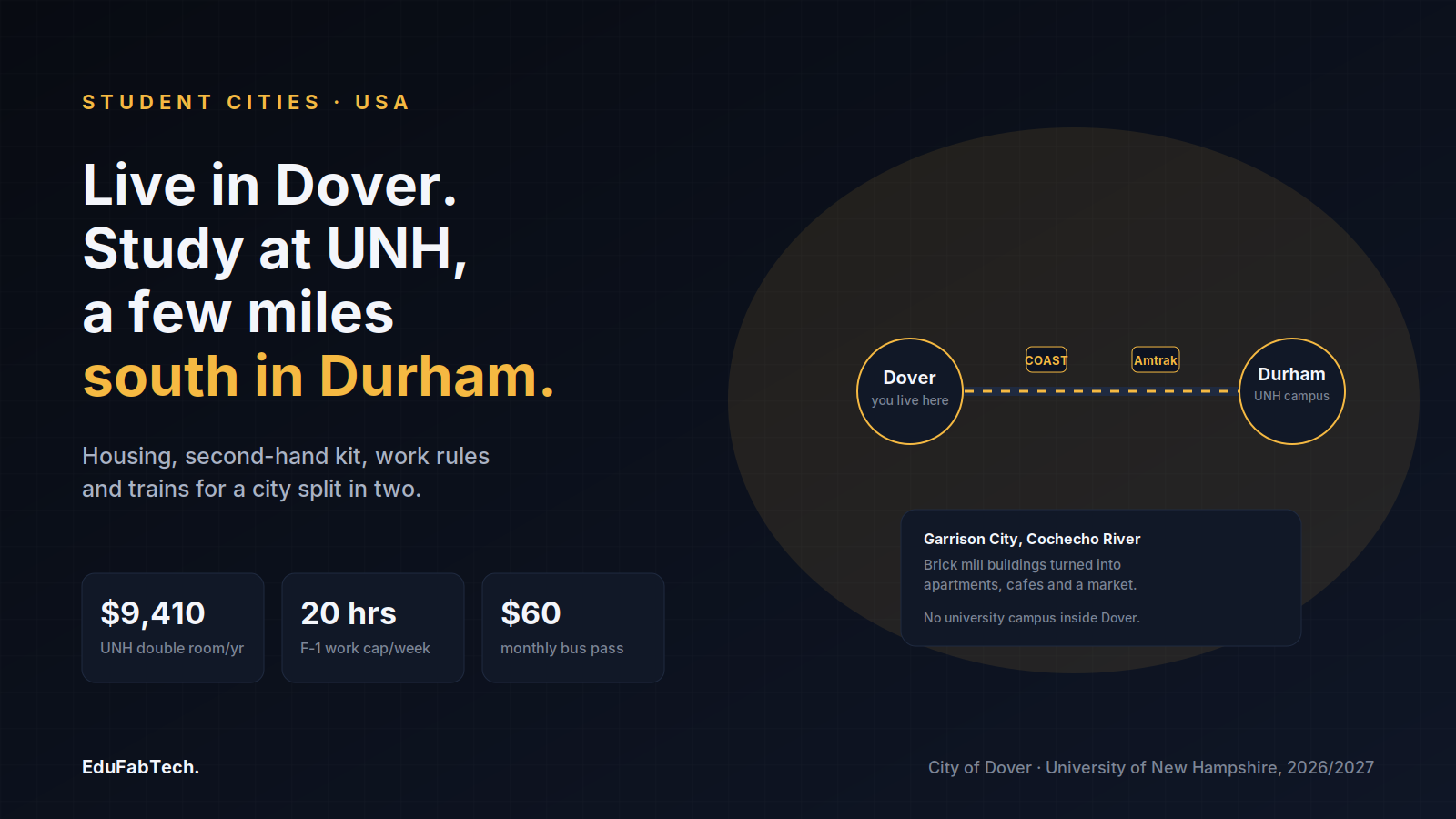
Dover does not have a university inside its city limits, and that is exactly why it matters to students. The state's flagship, the University of New Hampshire, sits in Durham, the next town south, and the two places function as one labour-and-housing market connected by a commuter train and a bus route. When Durham's small centre fills up, the rooms spill into Dover. If you are coming to study at UNH — from Manchester or from Mumbai — there is a good chance you will spend at least one year sleeping in the Garrison City and travelling in to Durham for seminars.
The city itself is an old mill town on the Cochecho River. The City of Dover's own history pages describe it as "the Garrison City," a colonial seaport that "flourished in the 19th century as the nation's leading manufacturer of cotton goods," with the river still running through a downtown of converted brick millworks (City of Dover). That industrial bone-structure is what gives downtown its character today: tall brick blocks, a riverwalk, and ground-floor space now filled with cafés, breweries and a weekly market rather than looms.
This guide sticks to things that can be checked against a named source: the university's own rate sheet, the transit operators' own fare pages, the city library, and the U.S. immigration authority on student work. Where a number has no reliable public source, that is said plainly rather than guessed. You can see current local listings for the city on EduFabTech's Dover page.
The university you will actually attend is in Durham
The University of New Hampshire describes its Durham campus as the state's "Land, Sea, and Space Grant" institution and a top-tier (R1) research university, and it highlights its number-one sustainability rating from the Association for the Advancement of Sustainability in Higher Education (University of New Hampshire). The sea-grant designation reflects real activity: UNH runs marine and ocean-engineering work on the nearby Seacoast, and its Durham campus spreads across a large tract of farmland, woods and playing fields rather than a tight urban block.
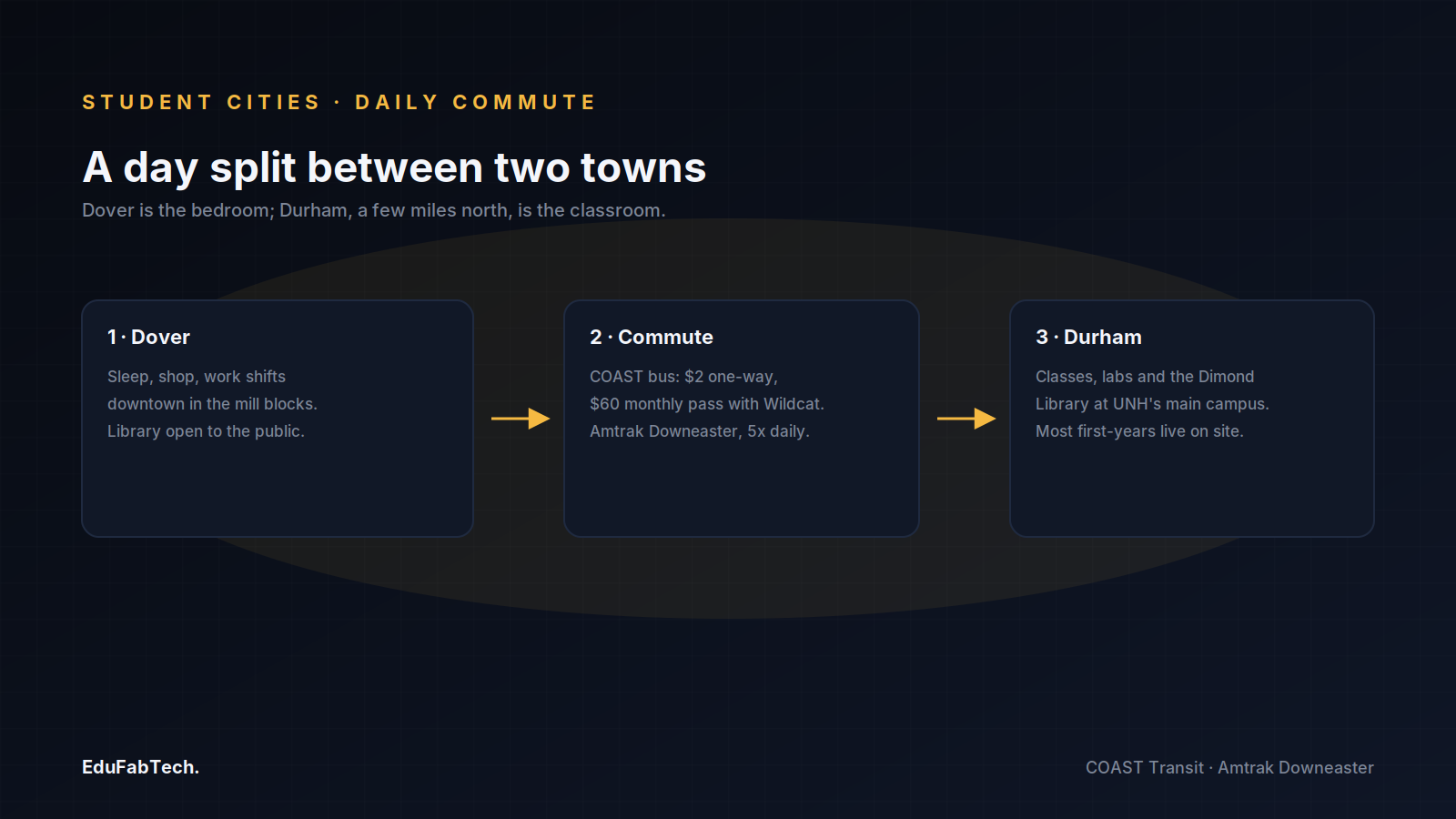
For a student living in Dover, the practical point is distance. Durham is only a few miles away, and most teaching, labs, the recreation centre and the main library are there, not in Dover. You will commute toward Durham for classes and back to Dover to sleep, shop and work. Nearly all first-year undergraduates are housed on campus, so the Dover option is mainly for second-years and above, graduate students, and anyone who missed the residence-hall deadline. EduFabTech keeps a feed of rooms and desks tagged to the university at /near/university-of-new-hampshire.
Finding a room in the Garrison City without being caught out
Dover's rental stock is a mix: apartments carved out of the downtown mill buildings, triple-deckers and single-family houses in the residential streets off Central Avenue, and newer blocks near the waterfront. Rooms close to the Spaulding Turnpike or the Dover–Durham road are the ones students chase, because they shorten the trip to campus. Start looking early — serious searching for an autumn-term room means looking in late spring, because the best-placed units turn over as the previous tenants graduate in May.
The scams in Dover follow a familiar local pattern. A listing appears for a mill-conversion loft or a room near the Durham line, priced noticeably below everything comparable; the "landlord" is conveniently out of state and asks you to wire a deposit, or send gift-card or cryptocurrency value, to "hold" the place before you can see it. Treat that as the warning sign it is. See the unit in person or on a live video call where the person walks through the actual rooms; meet whoever holds the lease; and insist on a written New Hampshire lease that names the address and the deposit amount. Normal local practice is a month's rent up front plus a security deposit — not a large cash transfer to a stranger. Never send money by bank transfer, gift card or cryptocurrency to reserve a room you have not seen. Browse rooms for the city on EduFabTech's Dover rooms page, and when in doubt, prefer a landlord you can meet.
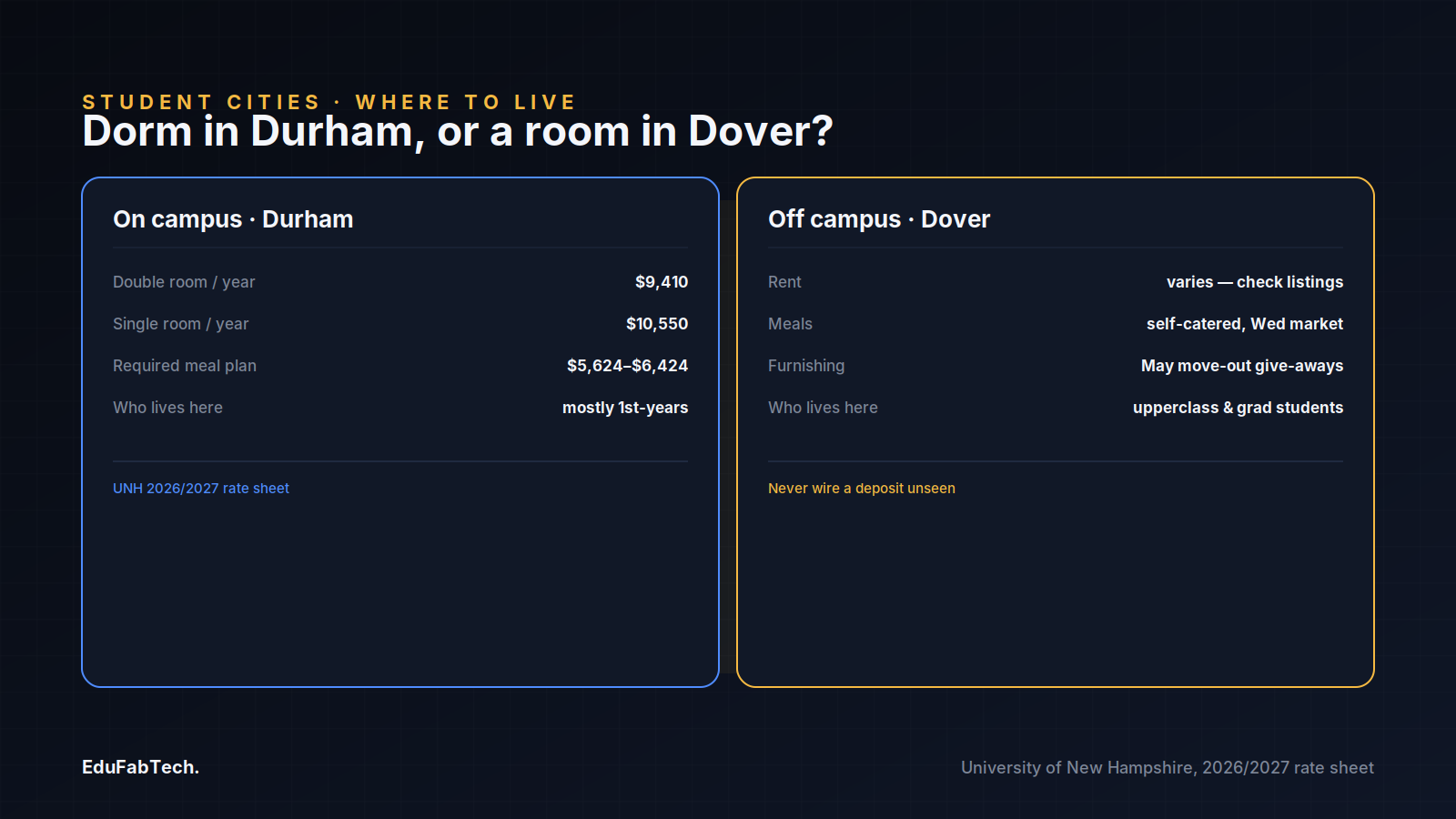
On the campus side, the clearest sourced housing figures come from UNH itself. The university's 2026/2027 rate sheet lists a double room at US$9,410 for the year, a single at US$10,550 and a triple at US$8,164, with required residential meal plans running from US$5,624 to US$6,424 for the year (University of New Hampshire, 2026/2027). Those are Durham dormitory prices; they are useful as a benchmark against which to judge a shared Dover apartment. The city and county do not publish a single tidy "student rent" figure, so any specific off-campus rent you are quoted should be checked against several current listings rather than one number.
Furnishing a room and shopping second-hand
A term-time room rarely needs new furniture. Dover's downtown has thrift and consignment shops within walking distance of the mill apartments, and the end of the UNH academic year in May produces a reliable flow of give-away desks, chairs and kitchen kit as students clear out of Durham halls — worth watching if your lease starts in summer. For food and small goods, the Dover Farmers' Market, run by the non-profit Seacoast Eat Local, trades on Wednesday afternoons through the growing season at Henry Law Park, with vegetables, fish, baked goods and prepared food from Seacoast producers (Seacoast Eat Local); the same organisation runs an indoor winter market in the region once the outdoor season ends.
For the rest, EduFabTech carries local second-hand feeds for the city — used furniture, kitchen kit and items given away free are gathered on its Dover second-hand page. Buying a desk and a lamp from someone a few streets away, and collecting them yourself, avoids both delivery costs and the deposit-scam risk that comes with paying before you see a thing.
Working part-time while you study
Downtown Dover's cafés, restaurants, breweries and shops are the obvious term-time employers for a domestic student, and the waterfront and festival calendar create seasonal work in summer. For international students the rules are stricter and worth reading from the source rather than from hearsay. The U.S. Department of Homeland Security's Study in the States service states that an F-1 student in on-campus employment may not work more than 20 hours per week when school is in session, and it directs students to get their designated school official's approval before starting any on-campus job (DHS, Study in the States). Off-campus work for F-1 students — such as Curricular or Optional Practical Training — has its own separate conditions and approvals.
This is not legal advice, and the details change. Before you accept any job, talk to UNH's designated school official in the international students' office, who signs off on what counts as permitted employment and when. Local job listings for the city are collected on EduFabTech's Dover jobs page.
Libraries and places to work
You have two good library systems, with different rules. The Dover Public Library is open to the public and reopened on 26 June 2026 after a US$7.1 million renovation of its 1905 Carnegie building that added an accessible main entrance with an elevator and stairs, expanded the children's and teen areas, and upgraded the electrical and life-safety systems with new restrooms on the second and third floors (City of Dover); the library traces its origins to 1883 (City of Dover). That is your in-town, no-enrolment-needed study space, a short walk from the downtown apartments.
On campus in Durham, UNH's Dimond Library is the main university library, with designated quiet rooms — among them the Addison and Hubbard reading rooms — and a mix of individual and group study space for enrolled students (UNH Library). Between the two, you can keep a city base and a campus base for the same day's reading. EduFabTech also lists bookable desks and quiet spots around the city at /in/united-states/dover-nh/study-spaces.
Trains and buses: getting to Durham and beyond
The reason Dover works as a student town is that you can live there without a car. Amtrak's Downeaster stops at the Dover station on Chestnut Street, in the downtown, five times a day in each direction; the operator puts the trip at roughly one hour to Portland, Maine and about 90 minutes to Boston's North Station, and the station connects to local COAST and Wildcat Transit buses (Amtrak Downeaster). That puts a weekend in two different states within easy reach.
For the daily commute, buses matter more than the train. COAST, the Cooperative Alliance for Seacoast Transportation, charges US$2.00 one-way on its local and regional routes and US$1.00 for seniors and riders with disabilities, and sells a US$60 monthly pass valid on both COAST and UNH's Wildcat Transit; crucially, its fare page states that University of New Hampshire students with a valid UNH ID ride free on all COAST routes, as do Great Bay Community College students (COAST). Wildcat Transit's own Route 3 links Durham/UNH with Dover. For an enrolled UNH student, then, the Dover–Durham commute is effectively fare-free on the bus — a real saving that makes the cheaper Dover rent worth the travel time.
What is good, and what is hard
The good: Dover is a walkable downtown with a genuine centre, not a strip of car parks, and the free-to-students bus plus the Downeaster mean you do not need a car to reach class, Portsmouth, Portland or Boston. Rent tends to undercut Durham because the stock is larger and the town is not purely a campus. The summer calendar — the free Cochecho Arts Festival at the Rotary Arts Pavilion in Henry Law Park among it — gives the place a life of its own beyond the university term (City of Dover).
The hard: the campus is in another town, so living in Dover means building your day around a bus or train timetable, and a missed connection is a real cost when a lab starts at nine. New England winters are long and dark, and the Seacoast gets its share of snow and freezing rain, which slows commutes. Demand from UNH students, Seacoast workers and families competes for the same apartments, so the better-placed, better-priced rooms go early and fast. And because Dover is a working city rather than a college town, its nightlife and student services are modest next to what you would find on a large urban campus — you trade some of that for lower rent and a quieter street.
A checklist for your first weeks
- Confirm whether you are required or guaranteed on-campus housing in Durham before committing to a Dover lease; compare it against the UNH rate sheet above.
- See any Dover room in person or on a live video walk-through, meet the leaseholder, and get a written lease before paying — never wire a deposit to "hold" a place.
- If you are an international student, meet UNH's international-student office and confirm your work plan against the DHS rules before taking any job.
- Get your UNH ID early so you can ride COAST for free, and learn the Wildcat Route 3 and Downeaster timetables for your class days.
- Join the Dover Public Library for an in-town study base, and scout Dimond Library's quiet rooms on campus.
- Furnish from local second-hand sellers and the end-of-year Durham give-aways rather than buying new and paying for delivery.
- Note the Dover farmers' market, festival and student move-out dates — they shape both your furniture-hunting and your budget.
A quick question for readers
Do you work part-time while you study?
Many students work to pay the bills. See how common it is — and how many hours people really do.
Pick an answer, create a free account in a minute, and your vote counts. Already a member? Sign in
Comments 0
CommentNo comments yet. Members start the conversation.
Source: University of New Hampshire
Sources (5)
- University of New Hampshire. 2026/2027 UNH Durham Food & Housing Rates. University of New Hampshire, 2026. unh.edu ↗ · checked 16 Oct 2026
- Northern New England Passenger Rail Authority. Dover Station. Amtrak Downeaster, 2026. amtrakdowneaster.com ↗ · checked 16 Oct 2026
- Cooperative Alliance for Seacoast Transportation. Fares & Ticket Information. COAST, 2026. coastbus.org ↗ · checked 16 Oct 2026
- City of Dover. Renovated Public Library now open; regular hours resume. City of Dover, New Hampshire, 2026. dover.nh.gov ↗ · checked 16 Oct 2026
- U.S. Department of Homeland Security. Working in the United States. Study in the States, 2026. studyinthestates.dhs.gov ↗ · checked 16 Oct 2026