Studying in El Paso: universities, housing and student life
A practical, honest guide to studying in El Paso, Texas — its two universities on the U.S.–Mexico border, where students live, what housing and transport cost, and what the Sun City is like day to day.
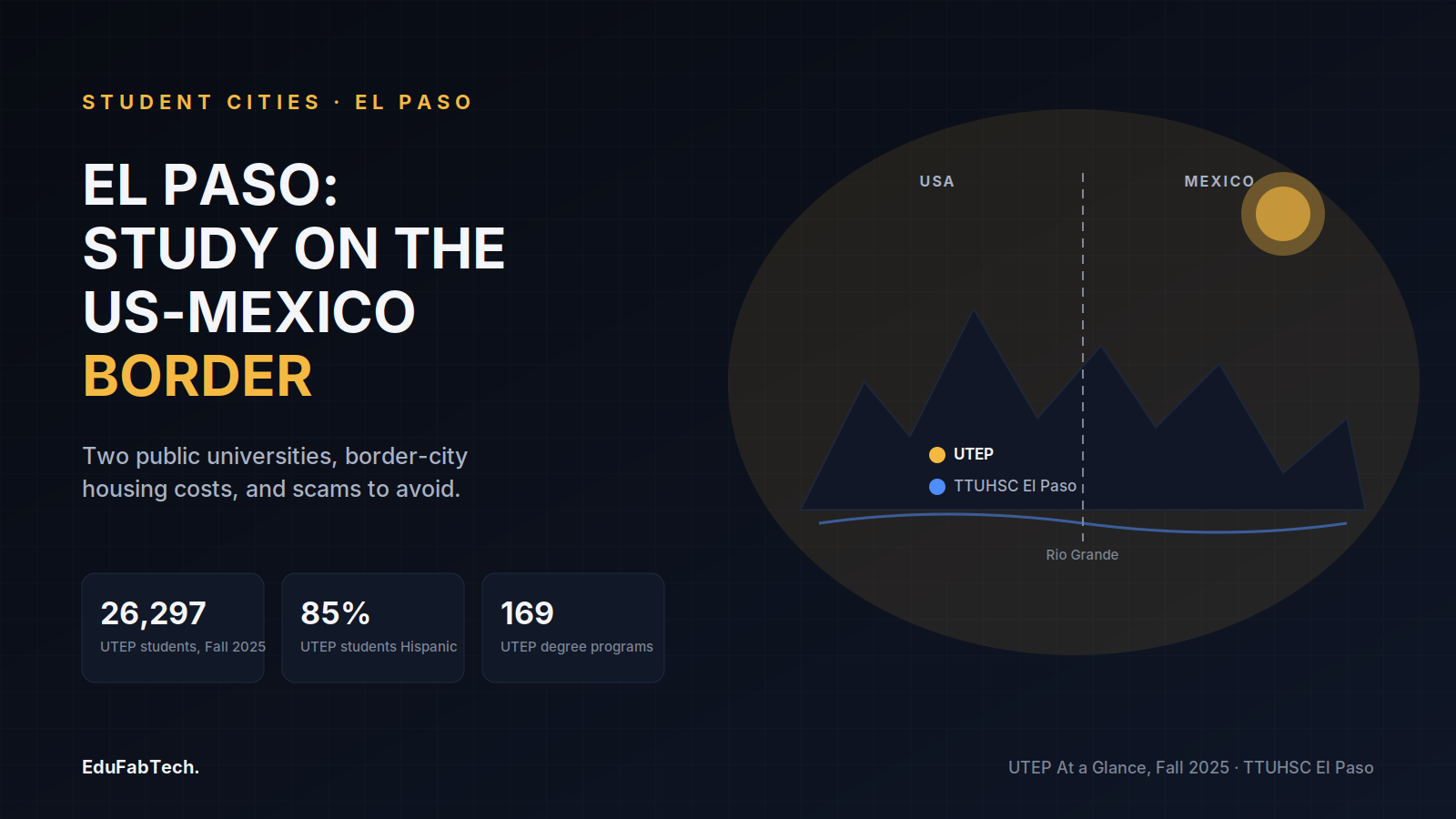
El Paso is a city that faces another country. Stand on the UTEP campus and the Franklin Mountains rise behind you, downtown sits to the south-east, and just beyond it the Rio Grande marks the line where the United States meets Ciudad Juárez, Mexico. The University of Texas at El Paso describes itself as sitting "on the U.S.-Mexico border in the El Paso-Ciudad Juárez binational metropolitan area," according to its course catalog — a setting that shapes almost everything about student life here, from the Spanish you will hear on campus to the desert light and the long, dry summers of the Chihuahuan Desert.
For students, this is a large but affordable city with two public universities, the larger of them a Hispanic-serving institution with a student body that is 85% Hispanic. It is not a compact walk-everywhere college town; it sprawls along the base of the mountains and out into the valley. Below is what it is actually like to study and live here — the universities, where people find rooms, what things cost, and the parts that are genuinely hard.
Two universities, one of them very large
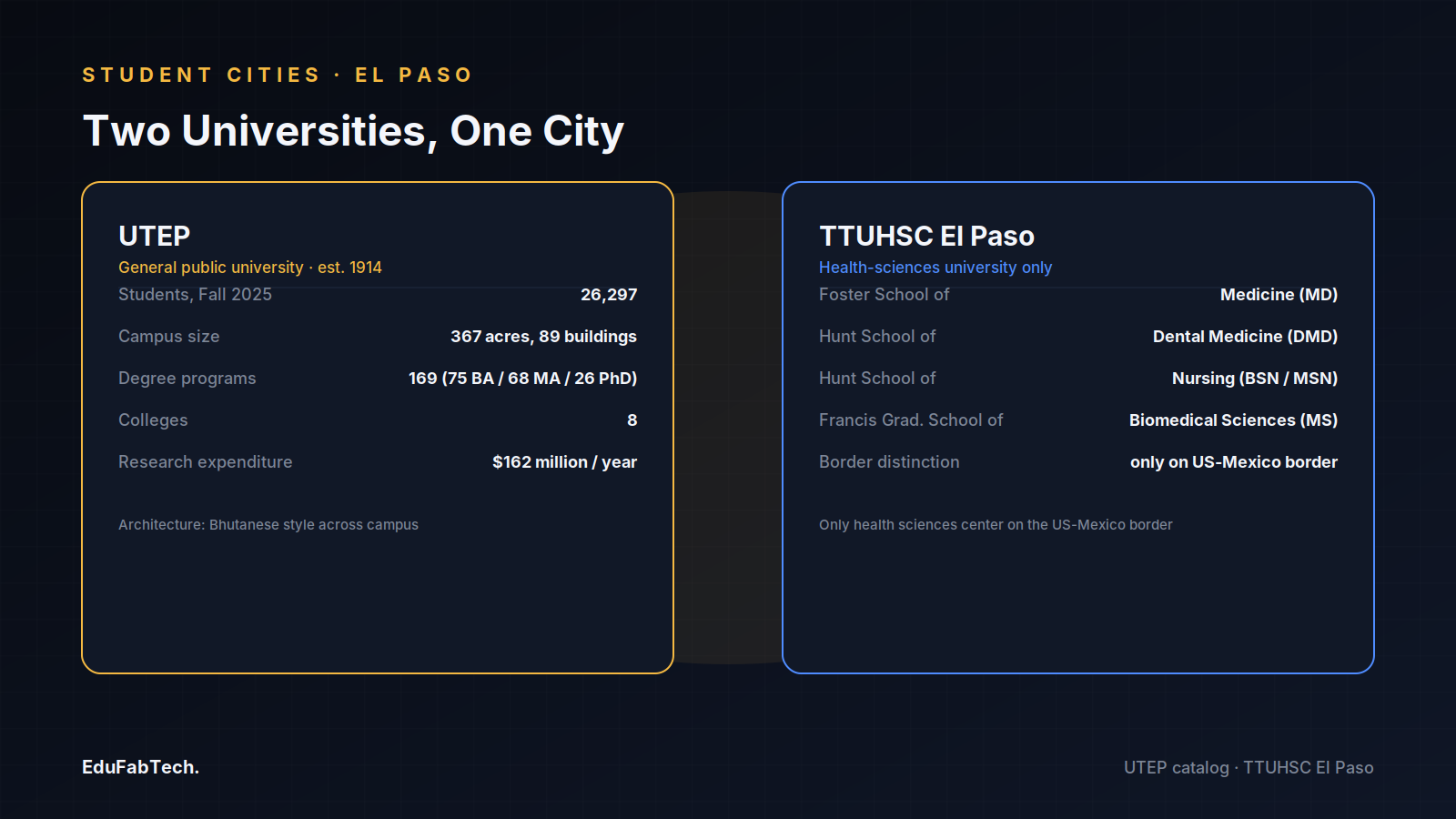
The University of Texas at El Paso (UTEP) is the anchor. Its catalog records that it was established in 1914 as the Texas State School of Mines and Metallurgy, and that the 367-acre campus holds 89 buildings, nearly all of them built in the Bhutanese architectural style that gives the place its distinctive sloping walls and tiered roofs. UTEP's own At a Glance page reports 26,297 students in Fall 2025, a student body that is 85% Hispanic, and roughly half of undergraduates being the first in their families to attend university. It offers 169 degree programmes — 75 bachelor's, 68 master's and 26 doctoral — across eight colleges, and reports $162 million in annual research expenditures.
The second institution is specialised. Texas Tech University Health Sciences Center El Paso (TTUHSC El Paso) is a stand-alone health-sciences university whose degree programmes run across four schools: the Foster School of Medicine (Doctor of Medicine), the Hunt School of Dental Medicine (Doctor of Dental Medicine), the Hunt School of Nursing (bachelor's and master's nursing degrees) and the Francis Graduate School of Biomedical Sciences (Master of Science). The institution describes itself as "the only health sciences center on the U.S.-Mexico border". If you are coming to El Paso for medicine, dentistry, nursing or biomedical research, this is the campus you will join; everyone else is almost certainly headed to UTEP.
The two campuses sit close together on the near-north edge of downtown, which means a single rented room can realistically serve a student at either one. Studying at UTEP has a particular texture: a commuter-heavy, bilingual, largely local student body, a campus that climbs the desert foothills, and a strong pull toward engineering, health sciences, education and business. Many students work while they study, and schedules are built around that reality.
Sunset Heights, Kern Place and the Westside
El Paso housing clusters by distance from campus. The neighbourhoods immediately around UTEP — Sunset Heights, with its historic early-twentieth-century houses north of downtown, and Kern Place just west of the campus — are the classic student districts: walkable to class, older building stock, and the small bar-and-taco strip along Cincinnati Avenue that functions as the unofficial student quarter. These areas are convenient but tighter on supply and often older inside.
Push west and north-west along Mesa Street and up onto the Westside and you trade walking distance for newer, larger apartment complexes and easier parking, at the cost of needing a bus or car to get to class. The Central and Five Points areas south-east of campus are cheaper and well connected by bus but further from the university's social life. Ciudad Juárez, directly across the international bridges, is part of the housing picture for some students too, though crossing the border on a class-day schedule is its own commitment.
On campus, UTEP runs apartment-style residence halls — Miner Village, Miner Heights and Miner Canyon — and its published Floor Plans and Rates state that for the 2026-2027 academic year a shared double room runs from about $2,406.66 to $3,088.07 per person per semester, while a one-person studio single is $3,634.86 per semester, on an academic-year contract running mid-August to mid-May. UTEP has also, according to a university news release, broken ground on Miner Crossing, a roughly 507-bed residence hall it expects to open for the Fall 2028 semester — worth knowing if you are planning several years ahead, but not an option yet.
Renting off campus near UTEP
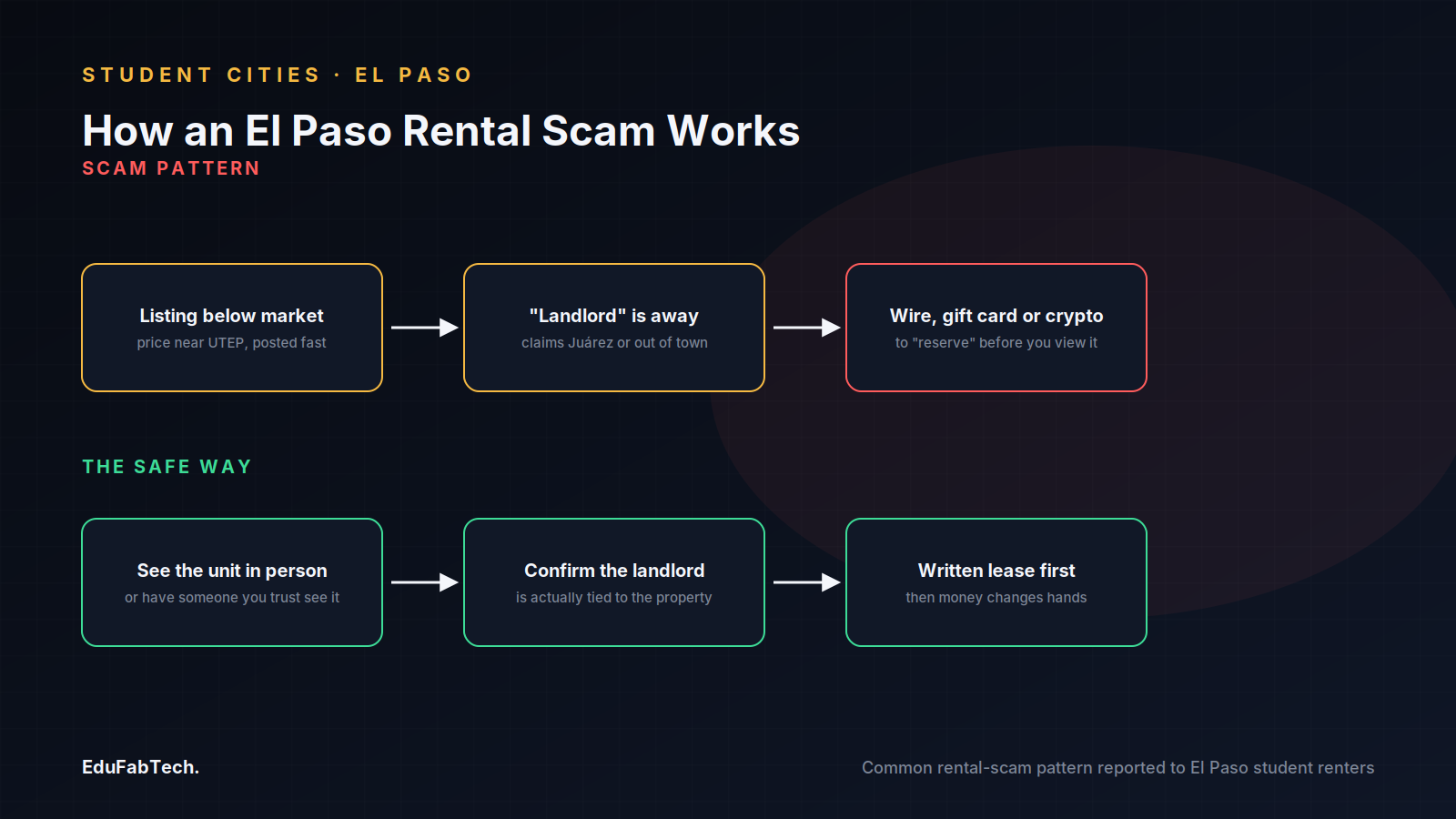
Most UTEP students live off campus, and that is where you need to be careful. Start looking early — the weeks before the August start are the tightest, and the best-placed rooms near Sunset Heights and Kern Place go first. In El Paso a landlord will normally ask for a deposit plus the first month's rent at signing; that is routine. What is not routine, and is the clearest warning sign, is being asked to send money before you have seen the place or met anyone.
Rental scams here follow a predictable shape: a listing for a house or apartment near UTEP at a price a little below the others, a "landlord" who says they are out of town (sometimes claiming to be in Juárez or away for work), and a request to wire a holding deposit or pay by gift card or cryptocurrency to "reserve" it. Treat that as a scam every time. Never send a deposit by bank transfer, gift card or crypto to hold a room. See the unit in person — or have someone you trust see it — confirm the person collecting rent is actually connected to the property, and get a written lease before any money changes hands. If you are arriving from abroad and cannot view a place first, it is safer to book short-term accommodation for the first couple of weeks and sign a lease once you are on the ground.
It helps to compare what is realistic before you commit. Browsing current rooms and sublets around the city — including our own El Paso listings for rooms and places to stay and the general directory of student listings in El Paso, and what is available near UTEP — gives you a feel for the going rate so an underpriced "deal" stands out as suspicious.
Furnishing a room: swap meets and giveaways
El Paso rewards patience when it comes to kitting out a room. The city has a strong swap-meet and flea-market culture — the long-running Bronco Swap Meet on Alameda Avenue in the lower valley is the best known — where second-hand furniture, kitchenware and bikes turn up cheaply; check the current opening days before you make the trip, since markets like these run on weekend-heavy schedules. Thrift chains and donation stores operate across the city as well. End of semester, especially in May, is the moment to watch, as departing students give away or sell furniture fast.
For a faster route, our local page collects what students in the city are passing on, from furniture to kitchenware: second-hand things in El Paso. A desert climate means outdoor finds survive in reasonable condition, but check upholstered furniture for pests before bringing it indoors.
Part-time work and the rules for international students
Many El Paso students work, and the campus itself is a large employer — libraries, dining, labs, administrative offices and research groups all hire students. For anyone on an F-1 student visa, the rules are set by federal immigration policy, not the university. The U.S. Department of Homeland Security's Study in the States guidance states that an F-1 student in on-campus employment "may not work more than 20 hours per week when school is in session," and that the first step before working is always to talk with your Designated School Official (DSO). Off-campus work for F-1 students is tightly restricted and generally requires specific authorisation tied to your programme.
This is general information, not legal advice, and the rules change — confirm your own situation with UTEP's international office and the official DHS and USCIS pages before you accept work. For local openings and student jobs, our El Paso jobs board is a starting point, but your campus student-employment portal and your DSO are the authorities that matter for anything visa-related.
Libraries and places to study
UTEP's main study building is the University Library, named as such on its hours page. Inside are group study rooms that circulate on a first-come basis, individual carrels on its upper floors, and a Collaborative Learning Center whose second floor holds roughly 250 desktop computers and 35 laptops for student use. Health-sciences students have their own library resources through TTUHSC El Paso.
Because so many students here commute and work, study space off campus matters as much as the library. The city's public libraries and the free streetcar corridor through downtown put a few more quiet options within reach, and coffee shops along Mesa Street and in Kern Place fill up with students during term. Our directory of study spaces and desks in El Paso gathers the ones students actually use when the library is full or too far.
Getting around: buses, a free streetcar, and the car question
El Paso's public transport is run by Sun Metro, the City of El Paso's transit operator. Its Fares & Passes page lists a student single-ride fare of $1.00 (against the standard $1.50), a student weekly pass at $7 and a student monthly pass at $30; the page notes that students over 18 must present a valid student ID for the reduced fare, and passes are sold at Sun Metro ticket offices and ticket vending machines. Sun Metro's Brio bus-rapid-transit runs the length of the Mesa corridor past the campus edge.
The one genuinely distinctive option is the El Paso Streetcar: Sun Metro's streetcar page states the fare is "Free!" and that the line has 27 stops. Its restored vintage streetcars run a loop through downtown and up past the UTEP area, which makes it a useful way to move between downtown, the border crossings and the campus edge without paying a fare.
That said, El Paso is a spread-out, car-shaped city, and plenty of students drive. If you live on the Westside or in the valley and study on a tight class-and-work schedule, a car removes a lot of friction — but factor in parking permits, insurance and fuel. UTEP's 2025-26 cost-of-attendance estimate budgets $2,600 a year for transportation, per its financial aid page.
What it costs — and the honest trade-offs
El Paso's student costs are modest, and UTEP's own planning figures show the scale. Its 2025-26 cost-of-attendance estimate puts full-time tuition and fees at $8,508 for a Texas resident and $21,164 for a non-resident, budgets $10,996 for on-campus housing and food over the year and a lower $5,416 for students living off campus. Those are UTEP's own planning numbers used to calculate financial aid, not a bill, but they frame where the money goes: housing and food, not tuition, is where a careful or careless budget shows up.
The good side of El Paso for students is real. Rents and everyday costs are low by big-city standards; the climate is dry and sunny for most of the year; and the food, shaped by the border, is varied and affordable. The bilingual, binational character makes it an unusually welcoming place for Spanish-speaking and first-generation students.
The hard parts are just as real. This is a sprawling desert city, so without a car or a bus route you can feel stranded, and commutes eat time. Summers are long and hot, and the dry heat takes adjustment. The near-campus housing stock is older and limited, so the walkable rooms go fast and the newer, bigger complexes sit further out. And because so many students work and commute, campus can feel quieter in the evenings than a traditional residential college town. None of this is a reason to stay away — but it is worth planning around rather than discovering in week three.
A checklist for your first weeks
- Confirm your enrolment and, if you are an international student, meet your DSO at UTEP's international office early — before taking any job.
- If you have not signed a lease yet, book short-term accommodation first and view rooms in person before paying any deposit; never wire money or pay by gift card to "hold" a place.
- Work out whether a student monthly pass ($30) or a car makes more sense for where you will live, and sort out your Sun Metro fare option early.
- Ride the free streetcar once to learn how downtown, the border crossings and the campus edge connect.
- Set up your UTEP library account and find your quiet and group study spots before finals pressure hits.
- Furnish gradually: watch the swap meets and end-of-semester giveaways rather than buying everything new, and check second-hand furniture for pests before bringing it in.
- Get out and meet people early — a lot of student life here happens off campus, so join a student organisation or event in your first fortnight.
A quick question for readers
Do you work part-time while you study?
Many students work to pay the bills. See how common it is — and how many hours people really do.
Pick an answer, create a free account in a minute, and your vote counts. Already a member? Sign in
Comments 0
CommentNo comments yet. Members start the conversation.
Source: The University of Texas at El Paso
Sources (5)
- The University of Texas at El Paso. Welcome to The University of Texas at El Paso. University of Texas at El Paso (course catalog), 2026. catalog.utep.edu ↗ · checked 20 Oct 2026
- The University of Texas at El Paso. Floor Plans and Rates (Spring and Fall). UTEP Housing and Residence Life, 2026. utep.edu ↗ · checked 20 Oct 2026
- Texas Tech University Health Sciences Center El Paso. Degree Programs. Texas Tech Health El Paso, 2026. ttuhscep.edu ↗ · checked 20 Oct 2026
- Sun Metro. Fares & Passes. City of El Paso – Sun Metro, 2026. sunmetro.net ↗ · checked 20 Oct 2026
- U.S. Department of Homeland Security. Working in the United States. Study in the States, 2026. studyinthestates.dhs.gov ↗ · checked 20 Oct 2026