Studying in Fairbanks: universities, housing and student life
A practical, sourced guide to the University of Alaska Fairbanks, where students live, what rooms and transport cost, and the honest trade-offs of studying in a subarctic city.
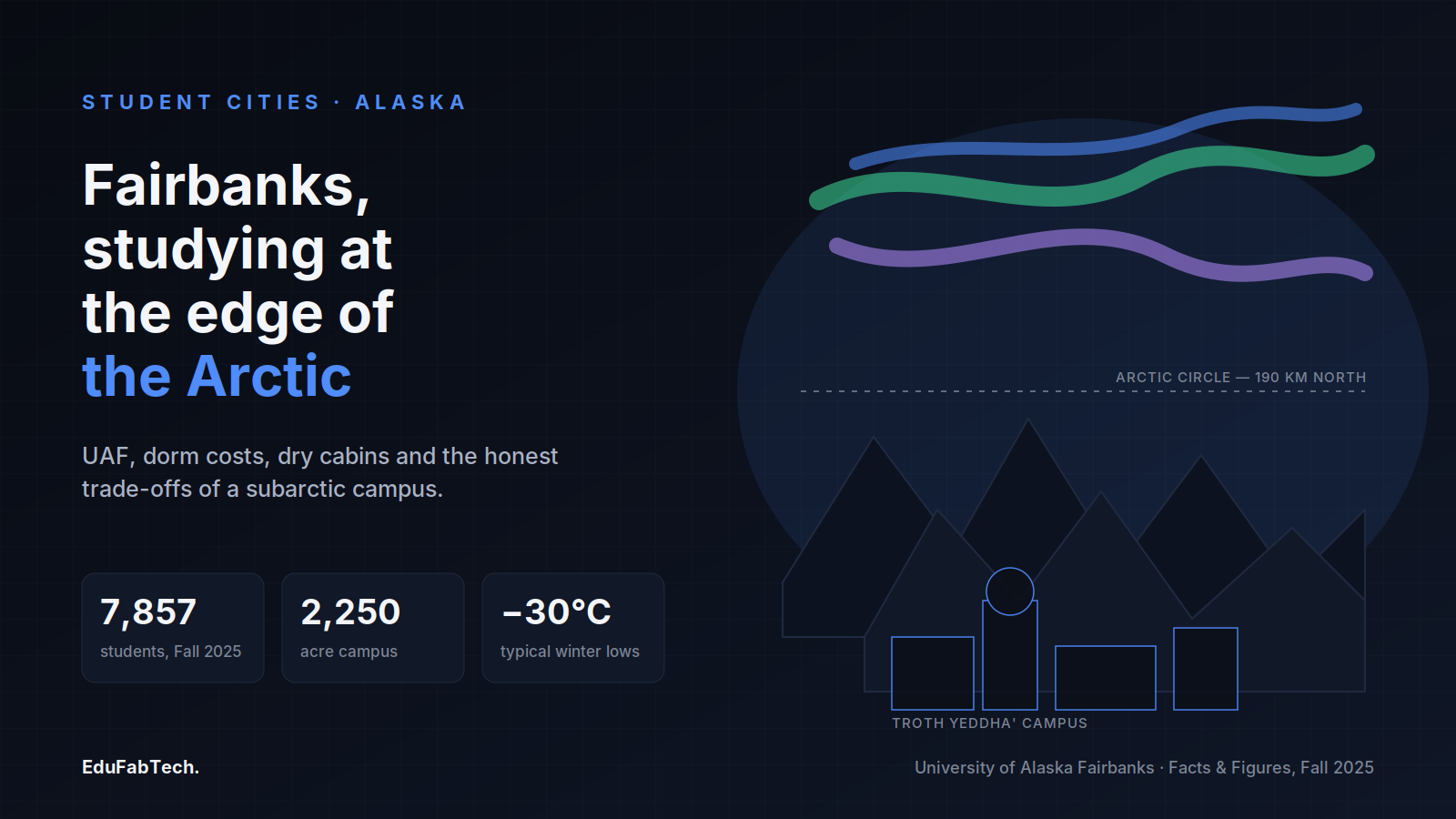
Fairbanks sits in the Tanana Valley of Alaska's interior, roughly 190 kilometres south of the Arctic Circle, where winter temperatures routinely fall below −30°C and summer brings nearly round-the-clock daylight. It is Alaska's second-largest city, a railroad and gold-rush town that grew into a hub for Arctic science. For a student, the defining facts are the cold, the distance, and a single large university that shapes much of local life. This guide covers that university, the neighbourhoods students settle into, what things cost with sources attached, and the honest trade-offs of studying this far north.
The University of Alaska Fairbanks (College) is the centre of gravity. According to the university's own Facts and Figures, UAF was founded in 1917, when Alaska was still a territory, and is now "America's northernmost Land, Sea and Space Grant institution." Its main campus is formally the Troth Yeddha' Campus — a name that means "wild potato ridge" in the Lower Tanana Athabascan (Dene) language, after the edible-rooted plant traditionally gathered on the hill. The university describes it as a 2,250-acre campus a few miles northwest of downtown, in the community of College. UAF reports a total enrolment of 7,857 students for Fall 2025, of whom 5,857 study at the Troth Yeddha' Campus, drawn from 52 states and territories and 51 foreign countries, and it offers 218 degrees and certificates across about 100 disciplines.
What marks UAF out is Arctic and cold-regions research. The same Facts and Figures page names the Geophysical Institute, the International Arctic Research Center and the Institute of Arctic Biology among its research units; the campus sits under the auroral oval, and students in geophysics, atmospheric science, wildlife biology, Arctic engineering and Alaska Native and Indigenous studies learn in a place where the subject matter is outside the window. Two parts of the university are worth a student's attention: the College of Fisheries and Ocean Sciences (Fairbanks), which grants degrees in fisheries, marine biology and oceanography and runs facilities on the coast as well as in Fairbanks, and UAF Community and Technical College (Fairbanks), which offers certificates and associate degrees in trades and workforce fields, often at a gentler pace and price than a four-year track.
College, Goldstream and the dry-cabin question
Students cluster in the College neighbourhood immediately around campus, where apartments, shared houses and university-adjacent rentals are within walking or short cycling distance of the Troth Yeddha' ridge. Beyond that, the common areas are Goldstream and Farmers Loop to the north, the older grid of downtown and the Weeks Field area to the south, and outlying hills and valleys — Ester, Two Rivers, Goldstream Valley — where rents fall but commutes lengthen and roads get icier. Fairbanks is spread out and car-centric; where you live changes your winter morning more than it would in a compact town.
One Fairbanks peculiarity deserves a warning before you sign anything. The university's International Student and Scholar Services office describes "dry cabins" as "small homes with no indoor running water," where "people supply water in containers and use an outhouse for going to the bathroom." These are genuinely common in and around Fairbanks, usually cheaper, and usually wired for electricity and internet — but hauling water at −35°C is a lifestyle, not a quirk, and a listing that looks like a bargain may be dry. Always ask directly whether a rental has running water and a flush toilet, and whether it is winterised, before you consider it.
Residence halls: rates and the meal-plan rule
For a first year, especially arriving from abroad, UAF's ISSS office recommends living on campus for at least the first semester for safety, community and proximity. Rooms are assigned first-come, first-served, with a $40 application fee and a $315 damage deposit; ISSS notes the application fee is refundable only if a visa is denied, so apply early but understand what is committed.
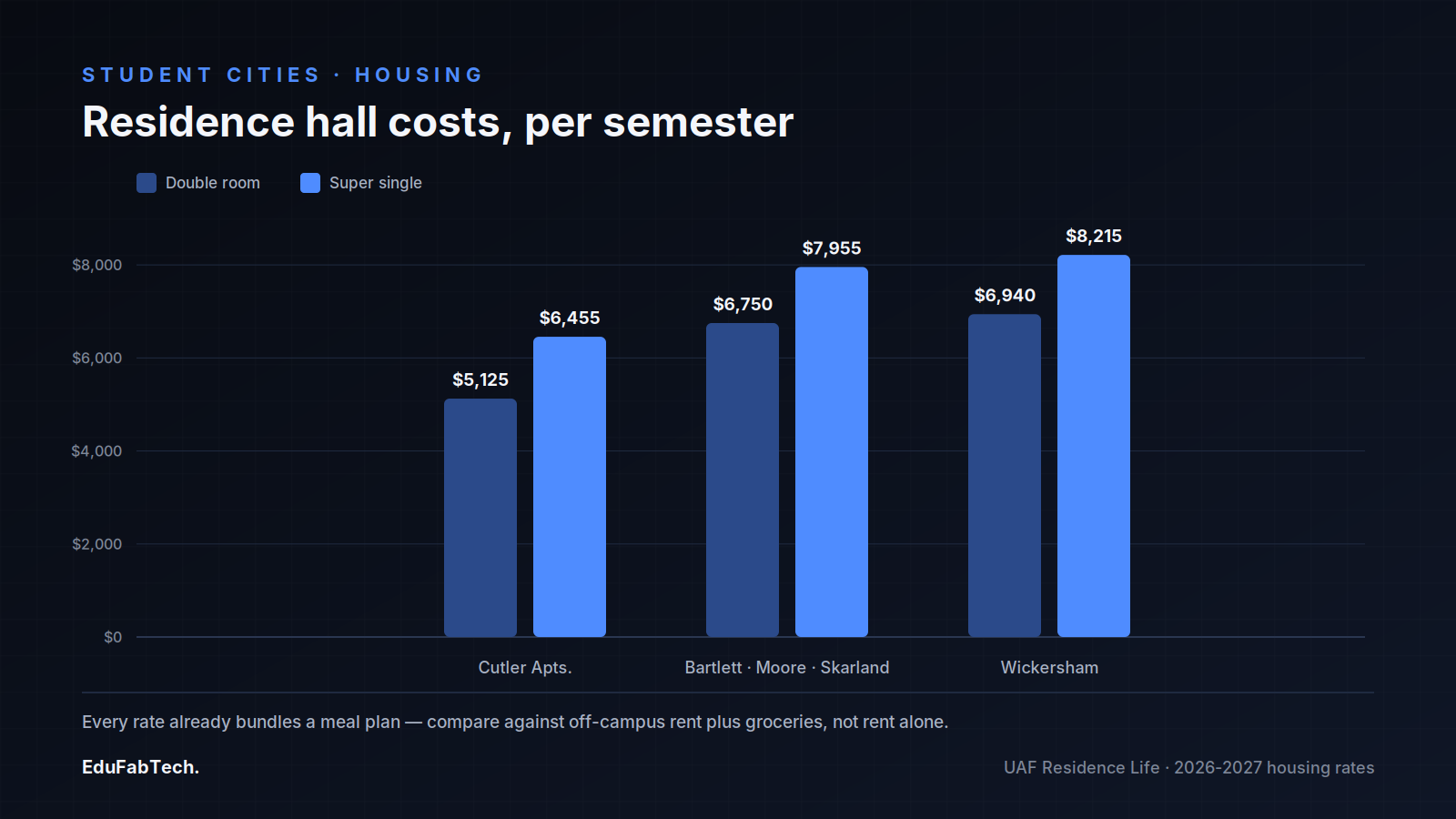
UAF Residence Life publishes its 2026-2027 housing rates as combined room-and-meal-plan semester figures — the quoted price already bundles a meal plan for residence-hall and Cutler residents. Among the traditional halls, Bartlett, Moore and Skarland list a double room with meal plan at $6,750 per semester, a single at $7,360 and a super single at $7,955; Wickersham runs higher, from $6,940 for a double to $8,215 for a super single. The lowest rates are at the Cutler Apartment Complex, where a double is $5,125 per semester, a single $5,680 and a super single $6,455, according to the same Residence Life page. Because food is folded into those numbers, compare them against an off-campus rent plus groceries rather than against rent alone.
Renting off campus without losing a deposit
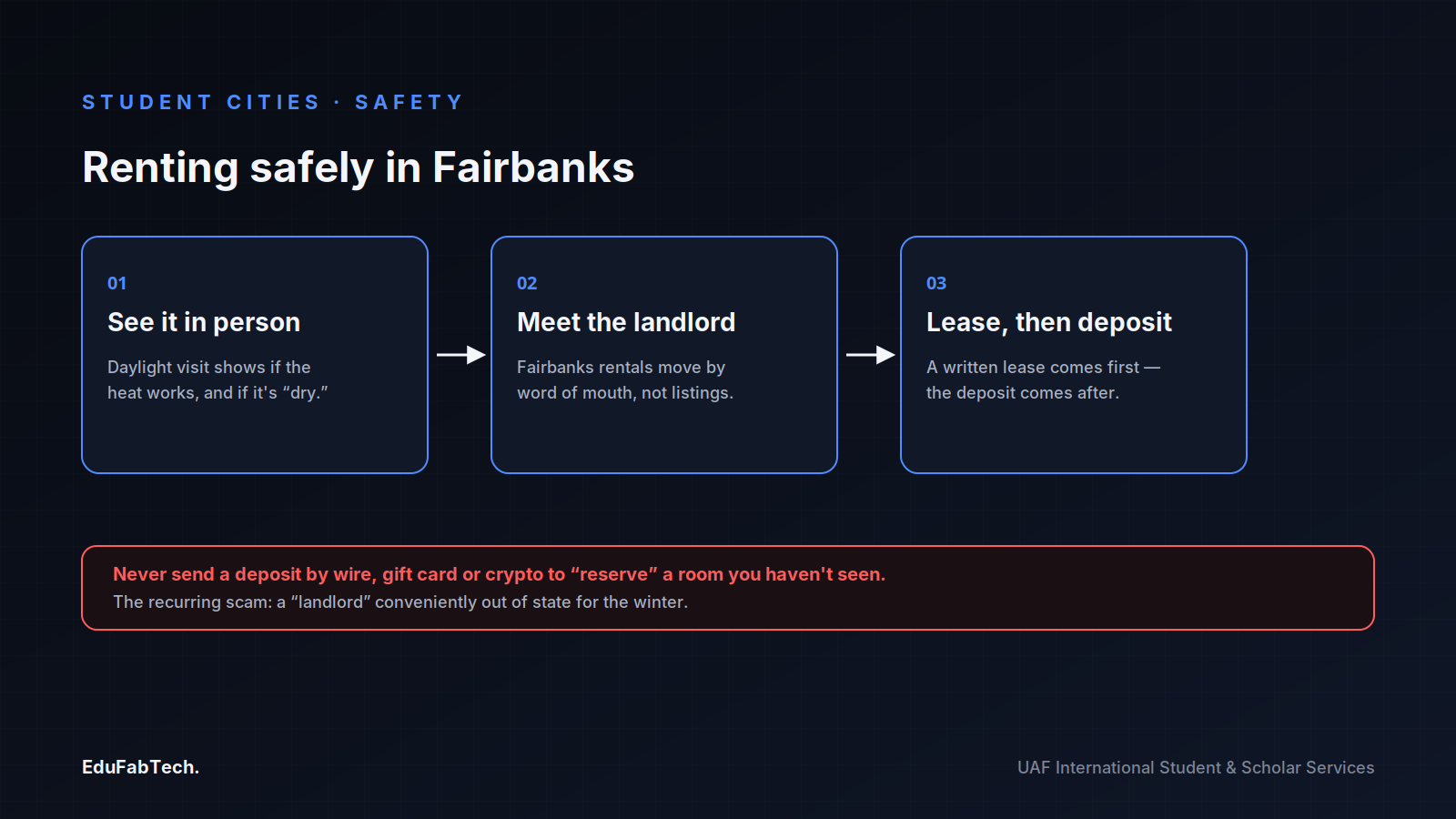
Fairbanks has a small, word-of-mouth rental market, and that shapes both how you find a room and how scams appear. UAF's ISSS office points students to Craigslist, the classifieds of the local newspaper — the Fairbanks Daily News-Miner — and to hostels or extended-stay hotels as a landing pad, noting that "some of the best student rentals are never advertised" and instead pass through peer networks. That informality is where trouble starts: the recurring scam on open listing sites is a "landlord" who is conveniently out of state (common in a town people leave for the winter or for work on the North Slope) and asks you to send a deposit to hold a place you have not seen.
The protections are straightforward and local. See the actual cabin or apartment in person, in daylight, and in cold if you can — a quick visit tells you whether the heat works, whether the pipes are liable to freeze, and whether "dry" was mentioned honestly. Meet the person who owns or manages it. A deposit in Fairbanks is normally paid once you have seen the place and have a written lease, not before. Never send money by bank wire, gift card or cryptocurrency to "reserve" a room sight-unseen — those payments are effectively irreversible, and no legitimate Fairbanks landlord needs them. If you are still overseas when term starts, the safer path is a residence hall for the first semester and an off-campus search once you are on the ground. EduFabTech's rooms listings for Fairbanks and the wider Fairbanks student page are a starting point, as is browsing what is listed near the University of Alaska Fairbanks.
Furnishing a room before the cold sets in
Fairbanks has a strong second-hand culture, partly because so many residents are seasonal and students cycle through: furniture, winter gear and kitchen kit change hands constantly, and the end-of-spring move-out is the best time to pick up a desk or a parka for very little. For local goods and a sense of the town, the Tanana Valley Farmers Market runs at 2600 College Road, a short distance from campus; its own calendar lists a 2026 outdoor season from 16 May to 19 September, open Wednesdays 11:00–16:00 and Saturdays 9:00–16:00, with a Holiday Bazaar moving indoors to the Carlson Center in December. The market is produce, crafts and food rather than furniture, but it is where the student end of town congregates in summer.
For the practical business of furnishing a room cheaply, work the second-hand channels rather than buying new in a town where shipping inflates prices; items given away free are worth watching around semester changeovers, when departing students pass on what they cannot ship. Prioritise warm bedding, a space heater you trust, and winter boots; those are what a Fairbanks room actually needs.
Working while you study
If you are an international student on an F-1 visa, the headline rule — set by the U.S. Department of Homeland Security's Student and Exchange Visitor Program — is that you may work on campus but no more than 20 hours per week while school is in session, with full-time hours allowed during periods when school is not in session. Off-campus work generally requires specific authorisation such as Curricular Practical Training or Optional Practical Training, which the U.S. Citizenship and Immigration Services sets out in its guidance on students and employment; UAF's own ISSS office administers OPT and advises students individually. This is a summary, not legal advice: confirm your own situation with ISSS before you accept any job, because the consequences of getting work authorisation wrong fall on your visa status.
On-campus jobs are the realistic option for most international students here — dining, the library, research labs and departmental roles. For domestic students, the labour market tracks the city's seasons, with more hiring in summer. Current openings aggregated for the city sit on EduFabTech's Fairbanks jobs page.
Libraries and places to study
The Elmer E. Rasmuson Library on the Troth Yeddha' Campus is the main academic library and the quiet heart of winter study, home to the Alaska and Polar Regions Collections and Archives — historical photographs, manuscripts, maps, oral histories and the moving images of the Alaska Film Archives documenting the circumpolar North. In the long dark months a warm, well-lit library within walking distance of the halls is not a small thing. Off campus, the Fairbanks North Star Borough runs the Noel Wien Library at 1215 Cowles Street downtown, its main public library, alongside the North Pole Branch Library in the neighbouring community of North Pole and a bookmobile serving outlying areas such as Ester, Two Rivers and Salcha. For spaces beyond the libraries — study rooms, cafés and desks students actually use — see EduFabTech's Fairbanks study-spaces page.
Getting around a cold-weather town
Public transport is the Metropolitan Area Commuter System (MACS), run by the Fairbanks North Star Borough, with a scheduled stop near the Wood Center on campus. According to the borough's bus fares page (fares effective 1 July 2022), the adult cash fare is $1.50, a day pass is $3.00, a monthly pass is $40.00 and a half-month pass $20.00; reduced fares of $0.75 cash and $2.00 day pass apply to riders aged 6–18, Medicare or Medicaid holders, active military and dependents, and people with qualifying disabilities, while seniors aged 60 and over and children under six ride free. There is no borough-wide free student pass listed, so budget for a pass if you will rely on the bus. Service runs Monday to Saturday and does not cover the whole sprawling borough, which is why many students end up driving.
That brings the honest caveat: winter driving here is a skill. UAF's ISSS transportation guidance stresses clearing all snow and ice from a vehicle, using winter tyres and an engine-block heater, and warns plainly that "drivers will go through red lights because the roads are so slick they cannot stop." For shorter distances in warmer months, the UAF Green Bikes programme, run by the Office of Sustainability, offers long-term bike rentals and fat bikes for winter riding. Plan your housing around your transport: a room on a MACS route or within cycling range of campus is worth more in January than a cheaper cabin twenty icy minutes away.
Costs, and what is good and hard about Fairbanks
Alaska is not a cheap state, and goods that travel a long way cost more. For an off-campus benchmark, the U.S. Census Bureau QuickFacts for Fairbanks city (2020–2024 American Community Survey five-year estimates) lists median gross rent at $1,496 a month, median household income at $73,534, and the median value of owner-occupied homes at $268,400, with only 39.8% of housing units owner-occupied — a renter-heavy town, which is why the rental market matters so much. Against that, a Cutler double at $5,125 per semester including a meal plan, per UAF Residence Life, is a defensible first-year choice once food and utilities are counted in.
What is good about Fairbanks is specific and real: a genuine research university where undergraduates can get near Arctic science, aurora overhead for much of the dark season, a tight community in which a newcomer is noticed and helped, and a cost of housing that — for Alaska — is lower than the coastal cities. What is hard is equally specific: extreme cold and long winter darkness that test anyone's mood, a car-dependent layout with limited transit, a small and informal rental market where you must look in person, the real prospect of a dry cabin if you do not ask, and prices on everyday goods inflated by distance. None of this is hidden if you plan for it.
A checklist for the first weeks
- Secure a residence-hall room early if you can, using the UAF Residence Life rates to budget room and meal plan together, and keep the $40 application fee and $315 deposit in mind.
- If renting off campus, see the place in person, confirm it has running water and is winterised, sign a written lease, and pay the deposit only then — never wire money or send gift cards or crypto to hold a room sight-unseen.
- Sort out winter: boots, a real parka, warm bedding and a heater you trust, bought second-hand through the city's used-goods channels wherever possible.
- Decide your transport before term: a MACS pass, a bike for the warm months, or a winterised car with a block heater — and pick housing on a route.
- If you are on a visa, meet UAF ISSS before taking any job and check the USCIS rules yourself.
- Find your study base early — the Rasmuson Library or a spot from the study-spaces list — because routine carries you through the dark months.
A quick question for readers
Do you work part-time while you study?
Many students work to pay the bills. See how common it is — and how many hours people really do.
Pick an answer, create a free account in a minute, and your vote counts. Already a member? Sign in
Comments 0
CommentNo comments yet. Members start the conversation.
Source: University of Alaska Fairbanks
Sources (5)
- University of Alaska Fairbanks. UAF Facts and Figures. University of Alaska Fairbanks Catalog, 2025. catalog.uaf.edu ↗ · checked 17 Oct 2026
- University of Alaska Fairbanks Residence Life. Housing Rates 2026-2027. University of Alaska Fairbanks, 2026. uaf.edu ↗ · checked 17 Oct 2026
- University of Alaska Fairbanks ISSS. Housing. University of Alaska Fairbanks International Student and Scholar Services, 2026. uaf.edu ↗ · checked 17 Oct 2026
- Fairbanks North Star Borough. MACS Bus Fares (effective 7/1/22). Fairbanks North Star Borough, 2022. fnsb.gov ↗ · checked 17 Oct 2026
- U.S. Census Bureau. QuickFacts: Fairbanks city, Alaska. U.S. Census Bureau, 2024. census.gov ↗ · checked 17 Oct 2026